
nur für Forschungszwecke
ONX-0914 (PR-957) Proteasome Inhibitor
Kat.-Nr.S7172
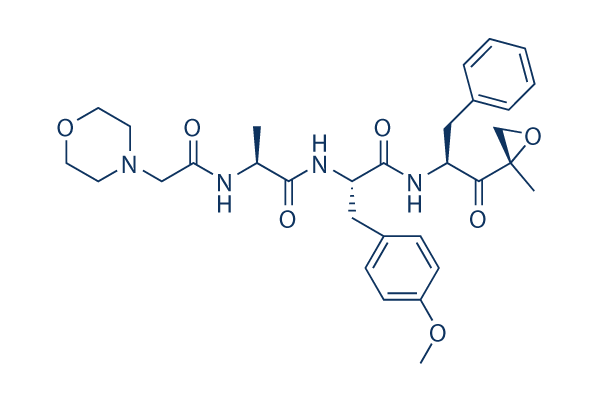
Chemische Struktur
Molekulargewicht: 580.67
Qualitätskontrolle
| Verwandte Ziele | HDAC Caspase Secretase MMP HCV Protease Cysteine Protease DPP Tyrosinase HIV Protease Serine Protease |
|---|---|
| Weitere Proteasome Inhibitoren | MG132 Celastrol Epoxomicin (BU-4061T) Oprozomib Delanzomib VR23 Marizomib (Salinosporamide A) PI-1840 KSQ-4279 (USP1-IN-1) Isoginkgetin |
Zellkultur, Behandlung & Arbeitskonzentration
| Zelllinien | Assay-Typ | Konzentration | Inkubationszeit | Formulierung | Aktivitätsbeschreibung | PMID |
|---|---|---|---|---|---|---|
| Raji | Function assay | Inhibition of proteasome subunit beta-5i in human Raji cells using BODIPY-NC005 by fluorescent densitometry, IC50=0.0057μM | 25006746 | |||
| EBC1 | Antitumor assay | 15 mg/kg | 5 days | Antitumor activity against human EBC1 cells xenografted in CD-1 nude mouse assessed as tumor regression at 15 mg/kg, po qd administered for 5 days on and 2 days off up to 32 days | 25006746 | |
| SJ-GBM2 | qHTS assay | qHTS of pediatric cancer cell lines to identify multiple opportunities for drug repurposing: Primary screen for SJ-GBM2 cells | 25006746 | |||
| SK-N-SH | qHTS assay | qHTS of pediatric cancer cell lines to identify multiple opportunities for drug repurposing: Primary screen for SK-N-SH cells | 25006746 | |||
| RPMI8226 | Function assay | Inhibition of proteasome subunit beta-1i in human RPMI8226 cells using BODIPY-NC001 by fluorescent densitometry, IC50=0.34μM | 25006746 | |||
| Raji | Function assay | Inhibition of proteasome subunit beta-1i in human Raji cells using BODIPY- epoxomicin by fluorescent densitometry, IC50=0.46μM | 25006746 | |||
| Raji | Function assay | Inhibition of proteasome subunit beta-2i in human Raji cells using BODIPY- epoxomicin by fluorescent densitometry, IC50=0.59μM | 25006746 | |||
| RPMI8226 | Function assay | Inhibition of proteasome subunit beta-2i in human RPMI8226 cells using BODIPY-epoxomicin by fluorescent densitometry, IC50=0.59μM | 25006746 | |||
| Raji | Function assay | Inhibition of 20s proteasome subunit beta-2c in human Raji cells using BODIPY- epoxomicin by fluorescent densitometry, IC50=1.1μM | 25006746 | |||
| RPMI8226 | Function assay | Inhibition of 20s proteasome subunit beta-2c in human RPMI8226 cells using BODIPY-epoxomicin by fluorescent densitometry, IC50=1.1μM | 25006746 | |||
| SK-N-MC | qHTS assay | qHTS of pediatric cancer cell lines to identify multiple opportunities for drug repurposing: Primary screen for SK-N-MC cells | 29339252 | |||
| RD | qHTS assay | qHTS of pediatric cancer cell lines to identify multiple opportunities for drug repurposing: Primary screen for RD cells | 29339252 | |||
| MG 63 (6-TG R) | qHTS assay | qHTS of pediatric cancer cell lines to identify multiple opportunities for drug repurposing: Primary screen for MG 63 (6-TG R) cells | 29339252 | |||
| NCI-H727 | Cytotoxicity assay | 48 hrs | Cytotoxicity against human NCI-H727 cells assessed as reduction in cell viability after 48 hrs by Hoechst 33342 staining based HCS assay, EC50=0.3μM | 29339252 | ||
| PC3 | Cytotoxicity assay | 48 hrs | Cytotoxicity against human PC3 cells assessed as reduction in cell viability after 48 hrs by Hoechst 33342 staining based HCS assay, EC50=0.33μM | 29339252 | ||
| HuH7 | Cytotoxicity assay | 48 hrs | Cytotoxicity against human HuH7 cells assessed as reduction in cell viability after 48 hrs by Hoechst 33342 staining based HCS assay, EC50=0.39μM | 29339252 | ||
| Caco2 | Cytotoxicity assay | 48 hrs | Cytotoxicity against human Caco2 cells assessed as reduction in cell viability after 48 hrs by Hoechst 33342 staining based HCS assay, EC50=1.3μM | 29339252 | ||
| DAOY | qHTS assay | qHTS of pediatric cancer cell lines to identify multiple opportunities for drug repurposing: Primary screen for DAOY cells | 30380863 | |||
| A673 | qHTS assay | qHTS of pediatric cancer cell lines to identify multiple opportunities for drug repurposing: Primary screen for A673 cells | 30380863 | |||
| Rh41 | qHTS assay | qHTS of pediatric cancer cell lines to identify multiple opportunities for drug repurposing: Primary screen for Rh41 cells | 30380863 | |||
| A20 | Function assay | Inhibition of LMP2 in mouse A20 cells by ELISA, IC50=0.328μM | 30380863 | |||
| A20 | Function assay | Inhibition of 20S proteosome beta 5 in mouse A20 cells by ELISA, IC50=0.401μM | 30380863 | |||
| MOLT4 | Function assay | Inhibition of 20S proteosome beta 5 in human MOLT4 cells by ELISA, IC50=0.422μM | 30380863 | |||
| A20 | Function assay | Inhibition of MECL1 in mouse A20 cells by ELISA, IC50=0.699μM | 30380863 | |||
| MOLT4 | Function assay | Inhibition of MECL1 in human MOLT4 cells by ELISA, IC50=0.902μM | 30380863 | |||
| A20 | Function assay | Inhibition of 20S proteosome beta 2 in mouse A20 cells by ELISA, IC50=0.913μM | 30380863 | |||
| MOLT4 | Function assay | Inhibition of 20S proteosome beta 2 in human MOLT4 cells by ELISA, IC50=0.927μM | 30380863 | |||
| PBMC | Function assay | 100 nM | 3 to 72 hrs | Inhibition of 20S proteasome beta 5i in human PBMC cells assessed as induction of PSMB5 expression at 100 nM after 3 to 72 hrs by RT-PCR analysis | 31283222 | |
| PBMC | Function assay | 100 nM | 3 to 72 hrs | Inhibition of 20S proteasome beta 5i in human PBMC cells assessed as induction of PSMB6 expression at 100 nM after 3 to 72 hrs by RT-PCR analysis | 31283222 | |
| PBMC | Function assay | 100 nM | 3 to 72 hrs | Inhibition of 20S proteasome beta 5i in human PBMC cells assessed as induction of PSMB7 expression at 100 nM after 3 to 72 hrs by RT-PCR method | 31283222 | |
| Klicken Sie hier, um weitere experimentelle Daten zu Zelllinien anzuzeigen | ||||||
Chemische Informationen, Lagerung & Stabilität
| Molekulargewicht | 580.67 | Formel | C31H40N4O7 |
Lagerung (Ab dem Eingangsdatum) | |
|---|---|---|---|---|---|
| CAS-Nr. | 960374-59-8 | SDF herunterladen | Lagerung von Stammlösungen |
|
|
| Synonyme | N/A | Smiles | CC(C(=O)NC(CC1=CC=C(C=C1)OC)C(=O)NC(CC2=CC=CC=C2)C(=O)C3(CO3)C)NC(=O)CN4CCOCC4 | ||
Löslichkeit
|
In vitro |
DMSO
: 100 mg/mL
(172.21 mM)
Water : 100 mg/mL Ethanol : 100 mg/mL |
Molaritätsrechner
|
In vivo |
|||||
In-vivo-Formulierungsrechner (Klare Lösung)
Schritt 1: Geben Sie die untenstehenden Informationen ein (Empfohlen: Ein zusätzliches Tier zur Berücksichtigung von Verlusten während des Experiments)
Schritt 2: Geben Sie die In-vivo-Formulierung ein (Dies ist nur der Rechner, keine Formulierung. Bitte kontaktieren Sie uns zuerst, wenn es im Abschnitt "Löslichkeit" keine In-vivo-Formulierung gibt.)
Berechnungsergebnisse:
Arbeitskonzentration: mg/ml;
Methode zur Herstellung der DMSO-Stammlösung: mg Wirkstoff vorgelöst in μL DMSO ( Konzentration der Stammlösung mg/mL, Bitte kontaktieren Sie uns zuerst, wenn die Konzentration die DMSO-Löslichkeit der Wirkstoffcharge überschreitet. )
Methode zur Herstellung der In-vivo-Formulierung: Nehmen Sie μL DMSO Stammlösung, dann hinzufügenμL PEG300, mischen und klären, dann hinzufügenμL Tween 80, mischen und klären, dann hinzufügen μL ddH2O, mischen und klären.
Methode zur Herstellung der In-vivo-Formulierung: Nehmen Sie μL DMSO Stammlösung, dann hinzufügen μL Maisöl, mischen und klären.
Hinweis: 1. Bitte stellen Sie sicher, dass die Flüssigkeit klar ist, bevor Sie das nächste Lösungsmittel hinzufügen.
2. Achten Sie darauf, das/die Lösungsmittel der Reihe nach hinzuzufügen. Sie müssen sicherstellen, dass die bei der vorherigen Zugabe erhaltene Lösung eine klare Lösung ist, bevor Sie mit der Zugabe des nächsten Lösungsmittels fortfahren. Physikalische Methoden wie Vortex, Ultraschall oder ein heißes Wasserbad können zur Unterstützung des Lösens verwendet werden.
Wirkmechanismus
| Merkmale |
The first highly selective, small molecule inhibitor of the immunoproteasome. Potential use in cancer and autoimmune diseases (e.g. rheumatoid arthritis, inflammatory bowel disease, and lupus).
|
|---|---|
| Targets/IC50/Ki |
LMP7
(Cell-free assay) ~10 nM
|
| In vitro |
ONX-0914 (PR-957) ist 20- bis 40-mal selektiver für LMP7 als für die nächstempfindlichen Stellen β5 oder LMP2. Es blockiert die Präsentation von LMP7-spezifischen, MHC-I-restriktierten Antigenen in vitro und in vivo mit minimaler Kreuzreaktivität für das konstitutive Proteasome. Die selektive Hemmung von LMP7 durch diese Verbindung blockiert die Produktion von Interleukin-23 (IL-23) durch aktivierte Monozyten und von Interferon-gamma und IL-2 durch T-Zellen. Die LMP7-Hemmung blockiert die Produktion von IL-23 um ~90 % und von Tumornekrosefaktor-α (TNF-α) und IL-6 um ~50 %.
|
| In vivo |
In Mausmodellen für rheumatoide Arthritis und Lupus kehrt die Behandlung mit ONX-0914 (PR-957) die Krankheitszeichen um und führt zu einer Reduktion der zellulären Infiltration, der Zytokinproduktion und der Autoantikörperspiegel bei gut verträglichen Dosen. Die maximal tolerierte Dosis (MTD) dieser Verbindung bei Mäusen beträgt 30 mg/kg Körpergewicht. Die IFN-g-Freisetzung wird bei LMP7-selektiven Konzentrationen um ~60 % und bei höheren Konzentrationen um ~90 % gehemmt. Die Produktion von IL-2 wird ebenfalls um ~50 % gehemmt.
|
Literatur |
Technischer Support
Tel: +1-832-582-8158 Ext:3
Wenn Sie weitere Fragen haben, hinterlassen Sie bitte eine Nachricht.

Produkte sind nur für Forschungszwecke bestimmt. Nicht für den menschlichen Gebrauch. Wir verkaufen nicht an Patienten.
©Copyright 2013 Selleck Chemicals. Alle Rechte vorbehalten.