
nur für Forschungszwecke
Floxuridine (FUDR) DNA/RNA Synthesis Inhibitor
Kat.-Nr.S1299
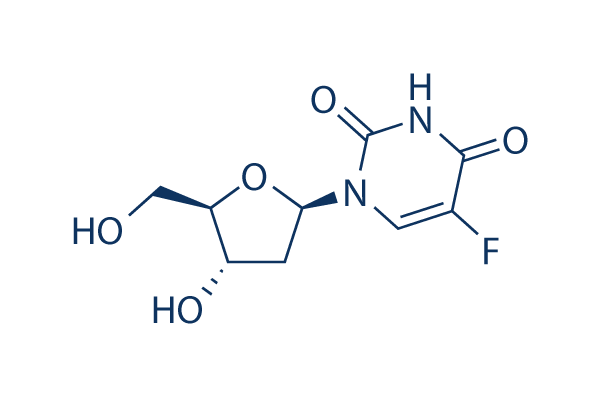
Chemische Struktur
Molekulargewicht: 246.19
Qualitätskontrolle
| Verwandte Ziele | HDAC PARP ATM/ATR DNA-PK WRN Topoisomerase PPAR Sirtuin Casein Kinase eIF |
|---|---|
| Weitere DNA/RNA Synthesis Inhibitoren | CX-5461 (Pidnarulex) B02 SCR7 Favipiravir (T-705) EED226 RK-33 BMH-21 Triapine (3-AP) Carmofur YK-4-279 |
Zellkultur, Behandlung & Arbeitskonzentration
| Zelllinien | Assay-Typ | Konzentration | Inkubationszeit | Formulierung | Aktivitätsbeschreibung | PMID |
|---|---|---|---|---|---|---|
| CCRF-CEM cell | Growth inhibition assay | Tested in vitro for the inhibition of cell growth of human T lymphoblastoid CCRF-CEM cell line (ATCC CCL 119), IC50=0.5 μM | ||||
| CCRF-CEM | Growth inhibition assay | In vitro concentration required for 50% inhibition of growth of human leukemia cell line CCRF-CEM with hPAP (0.2 unit/mL), GI50=0.0006 μM | ||||
| LNCaP cells | Cytotoxicity assay | Cytotoxic concentration in prostate specific antigen (PSA) producing human LNCaP cells, IC50=0.0692 μM | ||||
| TSU cells | Cytotoxicity assay | Cytotoxic concentration in non prostate specific antigen (PSA) producing human TSU cells, IC50=0.058 μM | ||||
| KBALB cell | Cytotoxicity assay | In vitro cell cytotoxicity against KBALB cell line (transformed fibroblast sarcoma cell line), CC50=6.00E-05 μM | ||||
| KBALB-STK cell | Cytotoxicity assay | In vitro cell cytotoxicity against KBALB-STK cell lines expressed in HSV-1 TK, IC50=8.80E-05 μM | ||||
| L1210 mouse leukemia cells | Growth inhibition assay | 24 h | Growth inhibition in L1210 mouse leukemia cells after 24 h treatment, IC50=0.0041 μM | |||
| L1210 mouse leukemia cells | Growth inhibition assay | 48 h | Growth inhibition in L1210 mouse leukemia cells after 48 hr treatment, IC50=0.00064 μM | |||
| L5178Y cell | Growth inhibition assay | Comparative inhibition of L5178Y cell growth in vitro (concentration required for 50% inhibition), IC50=0.00076 μM | ||||
| L5178Y cells | Function assay | Inhibitory concentration of compound was calculated on L5178Y cells by [14C]Leu incorporation, IC50=2 μM | ||||
| L1210 mouse leukemia cells | Function assay | 2 h | Thymidylate synthase inhibition in L1210 mouse leukemia cells after 2 hr treatment, IC50=0.0079 μM | |||
| LM cells | Function assay | 2 h | Thymidylate synthase inhibition in thymidine kinase deficient LM cells after 2 hr treatment, IC50=5.4 μM | |||
| HT1080 cells | Function assay | Cytostatic activity against human HT1080 cells by MTT assay, IC50=0.18 μM | ||||
| L1210 cells | Growth inhibition assay | 72 h | Cytostatic activity against mouse L1210 cells ATCC CCL219 assessed as growth reduction after 72 hrs, IC50=0.012 μM | |||
| HL60 cells | Growth inhibition assay | 72 h | Cytostatic activity against human HL60 cells ATCC CCL 240 assessed as growth reduction after 72 hrs, IC50=0.012 μM | |||
| CCRF-CEM cells | Growth inhibition assay | 72 h | Cytostatic activity against human CCRF-CEM cells ATCC CCL 119 assessed as growth reduction after 72 hrs, IC50=0.017 μM | |||
| L1210 cells | Growth inhibition assay | 72 h | Cytostatic activity in mouse L1210 cells assessed as inhibition of cell growth after 72 hrs, IC50=0.012 μM | |||
| HL60 cells | Growth inhibition assay | 72 h | Cytostatic activity in human HL60 cells assessed as inhibition of cell growth after 72 hrs, IC50=0.012 μM | |||
| CCRF-CEM cells | Growth inhibition assay | 72 h | Cytostatic activity in human CCRF-CEM cells assessed as inhibition of cell growth after 72 hrs, IC50=0.017 μM | |||
| CCRF-CEM cells | Function assay | 48 h | Anticancer activity against human CCRF-CEM cells after 48 hrs by sulforhodamine B assay, GI50=0.00631 μM | |||
| K562 cells | Function assay | 48 h | Anticancer activity against human K562 cells after 48 hrs by sulforhodamine B assay, GI50=0.79433 μM | |||
| MOLT4 cells | Function assay | 48 h | Anticancer activity against human MOLT4 cells after 48 hrs by sulforhodamine B assay, GI50=0.03981 μM | |||
| RPMI8266 cells | Function assay | 48 h | Anticancer activity against human RPMI8266 cells after 48 hrs by sulforhodamine B assay, GI50=0.79433 μM | |||
| human SR cells | Function assay | 48 h | Anticancer activity against human SR cells after 48 hrs by sulforhodamine B assay, GI50=0.01259 μM | |||
| A549 cells | Function assay | 48 h | Anticancer activity against human A549 cells after 48 hrs by sulforhodamine B assay, GI50=0.01259 μM | |||
| EKVX cells | Function assay | 48 h | Anticancer activity against human EKVX cells after 48 hrs by sulforhodamine B assay, GI50=10 μM | |||
| HOP62 cells | Function assay | 48 h | Anticancer activity against human HOP62 cells after 48 hrs by sulforhodamine B assay, GI50=0.02512 μM | |||
| HOP92 cells | Function assay | 48 h | Anticancer activity against human HOP92 cells after 48 hrs by sulforhodamine B assay, GI50=0.79433 μM | |||
| NCI-H226 cells | Function assay | 48 h | Anticancer activity against human NCI-H226 cells after 48 hrs by sulforhodamine B assay | |||
| NCI-H23 | Function assay | 48 h | Anticancer activity against human NCI-H23 cells after 48 hrs by sulforhodamine B assay, GI50=10 μM | |||
| NCI-H322 | Function assay | 48 h | Anticancer activity against human NCI-H322M cells after 48 hrs by sulforhodamine B assay, GI50=0.50119 μM | |||
| NCI-H460 | Function assay | 48 h | Anticancer activity against human NCI-H460 cells after 48 hrs by sulforhodamine B assay, GI50=0.50119 μM | |||
| NCI-H522 | Function assay | 48 h | Anticancer activity against human NCI-H522 cells after 48 hrs by sulforhodamine B assay, GI50=0.002 μM | |||
| COLO205 cells | Function assay | 48 h | Anticancer activity against human COLO205 cells after 48 hrs by sulforhodamine B assay, GI50=2.51189 μM | |||
| HCC2998 cells | Function assay | 48 h | Anticancer activity against human HCC2998 cells after 48 hrs by sulforhodamine B assay, GI50=1.58489 μM | |||
| HCT116 cells | Function assay | 48 h | Anticancer activity against human HCT116 cells after 48 hrs by sulforhodamine B assay, GI50=0.001 μM | |||
| HCT15 cells | Function assay | 48 h | Anticancer activity against human HCT15 cells after 48 hrs by sulforhodamine B assay, GI50=0.12589 μM | |||
| HT-29 cells | Function assay | 48 h | Anticancer activity against human HT-29 cells after 48 hrs by sulforhodamine B assay, GI50=1.99526 μM | |||
| KM12 cells | Function assay | 48 h | Anticancer activity against human KM12 cells after 48 hrs by sulforhodamine B assay, GI50=2.51189 μM | |||
| SW620 cells | Function assay | 48 h | Anticancer activity against human SW620 cells after 48 hrs by sulforhodamine B assay, GI50=6.30957 μM | |||
| SF268 cells | Function assay | 48 h | Anticancer activity against human SF268 cells after 48 hrs by sulforhodamine B assay, GI50=10 μM | |||
| SF295 cells | Function assay | 48 h | Anticancer activity against human SF295 cells after 48 hrs by sulforhodamine B assay, GI50=0.01259 μM | |||
| SF539 cells | Function assay | 48 h | Anticancer activity against human SF539 cells after 48 hrs by sulforhodamine B assay, GI50=0.03981 μM | |||
| SNB19 cells | Function assay | 48 h | Anticancer activity against human SNB19 cells after 48 hrs by sulforhodamine B assay, GI50=1.99526 μM | |||
| SNB75 cells | Function assay | 48 h | Anticancer activity against human SNB75 cells after 48 hrs by sulforhodamine B assay, GI50=0.19953 μM | |||
| U251 cells | Function assay | 48 h | Anticancer activity against human U251 cells after 48 hrs by sulforhodamine B assay, GI50=0.12589 μM | |||
| LOXIMVI cells | Function assay | 48 h | Anticancer activity against human LOXIMVI cells after 48 hrs by sulforhodamine B assay, GI50=0.02512 μM | |||
| MALME-3M cells | Function assay | 48 h | Anticancer activity against human MALME-3M cells after 48 hrs by sulforhodamine B assay, GI50=7.94328 μM | |||
| M14 cells | Function assay | 48 h | Anticancer activity against human M14 cells after 48 hrs by sulforhodamine B assay, GI50=0.15849 μM | |||
| SK-MEL-2 cells | Function assay | 48 h | Anticancer activity against human SK-MEL-2 cells after 48 hrs by sulforhodamine B assay, GI50=10 μM | |||
| SK-MEL-28 cells | Function assay | 48 h | Anticancer activity against human SK-MEL-28 cells after 48 hrs by sulforhodamine B assay, GI50=1.99526 μM | |||
| SK-MEL-5 cells | Function assay | 48 h | Anticancer activity against human SK-MEL-5 cells after 48 hrs by sulforhodamine B assay, GI50=0.19953 μM | |||
| UACC257 cells | Function assay | 48 h | Anticancer activity against human UACC257 cells after 48 hrs by sulforhodamine B assay, GI50=3.16228 μM | |||
| UACC62 cells | Function assay | 48 h | Anticancer activity against human UACC62 cells after 48 hrs by sulforhodamine B assay, GI50=0.03981 μM | |||
| IGROV1 cells | Function assay | 48 h | Anticancer activity against human IGROV1 cells after 48 hrs by sulforhodamine B assay, GI50=2.51189 μM | |||
| OVCAR-3 cells | Function assay | 48 h | Anticancer activity against human OVCAR-3 cells after 48 hrs by sulforhodamine B assay, GI50=2.51189 μM | |||
| OVCAR4 cells | Function assay | 48 h | Anticancer activity against human OVCAR4 cells after 48 hrs by sulforhodamine B assay, GI50=10 μM | |||
| OVCAR5 cells | Function assay | 48 h | Anticancer activity against human OVCAR5 cells after 48 hrs by sulforhodamine B assay, GI50=6.30957 Μm | |||
| OVCAR8 cells | Function assay | 48 h | Anticancer activity against human OVCAR8 cells after 48 hrs by sulforhodamine B assay, GI50=0.12589 μM | |||
| SKOV3 cells | Function assay | 48 h | Anticancer activity against human SKOV3 cells after 48 hrs by sulforhodamine B assay, GI50=1.99526 μM | |||
| 786-0 cells | Function assay | 48 h | Anticancer activity against human 786-0 cells after 48 hrs by sulforhodamine B assay, GI50=0.1 μM | |||
| A498 cells | Function assay | 48 h | Anticancer activity against human A498 cells after 48 hrs by sulforhodamine B assay, GI50=1.25893 μM | |||
| ACHN cells | Function assay | 48 h | Anticancer activity against human ACHN cells after 48 hrs by sulforhodamine B assay, GI50=0.03162 μM | |||
| Caki1 cells | Function assay | 48 h | Anticancer activity against human Caki1 cells after 48 hrs by sulforhodamine B assay, GI50=0.03162 μM | |||
| SN12C cells | Function assay | 48 h | Anticancer activity against human SN12C cells after 48 hrs by sulforhodamine B assay, GI50=0.19953 μM | |||
| TK10 cells | Function assay | 48 h | Anticancer activity against human TK10 cells after 48 hrs by sulforhodamine B assay, GI50=5.01187 μM | |||
| UO31 cells | Function assay | 48 h | Anticancer activity against human UO31 cells after 48 hrs by sulforhodamine B assay, GI50=0.12589 μM | |||
| PC3 cells | Function assay | 48 h | Anticancer activity against human PC3 cells after 48 hrs by sulforhodamine B assay, GI50=0.31623 μM | |||
| DU145 cells | Function assay | 48 h | Anticancer activity against human DU145 cells after 48 hrs by sulforhodamine B assay, GI50=0.25119 μM | |||
| MCF7 cells | Function assay | 48 h | Anticancer activity against human MCF7 cells after 48 hrs by sulforhodamine B assay, GI50=0.00631 μM | |||
| NCI/ADR-RES cells | Function assay | 48 h | Anticancer activity against human NCI/ADR-RES cells after 48 hrs by sulforhodamine B assay, GI50=1.25893 μM | |||
| MDA-MB-231 cells | Function assay | 48 h | Anticancer activity against human MDA-MB-231 cells after 48 hrs by sulforhodamine B assay, GI50=3.98107 μM | |||
| Hs 578T cells | Function assay | 48 h | Anticancer activity against human Hs 578T cells after 48 hrs by sulforhodamine B assay, GI50=3.98107 μM | |||
| MDA-MB-435 cells | Function assay | 48 h | Anticancer activity against human MDA-MB-435 cells after 48 hrs by sulforhodamine B assay, GI50=3.16228 μM | |||
| MDA-N cells | Function assay | 48 h | Anticancer activity against human MDA-N cells after 48 hrs by sulforhodamine B assay, GI50=1.25893 μM | |||
| BT549 cells | Function assay | 48 h | Anticancer activity against human BT549 cells after 48 hrs by sulforhodamine B assay, GI50=1 μM | |||
| T47D cells | Function assay | 48 h | Anticancer activity against human T47D cells after 48 hrs by sulforhodamine B assay, GI50=1.25893 μM | |||
| HepG2 cells | Cytotoxicity assay | 72 h | Cytotoxicity against human HepG2 cells after 72 hrs by MTT assay, EC50=18.84 μM | |||
| A549 cells | Cytotoxicity assay | 72 h | Cytotoxicity against human A549 cells after 72 hrs by MTT assay, EC50=9.74 μM | |||
| LAC cells | Cytotoxicity assay | 72 h | Cytotoxicity against human LAC cells after 72 hrs by MTT assay, EC50=32.09 μM | |||
| HeLa cells | Cytotoxicity assay | 72 h | Cytotoxicity against human HeLa cells after 72 hrs by MTT assay, EC50=10.26 μM | |||
| MDA-MB-231 cells | Cytotoxicity assay | Cytotoxicity against human MDA-MB-231 cells overexpressing urokinase plasminogen activator, IC50=0.21 μM | ||||
| human ACHN cells | Function assay | Anticancer activity against human ACHN cells by SRB assay, GI50=2.1 μM | ||||
| PC3 cells | Function assay | Anticancer activity against human PC3 cells by SRB assay, GI50=4.97 μM | ||||
| MDA-MB-231 cells | Function assay | Anticancer activity against human MDA-MB-231 cells by SRB assay, GI50=0.16 μM | ||||
| FM3A cells | Function assay | 2 days | Cytostatic activity against mouse FM3A cells after 2 days by coulter counting analysis, IC50=0.0094 μM | |||
| HeLa cells | Function assay | Cytostatic activity against human HeLa cells in presence of 20 uM thymidine, IC50=8.5 μM | ||||
| LLC cells | Cytotoxicity assay | 24 h | Cytotoxicity against mouse LLC cells after 24 hrs by resazurin assay, IC50=14.2 μM | |||
| LLC cells | Cytotoxicity assay | 72 h | Cytotoxicity against mouse LLC cells after 72 hrs by resazurin assay, IC50=2 μM | |||
| RAW264.7 cells | Cytotoxicity assay | 72 h | Cytotoxicity against mouse RAW264.7 cells after 72 hrs by resazurin assay, IC50=30 μM | |||
| A549 cells | Cytotoxicity assay | 72 h | Cytotoxicity against human A549 cells assessed as cell viability after 72 hrs by WST-8 assay, IC50=0.047 μM | |||
| A2780 cells | Cytotoxicity assay | 5 days | Cytotoxicity against human A2780 cells after 5 days by MTT assay, IC50=0.026 μM | |||
| LMTK cells | Cytotoxicity assay | 5 days | Cytotoxicity against thymidine kinase-deficient mouse LMTK cells after 5 days by MTT assay, IC50=4.5 μM | |||
| A549 cells | Cytotoxicity assay | 72 h | Cytotoxicity against human A549 cells after 72 hrs by microplate reader method, IC50=0.0124 μM | |||
| CEM cells | Function assay | 72 h | Cytostatic activity against human CEM cells expressing human ENT1 transporter after 72 hrs by cell counting in presence of NBMPR, IC50=0.8 μM | |||
| Hela cells | Function assay | 72 h | Cytostatic activity against human HeLa cells after 72 hrs by cell counting, IC50=0.05 μM | |||
| CEM/0 cells | Function assay | 72 h | Cytostatic activity against human CEM/0 cells after 72 hrs by cell counting, IC50=0.022 μM | |||
| L1210/0 cells | Function assay | 48 h | Cytostatic activity against mouse L1210/0 cells after 48 hrs by cell counting, IC50=0.0009 μM | |||
| MCF7 cells | Cytotoxicity assay | 72 h | Cytotoxicity against human MCF7 cells after 72 hrs by SRB assay, IC50=12.19 μM | |||
| HeLa cells | Cytotoxicity assay | 72 h | Cytotoxicity against human HeLa cells after 72 hrs by SRB assay, IC50=6.5 μM | |||
| HL60 cells | Proliferation assay | 72 h | Antiproliferative activity against human HL60 cells assessed as growth inhibition after 72 hrs by MTT assay, IC50=0.24 μM | |||
| SW707 cells | Proliferation assay | 72 h | Antiproliferative activity against human SW707 cells assessed as growth inhibition after 72 hrs by SRB method, IC50=23.86 μM | |||
| LoVo cells | Proliferation assay | 72 h | Antiproliferative activity against human LoVo cells assessed as growth inhibition after 72 hrs by SRB method, IC50=19.07 μM | |||
| BALB/3T3 cell | Proliferation assay | 72 h | Antiproliferative activity against mouse BALB/3T3 cells assessed as growth inhibition after 72 hrs by SRB method, IC50=23.9 μM | |||
| HFF cells | Function assay | 72 h | Antiparasitic activity against Toxoplasma gondii ATCC 50839 infected in HFF cells after 72 hrs by beta-galactosidase reporter gene assay, EC50=0.91 μM | |||
| CCRFCEM cells | Function assay | Cytostatic activity against human CCRFCEM cells by MTT assay, IC50=0.29 μM | ||||
| RXF393 cells | Function assay | 48 h | Anticancer activity against human RXF393 cells after 48 hrs by sulforhodamine B assay, GI50=3.98107 μM | |||
| HL-60(TB) cells | Function assay | 48 h | Anticancer activity against human HL-60(TB) cells after 48 hrs by sulforhodamine B assay, GI50=0.19953 μM | |||
| L1210 cells | Function assay | 15 mins | Inhibition of thymidylate synthase in mouse L1210 cells assessed as inhibition of tritium release from [5-3H]deoxyuridine after preincubation for 15 mins by liquid scintillation counting, IC50=0.0006 μM | |||
| Colo-357 cells | Function assay | 100 μM | 15 mins | Activity at MRP5 in human Colo-357 cells assessed as 5-FdUMP accumulation at 100 uM after 15 mins | ||
| KB cells | Cytotoxicity assay | 72 h | Cytotoxicity against human KB cells after 72 hrs by SRB assay, IC50=8.69 μM | |||
| Klicken Sie hier, um weitere experimentelle Daten zu Zelllinien anzuzeigen | ||||||
Chemische Informationen, Lagerung & Stabilität
| Molekulargewicht | 246.19 | Formel | C9H11FN2O5 |
Lagerung (Ab dem Eingangsdatum) | |
|---|---|---|---|---|---|
| CAS-Nr. | 50-91-9 | SDF herunterladen | Lagerung von Stammlösungen |
|
|
| Synonyme | NSC 27640, Deoxyfluorouridine | Smiles | C1C(C(OC1N2C=C(C(=O)NC2=O)F)CO)O | ||
Löslichkeit
|
In vitro |
DMSO
: 49 mg/mL
(199.03 mM)
Water : 49 mg/mL Ethanol : 10 mg/mL |
Molaritätsrechner
|
In vivo |
|||||
In-vivo-Formulierungsrechner (Klare Lösung)
Schritt 1: Geben Sie die untenstehenden Informationen ein (Empfohlen: Ein zusätzliches Tier zur Berücksichtigung von Verlusten während des Experiments)
Schritt 2: Geben Sie die In-vivo-Formulierung ein (Dies ist nur der Rechner, keine Formulierung. Bitte kontaktieren Sie uns zuerst, wenn es im Abschnitt "Löslichkeit" keine In-vivo-Formulierung gibt.)
Berechnungsergebnisse:
Arbeitskonzentration: mg/ml;
Methode zur Herstellung der DMSO-Stammlösung: mg Wirkstoff vorgelöst in μL DMSO ( Konzentration der Stammlösung mg/mL, Bitte kontaktieren Sie uns zuerst, wenn die Konzentration die DMSO-Löslichkeit der Wirkstoffcharge überschreitet. )
Methode zur Herstellung der In-vivo-Formulierung: Nehmen Sie μL DMSO Stammlösung, dann hinzufügenμL PEG300, mischen und klären, dann hinzufügenμL Tween 80, mischen und klären, dann hinzufügen μL ddH2O, mischen und klären.
Methode zur Herstellung der In-vivo-Formulierung: Nehmen Sie μL DMSO Stammlösung, dann hinzufügen μL Maisöl, mischen und klären.
Hinweis: 1. Bitte stellen Sie sicher, dass die Flüssigkeit klar ist, bevor Sie das nächste Lösungsmittel hinzufügen.
2. Achten Sie darauf, das/die Lösungsmittel der Reihe nach hinzuzufügen. Sie müssen sicherstellen, dass die bei der vorherigen Zugabe erhaltene Lösung eine klare Lösung ist, bevor Sie mit der Zugabe des nächsten Lösungsmittels fortfahren. Physikalische Methoden wie Vortex, Ultraschall oder ein heißes Wasserbad können zur Unterstützung des Lösens verwendet werden.
Wirkmechanismus
| In vitro |
Floxuridine (FUDR) weist eine höhere Affinität zu PEPT1 auf als die entsprechenden 5'-O-Monoaminosäureester-Prodrugs. In Kombination mit Leucovorin führt es zu synergistischen hemmenden Effekten auf das Wachstum menschlicher T-Lymphoblasten-Leukämiezellen. Diese Verbindung hemmt signifikant die Aufnahme von sowohl [(3)H]-Inosin als auch [(3)H]-Adenosin (60-70 % der Kontrolle), während ihre Aminosäureester-Prodrugs, einschließlich Val-, Phe-, Pro-, Asp- und Lys-Ester, eine deutlich verringerte Hemmwirkung aufweisen (10-30 % der Kontrolle). Es hemmt die Zellproliferation um mehr als 50 % im Vergleich zu den unbehandelten Kontrollzellen nach 36 Tagen, wobei die Zellzahl immer noch um das Vierfache im Vergleich zur anfänglichen Zelldichte ansteigt. Es führt auch zu verlängerten Effekten auf die Proliferation menschlicher Tenon-Kapsel-Fibroblasten in vitro. Aufgrund seiner kurzen Halbwertszeit, der steilen Dosis-Wirkungs-Kurve, der hohen Gesamtkörperclearance und der hohen hepatischen Extraktion ist es ein ideales Medikament für die hepatische arterielle Infusion (HAI).
|
Literatur |
|
|---|
Klinische Studieninformationen
(Daten von https://clinicaltrials.gov, aktualisiert am 2024-05-22)
| NCT-Nummer | Rekrutierung | Erkrankungen | Sponsor/Kooperationspartner | Startdatum | Phasen |
|---|---|---|---|---|---|
| NCT01042691 | Completed | Unresectable Colorectal Liver Metastases |
David Bartlett|The Pittsburgh Foundation|Sanofi|University of Pittsburgh |
May 2003 | Phase 1 |
| NCT00695201 | Completed | Colon Cancer|Rectal Cancer |
Memorial Sloan Kettering Cancer Center|University of Medicine and Dentistry of New Jersey|Rutgers The State University of New Jersey|Sanofi |
August 2000 | Phase 1 |
Technischer Support
Tel: +1-832-582-8158 Ext:3
Wenn Sie weitere Fragen haben, hinterlassen Sie bitte eine Nachricht.

Produkte sind nur für Forschungszwecke bestimmt. Nicht für den menschlichen Gebrauch. Wir verkaufen nicht an Patienten.
©Copyright 2013 Selleck Chemicals. Alle Rechte vorbehalten.