
nur für Forschungszwecke
RK-33 DDX3-Inhibitor
Kat.-Nr.S8246
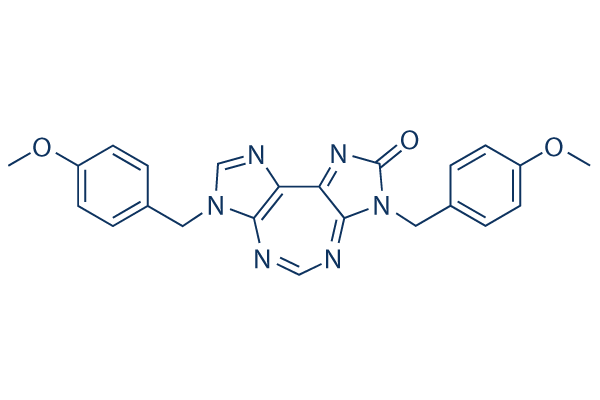
Chemische Struktur
Molekulargewicht: 428.44
Qualitätskontrolle
| Verwandte Ziele | CDK HSP PD-1/PD-L1 ROCK Wee1 Microtubule Associated Ras KRas Aurora Kinase Casein Kinase |
|---|---|
| Weitere DNA/RNA Synthesis Inhibitoren | CX-5461 (Pidnarulex) B02 SCR7 Favipiravir (T-705) EED226 BMH-21 Triapine (3-AP) Carmofur YK-4-279 Halofuginone |
Zellkultur, Behandlung & Arbeitskonzentration
| Zelllinien | Assay-Typ | Konzentration | Inkubationszeit | Formulierung | Aktivitätsbeschreibung | PMID |
|---|---|---|---|---|---|---|
| A549 | Cytotoxicity assay | 72 hrs | Cytotoxicity against human A549 cells after 72 hrs by WST1 assay, IC50 = 2.5 μM. | 21572541 | ||
| A549 | Cytotoxicity assay | 72 hrs | Cytotoxicity against human A549 cells after 72 hrs by WST1 assay, IC50 = 2.56 μM. | 23290252 | ||
| H460 | Cytotoxicity assay | 72 hrs | Cytotoxicity against human H460 cells after 72 hrs by WST1 assay, IC50 = 2.8 μM. | 21572541 | ||
| H460 | Cytotoxicity assay | 72 hrs | Cytotoxicity against human H460 cells after 72 hrs by WST1 assay, IC50 = 2.87 μM. | 23290252 | ||
| MDA-MB-231 | Cytotoxicity assay | 72 hrs | Cytotoxicity against human MDA-MB-231 cells after 72 hrs by WST1 assay, IC50 = 4.01 μM. | 21572541 | ||
| MDA-MB-231 | Cytotoxicity assay | 72 hrs | Cytotoxicity against human MDA-MB-231 cells after 72 hrs by WST1 assay, IC50 = 4.05 μM. | 23290252 | ||
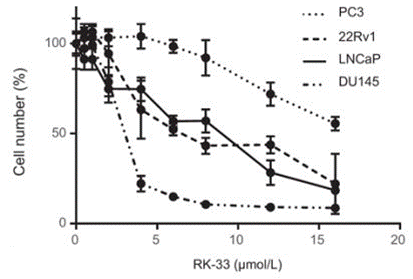
| PC3 | Cytotoxicity assay | 72 hrs | Cytotoxicity against human PC3 cells after 72 hrs by WST1 assay, IC50 = 4.8 μM. | 21572541 | ||
| PC3 | Cytotoxicity assay | 72 hrs | Cytotoxicity against human PC3 cells after 72 hrs by WST1 assay, IC50 = 4.9 μM. | 23290252 | ||
| MCF7 | Cytotoxicity assay | 72 hrs | Cytotoxicity against human MCF7 cells after 72 hrs by WST1 assay, IC50 = 7.5 μM. | 21572541 | ||
| MCF7 | Cytotoxicity assay | 72 hrs | Cytotoxicity against human MCF7 cells after 72 hrs by WST1 assay, IC50 = 7.59 μM. | 23290252 | ||
| OVCAR3 | Cytotoxicity assay | 72 hrs | Cytotoxicity against human OVCAR3 cells after 72 hrs by WST1 assay, IC50 = 14.5 μM. | 21572541 | ||
| OVCAR3 | Cytotoxicity assay | 72 hrs | Cytotoxicity against human OVCAR3 cells after 72 hrs by WST1 assay, IC50 = 14.5 μM. | 23290252 | ||
| Klicken Sie hier, um weitere experimentelle Daten zu Zelllinien anzuzeigen | ||||||
Chemische Informationen, Lagerung & Stabilität
| Molekulargewicht | 428.44 | Formel | C23H20N6O3 |
Lagerung (Ab dem Eingangsdatum) | |
|---|---|---|---|---|---|
| CAS-Nr. | 1070773-09-9 | SDF herunterladen | Lagerung von Stammlösungen |
|
|
| Synonyme | N/A | Smiles | COC1=CC=C(C=C1)CN2C=NC3=C2N=CN=C4C3=NC(=O)N4CC5=CC=C(C=C5)OC | ||
Löslichkeit
|
In vitro |
DMSO
: 40 mg/mL
(93.36 mM)
Water : Insoluble Ethanol : Insoluble |
Molaritätsrechner
|
In vivo |
|||||
In-vivo-Formulierungsrechner (Klare Lösung)
Schritt 1: Geben Sie die untenstehenden Informationen ein (Empfohlen: Ein zusätzliches Tier zur Berücksichtigung von Verlusten während des Experiments)
Schritt 2: Geben Sie die In-vivo-Formulierung ein (Dies ist nur der Rechner, keine Formulierung. Bitte kontaktieren Sie uns zuerst, wenn es im Abschnitt "Löslichkeit" keine In-vivo-Formulierung gibt.)
Berechnungsergebnisse:
Arbeitskonzentration: mg/ml;
Methode zur Herstellung der DMSO-Stammlösung: mg Wirkstoff vorgelöst in μL DMSO ( Konzentration der Stammlösung mg/mL, Bitte kontaktieren Sie uns zuerst, wenn die Konzentration die DMSO-Löslichkeit der Wirkstoffcharge überschreitet. )
Methode zur Herstellung der In-vivo-Formulierung: Nehmen Sie μL DMSO Stammlösung, dann hinzufügenμL PEG300, mischen und klären, dann hinzufügenμL Tween 80, mischen und klären, dann hinzufügen μL ddH2O, mischen und klären.
Methode zur Herstellung der In-vivo-Formulierung: Nehmen Sie μL DMSO Stammlösung, dann hinzufügen μL Maisöl, mischen und klären.
Hinweis: 1. Bitte stellen Sie sicher, dass die Flüssigkeit klar ist, bevor Sie das nächste Lösungsmittel hinzufügen.
2. Achten Sie darauf, das/die Lösungsmittel der Reihe nach hinzuzufügen. Sie müssen sicherstellen, dass die bei der vorherigen Zugabe erhaltene Lösung eine klare Lösung ist, bevor Sie mit der Zugabe des nächsten Lösungsmittels fortfahren. Physikalische Methoden wie Vortex, Ultraschall oder ein heißes Wasserbad können zur Unterstützung des Lösens verwendet werden.
Wirkmechanismus
| Targets/IC50/Ki |
DDX3
|
|---|---|
| In vitro |
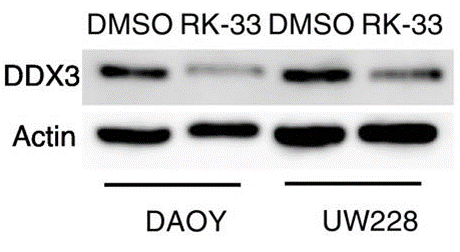
RK-33 bindet spezifisch an DDX3, aber nicht an die eng verwandten Proteine DDX5 und DDX17. Diese Verbindung hemmt das Krebswachstum und radiosensibilisiert Lungenkrebszellen auf DDX3-abhängige Weise. Es hat keine Auswirkung auf die mitochondriale Atmung oder die ATP-Generierung. Diese Chemikalie drosselt die Proliferation und induziert Apoptose auf DDX3-abhängige Weise. Die Wnt-Signalübertragung wird durch DDX3 vermittelt und durch RK-33 gehemmt. Es beeinträchtigt die strahleninduzierte DNA-Schadensreparatur durch Hemmung der NHEJ-Aktivität.
|
| In vivo |
RK-33 in Kombination mit Strahlung induziert Tumorrückbildung in mehreren Mausmodellen von Lungenkrebs. Diese Verbindung ist in der verwendeten Dosis bei SCID-Mäusen nicht toxisch. Mit dieser Chemikalie behandelte Mäuse zeigen keine erkennbaren morphologischen Veränderungen.
|
Literatur |
Anwendungen
| Methoden | Biomarker | Bilder | PMID |
|---|---|---|---|
| Western blot | DDX3 Cyclin D1 / Cyclin E1 |
|
30292066 |
| Growth inhibition assay | Cell viability |
|
27634756 |
Technischer Support
Tel: +1-832-582-8158 Ext:3
Wenn Sie weitere Fragen haben, hinterlassen Sie bitte eine Nachricht.

Produkte sind nur für Forschungszwecke bestimmt. Nicht für den menschlichen Gebrauch. Wir verkaufen nicht an Patienten.
©Copyright 2013 Selleck Chemicals. Alle Rechte vorbehalten.