
nur für Forschungszwecke
Leflunomide Dehydrogenase Inhibitor
Kat.-Nr.: S1247
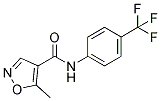
Chemische Struktur
Molekulargewicht: 270.21
Qualitätskontrolle (Quality Control)
Zellkultur, Behandlung & Arbeitskonzentration
(Cell Culture, Treatment & Working Concentration)
| Zelllinien | Assay-Typ | Konzentration | Inkubationszeit | Formulierung | Aktivitätsbeschreibung | PMID |
|---|---|---|---|---|---|---|
| B-cells | Function assay | In vitro inhibition of Ab formation from trinitrophenyl-lipopolysaccharide (TNP-LPS) B-cells, IC50=5.1μM | 11384243 | |||
| A673 | qHTS assay | qHTS of pediatric cancer cell lines to identify multiple opportunities for drug repurposing: Primary screen for A673 cells | 29435139 | |||
| SK-N-MC | qHTS assay | qHTS of pediatric cancer cell lines to identify multiple opportunities for drug repurposing: Primary screen for SK-N-MC cells | 29435139 | |||
| SK-N-MC | qHTS assay | qHTS of pediatric cancer cell lines to identify multiple opportunities for drug repurposing: Confirmatory screen for SK-N-MC cells | 29435139 | |||
| Klicken Sie hier, um weitere experimentelle Daten zu Zelllinien anzuzeigen | ||||||
Chemische Informationen, Lagerung & Stabilität (Chemical Information, Storage & Stability)
| Molekulargewicht | 270.21 | Formel | C12H9F3N2O2 |
Lagerung (Ab dem Eingangsdatum) | |
|---|---|---|---|---|---|
| CAS-Nr. | 75706-12-6 | SDF herunterladen | Lagerung von Stammlösungen |
|
|
| Synonyme | HWA486, RS-34821, SU101 | Smiles | CC1=C(C=NO1)C(=O)NC2=CC=C(C=C2)C(F)(F)F | ||
Löslichkeit (Solubility)
|
In vitro |
DMSO
: 54 mg/mL
(199.84 mM)
Ethanol : 54 mg/mL Water : Insoluble |
Molaritätsrechner
|
In vivo |
|||||
In-vivo-Formulierungsrechner (Klare Lösung)
Schritt 1: Geben Sie die untenstehenden Informationen ein (Empfohlen: Ein zusätzliches Tier zur Berücksichtigung von Verlusten während des Experiments)
Schritt 2: Geben Sie die In-vivo-Formulierung ein (Dies ist nur der Rechner, keine Formulierung. Bitte kontaktieren Sie uns zuerst, wenn es im Abschnitt "Löslichkeit" keine In-vivo-Formulierung gibt.)
Berechnungsergebnisse:
Arbeitskonzentration: mg/ml;
Methode zur Herstellung der DMSO-Stammlösung: mg Wirkstoff vorgelöst in μL DMSO ( Konzentration der Stammlösung mg/mL, Bitte kontaktieren Sie uns zuerst, wenn die Konzentration die DMSO-Löslichkeit der Wirkstoffcharge überschreitet. )
Methode zur Herstellung der In-vivo-Formulierung: Nehmen Sie μL DMSO Stammlösung, dann hinzufügenμL PEG300, mischen und klären, dann hinzufügenμL Tween 80, mischen und klären, dann hinzufügen μL ddH2O, mischen und klären.
Methode zur Herstellung der In-vivo-Formulierung: Nehmen Sie μL DMSO Stammlösung, dann hinzufügen μL Maisöl, mischen und klären.
Hinweis: 1. Bitte stellen Sie sicher, dass die Flüssigkeit klar ist, bevor Sie das nächste Lösungsmittel hinzufügen.
2. Achten Sie darauf, das/die Lösungsmittel der Reihe nach hinzuzufügen. Sie müssen sicherstellen, dass die bei der vorherigen Zugabe erhaltene Lösung eine klare Lösung ist, bevor Sie mit der Zugabe des nächsten Lösungsmittels fortfahren. Physikalische Methoden wie Vortex, Ultraschall oder ein heißes Wasserbad können zur Unterstützung des Lösens verwendet werden.
Wirkmechanismus (Mechanism of Action)
| Targets/IC50/Ki |
Dihydroorotate dehydrogenase
|
|---|---|
| In vitro |
Leflunomide is actually a prodrug that is processed in vivo to the active metabolite A771726,which has been shown to inhibit proliferation of mononuclear and T-cells. This compound is an inhibitor of several protein tyrosine kinases, with IC50 values between 30 mM and 100 mM in vitro cellular and enzymatic assays. It is capable of inhibiting anti-CD3- and interleukin-2 (IL-2)-stimulated T cell proliferation. This drug is able to inhibit p59fyn and p56lck activity in in vitro tyrosine kinase assays. It also inhibits Ca2+ mobilization in Jurkat cells stimulated by anti-CD3 antibody but not in those stimulated by ionomycin. This compound also inhibits distal events of anti-CD3 monoclonal antibody stimulation, namely, IL-2 production and IL-2 receptor expression on human T lymphocytes. It also inhibits tyrosine phosphorylation in CTLL-4 cells stimulated by IL-2. This immunomodulatory drug may exert its effects by inhibiting the mitochondrial enzyme dihydroorotate dehydrogenase (DHODH), which plays a key role in the de novo synthesis of the pyrimidine ribonucleotide uridine monophosphate (rUMP). It prevents the expansion of activated and autoimmune lymphocytes by interfering with the cell cycle progression due to inadequate production of rUMP and utilizing mechanisms involving p53.
|
| In vivo |
Leflunomide is able to prevent and reverse allograft and xenograft rejection in rodents, dogs, and monkeys.
|
Literatur |
|
Anwendungen (Applications)
| Methoden | Biomarker | Bilder | PMID |
|---|---|---|---|
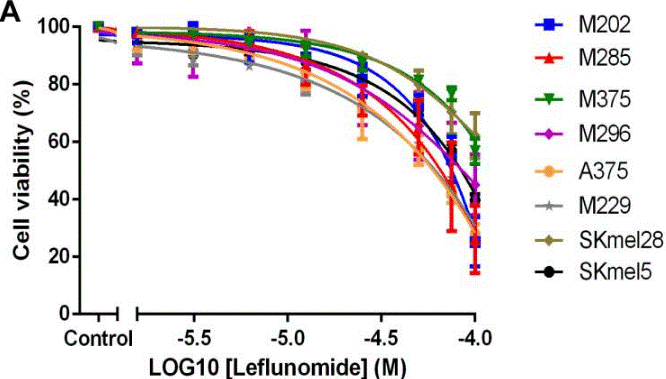
| Growth inhibition assay | Cell viability |
|
29423085 |
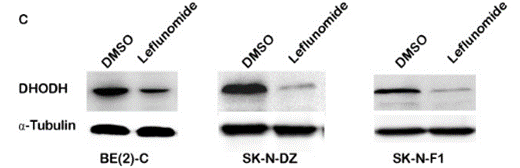
| Western blot | DH0DH ATF4 / CHOP CDK2 / Cyclin A2 |
|
23977077 |
Klinische Studieninformationen (Clinical Trial Information)
(Daten von https://clinicaltrials.gov, aktualisiert am 2026-07-16)
| NCT-Nummer | Rekrutierung | Erkrankungen | Sponsor/Kooperationspartner | Startdatum | Phasen |
|---|---|---|---|---|---|
| NCT07709013 | RECRUITING | Hematologic Malignancies |
Tata Memorial Centre |
2024-10-18 | PHASE2 |
| NCT02714634 | RECRUITING | Rheumatoid Arthritis; Insufficient Response to Methotrexate or Leflunomide |
University Hospital, Strasbourg, France |
2016-03-30 | PHASE4 |
| NCT03414502 | RECRUITING | Rheumatoid Arthritis |
University of Nebraska |
2007-12-10 | PHASE3 |
| NCT07138898 | RECRUITING | Rheumatic Disease |
NYU Langone Health |
2025-12-12 | PHASE2 |
| NCT04542733 | ACTIVE_NOT_RECRUITING | Kidney Transplant Infection; BK Virus Infection |
King Chulalongkorn Memorial Hospital |
2023-06-15 | |
| NCT06923488 | RECRUITING | Myelodysplastic Syndromes |
West Virginia University |
2025-07-15 | PHASE1; PHASE2 |

Produkte sind nur für Forschungszwecke bestimmt. Nicht für den menschlichen Gebrauch. Wir verkaufen nicht an Patienten.
©Copyright 2013 Selleck Chemicals. Alle Rechte vorbehalten.