
nur für Forschungszwecke
Menadione (Vitamin K3) phosphatase Inhibitor
Kat.-Nr.S1949
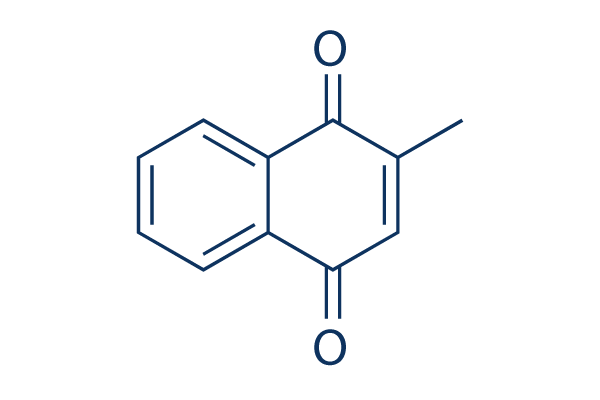
Chemische Struktur
Molekulargewicht: 172.18
Qualitätskontrolle
Zellkultur, Behandlung & Arbeitskonzentration
| Zelllinien | Assay-Typ | Konzentration | Inkubationszeit | Formulierung | Aktivitätsbeschreibung | PMID |
|---|---|---|---|---|---|---|
| HT22 cells | Function assay | Neuroprotective activity in mouse HT22 cells assessed as prevention from glutamate-induced oxidative cell death by MTS assay, PD50=0.797 μM | ||||
| HeLa cell | Cytotoxicity assay | Cytotoxicity against HeLa cell lines, EC50=3.7 μM | ||||
| PaCa2 cell | Proliferation assay | Antiproliferative activity against human pancreatic carcinoma Mia PaCa2 cell line by colorimetric assay, IC50=6.2 μM | ||||
| HT-29 cells | Cytotoxicity assay | 72 h | Cytotoxicity against human HT-29 cells assessed as growth inhibition after 72 hrs by MTS assay, IC50=9.69 μM | |||
| DU145 cells | Cytotoxicity assay | 72 h | Cytotoxicity against human DU145 cells assessed as growth inhibition after 72 hrs by MTS assay, IC50=9.86 μM | |||
| MDA-MB-231 cells | Cytotoxicity assay | 72 h | Cytotoxicity against human MDA-MB-231 cells assessed as growth inhibition after 72 hrs by MTS assay, IC50=12.68 μM | |||
| human A2058 cells | Cytotoxicity assay | Cytotoxicity against human A2058 cells assessed as inhibition of formazan formation at day 5 by measuring absorbance at 430 nm, IC50=13.4 μM | ||||
| SAS cells | Cytotoxicity assay | 48 h | Cytotoxicity against human SAS cells assessed as reduction in cell viability after 48 hrs by MTT assay, IC50=14 μM | |||
| HaCaT cells | Function assay | 48 h | Antihyperproliferative activity against human HaCaT cells assessed as inhibition of cell growth after 48 hrs by phase contrast microscopy, IC50=15.8 μM | |||
| HeLa cells | Cytotoxicity assay | 48 h | Cytotoxicity against human HeLa cells assessed as reduction in cell viability after 48 hrs by MTT assay, IC50=18 μM | |||
| CRL2796 cells | Cytotoxicity assay | Cytotoxicity against human CRL2796 cells assessed as inhibition of formazan formation at day 4 by measuring absorbance at 430 nm, IC50=21 μM | ||||
| HL60 cells | Function assay | 50 μM | Induction of necrosis in intact human HL60 cells assessed as cytosolic LDH release at 50 uM | |||
| Klicken Sie hier, um weitere experimentelle Daten zu Zelllinien anzuzeigen | ||||||
Chemische Informationen, Lagerung & Stabilität
| Molekulargewicht | 172.18 | Formel | C11H8O2 |
Lagerung (Ab dem Eingangsdatum) | |
|---|---|---|---|---|---|
| CAS-Nr. | 58-27-5 | SDF herunterladen | Lagerung von Stammlösungen |
|
|
| Synonyme | NSC 4170 | Smiles | CC1=CC(=O)C2=CC=CC=C2C1=O | ||
Löslichkeit
|
In vitro |
DMSO
: 34 mg/mL
(197.46 mM)
Ethanol : 34 mg/mL Water : Insoluble |
Molaritätsrechner
|
In vivo |
|||||
In-vivo-Formulierungsrechner (Klare Lösung)
Schritt 1: Geben Sie die untenstehenden Informationen ein (Empfohlen: Ein zusätzliches Tier zur Berücksichtigung von Verlusten während des Experiments)
Schritt 2: Geben Sie die In-vivo-Formulierung ein (Dies ist nur der Rechner, keine Formulierung. Bitte kontaktieren Sie uns zuerst, wenn es im Abschnitt "Löslichkeit" keine In-vivo-Formulierung gibt.)
Berechnungsergebnisse:
Arbeitskonzentration: mg/ml;
Methode zur Herstellung der DMSO-Stammlösung: mg Wirkstoff vorgelöst in μL DMSO ( Konzentration der Stammlösung mg/mL, Bitte kontaktieren Sie uns zuerst, wenn die Konzentration die DMSO-Löslichkeit der Wirkstoffcharge überschreitet. )
Methode zur Herstellung der In-vivo-Formulierung: Nehmen Sie μL DMSO Stammlösung, dann hinzufügenμL PEG300, mischen und klären, dann hinzufügenμL Tween 80, mischen und klären, dann hinzufügen μL ddH2O, mischen und klären.
Methode zur Herstellung der In-vivo-Formulierung: Nehmen Sie μL DMSO Stammlösung, dann hinzufügen μL Maisöl, mischen und klären.
Hinweis: 1. Bitte stellen Sie sicher, dass die Flüssigkeit klar ist, bevor Sie das nächste Lösungsmittel hinzufügen.
2. Achten Sie darauf, das/die Lösungsmittel der Reihe nach hinzuzufügen. Sie müssen sicherstellen, dass die bei der vorherigen Zugabe erhaltene Lösung eine klare Lösung ist, bevor Sie mit der Zugabe des nächsten Lösungsmittels fortfahren. Physikalische Methoden wie Vortex, Ultraschall oder ein heißes Wasserbad können zur Unterstützung des Lösens verwendet werden.
Wirkmechanismus
| Targets/IC50/Ki |
Cdc25 phosphatase
DNA polymerase γ
|
|---|---|
| In vitro |
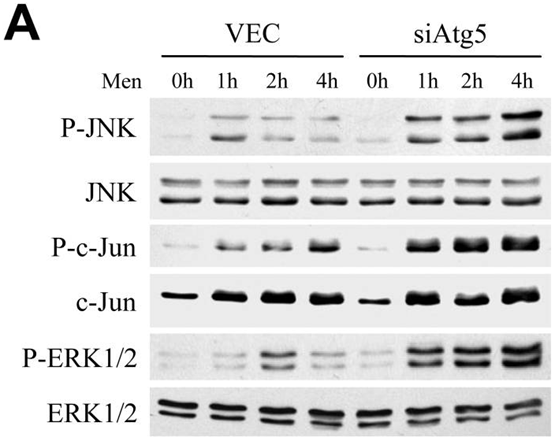
Menadione (Vitamin K3) verhindert die mitochondriale Ca(2+)-Aufnahme in normalen pankreatischen Azinuszellen, was eine schnelle Ausbreitung von Ca(2+) in der Zelle ermöglicht. Die induzierte mitochondriale Depolarisation ist auf die Induktion der Permeabilitätsübergangspore zurückzuführen. Bei nicht-toxischer Konzentration führt diese Verbindung zu einer kurzen Aktivierung der extrazellulären signalregulierten Kinase (ERK) und der c-Jun N-terminalen Kinase (JNK) in der RALA255-10G Ratten-Hepatozyten-Zelllinie. Es ist gleich wirksam gegen multiresistente und parentale Leukämiezelllinien mit IC50-Werten von 13,5 mM bzw. 18 mM. Die Verbindung hemmt die Inkorporation von radioaktivem Thymidin, Uridin und Aminosäuren in DNA, RNA und Protein in drei menschlichen Krebszelllinien. Bei 1-20 mM hemmt es die Zellproliferation von AR4-2J-Zellen dosis- und zeitabhängig. Eine Konzentration von 100 mM verursacht einen schnellen Zelltod. Dieser Wert (100 mM) induziert DNA-Schmierung in der Elektrophorese, was auf Nekrose hindeutet, während niedrigere Konzentrationen (10-20 mM) eine DNA-Leiter induzieren, was auf Apoptose hindeutet. Konzentrationen von 1-20 mM induzieren Wildtyp-P53, während 100 mM eine geringere Wirkung auf Wildtyp-P53 hat. Die Behandlung damit beeinflusst deutlich die mitochondriale Funktion von Jurkat-T-Zellen, indem sie einen Kollaps des inneren Transmembranpotenzials (DeltaPsi(m)) und eine Abnahme der inneren Membranmasse induziert, was durch N-Acetylcystein vollständig rückgängig gemacht werden konnte. |
Literatur |
|
Anwendungen
| Methoden | Biomarker | Bilder | PMID |
|---|---|---|---|
| Western blot | p-JNK / JNK / p-c-Jun / c-Jun / p-ERK / ERK Cyclin B1 / CDK1 / CDC25C c-Fos / HO-1 |
|
20578144 |
Klinische Studieninformationen
(Daten von https://clinicaltrials.gov, aktualisiert am 2024-05-22)
| NCT-Nummer | Rekrutierung | Erkrankungen | Sponsor/Kooperationspartner | Startdatum | Phasen |
|---|---|---|---|---|---|
| NCT01094444 | Completed | Folliculitis |
Per Pfeiffer|Odense University Hospital |
May 2010 | Phase 2 |
| NCT00656786 | Completed | EGFR Inhibitor-associated Rash |
Spectrum Pharmaceuticals Inc |
April 3 2008 | Phase 1 |
Technischer Support
Tel: +1-832-582-8158 Ext:3
Wenn Sie weitere Fragen haben, hinterlassen Sie bitte eine Nachricht.

Produkte sind nur für Forschungszwecke bestimmt. Nicht für den menschlichen Gebrauch. Wir verkaufen nicht an Patienten.
©Copyright 2013 Selleck Chemicals. Alle Rechte vorbehalten.