
nur für Forschungszwecke
AG-221 (Enasidenib) Mutanter IDH2 Inhibitor
Kat.-Nr.: S8205
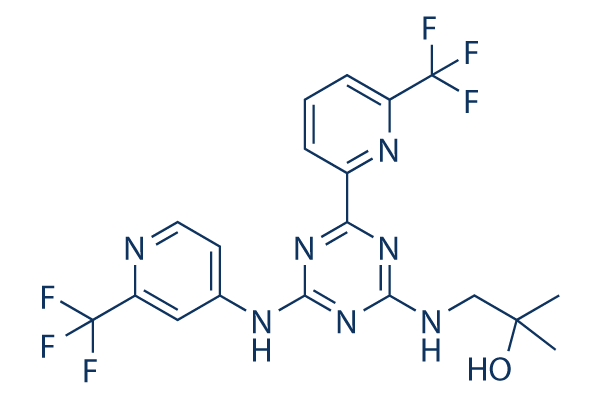
Chemische Struktur
Molekulargewicht: 473.38
Qualitätskontrolle (Quality Control)
Chemische Informationen, Lagerung & Stabilität (Chemical Information, Storage & Stability)
| Molekulargewicht | 473.38 | Formel | C19H17F6N7O |
Lagerung (Ab dem Eingangsdatum) | |
|---|---|---|---|---|---|
| CAS-Nr. | 1446502-11-9 | SDF herunterladen | Lagerung von Stammlösungen |
|
|
| Synonyme | N/A | Smiles | CC(C)(CNC1=NC(=NC(=N1)C2=NC(=CC=C2)C(F)(F)F)NC3=CC(=NC=C3)C(F)(F)F)O | ||
Löslichkeit (Solubility)
|
In vitro |
DMSO
: 94 mg/mL
(198.57 mM)
Ethanol : 94 mg/mL Water : Insoluble |
Molaritätsrechner
|
In vivo |
|||||
In-vivo-Formulierungsrechner (Klare Lösung)
Schritt 1: Geben Sie die untenstehenden Informationen ein (Empfohlen: Ein zusätzliches Tier zur Berücksichtigung von Verlusten während des Experiments)
Schritt 2: Geben Sie die In-vivo-Formulierung ein (Dies ist nur der Rechner, keine Formulierung. Bitte kontaktieren Sie uns zuerst, wenn es im Abschnitt "Löslichkeit" keine In-vivo-Formulierung gibt.)
Berechnungsergebnisse:
Arbeitskonzentration: mg/ml;
Methode zur Herstellung der DMSO-Stammlösung: mg Wirkstoff vorgelöst in μL DMSO ( Konzentration der Stammlösung mg/mL, Bitte kontaktieren Sie uns zuerst, wenn die Konzentration die DMSO-Löslichkeit der Wirkstoffcharge überschreitet. )
Methode zur Herstellung der In-vivo-Formulierung: Nehmen Sie μL DMSO Stammlösung, dann hinzufügenμL PEG300, mischen und klären, dann hinzufügenμL Tween 80, mischen und klären, dann hinzufügen μL ddH2O, mischen und klären.
Methode zur Herstellung der In-vivo-Formulierung: Nehmen Sie μL DMSO Stammlösung, dann hinzufügen μL Maisöl, mischen und klären.
Hinweis: 1. Bitte stellen Sie sicher, dass die Flüssigkeit klar ist, bevor Sie das nächste Lösungsmittel hinzufügen.
2. Achten Sie darauf, das/die Lösungsmittel der Reihe nach hinzuzufügen. Sie müssen sicherstellen, dass die bei der vorherigen Zugabe erhaltene Lösung eine klare Lösung ist, bevor Sie mit der Zugabe des nächsten Lösungsmittels fortfahren. Physikalische Methoden wie Vortex, Ultraschall oder ein heißes Wasserbad können zur Unterstützung des Lösens verwendet werden.
Wirkmechanismus (Mechanism of Action)
| Targets/IC50/Ki |
IDH2
(Cell-free assay) 12 nM
|
|---|---|
| In vitro |
Enasidenib (AG-221) has been demonstrated to reduce 2-HG levels by >90% and reverse histone and deoxyribonucleic acid (DNA) hypermethylation in vitro, and to induce differentiation in leukemia cell models. |
| In vivo |
Enasidenib (AG-221) is able to potently reduce 2HG found in the bone marrow, plasma and urine of engrafted mice. Treatment with this compound also induced a dose dependent, statistically significant, survival benefit. A proliferative burst of the human specific CD45+ blast cells is followed by cellular differentiation as measured by the expression of CD11b, CD14 and CD15 and cell morphology after its administration. It also restores megakaryocyte-erythroid progenitor (MEP) differentiation that is suppressed by mutant IDH2 expression and reverses the effects of mutant IDH2 on DNA methylation in mutant stem/progenitor cells. Clinical trials combining IDH2 inhibitors with other targeted AML therapies are warranted in order to increase therapeutic efficacy. |
Literatur |
|
Klinische Studieninformationen (Clinical Trial Information)
(Daten von https://clinicaltrials.gov, aktualisiert am 2026-09-03)
| NCT-Nummer | Rekrutierung | Erkrankungen | Sponsor/Kooperationspartner | Startdatum | Phasen |
|---|---|---|---|---|---|
| NCT03013998 | RECRUITING | Previously Untreated Relapsed Refractory Acute Myeloid Leukemia |
Beat AML, LLC |
2016-11 | PHASE2; PHASE3 |
| NCT02813135 | RECRUITING | Pediatric Cancer |
Gustave Roussy, Cancer Campus, Grand Paris |
2016-08-03 | PHASE1; PHASE2 |
| NCT05564390 | RECRUITING | Acute Myeloid Leukemia; Acute Myeloid Leukemia Arising From Previous Myelodysplastic/Myeloproliferative Neoplasm; Acute Myeloid Leukemia Post Cytotoxic Therapy; Acute Myeloid Leukemia, Myelodysplasia-Related; Myelodysplastic Syndrome |
National Cancer Institute (NCI) |
2024-06-18 | PHASE2 |
| NCT06240754 | RECRUITING | Clonal Cytopenia of Undetermined Significance; CCUS Clonal Cytopenia of Undetermined Significance |
Washington University School of Medicine |
2024-10-10 | PHASE2 |
| NCT06176989 | RECRUITING | Metastatic Chondrosarcoma; Locally Advanced Chondrosarcoma; Metastatic Sinonasal Adenocarcinoma; Locally Advanced Sinonasal Adenocarcinoma; Metastatic Large-cell Neuroendocrine Carcinoma; Locally Advanced Large-cell Neuroendocrine Carcinoma; Metastatic Olfactory Neuroblastoma; Locally Advanced Olfactory Neuroblastoma; Metastatic Sinonasal Undifferentiated Carcinoma; Locally Advanced Sinonasal Undifferentiated Carcinoma |
National Cancer Institute (NCI) |
2024-03-04 | PHASE2 |
| NCT06756308 | ACTIVE_NOT_RECRUITING | T-cell Lymphoma |
Memorial Sloan Kettering Cancer Center |
2024-12-24 | PHASE2 |

Produkte sind nur für Forschungszwecke bestimmt. Nicht für den menschlichen Gebrauch. Wir verkaufen nicht an Patienten.
©Copyright 2013 Selleck Chemicals. Alle Rechte vorbehalten.