
nur für Forschungszwecke
Tetraethylthiuram disulfide (Disulfiram) ALDH-Inhibitor
Kat.-Nr.S1680
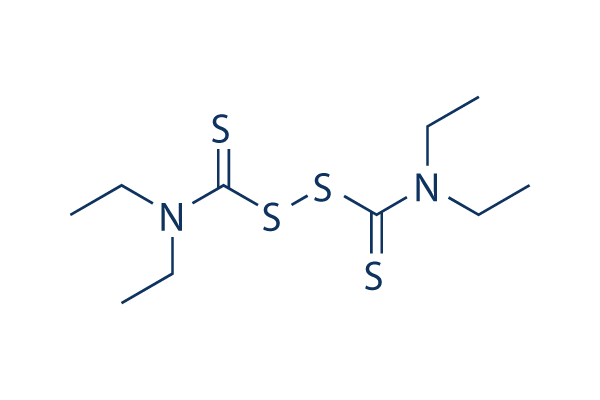
Chemische Struktur
Molekulargewicht: 296.54
Qualitätskontrolle
Zellkultur, Behandlung & Arbeitskonzentration
| Zelllinien | Assay-Typ | Konzentration | Inkubationszeit | Formulierung | Aktivitätsbeschreibung | PMID |
|---|---|---|---|---|---|---|
| insect cells | Function assay | 30 mins | Inhibition of recombinant human LOXL4 expressed in baculovirus infected insect cells using diaminopentane as substrate preincubated for 30 mins followed by substrate addition measured after 1 hr by fluorimetric method, IC50 = 0.059 μM. | 30098867 | ||
| CHO | Function assay | 30 mins | Inhibition of recombinant human LOXL3 expressed in CHO cells using diaminopentane as substrate preincubated for 30 mins followed by substrate addition measured after 1 hr by fluorimetric method, IC50 = 0.093 μM. | 30098867 | ||
| MCF7 | Antiproliferative assay | 72 hrs | Antiproliferative activity against human MCF7 cells expressing BCA2 and estrogen receptor after 72 hrs by MTT assay, IC50 = 0.1 μM. | 20222671 | ||
| NS0 | Function assay | 30 mins | Inhibition of recombinant LOXL2 (unknown origin) expressed in NS0 cells using diaminopentane as substrate preincubated for 30 mins followed by substrate addition measured after 1 hr by fluorimetric method, IC50 = 0.15 μM. | 30098867 | ||
| T47D | Antiproliferative assay | 72 hrs | Antiproliferative activity against human T47D cells expressing BCA2 and estrogen receptor after 72 hrs by MTT assay, IC50 = 0.17 μM. | 20222671 | ||
| MDA-MB-231 | Antiproliferative assay | 72 hrs | Antiproliferative activity against human MDA-MB-231 cells expressing BCA2 and ERalpha after 72 hrs by MTT assay, IC50 = 0.32 μM. | 20222671 | ||
| HEK293 | Function assay | 30 mins | Inhibition of recombinant human LOX expressed in HEK293 cells using diaminopentane as substrate preincubated for 30 mins followed by substrate addition measured after 1 hr by fluorimetric method, IC50 = 0.32 μM. | 30098867 | ||
| CHO | Function assay | Agonist activity at human TRPA1 channel expressed in CHO cells assessed as increase in intracellular calcium levels, EC50 = 3 μM. | 20356305 | |||
| CEM-SS | Antiviral assay | Antiviral activity against HIV-1 in CEM-SS cells using XXT assay, IC50 = 3.9 μM. | 9207937 | |||
| MCF10A | Antiproliferative assay | 72 hrs | Antiproliferative activity against human MCF10A cells after 72 hrs by MTT assay, IC50 = 10 μM. | 20222671 | ||
| HepG2 | Cytotoxicity assay | 72 hrs | Cytotoxicity against human HepG2 cells assessed as reduction in cell viability after 72 hrs by MTT assay, IC50 = 38 μM. | 29571571 | ||
| TC32 | qHTS assay | qHTS of pediatric cancer cell lines to identify multiple opportunities for drug repurposing: Primary screen for TC32 cells | 29435139 | |||
| DAOY | qHTS assay | qHTS of pediatric cancer cell lines to identify multiple opportunities for drug repurposing: Primary screen for DAOY cells | 29435139 | |||
| SJ-GBM2 | qHTS assay | qHTS of pediatric cancer cell lines to identify multiple opportunities for drug repurposing: Primary screen for SJ-GBM2 cells | 29435139 | |||
| A673 | qHTS assay | qHTS of pediatric cancer cell lines to identify multiple opportunities for drug repurposing: Primary screen for A673 cells | 29435139 | |||
| SK-N-MC | qHTS assay | qHTS of pediatric cancer cell lines to identify multiple opportunities for drug repurposing: Primary screen for SK-N-MC cells | 29435139 | |||
| BT-37 | qHTS assay | qHTS of pediatric cancer cell lines to identify multiple opportunities for drug repurposing: Primary screen for BT-37 cells | 29435139 | |||
| NB-EBc1 | qHTS assay | qHTS of pediatric cancer cell lines to identify multiple opportunities for drug repurposing: Primary screen for NB-EBc1 cells | 29435139 | |||
| U-2 OS | qHTS assay | qHTS of pediatric cancer cell lines to identify multiple opportunities for drug repurposing: Primary screen for U-2 OS cells | 29435139 | |||
| Saos-2 | qHTS assay | qHTS of pediatric cancer cell lines to identify multiple opportunities for drug repurposing: Primary screen for Saos-2 cells | 29435139 | |||
| SK-N-SH | qHTS assay | qHTS of pediatric cancer cell lines to identify multiple opportunities for drug repurposing: Primary screen for SK-N-SH cells | 29435139 | |||
| NB1643 | qHTS assay | qHTS of pediatric cancer cell lines to identify multiple opportunities for drug repurposing: Primary screen for NB1643 cells | 29435139 | |||
| LAN-5 | qHTS assay | qHTS of pediatric cancer cell lines to identify multiple opportunities for drug repurposing: Primary screen for LAN-5 cells | 29435139 | |||
| BT-12 | qHTS assay | qHTS of pediatric cancer cell lines to identify multiple opportunities for drug repurposing: Primary screen for BT-12 cells | 29435139 | |||
| Rh18 | qHTS assay | qHTS of pediatric cancer cell lines to identify multiple opportunities for drug repurposing: Primary screen for Rh18 cells | 29435139 | |||
| OHS-50 | qHTS assay | qHTS of pediatric cancer cell lines to identify multiple opportunities for drug repurposing: Primary screen for OHS-50 cells | 29435139 | |||
| RD | qHTS assay | qHTS of pediatric cancer cell lines to identify multiple opportunities for drug repurposing: Primary screen for RD cells | 29435139 | |||
| MG 63 (6-TG R) | qHTS assay | qHTS of pediatric cancer cell lines to identify multiple opportunities for drug repurposing: Primary screen for MG 63 (6-TG R) cells | 29435139 | |||
| fibroblast cells | qHTS assay | qHTS of pediatric cancer cell lines to identify multiple opportunities for drug repurposing: Primary screen for control Hh wild type fibroblast cells | 29435139 | |||
| Rh41 | qHTS assay | qHTS of pediatric cancer cell lines to identify multiple opportunities for drug repurposing: Primary screen for Rh41 cells | 29435139 | |||
| NB1643 | qHTS assay | qHTS of pediatric cancer cell lines to identify multiple opportunities for drug repurposing: Confirmatory screen for NB1643 cells | 29435139 | |||
| A673 | qHTS assay | qHTS of pediatric cancer cell lines to identify multiple opportunities for drug repurposing: Confirmatory screen for A673 cells) | 29435139 | |||
| LAN-5 | qHTS assay | qHTS of pediatric cancer cell lines to identify multiple opportunities for drug repurposing: Confirmatory screen for LAN-5 cells | 29435139 | |||
| DAOY | qHTS assay | qHTS of pediatric cancer cell lines to identify multiple opportunities for drug repurposing: Confirmatory screen for DAOY cells | 29435139 | |||
| SJ-GBM2 | qHTS assay | qHTS of pediatric cancer cell lines to identify multiple opportunities for drug repurposing: Confirmatory screen for SJ-GBM2 cells | 29435139 | |||
| BT-37 | qHTS assay | qHTS of pediatric cancer cell lines to identify multiple opportunities for drug repurposing: Confirmatory screen for BT-37 cells | 29435139 | |||
| TC32 | qHTS assay | qHTS of pediatric cancer cell lines to identify multiple opportunities for drug repurposing: Confirmatory screen for TC32 cells | 29435139 | |||
| U-2 OS | qHTS assay | qHTS of pediatric cancer cell lines to identify multiple opportunities for drug repurposing: Confirmatory screen for U-2 OS cells | 29435139 | |||
| Rh41 | qHTS assay | qHTS of pediatric cancer cell lines to identify multiple opportunities for drug repurposing: Confirmatory screen for Rh41 cells | 29435139 | |||
| RD | qHTS assay | qHTS of pediatric cancer cell lines to identify multiple opportunities for drug repurposing: Confirmatory screen for RD cells | 29435139 | |||
| Saos-2 | qHTS assay | qHTS of pediatric cancer cell lines to identify multiple opportunities for drug repurposing: Confirmatory screen for Saos-2 cells | 29435139 | |||
| Klicken Sie hier, um weitere experimentelle Daten zu Zelllinien anzuzeigen | ||||||
Chemische Informationen, Lagerung & Stabilität
| Molekulargewicht | 296.54 | Formel | C10H20N2S4 |
Lagerung (Ab dem Eingangsdatum) | |
|---|---|---|---|---|---|
| CAS-Nr. | 97-77-8 | SDF herunterladen | Lagerung von Stammlösungen |
|
|
| Synonyme | NSC 190940, Tetraethylthiuram disulfide, TETD | Smiles | CCN(CC)C(=S)SSC(=S)N(CC)CC | ||
Löslichkeit
|
In vitro |
DMSO
: 59 mg/mL
(198.96 mM)
Ethanol : 59 mg/mL Water : Insoluble |
Molaritätsrechner
|
In vivo |
|||||
In-vivo-Formulierungsrechner (Klare Lösung)
Schritt 1: Geben Sie die untenstehenden Informationen ein (Empfohlen: Ein zusätzliches Tier zur Berücksichtigung von Verlusten während des Experiments)
Schritt 2: Geben Sie die In-vivo-Formulierung ein (Dies ist nur der Rechner, keine Formulierung. Bitte kontaktieren Sie uns zuerst, wenn es im Abschnitt "Löslichkeit" keine In-vivo-Formulierung gibt.)
Berechnungsergebnisse:
Arbeitskonzentration: mg/ml;
Methode zur Herstellung der DMSO-Stammlösung: mg Wirkstoff vorgelöst in μL DMSO ( Konzentration der Stammlösung mg/mL, Bitte kontaktieren Sie uns zuerst, wenn die Konzentration die DMSO-Löslichkeit der Wirkstoffcharge überschreitet. )
Methode zur Herstellung der In-vivo-Formulierung: Nehmen Sie μL DMSO Stammlösung, dann hinzufügenμL PEG300, mischen und klären, dann hinzufügenμL Tween 80, mischen und klären, dann hinzufügen μL ddH2O, mischen und klären.
Methode zur Herstellung der In-vivo-Formulierung: Nehmen Sie μL DMSO Stammlösung, dann hinzufügen μL Maisöl, mischen und klären.
Hinweis: 1. Bitte stellen Sie sicher, dass die Flüssigkeit klar ist, bevor Sie das nächste Lösungsmittel hinzufügen.
2. Achten Sie darauf, das/die Lösungsmittel der Reihe nach hinzuzufügen. Sie müssen sicherstellen, dass die bei der vorherigen Zugabe erhaltene Lösung eine klare Lösung ist, bevor Sie mit der Zugabe des nächsten Lösungsmittels fortfahren. Physikalische Methoden wie Vortex, Ultraschall oder ein heißes Wasserbad können zur Unterstützung des Lösens verwendet werden.
Wirkmechanismus
| Targets/IC50/Ki |
ALDH1
(Cell-free assay) 0.15 μM
ALDH2
(Cell-free assay) 1.45 μM
|
|---|---|
| In vitro |
Disulfiram-Kupfer-Komplex hemmt potent die proteasomale Aktivität in kultivierten Brustkrebszellen MDA-MB-231 und MCF10DCIS.com, aber nicht in normalen, immortalisierten MCF-10A-Zellen, vor der Induktion des apoptotischen Krebszelltods. Diese Verbindung (DS), ein klinisch verwendetes Anti-Alkoholismus-Medikament, hemmt stark die konstitutive und 5-FU-induzierte NF-kappaB-Aktivität in einer dosisabhängigen Weise. Sie hemmt sowohl die nukleäre Translokation von NF-kappaB als auch die DNA-Bindungsaktivität, hat aber keinen Einfluss auf den 5-FU-induzierten IkappaBalpha-Abbau. Diese Chemikalie verstärkt signifikant den apoptotischen Effekt von 5-FU auf DLD-1- und RKO(WT)-Zelllinien und potenzierte synergistisch die Zytotoxizität von 5-FU auf beide Zelllinien. Sie beseitigt auch effektiv die 5-FU-Chemoresistenz in einer 5-FU-resistenten Zelllinie H630(5-FU) in vitro. Oseltamivir verringert die Anzahl der lebensfähigen Zellen, und die Zugabe von CuCl(2) verstärkt signifikant den DSF-induzierten Zelltod auf weniger als 10 % der Kontrolle. Diese Verbindung, die Melanomzellen in Kombination mit Cu2+ oder Zn2+ verabreicht wird, verringert die Expression von Cyclin A und reduziert die Proliferation in vitro bei niedrigeren Konzentrationen als Disulfiram allein. |
| In vivo |
Disulfiram hemmt signifikant das Tumorwachstum (um 74%), verbunden mit einer In-vivo-Proteasomenhemmung (gemessen an verminderten Spiegeln der Proteasomenaktivität im Tumorgewebe und der Akkumulation von ubiquitinierten Proteinen und natürlichen Proteasomensubstraten p27 und Bax) und der Apoptoseinduktion (gezeigt durch Caspaseaktivierung und apoptotische Kernbildung) bei Mäusen mit MDA-MB-231-Tumor-Xenotransplantaten. Diese Verbindung blockiert die P-Glykoprotein-Extrusionspumpe, hemmt den Transkriptionsfaktor nukleärer Faktor-kappaB, sensibilisiert Tumoren für die Chemotherapie, reduziert die Angiogenese und hemmt das Tumorwachstum bei Mäusen. Sie hemmt Wachstum und Angiogenese bei Melanomen, die in immundefiziente Mäuse transplantiert wurden, und diese Effekte werden durch Zn2+-Supplementierung verstärkt. |
Literatur |
|
Klinische Studieninformationen
(Daten von https://clinicaltrials.gov, aktualisiert am 2024-05-22)
| NCT-Nummer | Rekrutierung | Erkrankungen | Sponsor/Kooperationspartner | Startdatum | Phasen |
|---|---|---|---|---|---|
| NCT05626920 | Recruiting | Inherited Retinal Dystrophy Primarily Involving Sensory Retina |
University of Washington |
December 2023 | Phase 1|Phase 2 |
| NCT04485130 | Terminated | Covid19 |
University of California San Francisco |
August 18 2021 | Phase 2 |
| NCT03151772 | Terminated | Glioblastoma |
Sahlgrenska University Hospital Sweden |
January 29 2018 | Early Phase 1 |
| NCT02309801 | Completed | Healthy |
Parc de Salut Mar|Ministerio de Sanidad Servicios Sociales e Igualdad |
July 2012 | Phase 1 |
Technischer Support
Tel: +1-832-582-8158 Ext:3
Wenn Sie weitere Fragen haben, hinterlassen Sie bitte eine Nachricht.

Produkte sind nur für Forschungszwecke bestimmt. Nicht für den menschlichen Gebrauch. Wir verkaufen nicht an Patienten.
©Copyright 2013 Selleck Chemicals. Alle Rechte vorbehalten.