
nur für Forschungszwecke
Birabresib (OTX015) BET Inhibitor
Kat.-Nr.S7360
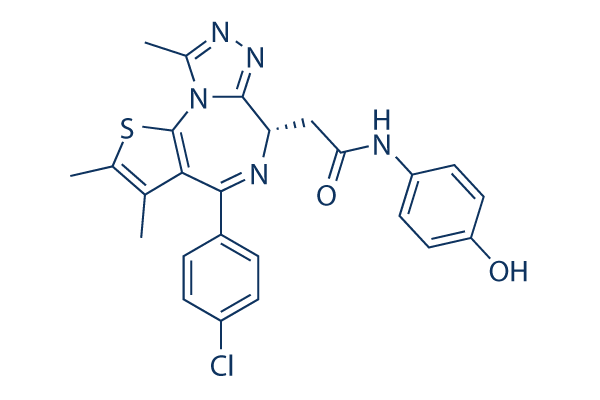
Chemische Struktur
Molekulargewicht: 491.99
Qualitätskontrolle
Zellkultur, Behandlung & Arbeitskonzentration
| Zelllinien | Assay-Typ | Konzentration | Inkubationszeit | Formulierung | Aktivitätsbeschreibung | PMID |
|---|---|---|---|---|---|---|
| Rosetta2 DE3 | Function assay | 30 mins | Displacement of FAM-labeled ZBA248 from BRD3 BD2 (306 to 417 amino acid residues) (unknown origin) expressed in Rosetta2 DE3 cells after 30 mins by fluorescence polarization assay, Ki=0.004μM. | 26080064 | ||
| Rosetta2 DE3 | Function assay | 30 mins | Displacement of FAM-labeled ZBA248 from BRD2 BD2 (349 to 460 amino acid residues) (unknown origin) expressed in Rosetta2 DE3 cells after 30 mins by fluorescence polarization assay, Ki=0.0054μM. | 26080064 | ||
| Rosetta2 DE3 | Function assay | 30 mins | Displacement of FAM-labeled ZBA248 from BRD4 BD2 (333 to 460 amino acid residues) (unknown origin) expressed in Rosetta2 DE3 cells after 30 mins by fluorescence polarization assay, Ki=0.006μM. | 26080064 | ||
| MM1S | Antiproliferative assay | 72 hrs | Antiproliferative activity against human MM1S cells after 72 hrs by CCK8 or SRB assay, IC50=0.0063μM. | 31490070 | ||
| Rosetta2 DE3 | Function assay | 30 mins | Displacement of FAM-labeled ZBA248 from BRD3 BD1 (24 to 144 amino acid residues) (unknown origin) expressed in Rosetta2 DE3 cells after 30 mins by fluorescence polarization assay, Ki=0.0107μM. | 26080064 | ||
| Rosetta2 DE3 | Function assay | 30 mins | Displacement of FAM-labeled ZBA248 from BRD4 BD1 (44 to 168 amino acid residues) (unknown origin) expressed in Rosetta2 DE3 cells after 30 mins by fluorescence polarization assay, Ki=0.0109μM. | 26080064 | ||
| Rosetta2 DE3 | Function assay | 30 mins | Displacement of FAM-labeled ZBA248 from BRD2 BD1 (72 to 205 amino acid residues) (unknown origin) expressed in Rosetta2 DE3 cells after 30 mins by fluorescence polarization assay, Ki=0.0166μM. | 26080064 | ||
| Rosetta2 DE3 | Function assay | 30 mins | Displacement of FAM-labeled ZBA248 from BRD4 BD2 (333 to 460 amino acid residues) (unknown origin) expressed in Rosetta2 DE3 cells after 30 mins by fluorescence polarization assay, IC50=0.0166μM. | 26080064 | ||
| MV4-11 | Antiproliferative assay | 4 days | Antiproliferative activity against human MV4-11 cells assessed as cell growth inhibition after 4 days by CCK8 assay, IC50=0.0176μM. | 31461688 | ||
| MM1S | Antiproliferative assay | 4 days | Antiproliferative activity against human MM1S cells assessed as cell growth inhibition after 4 days by CCK8 assay, IC50=0.0227μM. | 31461688 | ||
| Rosetta2 DE3 | Function assay | 30 mins | Displacement of FAM-labeled ZBA248 from BRD4 BD1 (44 to 168 amino acid residues) (unknown origin) expressed in Rosetta2 DE3 cells after 30 mins by fluorescence polarization assay, IC50=0.0255μM. | 26080064 | ||
| THP1 | Antiproliferative assay | Antiproliferative activity against human THP1 cells, IC50=0.033μM. | 28939121 | |||
| BL21(DE3) | Function assay | 4 hrs | Displacement of 5-FITC labelled (+)-JQ1 from His6-tagged human BRD4 bromodomain 1 expressed in Escherichia coli BL21(DE3) )-codon plus-RIL cells incubated for 4 hrs in dark condition by fluorescence anisotropy binding assay, IC50=0.0343μM. | 31490070 | ||
| MV4-11 | Antiproliferative assay | 72 hrs | Antiproliferative activity against human MV4-11 cells assessed as reduction in cell viability measured after 72 hrs by Celltitre-glo luminescence assay, IC50=0.0463μM. | 32208600 | ||
| TY82 | Antiproliferative assay | Antiproliferative activity against human TY82 cells, IC50=0.067μM. | 28939121 | |||
| insect cells | Function assay | Inhibition of recombinant full length human N-terminal His6-tagged BRD4 (2 to 1362 residues) expressed in baculovirus infected insect cells using histone H4 peptide as substrate by alpha screen assay, IC50=0.092μM. | 30529546 | |||
| LNCAP | Antiproliferative assay | Antiproliferative activity against human LNCAP cells, IC50=0.1114μM. | 29758518 | |||
| Kasumi-1 | Antiproliferative assay | 72 hrs | Antiproliferative activity against human Kasumi-1 cells assessed as reduction in cell viability measured after 72 hrs by Celltitre-glo luminescence assay, IC50=0.135μM. | 32208600 | ||
| MM1S | Antiproliferative assay | 72 hrs | Antiproliferative activity against human MM1S cells assessed as reduction in cell viability measured after 72 hrs by Celltitre-glo luminescence assay, IC50=0.137μM. | 32208600 | ||
| RS4:11 | Antiproliferative assay | 72 hrs | Antiproliferative activity against human RS4:11 cells assessed as reduction in cell viability measured after 72 hrs by Celltitre-glo luminescence assay, IC50=0.416μM. | 32208600 | ||
| MV4-11 | Cell cycle assay | 125 nM | 24 hrs | Cell cycle arrest in human MV4-11 cells assessed as increase in accumulation at G1-phase at 125 nM measured after 24 hrs by propidium iodide staining based flow cytometry | 32208600 | |
| MV4-11 | Function assay | 500 nM | 6 to 24 hrs | Inhibition of BRD4 in human MV4-11 cells assessed as reduction in c-Myc expression at 500 nM measured after 6 to 24 hrs by Western blot analysis | 32208600 | |
| MV4-11 | Function assay | 31.25 to 125 nM | 6 hrs | Inhibition of BRD4 in human MV4-11 cells assessed as reduction in c-Myc mRNA level at 31.25 to 125 nM measured after 6 hrs by SYBR green dye based RT-qPCR analysis | 32208600 | |
| MV4-11 | Function assay | 31.25 to 125 nM | 6 hrs | Inhibition of BRD4 in human MV4-11 cells assessed as reduction in BCL2 mRNA level at 31.25 to 125 nM measured after 6 hrs by SYBR green dye based RT-qPCR analysis | 32208600 | |
| MV4-11 | Function assay | 31.25 to 125 nM | 6 hrs | Inhibition of BRD4 in human MV4-11 cells assessed as reduction in CDK6 mRNA level at 31.25 to 125 nM measured after 6 hrs by SYBR green dye based RT-qPCR analysis | 32208600 | |
| TY82 | Antiproliferative assay | 72 hrs | Antiproliferative activity against human TY82 cells after 72 hrs by CCK8 or SRB assay | 31490070 | ||
| MV4-11 | Function assay | 10 to 100 nM | 24 hrs | Inhibition of BRD4 in human MV4-11 cells assessed as reduction in c-Myc mRNA level at 10 to 100 nM after 24 hrs by real time qPCR analysis | 31490070 | |
| MV4-11 | Antiproliferative assay | 72 hrs | Antiproliferative activity against human MV4-11 cells after 72 hrs by CCK8 or SRB assay | 31490070 | ||
| MV4-11 | Apoptosis assay | 24 hrs | Induction of apoptosis in human MV4-11 cells after 24 hrs by Annexin V staining based assay | 31490070 | ||
| RKO | Cell cycle assay | 100 nM | 24 hrs | Induction of cell cycle arrest in human RKO cells assessed as increase in accumulation at G1 phase at 100 nM after 24 hrs by propidium iodide staining based flow cytometric analysis | 31490070 | |
| Klicken Sie hier, um weitere experimentelle Daten zu Zelllinien anzuzeigen | ||||||
Chemische Informationen, Lagerung & Stabilität
| Molekulargewicht | 491.99 | Formel | C25H22ClN5O2S |
Lagerung (Ab dem Eingangsdatum) | |
|---|---|---|---|---|---|
| CAS-Nr. | 202590-98-5 | SDF herunterladen | Lagerung von Stammlösungen |
|
|
| Synonyme | MK 8628 | Smiles | CC1=C(SC2=C1C(=NC(C3=NN=C(N32)C)CC(=O)NC4=CC=C(C=C4)O)C5=CC=C(C=C5)Cl)C | ||
Löslichkeit
|
In vitro |
DMSO
: 98 mg/mL
(199.19 mM)
Ethanol : 11 mg/mL Water : Insoluble |
Molaritätsrechner
|
In vivo |
|||||
In-vivo-Formulierungsrechner (Klare Lösung)
Schritt 1: Geben Sie die untenstehenden Informationen ein (Empfohlen: Ein zusätzliches Tier zur Berücksichtigung von Verlusten während des Experiments)
Schritt 2: Geben Sie die In-vivo-Formulierung ein (Dies ist nur der Rechner, keine Formulierung. Bitte kontaktieren Sie uns zuerst, wenn es im Abschnitt "Löslichkeit" keine In-vivo-Formulierung gibt.)
Berechnungsergebnisse:
Arbeitskonzentration: mg/ml;
Methode zur Herstellung der DMSO-Stammlösung: mg Wirkstoff vorgelöst in μL DMSO ( Konzentration der Stammlösung mg/mL, Bitte kontaktieren Sie uns zuerst, wenn die Konzentration die DMSO-Löslichkeit der Wirkstoffcharge überschreitet. )
Methode zur Herstellung der In-vivo-Formulierung: Nehmen Sie μL DMSO Stammlösung, dann hinzufügenμL PEG300, mischen und klären, dann hinzufügenμL Tween 80, mischen und klären, dann hinzufügen μL ddH2O, mischen und klären.
Methode zur Herstellung der In-vivo-Formulierung: Nehmen Sie μL DMSO Stammlösung, dann hinzufügen μL Maisöl, mischen und klären.
Hinweis: 1. Bitte stellen Sie sicher, dass die Flüssigkeit klar ist, bevor Sie das nächste Lösungsmittel hinzufügen.
2. Achten Sie darauf, das/die Lösungsmittel der Reihe nach hinzuzufügen. Sie müssen sicherstellen, dass die bei der vorherigen Zugabe erhaltene Lösung eine klare Lösung ist, bevor Sie mit der Zugabe des nächsten Lösungsmittels fortfahren. Physikalische Methoden wie Vortex, Ultraschall oder ein heißes Wasserbad können zur Unterstützung des Lösens verwendet werden.
Wirkmechanismus
| Merkmale |
Orally bioavailable BRD2/3/4-selective inhibitor that has been tested in Phase I clinical trials for treatment of Haematological Malignancies.
|
|---|---|
| Targets/IC50/Ki |
BRDs
(Cell-free assay) 10-19 nM(EC50)
|
| In vitro |
Birabresib (OTX015) hemmt die Bindung von BRD2, BRD3 und BRD4 an AcH4 mit einer IC50 im Bereich von 92 bis 112 nM und hemmt das Wachstum einer Vielzahl menschlicher Krebszelllinien mit einer GI50 im Bereich von 60 bis 200 nM. Es führt zu einer raschen Herunterregulierung der c-MYC-Expression und zeigt synergistische antiproliferative Effekte in Kombination mit ALK-Inhibitoren in ALKpos ALCL-Zelllinien.
|
| Kinase-Assay |
TR-FRET-Assay
|
|
Um die Bindung von Birabresib (OTX015) an BRD2, BRD3 und BRD4 zu bewerten, werden BRD-exprimierende CHO-Zelllysate (aus CHO-Zellen, die mit Expressionsplasmiden für Flag-markiertes BRD2, BRD3 oder BRD4 oder nur mit Vektor transfiziert wurden), Europium-konjugierter Anti-Flag-Antikörper, XL-665-konjugiertes Streptavidin und biotinyliertes It 0,2 bis 2 Stunden bei Raumtemperatur inkubiert. Die Fluoreszenz wird mittels TR-FRET unter Verwendung eines EnVision 2103 Multilabel Readers gemessen und die EC50 für die Bindung wird mittels nichtlinearer Regression mit PRISM Version 5.02 berechnet.
|
|
| In vivo |
Birabresib (OTX015) hemmt das Wachstum von Ty82 BRD-NUT-Mittellinienkarzinomtumoren in Nacktmäusen signifikant um 79% bei 100 mg/kg qd und 61% bei 10 mg/kg bid, wenn es oral (p.o.) verabreicht wird.
|
Literatur |
|
Anwendungen
| Methoden | Biomarker | Bilder | PMID |
|---|---|---|---|
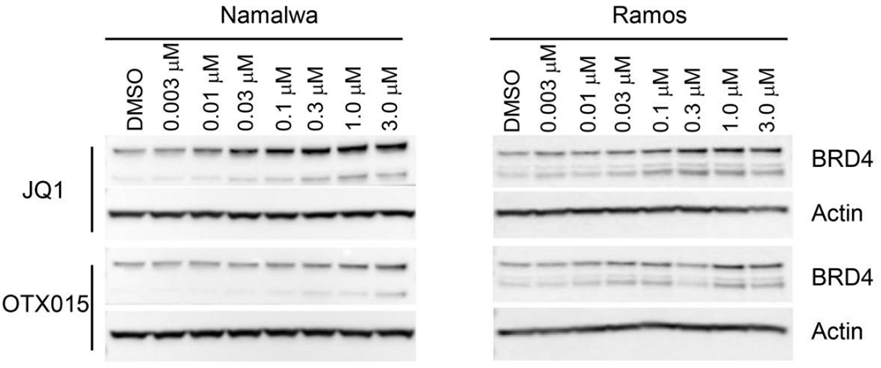
| Western blot | BRD4 c-Myc JAK2 / p-STAT5 / STAT5 / p-STAT3 / c-Myc / PIM1 / CDK6 / HEXIM1 / p27 / p21 / Bcl-xL / γH2AX ZO-1 / Vimentin |
|
26051217 |
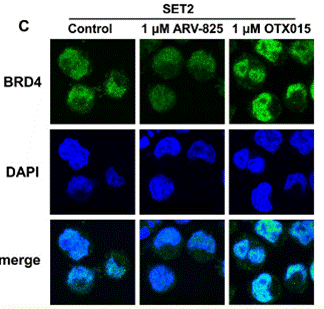
| Immunofluorescence | BRD4 Vimentin |
|
28042144 |
Klinische Studieninformationen
(Daten von https://clinicaltrials.gov, aktualisiert am 2024-05-22)
| NCT-Nummer | Rekrutierung | Erkrankungen | Sponsor/Kooperationspartner | Startdatum | Phasen |
|---|---|---|---|---|---|
| NCT02698176 | Terminated | NUT Midline Carcinoma (NMC)|Triple Negative Breast Cancer (TNBC)|Non-small Cell Lung Cancer (NSCLC)|Castration-resistant Prostate Cancer (CRPC) |
Merck Sharp & Dohme LLC |
May 4 2016 | Phase 1 |
| NCT02698189 | Terminated | AML Including AML de Novo and AML Secondary to MDS|DLBCL |
Merck Sharp & Dohme LLC |
May 19 2016 | Phase 1 |
| NCT02296476 | Terminated | Glioblastoma Multiforme |
Oncoethix GmbH a subsidiary of Merck & Co. Inc. (Rahway New Jersey USA) |
October 29 2014 | Phase 2 |
| NCT02259114 | Completed | NUT Midline Carcinoma|Triple Negative Breast Cancer|Non-small Cell Lung Cancer With Rearranged ALK Gene/Fusion Protein or KRAS Mutation|Castrate-resistant Prostate Cancer|CRPC|Pancreatic Ductal Adenocarcinoma |
Oncoethix GmbH a subsidiary of Merck & Co. Inc. (Rahway New Jersey USA) |
October 23 2014 | Phase 1 |
| NCT01713582 | Completed | Acute Myeloid Leukemia|Diffuse Large B-cell Lymphoma|Acute Lymphoblastic Leukemia|Multiple Myeloma |
Oncoethix GmbH a subsidiary of Merck & Co. Inc. (Rahway New Jersey USA) |
December 14 2012 | Phase 1 |
Technischer Support
Tel: +1-832-582-8158 Ext:3
Wenn Sie weitere Fragen haben, hinterlassen Sie bitte eine Nachricht.

Produkte sind nur für Forschungszwecke bestimmt. Nicht für den menschlichen Gebrauch. Wir verkaufen nicht an Patienten.
©Copyright 2013 Selleck Chemicals. Alle Rechte vorbehalten.