
nur für Forschungszwecke
Apabetalone (RVX-208) BET Inhibitor
Kat.-Nr.S7295
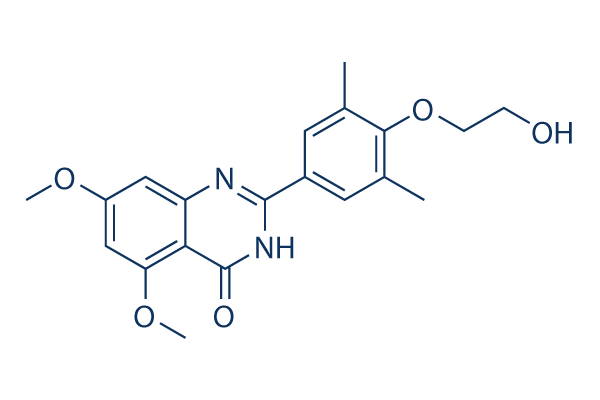
Chemische Struktur
Molekulargewicht: 370.4
Qualitätskontrolle
Zellkultur, Behandlung & Arbeitskonzentration
| Zelllinien | Assay-Typ | Konzentration | Inkubationszeit | Formulierung | Aktivitätsbeschreibung | PMID |
|---|---|---|---|---|---|---|
| HepG2 | Function assay | ~60 μM | DMSO | induces apoA-I mRNA and de novo synthesis of apoA-I. | 20513599 | |
| U2OS | Function assay | ~5 μM | displaces BET proteins from chromatin | 24248379 | ||
| BL21(DE3)-R3-pRARE2 | Function assay | Inhibition of recombinant human His6-tagged BRD4 bromodomain 2 expressed in Escherichia coli BL21(DE3)-R3-pRARE2 cells preincubated for 30 mins followed by HSGRGK(Ac)GGK(Ac)GLGK(Ac)GGAK(Ac)RHRK(Biotin)-OH peptide substrate addition after 30 mins by alphas, Kd = 0.135 μM. | 28195723 | |||
| BL21(DE3) | Function assay | Binding affinity to human BRD4 bromodomain 2 expressed in Escherichia coli BL21 (DE3) cells by isothermal titration calorimetry, Kd = 0.14 μM. | 26367539 | |||
| BL21(DE3)-R3-pRARE2 | Function assay | Inhibition of recombinant human His6-tagged BRD3 bromodomain 2 expressed in Escherichia coli BL21(DE3)-R3-pRARE2 cells, Kd = 0.195 μM. | 28195723 | |||
| BL21(DE3) | Function assay | Binding affinity to human BRD2 bromodomain 2 expressed in Escherichia coli BL21 (DE3) cells by isothermal titration calorimetry, Kd = 0.25 μM. | 26367539 | |||
| BL21(DE3)-R3-pRARE2 | Function assay | Inhibition of recombinant human His6-tagged BRD2 bromodomain 2 expressed in Escherichia coli BL21(DE3)-R3-pRARE2 cells, Kd = 0.251 μM. | 28195723 | |||
| BL21(DE3) | Function assay | Binding affinity to human BRD4 bromodomain 1 expressed in Escherichia coli BL21 (DE3) cells by isothermal titration calorimetry, Kd = 1.1 μM. | 26367539 | |||
| BL21(DE3)-R3-pRARE2 | Function assay | Inhibition of recombinant human His6-tagged BRD4 bromodomain 1 expressed in Escherichia coli BL21(DE3)-R3-pRARE2 cells preincubated for 30 mins followed by H4K5acK8acK12acK16ac peptide substrate addition after 30 mins by alphascreen assay, Kd = 1.142 μM. | 28195723 | |||
| SAE | Function assay | 24 hrs | Inhibition of BRD4 in human SAE cells assessed as reduction in TLR3 agonist poly(I:C) -induced ISG54 RNA expression preincubated for 24 hrs followed by poly(I:C) addition and measured after 4 hrs by SYBR green dye-based qRT-PCR analysis, IC50 = 2.63 μM. | 29649741 | ||
| SAE | Function assay | 24 hrs | Inhibition of BRD4 in human SAE cells assessed as reduction in TLR3 agonist poly(I:C) -induced ISG56 RNA expression preincubated for 24 hrs followed by poly(I:C) addition and measured after 4 hrs by SYBR green dye-based qRT-PCR analysis, IC50 = 2.74 μM. | 29649741 | ||
| SAE | Function assay | 24 hrs | Inhibition of BRD4 in human SAE cells assessed as reduction in TLR3 agonist poly(I:C) -induced grobeta RNA expression preincubated for 24 hrs followed by poly(I:C) addition and measured after 4 hrs by SYBR green dye-based qRT-PCR analysis, IC50 = 3.73 μM. | 29649741 | ||
| SAE | Function assay | 24 hrs | Inhibition of BRD4 in human SAE cells assessed as reduction in TLR3 agonist poly(I:C) -induced IL-8 RNA expression preincubated for 24 hrs followed by poly(I:C) addition and measured after 4 hrs by SYBR green dye-based qRT-PCR analysis, IC50 = 3.85 μM. | 29649741 | ||
| BL21(DE3)-R3-pRARE2 | Function assay | Inhibition of recombinant human His6-tagged BRD3 bromodomain 1 expressed in Escherichia coli BL21(DE3)-R3-pRARE2 cells, Kd = 4.065 μM. | 28195723 | |||
| MV4-11 | Antiproliferative assay | 72 hrs | Antiproliferative activity against human MV4-11 cells after 72 hrs by MTT assay, IC50 = 4.48 μM. | 28765013 | ||
| BL21(DE3)-R3-pRARE2 | Function assay | Inhibition of recombinant human His6-tagged BRD2 bromodomain 1 expressed in Escherichia coli BL21(DE3)-R3-pRARE2 cells, Kd = 5.78 μM. | 28195723 | |||
| BL21(DE3) | Function assay | Binding affinity to human BRD2 bromodomain 1 expressed in Escherichia coli BL21 (DE3) cells by isothermal titration calorimetry, Kd = 5.8 μM. | 26367539 | |||
| OCI-AML3 | Antiproliferative assay | 72 hrs | Antiproliferative activity against human OCI-AML3 cells after 72 hrs by MTT assay, IC50 = 7.17 μM. | 28765013 | ||
| OCI-AML2 | Antiproliferative assay | 72 hrs | Antiproliferative activity against human OCI-AML2 cells after 72 hrs by MTT assay, IC50 = 8.31 μM. | 28765013 | ||
| MCF7 | Autophagy assay | 150 uM | Induction of autophagy in human MCF7 cells assessed as downregulation of p62/SQSTM1 expression at 150 uM by Western blot analysis | 29172540 | ||
| MDA-MB-231 | Autophagy assay | 150 uM | Induction of autophagy in human MDA-MB-231 cells assessed as downregulation of p62/SQSTM1 expression at 150 uM by Western blot analysis | 29172540 | ||
| Klicken Sie hier, um weitere experimentelle Daten zu Zelllinien anzuzeigen | ||||||
Chemische Informationen, Lagerung & Stabilität
| Molekulargewicht | 370.4 | Formel | C20H22N2O5 |
Lagerung (Ab dem Eingangsdatum) | |
|---|---|---|---|---|---|
| CAS-Nr. | 1044870-39-4 | SDF herunterladen | Lagerung von Stammlösungen |
|
|
| Synonyme | RVX-000222 | Smiles | CC1=CC(=CC(=C1OCCO)C)C2=NC3=C(C(=CC(=C3)OC)OC)C(=O)N2 | ||
Löslichkeit
|
In vitro |
DMSO
: 74 mg/mL
(199.78 mM)
Water : Insoluble Ethanol : Insoluble |
Molaritätsrechner
|
In vivo |
|||||
In-vivo-Formulierungsrechner (Klare Lösung)
Schritt 1: Geben Sie die untenstehenden Informationen ein (Empfohlen: Ein zusätzliches Tier zur Berücksichtigung von Verlusten während des Experiments)
Schritt 2: Geben Sie die In-vivo-Formulierung ein (Dies ist nur der Rechner, keine Formulierung. Bitte kontaktieren Sie uns zuerst, wenn es im Abschnitt "Löslichkeit" keine In-vivo-Formulierung gibt.)
Berechnungsergebnisse:
Arbeitskonzentration: mg/ml;
Methode zur Herstellung der DMSO-Stammlösung: mg Wirkstoff vorgelöst in μL DMSO ( Konzentration der Stammlösung mg/mL, Bitte kontaktieren Sie uns zuerst, wenn die Konzentration die DMSO-Löslichkeit der Wirkstoffcharge überschreitet. )
Methode zur Herstellung der In-vivo-Formulierung: Nehmen Sie μL DMSO Stammlösung, dann hinzufügenμL PEG300, mischen und klären, dann hinzufügenμL Tween 80, mischen und klären, dann hinzufügen μL ddH2O, mischen und klären.
Methode zur Herstellung der In-vivo-Formulierung: Nehmen Sie μL DMSO Stammlösung, dann hinzufügen μL Maisöl, mischen und klären.
Hinweis: 1. Bitte stellen Sie sicher, dass die Flüssigkeit klar ist, bevor Sie das nächste Lösungsmittel hinzufügen.
2. Achten Sie darauf, das/die Lösungsmittel der Reihe nach hinzuzufügen. Sie müssen sicherstellen, dass die bei der vorherigen Zugabe erhaltene Lösung eine klare Lösung ist, bevor Sie mit der Zugabe des nächsten Lösungsmittels fortfahren. Physikalische Methoden wie Vortex, Ultraschall oder ein heißes Wasserbad können zur Unterstützung des Lösens verwendet werden.
Wirkmechanismus
| Merkmale |
First-in-class BD2-selective inhibitor of BET bromodomain and has been tested in Phase II clinical trials for treatment of coronary syndromes and atherosclerosis.
|
|---|---|
| Targets/IC50/Ki |
BD2
(Cell-free assay) 0.51 μM
|
| In vitro |
Apabetalone (RVX-208), ein BET Bromodomain-Inhibitor, bindet bevorzugt an die zweite Bromodomäne, die auf BET-Proteinen gefunden wird. Als Stimulator der Apolipoprotein (APO) AI-Genexpression erhöht es apoA-I und HDL-C in vitro.
|
| In vivo |
Apabetalone (RVX-208) erhöht signifikant Serum-apoA-I und HDL-C in AGMs und verbessert den Cholesterinefflux über verschiedene Wege.
|
Literatur |
|
Anwendungen
| Methoden | Biomarker | Bilder | PMID |
|---|---|---|---|
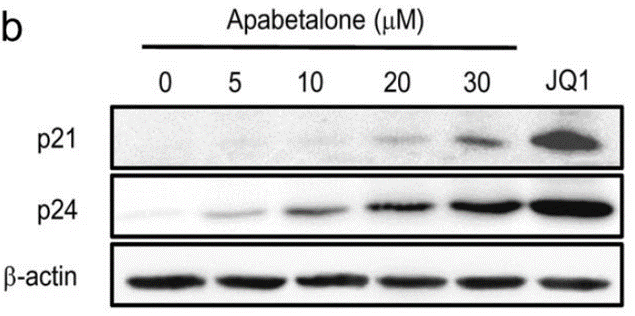
| Western blot | p21 / p24 / β-actin cyclin D1 / CDK4 / CDK6 / p24 / β-actin Rb / p-Rb(S780) / p-Rb(S795) / p-Rb(S807/811) / β-actin Cyclin T1 / CDK9-55kDa / CDK9-42kDa / p-CDK9 / CTD / CTD-Ser2P / p24 / β-actin Phospho-RelA / Total-RelA / Actin / BRD2 / α-Tubulin |
|
29789664 |
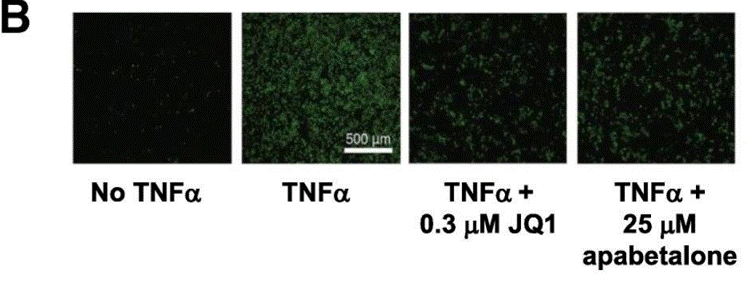
| Immunofluorescence | monocyte adhesion DNA SARS-CoV-2 CTNT |
|
31300040 |
Klinische Studieninformationen
(Daten von https://clinicaltrials.gov, aktualisiert am 2024-05-22)
| NCT-Nummer | Rekrutierung | Erkrankungen | Sponsor/Kooperationspartner | Startdatum | Phasen |
|---|---|---|---|---|---|
| NCT03160430 | Not yet recruiting | Kidney Failure Chronic |
Resverlogix Corp |
November 22 2024 | Phase 1|Phase 2 |
| NCT03228940 | Withdrawn | Fabry Disease |
Resverlogix Corp |
November 22 2022 | Phase 1|Phase 2 |
| NCT01863225 | Terminated | Dyslipidemia|Coronary Artery Disease |
Resverlogix Corp|South Australian Health and Medical Research Institute |
May 2013 | Phase 2 |
| NCT01728467 | Completed | Diabetes |
Resverlogix Corp|Baker Heart and Diabetes Institute|Nucleus Network Ltd |
November 2012 | Phase 2 |
| NCT01067820 | Completed | Coronary Artery Disease |
Resverlogix Corp|The Cleveland Clinic |
September 2011 | Phase 2 |
| NCT01423188 | Completed | Coronary Artery Disease|Dyslipidemia |
Resverlogix Corp|The Cleveland Clinic |
August 2011 | Phase 2 |
Technischer Support
Tel: +1-832-582-8158 Ext:3
Wenn Sie weitere Fragen haben, hinterlassen Sie bitte eine Nachricht.

Produkte sind nur für Forschungszwecke bestimmt. Nicht für den menschlichen Gebrauch. Wir verkaufen nicht an Patienten.
©Copyright 2013 Selleck Chemicals. Alle Rechte vorbehalten.