
nur für Forschungszwecke
Molibresib (I-BET-762) BET Inhibitor
Kat.-Nr.S7189
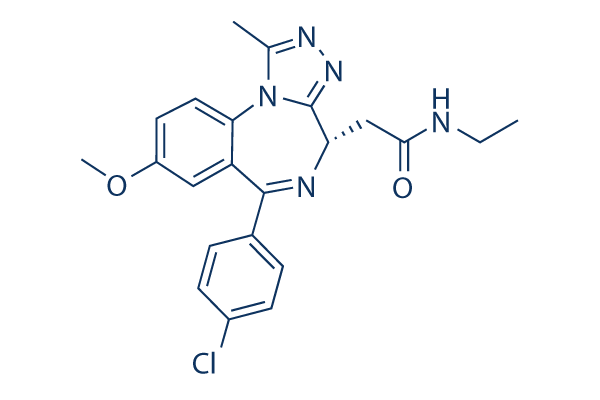
Chemische Struktur
Molekulargewicht: 423.9
Qualitätskontrolle
Zellkultur, Behandlung & Arbeitskonzentration
| Zelllinien | Assay-Typ | Konzentration | Inkubationszeit | Formulierung | Aktivitätsbeschreibung | PMID |
|---|---|---|---|---|---|---|
| HepG2 | Function assay | 18 hrs | Induction of human ApoA1 gene expression in stably transfected human HepG2 cells coexpressing luciferase reporter gene after 18 hrs by luminescence assay, EC50 = 0.7 μM. | 21568322 | ||
| HepG2 | Function assay | 6 hrs | Induction of human ApoA1 protein synthesis in human HepG2 cells assessed as neosynthesised radiolabeled protein secretion after 6 hrs by SDS PAGE analysis in presence of [35S]methionine | 21568322 | ||
| HepG2 | Function assay | 18 hrs | Upregulation of ApoA1 expression in human HepG2 cells assessed as concentration required to increase 70% of luciferase activity after 18 hrs by luciferase reporter gene assay, EC170 = 0.2 μM. | 22386529 | ||
| HepG2 | Function assay | 18 hrs | Induction of human ApoA1 gene expression in stably transfected human HepG2 cells coexpressing luciferase reporter gene after 18 hrs by luminescence assay, EC50 = 0.7 μM. | 22924434 | ||
| PBMC | Antiinflammatory assay | Antiinflammatory activity against human PBMC cells assessed as LPS-induced IL-6 production by chemiluminescence assay, IC50 = 0.31623 μM. | 24015967 | |||
| Raji | Function assay | 4 hrs | Inhibition of BRD4 in human Raji cells assessed as reduction of MYC expression after 4 hrs, IC50 = 0.19 μM. | 24900758 | ||
| Rosetta2 DE3 | Function assay | 30 mins | Displacement of FAM-labeled ZBA248 from BRD3 BD2 (306 to 417 amino acid residues) (unknown origin) expressed in Rosetta2 DE3 cells after 30 mins by fluorescence polarization assay, Ki = 0.0303 μM. | 26080064 | ||
| Rosetta2 DE3 | Function assay | 30 mins | Displacement of FAM-labeled ZBA248 from BRD4 BD2 (333 to 460 amino acid residues) (unknown origin) expressed in Rosetta2 DE3 cells after 30 mins by fluorescence polarization assay, Ki = 0.0323 μM. | 26080064 | ||
| Rosetta2 DE3 | Function assay | 30 mins | Displacement of FAM-labeled ZBA248 from BRD4 BD1 (44 to 168 amino acid residues) (unknown origin) expressed in Rosetta2 DE3 cells after 30 mins by fluorescence polarization assay, Ki = 0.0388 μM. | 26080064 | ||
| Rosetta2 DE3 | Function assay | Binding affinity to biotinylated BRD3 BD2 (306 to 417 amino acid residues) (unknown origin) expressed in Rosetta2 DE3 cells by bio-layer interferometry method, Kd = 0.0407 μM. | 26080064 | |||
| Rosetta2 DE3 | Function assay | Binding affinity to biotinylated BRD2 BD2 (349 to 460 amino acid residues) (unknown origin) expressed in Rosetta2 DE3 cells by bio-layer interferometry method, Kd = 0.0454 μM. | 26080064 | |||
| Rosetta2 DE3 | Function assay | Binding affinity to biotinylated BRD4 BD2 (333 to 460 amino acid residues) (unknown origin) expressed in Rosetta2 DE3 cells by bio-layer interferometry method, Kd = 0.0476 μM. | 26080064 | |||
| Rosetta2 DE3 | Function assay | 30 mins | Displacement of FAM-labeled ZBA248 from BRD2 BD2 (349 to 460 amino acid residues) (unknown origin) expressed in Rosetta2 DE3 cells after 30 mins by fluorescence polarization assay, Ki = 0.0492 μM. | 26080064 | ||
| Rosetta2 DE3 | Function assay | 30 mins | Displacement of FAM-labeled ZBA248 from BRD3 BD1 (24 to 144 amino acid residues) (unknown origin) expressed in Rosetta2 DE3 cells after 30 mins by fluorescence polarization assay, Ki = 0.0539 μM. | 26080064 | ||
| Rosetta2 DE3 | Function assay | 30 mins | Displacement of FAM-labeled ZBA248 from BRD2 BD1 (72 to 205 amino acid residues) (unknown origin) expressed in Rosetta2 DE3 cells after 30 mins by fluorescence polarization assay, Ki = 0.0568 μM. | 26080064 | ||
| Rosetta2 DE3 | Function assay | Binding affinity to biotinylated BRD3 BD1 (24 to 144 amino acid residues) (unknown origin) expressed in Rosetta2 DE3 cells by bio-layer interferometry method, Kd = 0.0607 μM. | 26080064 | |||
| MV4-11 | Cytotoxicity assay | 4 days | Cytotoxicity against human MV4-11 cells harboring MLL1 fusion gene assessed as growth inhibition after 4 days by CellTiter-Glo luminescent assay, IC50 = 0.093 μM. | 26080064 | ||
| Rosetta2 DE3 | Function assay | 30 mins | Displacement of FAM-labeled ZBA248 from BRD4 BD2 (333 to 460 amino acid residues) (unknown origin) expressed in Rosetta2 DE3 cells after 30 mins by fluorescence polarization assay, IC50 = 0.0984 μM. | 26080064 | ||
| Rosetta2 DE3 | Function assay | Binding affinity to biotinylated BRD4 BD1 (44 to 168 amino acid residues) (unknown origin) expressed in Rosetta2 DE3 cells by bio-layer interferometry method, Kd = 0.0994 μM. | 26080064 | |||
| Rosetta2 DE3 | Function assay | 30 mins | Displacement of FAM-labeled ZBA248 from BRD4 BD1 (44 to 168 amino acid residues) (unknown origin) expressed in Rosetta2 DE3 cells after 30 mins by fluorescence polarization assay, IC50 = 0.156 μM. | 26080064 | ||
| Rosetta2 DE3 | Function assay | Binding affinity to biotinylated BRD2 BD1 (72 to 205 amino acid residues) (unknown origin) expressed in Rosetta2 DE3 cells by bio-layer interferometry method, Kd = 0.159 μM. | 26080064 | |||
| MOLM13 | Cytotoxicity assay | 4 days | Cytotoxicity against human MOLM13 cells harboring MLL1 fusion gene assessed as growth inhibition after 4 days by CellTiter-Glo luminescent assay, IC50 = 0.241 μM. | 26080064 | ||
| BL21(DE3) | Function assay | Binding affinity to N-terminal His6-tagged-BRD4 bromodomain 2 (unknown origin) expressed in competent Escherichia coli BL21(DE3) cells by isothermal titration calorimetry, Kd = 0.065 μM. | 26367539 | |||
| BL21(DE3) | Function assay | Binding affinity to N-terminal His6-tagged-BRD4 bromodomain 1 (unknown origin) expressed in competent Escherichia coli BL21(DE3) cells by isothermal titration calorimetry, Kd = 0.095 μM. | 26367539 | |||
| BL21(DE3) | Function assay | Binding affinity to full length N-terminal His6-tagged-BRD2 bromodomain 2 (unknown origin) expressed in competent Escherichia coli BL21(DE3) cells by isothermal titration calorimetry, Kd = 0.1 μM. | 26367539 | |||
| BL21(DE3) | Function assay | Binding affinity to full length N-terminal His6-tagged-BRD2 bromodomain 1 (unknown origin) expressed in competent Escherichia coli BL21(DE3) cells by isothermal titration calorimetry, Kd = 0.23 μM. | 26367539 | |||
| BL21(DE3)-R3-pRARE2 | Function assay | Inhibition of human His-tagged BRD4 bromodomain 2 expressed in Escherichia coli BL21(DE3)-R3-pRARE2 cells by FRET assay, IC50 = 0.036 μM. | 26731490 | |||
| BL21(DE3)-R3-pRARE2 | Function assay | Inhibition of human His-tagged BRD4 bromodomain 1 expressed in Escherichia coli BL21(DE3)-R3-pRARE2 cells by FRET assay, IC50 = 0.036 μM. | 26731490 | |||
| Rosetta2 DE3 | Function assay | 30 mins | Inhibition of FAM-labeled ZBA248 binding to recombinant human N-terminal His6-tagged BRD4 bromodomain 2 (333 to 460 residues) expressed in Rosetta2 DE3 cells after 30 mins by Flourescence polarization assay, Ki = 0.023 μM. | 28463487 | ||
| Rosetta2 DE3 | Function assay | 30 mins | Inhibition of FAM-labeled ZBA248 binding to recombinant human N-terminal His6-tagged BRD4 bromodomain 1 (44 to 168 residues) expressed in Rosetta2 DE3 cells after 30 mins by Flourescence polarization assay, Ki = 0.0464 μM. | 28463487 | ||
| Rosetta2 DE3 | Function assay | 30 mins | Inhibition of FAM-labeled ZBA248 binding to recombinant human N-terminal His6-tagged BRD4 bromodomain 2 (333 to 460 residues) expressed in Rosetta2 DE3 cells after 30 mins by Flourescence polarization assay, IC50 = 0.0775 μM. | 28463487 | ||
| MV4-11 | Growth inhibition assay | 4 days | Growth inhibition of human MV4-11 cells after 4 days by WST-8 assay, IC50 = 0.093 μM. | 28463487 | ||
| Rosetta2 DE3 | Function assay | 30 mins | Inhibition of FAM-labeled ZBA248 binding to recombinant human N-terminal His6-tagged BRD4 bromodomain 1 (44 to 168 residues) expressed in Rosetta2 DE3 cells after 30 mins by Flourescence polarization assay, IC50 = 0.145 μM. | 28463487 | ||
| MOLM13 | Growth inhibition assay | 4 days | Growth inhibition of human MOLM13 cells after 4 days by WST-8 assay, IC50 = 0.241 μM. | 28463487 | ||
| TY82 | Antiproliferative assay | 72 hrs | Antiproliferative activity against human TY82 cells after 72 hrs by CCK8 assay, IC50 = 0.2 μM. | 28586718 | ||
| MM1S | Antiproliferative assay | 72 hrs | Antiproliferative activity against human MM1S cells after 72 hrs by CCK8 assay, IC50 = 0.23 μM. | 28586718 | ||
| BL21 (DE3)-codon plus-RIL | Function assay | 4 hrs | Inhibition of JQ1-FITC binding to His6-tagged BRD4-BD1 (unknown origin) expressed in Escherichia coli BL21 (DE3)-codon plus-RIL cells incubated in dark for 4 hrs by fluorescence anisotropy assay, IC50 = 0.26 μM. | 28586718 | ||
| THP1 | Antiproliferative assay | Antiproliferative activity against human THP1 cells, IC50 = 0.29 μM. | 28939121 | |||
| TY82 | Antiproliferative assay | Antiproliferative activity against human TY82 cells, IC50 = 0.39 μM. | 28939121 | |||
| NALM16 | Cytotoxicity assay | 5 days | Cytotoxicity against human NALM16 cells assessed as reduction in cell viability after 5 days by CellTiter-Glo assay, EC50 = 0.27 μM. | 29170024 | ||
| NALM6 | Cytotoxicity assay | 5 days | Cytotoxicity against human NALM6 cells assessed as reduction in cell viability after 5 days by CellTiter-Glo assay, EC50 = 0.39 μM. | 29170024 | ||
| 697 | Cytotoxicity assay | 5 days | Cytotoxicity against human 697 cells assessed as reduction in cell viability after 5 days by CellTiter-Glo assay, EC50 = 1.17 μM. | 29170024 | ||
| HD-MB03 | Cytotoxicity assay | 5 days | Cytotoxicity against human HD-MB03 cells assessed as reduction in cell viability after 5 days by CellTiter-Glo assay, EC50 = 3.5 μM. | 29170024 | ||
| A673 | qHTS assay | qHTS of pediatric cancer cell lines to identify multiple opportunities for drug repurposing: Primary screen for A673 cells | 29435139 | |||
| DAOY | qHTS assay | qHTS of pediatric cancer cell lines to identify multiple opportunities for drug repurposing: Primary screen for DAOY cells | 29435139 | |||
| Saos-2 | qHTS assay | qHTS of pediatric cancer cell lines to identify multiple opportunities for drug repurposing: Primary screen for Saos-2 cells | 29435139 | |||
| BT-37 | qHTS assay | qHTS of pediatric cancer cell lines to identify multiple opportunities for drug repurposing: Primary screen for BT-37 cells | 29435139 | |||
| RD | qHTS assay | qHTS of pediatric cancer cell lines to identify multiple opportunities for drug repurposing: Primary screen for RD cells | 29435139 | |||
| MG 63 (6-TG R) | qHTS assay | qHTS of pediatric cancer cell lines to identify multiple opportunities for drug repurposing: Primary screen for MG 63 (6-TG R) cells | 29435139 | |||
| NB1643 | qHTS assay | qHTS of pediatric cancer cell lines to identify multiple opportunities for drug repurposing: Primary screen for NB1643 cells | 29435139 | |||
| OHS-50 | qHTS assay | qHTS of pediatric cancer cell lines to identify multiple opportunities for drug repurposing: Primary screen for OHS-50 cells | 29435139 | |||
| Rh41 | qHTS assay | qHTS of pediatric cancer cell lines to identify multiple opportunities for drug repurposing: Primary screen for Rh41 cells | 29435139 | |||
| SJ-GBM2 | qHTS assay | qHTS of pediatric cancer cell lines to identify multiple opportunities for drug repurposing: Primary screen for SJ-GBM2 cells | 29435139 | |||
| SK-N-MC | qHTS assay | qHTS of pediatric cancer cell lines to identify multiple opportunities for drug repurposing: Primary screen for SK-N-MC cells | 29435139 | |||
| NB-EBc1 | qHTS assay | qHTS of pediatric cancer cell lines to identify multiple opportunities for drug repurposing: Primary screen for NB-EBc1 cells | 29435139 | |||
| LAN-5 | qHTS assay | qHTS of pediatric cancer cell lines to identify multiple opportunities for drug repurposing: Primary screen for LAN-5 cells | 29435139 | |||
| TY82 | Antiproliferative assay | 72 hrs | Antiproliferative activity against human TY82 cells after 72 hrs by CCK8 assay, IC50 = 0.3043 μM. | 29525435 | ||
| MM1S | Antiproliferative assay | 72 hrs | Antiproliferative activity against human MM1S cells after 72 hrs by CCK8 assay, IC50 = 0.3492 μM. | 29525435 | ||
| TY82 | Function assay | 0.2 to 1 uM | 24 hrs | Inhibition of BRD4 in human TY82 cells assessed as reduction in c-Myc protein expression at 0.2 to 1 uM after 24 hrs by Western blot analysis | 29525435 | |
| TY82 | Function assay | 0.2 to 1 uM | 24 hrs | Inhibition of BRD4 in human TY82 cells assessed as reduction in c-Myc mRNA expression at 0.2 to 1 uM after 24 hrs by RT-PCR analysis | 29525435 | |
| TY82 or NCI-H1299 | Function assay | 0.2 to 1 uM | 24 hrs | Inhibition of BRD4 in human TY82 or NCI-H1299 cells assessed as reduction in PD-L1 protein expression at 0.2 to 1 uM after 24 hrs by Western blot analysis | 29525435 | |
| TY82 or NCI-H1299 | Function assay | 0.2 to 1 uM | 24 hrs | Inhibition of BRD4 in human TY82 or NCI-H1299 cells assessed as reduction in PD-L1 mRNA expression at 0.2 to 1 uM after 24 hrs by RT-PCR analysis | 29525435 | |
| C4-2B | Antiproliferative assay | 96 hrs | Antiproliferative activity against human C4-2B cells after 96 hrs by Cell-Titer glo reagent based luminescence assay | 29541371 | ||
| 22Rv1 | Antiproliferative assay | 96 hrs | Antiproliferative activity against human 22Rv1 cells after 96 hrs by Cell-Titer glo reagent based luminescence assay | 29541371 | ||
| LNCAP | Antiproliferative assay | 96 hrs | Antiproliferative activity against human LNCAP cells after 96 hrs by Cell-Titer glo reagent based luminescence assay | 29541371 | ||
| HL60 | Cytotoxicity assay | Cytotoxicity against human HL60 cells by MTS assay, IC50 = 0.12 μM. | 29657099 | |||
| Raji | Function assay | Inhibition of BRD4-BD1 in human Raji cells assessed as downregulation of MYC gene expression by PCR method, IC50 = 0.132 μM. | 29657099 | |||
| LNCAP | Antiproliferative assay | Antiproliferative activity against human LNCAP cells, IC50 = 0.3565 μM. | 29758518 | |||
| MV411 | Cytotoxicity assay | 72 hrs | Cytotoxicity against human MV411 cells after 72 hrs by CellTiter-Glo assay, IC50 = 0.8 μM. | 30268702 | ||
| Klicken Sie hier, um weitere experimentelle Daten zu Zelllinien anzuzeigen | ||||||
Chemische Informationen, Lagerung & Stabilität
| Molekulargewicht | 423.9 | Formel | C22H22ClN5O2 |
Lagerung (Ab dem Eingangsdatum) | |
|---|---|---|---|---|---|
| CAS-Nr. | 1260907-17-2 | SDF herunterladen | Lagerung von Stammlösungen |
|
|
| Synonyme | GSK525762, GSK525762A | Smiles | CCNC(=O)CC1C2=NN=C(N2C3=C(C=C(C=C3)OC)C(=N1)C4=CC=C(C=C4)Cl)C | ||
Löslichkeit
|
In vitro |
DMSO
: 84 mg/mL
(198.15 mM)
Ethanol : 42 mg/mL Water : Insoluble |
Molaritätsrechner
|
In vivo |
|||||
In-vivo-Formulierungsrechner (Klare Lösung)
Schritt 1: Geben Sie die untenstehenden Informationen ein (Empfohlen: Ein zusätzliches Tier zur Berücksichtigung von Verlusten während des Experiments)
Schritt 2: Geben Sie die In-vivo-Formulierung ein (Dies ist nur der Rechner, keine Formulierung. Bitte kontaktieren Sie uns zuerst, wenn es im Abschnitt "Löslichkeit" keine In-vivo-Formulierung gibt.)
Berechnungsergebnisse:
Arbeitskonzentration: mg/ml;
Methode zur Herstellung der DMSO-Stammlösung: mg Wirkstoff vorgelöst in μL DMSO ( Konzentration der Stammlösung mg/mL, Bitte kontaktieren Sie uns zuerst, wenn die Konzentration die DMSO-Löslichkeit der Wirkstoffcharge überschreitet. )
Methode zur Herstellung der In-vivo-Formulierung: Nehmen Sie μL DMSO Stammlösung, dann hinzufügenμL PEG300, mischen und klären, dann hinzufügenμL Tween 80, mischen und klären, dann hinzufügen μL ddH2O, mischen und klären.
Methode zur Herstellung der In-vivo-Formulierung: Nehmen Sie μL DMSO Stammlösung, dann hinzufügen μL Maisöl, mischen und klären.
Hinweis: 1. Bitte stellen Sie sicher, dass die Flüssigkeit klar ist, bevor Sie das nächste Lösungsmittel hinzufügen.
2. Achten Sie darauf, das/die Lösungsmittel der Reihe nach hinzuzufügen. Sie müssen sicherstellen, dass die bei der vorherigen Zugabe erhaltene Lösung eine klare Lösung ist, bevor Sie mit der Zugabe des nächsten Lösungsmittels fortfahren. Physikalische Methoden wie Vortex, Ultraschall oder ein heißes Wasserbad können zur Unterstützung des Lösens verwendet werden.
Wirkmechanismus
| Targets/IC50/Ki |
BET proteins
(Cell-free assay) 35 nM
|
|---|---|
| In vitro |
Molibresib (I-BET-762) ist ein Inhibitor für BET (Bromodomänen und extra-terminale Domäne)-Proteine, BRD2, BRD3 und BRD4, das an die Tandem-Bromodomänen von BET mit einem Kd von 50,5–61,3 nM bindet und ein tetra-acetyliertes H4-Peptid, das an Tandem-Bromodomänen von BET vorabgebunden ist, mit einer IC50 von 32,5–42,5 nM in der FRET-Analyse verdrängt. Diese Verbindung besetzt die Acetyllysin-Bindetasche von BET-Proteinen und hemmt deren Bindung an acetylierte Histone, wodurch die Bildung von Chromatin-Komplexen, die für die Expression entzündlicher Gene essentiell sind, gestört wird. Die Behandlung damit während der ersten 2 Tage der Differenzierung verändert die Zytokinproduktion von CD4+-T-Zellen, wobei die Expression mehrerer entzündungshemmender Genprodukte hochreguliert und die Expression mehrerer proinflammatorischer Zytokine herunterreguliert wird.
|
| Kinase-Assay |
Fluoreszenzresonanzenergietransfer (FRET)-Titrationen
|
|
Fluoreszenzresonanzenergietransfer (FRET)-Titrationen. Molibresib (I-BET-762) wird gegen BRD2 (200 nM), BRD3 (100 nM) und BRD4 (50 nM) in 50 mM HEPES pH 7,5, 50 mM NaCl, 0,5 mM CHAPS in Gegenwart von tetra-acetyliertem Histon H4-Peptid (200 nM) titriert. Nach 1-stündiger Äquilibrierung wird die Bromodomänenprotein-Peptid-Interaktion mittels FRET nach Zugabe von 2 nM Europium-Cryptat-markiertem Streptavidin und 10 nM XL-665-markiertem Anti-6His-Antikörper in Assay-Puffer, der 0,05 % (v/v) BSA und 400 mM KF enthält, detektiert. Die Platten werden mit einem Envision Plate Reader (Anregung 320 nm, Emission 615 nm und 665 nm) gelesen.
|
|
| In vivo |
Molibresib (I-BET-762) verleiht Schutz vor Lipopolysaccharid-induziertem Endotoxinschock und Bakterien-induzierter Sepsis. Eine Einzeldosis dieser Verbindung, 1,5 Stunden nach LPS-Injektion angewendet, heilt die Mäuse, und zweimal tägliche Injektionen über 2 Tage schützen sie vor dem Tod durch Sepsis. Eine begrenzte Behandlung damit ausschließlich während des frühen Primings hemmte die Fähigkeit von Th1-differenzierten 2D2 T-Zellen, Neuroinflammation in einem Mausmodell der experimentellen autoimmunen Enzephalomyelitis (EAE) zu induzieren.
|
Literatur |
|
Anwendungen
| Methoden | Biomarker | Bilder | PMID |
|---|---|---|---|
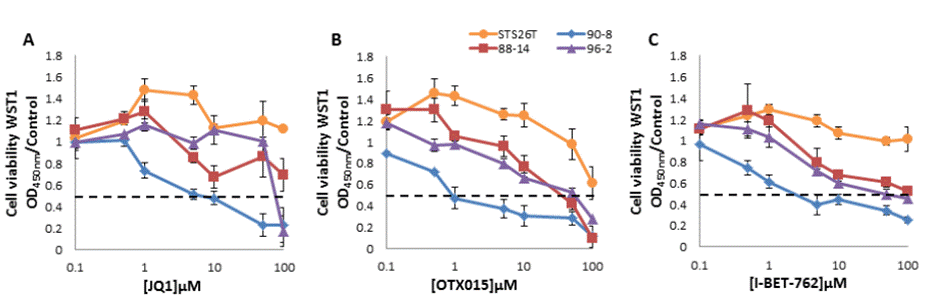
| Growth inhibition assay | Cell viability |
|
26840085 |
Klinische Studieninformationen
(Daten von https://clinicaltrials.gov, aktualisiert am 2024-05-22)
| NCT-Nummer | Rekrutierung | Erkrankungen | Sponsor/Kooperationspartner | Startdatum | Phasen |
|---|---|---|---|---|---|
| NCT03266159 | Withdrawn | Solid Tumours |
GlaxoSmithKline |
November 27 2017 | Phase 2 |
| NCT02964507 | Terminated | Neoplasms |
GlaxoSmithKline |
February 2 2017 | Phase 1 |
| NCT01943851 | Completed | Neoplasms |
GlaxoSmithKline |
May 14 2014 | Phase 2 |
| NCT01587703 | Completed | Carcinoma Midline |
GlaxoSmithKline |
March 28 2012 | Phase 1 |
Technischer Support
Tel: +1-832-582-8158 Ext:3
Wenn Sie weitere Fragen haben, hinterlassen Sie bitte eine Nachricht.

Produkte sind nur für Forschungszwecke bestimmt. Nicht für den menschlichen Gebrauch. Wir verkaufen nicht an Patienten.
©Copyright 2013 Selleck Chemicals. Alle Rechte vorbehalten.