
nur für Forschungszwecke
Dacomitinib EGFR Inhibitor
Kat.-Nr.S2727
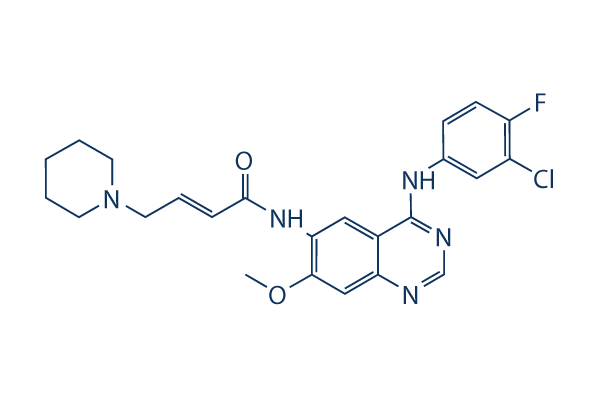
Chemische Struktur
Molekulargewicht: 469.94
Qualitätskontrolle
| Verwandte Ziele | VEGFR PDGFR FGFR c-Met Src MEK CSF-1R FLT3 HER2 c-Kit |
|---|---|
| Weitere EGFR Inhibitoren | Lazertinib (YH25448) Icotinib Hydrochloride Sunvozertinib AG-490 AG-1478 Canertinib (CI-1033) WZ4002 Rociletinib (CO-1686) Poziotinib (NOV120101, HM781-36B) Genistein |
Zellkultur, Behandlung & Arbeitskonzentration
| Zelllinien | Assay-Typ | Konzentration | Inkubationszeit | Formulierung | Aktivitätsbeschreibung | PMID |
|---|---|---|---|---|---|---|
| PC9 cells | Function assay | 2 h | Inhibition of EGFR exon 19 deletion activating mutant phosphorylation in human PC9 cells after 2 hrs by fluorescence assay, IC50=0.63 nM | 23930994 | ||
| human LoVo cells | Function assay | 2 h | Inhibition of wild type EGFR phosphorylation in human LoVo cells after 2 hrs by fluorescence assay, IC50=0.011 μM | 23930994 | ||
| human NCI-H1975 cells | Function assay | 2 h | Inhibition of EGFR L858R/T970M double mutant phosphorylation in human NCI-H1975 cells after 2 hrs by fluorescence assay, IC50=0.042 μM | 23930994 | ||
| human NCI-H1975 cells | Proliferation assay | Antiproliferative activity against human NCI-H1975 cells assessed as growth inhibition, GI50=0.1233 μM | 26310890 | |||
| Sf9 | Function assay | 6 mins | Irreversible inhibition of GST-tagged ERBB1 (unknown origin) (Met-668 to Ala-1211 residues) expressed in baculovirus infected Sf9 insect cells assessed as reduction in Glu/Tyr copolymer phosphorylation after 6 mins by ELISA, IC50 = 0.006 μM. | 27491023 | ||
| NIH/3T3 | Function assay | 2 hrs | Irreversible inhibition of full length human ERBB1 autophosphorylation transfected in EGF-stimulated mouse NIH/3T3 cells incubated for 2 hrs followed by stimulation with EGF for 10 mins, IC50 = 0.006 μM. | 27491023 | ||
| Sf9 | Function assay | 6 mins | Irreversible inhibition of GST-tagged ERBB2 (unknown origin) (Ile-675 to Val-1256 residues) expressed in baculovirus infected Sf9 insect cells assessed as reduction in Glu/Tyr copolymer phosphorylation after 6 mins by ELISA, IC50 = 0.046 μM. | 27491023 | ||
| Sf9 | Function assay | 6 mins | Irreversible inhibition of GST-tagged ERBB4 (unknown origin) (Gly-259 to Gly-690 residues) expressed in baculovirus infected Sf9 insect cells assessed as reduction in Glu/Tyr copolymer phosphorylation after 6 mins by ELISA, IC50 = 0.074 μM. | 27491023 | ||
| Sf9 | Function assay | 30 mins | Irreversible inhibition of human recombinant GST-tagged JAK3 expressed in baculovirus infected Sf9 insect cells assessed as reduction in polyglutamic acid-tyrosine phosphorylation after 30 mins by ELISA, IC50 = 3.57 μM. | 27491023 | ||
| NIH/3T3 | Function assay | 30 mg/kg | 2 days | In vivo inhibition of full length human ERBB1 autophosphorylation transfected in NIH/3T3 cells implanted in mouse at 30 mg/kg, po qd for 2 days measured 24 hrs post last dose by Western blot analysis | 27491023 | |
| insect cells | Function assay | Inhibition of GST-tagged human EGFR catalytic domain expressed in insect cells, IC50 = 0.006 μM. | 28754471 | |||
| NCI-H1819 | Antiproliferative assay | 72 hrs | Antiproliferative activity against human NCI-H1819 cells expressing wild type HER2 incubated for 72 hrs by MTS assay, IC50 = 0.029 μM. | 28754471 | ||
| insect cells | Function assay | Inhibition of GST-tagged human HER2 catalytic domain expressed in insect cells, IC50 = 0.0457 μM. | 28754471 | |||
| NCI-H1975 | Antiproliferative assay | 72 hrs | Antiproliferative activity against human NCI-H1975 cells expressing EGFR T790M/L858R mutant incubated for 72 hrs by MTS assay, IC50 = 0.44 μM. | 28754471 | ||
| Klicken Sie hier, um weitere experimentelle Daten zu Zelllinien anzuzeigen | ||||||
Chemische Informationen, Lagerung & Stabilität
| Molekulargewicht | 469.94 | Formel | C24H25ClFN5O2 |
Lagerung (Ab dem Eingangsdatum) | |
|---|---|---|---|---|---|
| CAS-Nr. | 1110813-31-4 | SDF herunterladen | Lagerung von Stammlösungen |
|
|
| Synonyme | PF299804,PF299 | Smiles | COC1=C(C=C2C(=C1)N=CN=C2NC3=CC(=C(C=C3)F)Cl)NC(=O)C=CCN4CCCCC4 | ||
Löslichkeit
|
In vitro |
DMSO
: 49 mg/mL
(104.26 mM)
Ethanol : 15 mg/mL Water : Insoluble |
Molaritätsrechner
|
In vivo |
|||||
In-vivo-Formulierungsrechner (Klare Lösung)
Schritt 1: Geben Sie die untenstehenden Informationen ein (Empfohlen: Ein zusätzliches Tier zur Berücksichtigung von Verlusten während des Experiments)
Schritt 2: Geben Sie die In-vivo-Formulierung ein (Dies ist nur der Rechner, keine Formulierung. Bitte kontaktieren Sie uns zuerst, wenn es im Abschnitt "Löslichkeit" keine In-vivo-Formulierung gibt.)
Berechnungsergebnisse:
Arbeitskonzentration: mg/ml;
Methode zur Herstellung der DMSO-Stammlösung: mg Wirkstoff vorgelöst in μL DMSO ( Konzentration der Stammlösung mg/mL, Bitte kontaktieren Sie uns zuerst, wenn die Konzentration die DMSO-Löslichkeit der Wirkstoffcharge überschreitet. )
Methode zur Herstellung der In-vivo-Formulierung: Nehmen Sie μL DMSO Stammlösung, dann hinzufügenμL PEG300, mischen und klären, dann hinzufügenμL Tween 80, mischen und klären, dann hinzufügen μL ddH2O, mischen und klären.
Methode zur Herstellung der In-vivo-Formulierung: Nehmen Sie μL DMSO Stammlösung, dann hinzufügen μL Maisöl, mischen und klären.
Hinweis: 1. Bitte stellen Sie sicher, dass die Flüssigkeit klar ist, bevor Sie das nächste Lösungsmittel hinzufügen.
2. Achten Sie darauf, das/die Lösungsmittel der Reihe nach hinzuzufügen. Sie müssen sicherstellen, dass die bei der vorherigen Zugabe erhaltene Lösung eine klare Lösung ist, bevor Sie mit der Zugabe des nächsten Lösungsmittels fortfahren. Physikalische Methoden wie Vortex, Ultraschall oder ein heißes Wasserbad können zur Unterstützung des Lösens verwendet werden.
Wirkmechanismus
| Targets/IC50/Ki |
EGFR
(Cell-free assay) 6.0 nM
ErbB2
(Cell-free assay) 45.7 nM
ErbB4
(Cell-free assay) 73.7 nM
|
|---|---|
| In vitro |
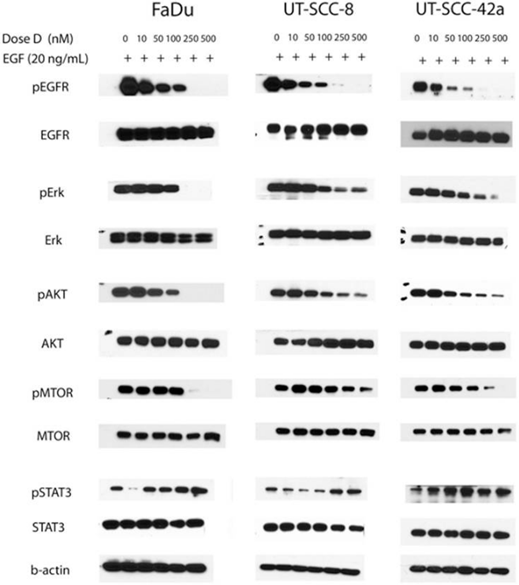
PF299804 ist ein spezifischer Inhibitor der ERBB-Kinasefamilie. Diese Verbindung hemmt die EGFR-Signalübertragung und induziert Apoptose in der EGFR T790M-haltigen H3255 GR-Zelllinie. Sie ist wirksam in -sensitiven und NSCLC-Zelllinien. Diese Chemikalie hemmt das Wachstum von H3255- und HCC827-Zellen, die zur Expression von EGFR T790M konstruiert wurden. Sie hemmt die EGFR-Phosphorylierung in Gegenwart der T790M-Mutation. Dieser Wirkstoff soll die ERBB-Tyrosinkinaseaktivität irreversibel hemmen, indem er an die ATP-Bindungsstelle bindet und nukleophile Cysteinreste in den katalytischen Domänen der ERBB-Familienmitglieder kovalent modifiziert. Er zeigt signifikante wachstumshemmende Wirkungen in HER2-amplifizierten Magenkrebszellen (SNU216, N87) und hat niedrigere 50%ige Hemmkonzentrationswerte im Vergleich zu anderen EGFR-Tyrosinkinaseinhibitoren, einschließlich BIBW-2992 und CI-1033. Dieser Inhibitor induziert Apoptose und G1-Arrest und hemmt die Phosphorylierung von Rezeptoren der HER-Familie und nachgeschalteter Signalwege, einschließlich STAT3, AKT und extrazellulär signalregulierter Kinasen (ERK) in HER2-amplifizierten Magenkrebszellen. Er blockiert auch die EGFR/HER2-, HER2/HER3- und HER3/HER4-Heterodimerbildung sowie die Assoziation von HER3 mit p85 α in SNU216-Zellen. Eine aktuelle Untersuchung verwendet siebenundvierzig menschliche Brustkrebs- und immortalisierten Brustepithelzelllinien, um die Hemmwirkung dieser Verbindung zu bewerten. Die Ergebnisse zeigen, dass sie das Wachstum von HER-2-amplifizierten Brustkrebszelllinien stärker hemmt als von nicht-amplifizierten Linien (RR = 3,39, p < 0,0001). Diese Chemikalie reduziert die Phosphorylierung von HER2, EGFR, HER4, AKT und ERK in der Mehrheit der sensitiven Linien. Sie entfaltet ihre antiproliferative Wirkung durch einen kombinierten G0/G1-Arrest und eine Induktion der Apoptose. |
| Kinase-Assay |
ELISA-basierter ERBB-Kinase-Assay
|
|
Die zytoplasmatischen Fusionsproteine ERBB1, ERBB2 und ERBB4 werden durch Klonen der ERBB1-Sequenz (Met-668 bis Ala-1211), ERBB2 (Ile-675 bis Val-1256) und ERBB4-Sequenz (Gly-259 bis Gly-690) mittels PCR in den Baculovirusvektor pFastBac hergestellt. Die Proteine werden in Baculovirus-infizierten Sf9-Insektenzellen als GST-Fusionsproteine exprimiert. Die Proteine werden durch Affinitätschromatographie unter Verwendung von Glutathion-Sepharose-Kügelchen gereinigt. Die Hemmung der ERBB-Tyrosinkinaseaktivität wird mittels eines ELISA-basierten Rezeptor-Tyrosinkinase-Assays bewertet. Kinase-Reaktionen (50 mM HEPES, pH 7,4, 125 mM NaCl, 10 mM MgCl2, 100 μM Natriumorthovanadat, 2 mM Dithiothreit, 20 μM ATP, diese Verbindung oder Fahrzeugkontrolle und 1-5 nM GST-erbB pro 50 μL Reaktionsgemisch) werden in 96-Well-Platten durchgeführt, die mit 0,25 mg/mL Poly-Glu-Tyr beschichtet sind. Die Reaktionen werden 6 Minuten lang bei Raumtemperatur unter Schütteln inkubiert. Kinase-Reaktionen werden durch Entfernung des Reaktionsgemischs gestoppt, und dann werden die Wells mit Waschpuffer (0,1 % Tween 20 in PBS) gewaschen. Phosphorylierte Tyrosinreste werden durch Zugabe von 0,2 μg/mL Anti-Phosphotyrosin-Antikörper (Oncogene Ab-4; 50 μL/Well), gekoppelt an Meerrettichperoxidase (HRP), verdünnt in PBS, enthaltend 3 % BSA und 0,05 % Tween 20, für 25 Minuten unter Schütteln bei Raumtemperatur nachgewiesen. Der Antikörper wird entfernt, und die Platten werden in Waschpuffer gewaschen. HRP-Substrat (SureBlue3,3
,5,5-Tetramethylbenzidin oder TMB) wird hinzugefügt (50 μL pro Well) und 10-20 Minuten lang unter Schütteln bei Raumtemperatur inkubiert. Die TMB-Reaktion wird durch Zugabe von 50 μL Stopplösung (0,09 N H2SO4) gestoppt. Das Signal wird durch Messung der Absorption bei 450 nm quantifiziert. IC50-Werte werden für diese Verbindung unter Verwendung der Median-Effekt-Methode bestimmt.
|
|
| In vivo |
Oral verabreichtes PF299804 hemmt effektiv das Wachstum von HCC827 Del/T790M Xenograften. Eine niedrige orale Verabreichung dieser Verbindung (15 mg/kg) führt zu einer signifikanten Antitumoraktivität, einschließlich ausgeprägter Tumorrückbildungen in einer Vielzahl menschlicher Tumor-Xenograft-Modelle, die ERBB-Familienmitglieder exprimieren und/oder überexprimieren oder die Doppelmutation (L858R/T790M) in ERBB1 (EGFR) enthalten. |
Literatur |
|
Anwendungen
| Methoden | Biomarker | Bilder | PMID |
|---|---|---|---|
| Western blot | pEGFR / EGFR / pERK / ERK / pAKT / AKT / p-mTOR / mTOR / pSTAT3 / STAT3 |
|
24853121 |
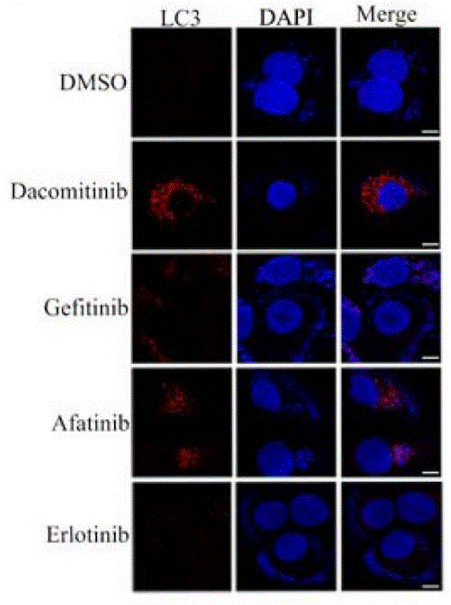
| Immunofluorescence | LC3 |
|
28366635 |
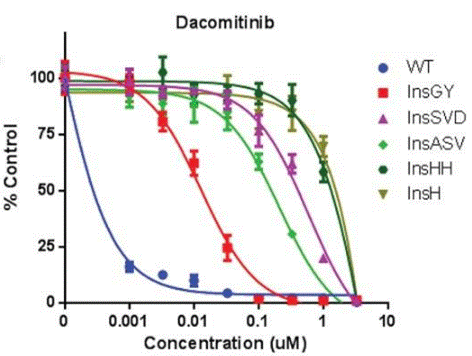
| Growth inhibition assay | Cell viability |
|
28363995 |
Klinische Studieninformationen
(Daten von https://clinicaltrials.gov, aktualisiert am 2024-05-22)
| NCT-Nummer | Rekrutierung | Erkrankungen | Sponsor/Kooperationspartner | Startdatum | Phasen |
|---|---|---|---|---|---|
| NCT06075615 | Not yet recruiting | Carcinoma Non-Small-Cell Lung |
Pfizer |
September 1 2024 | -- |
| NCT06321510 | Not yet recruiting | Lung Cancer |
Pfizer |
April 1 2024 | -- |
| NCT04609319 | Active not recruiting | Lung Cancer |
Pfizer |
January 23 2021 | -- |
| NCT03865446 | Completed | Severe Hepatic Impairment |
Pfizer |
April 5 2019 | Phase 1 |
| NCT02382796 | Completed | NSCLC |
Pfizer |
July 10 2015 | Phase 2 |
| NCT02268747 | Unknown status | Skin Squamous Cell Cancer |
Fondazione IRCCS Istituto Nazionale dei Tumori Milano |
November 2014 | Phase 2 |
Technischer Support
Tel: +1-832-582-8158 Ext:3
Wenn Sie weitere Fragen haben, hinterlassen Sie bitte eine Nachricht.
Häufig gestellte Fragen
Frage 1:
I would like to know whether the in vivo formulation you recommend for it is suitable for oral administration?
Antwort:
S2727 in 1% DMSO+30% polyethylene glycol+1% Tween 80 at 10mg/ml is a homogeneous suspension, and it was fine for oral gavage. When preparing the solution, please dissolve it in DMSO clearly first. If it dissolves not readily, please sonicate and warm it at about 45-50℃ for a while to help dissolving. Then add PEG 300 and Tween 80. After they mixed well, dilute with water. Then it will become a homogeneous suspension.

Produkte sind nur für Forschungszwecke bestimmt. Nicht für den menschlichen Gebrauch. Wir verkaufen nicht an Patienten.
©Copyright 2013 Selleck Chemicals. Alle Rechte vorbehalten.