
nur für Forschungszwecke
Trametinib (GSK1120212) MEK Inhibitor
Kat.-Nr.S2673
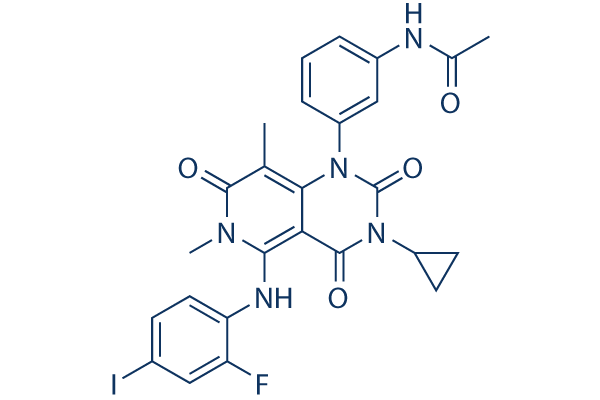
Chemische Struktur
Molekulargewicht: 615.39
Qualitätskontrolle
| Verwandte Ziele | ERK p38 MAPK Raf JNK Ras KRas S6 Kinase MAP4K TAK1 Mixed Lineage Kinase |
|---|---|
| Weitere MEK Inhibitoren | PD0325901 (Mirdametinib) U0126-EtOH PD 98059 PD184352 (CI-1040) BIX 02189 Pimasertib (AS-703026) Refametinib (RDEA119) TAK-733 AZD8330 SL-327 |
Zellkultur, Behandlung & Arbeitskonzentration
| Zelllinien | Assay-Typ | Konzentration | Inkubationszeit | Formulierung | Aktivitätsbeschreibung | PMID |
|---|---|---|---|---|---|---|
| MDA-MB-231, SW480 and SW1116 cells | Function assay | 100 nM | 24 h | trametinib could decrease YAP levels and inhibit LMB-induced YAP upregulation in MDA-MB-231, SW1116 and SW480 cells | 30833665 | |
| RG7388-resistant U87MG cells | Function assay | 10 nM | 24 h | DMSO | Trametinib treatment reduced the invasive phenotype of RG7388 resistant cells. | 30274984 |
| BJAB cells | Function assay | 0.01μM | 24 h | 0.01 μM trametinib effectively suppressed the ERK hyperactivation in BJAB cells caused by the combined treatment of BKM120 and Danusertib. | 30947576 | |
| Human PDAC cell lines (MIA-PACA, PANC-1, CFPAC-1, PL45, CAPAN-2 and HPAF-II) | Function assay | 10 nM or 100 nM | 3-days or 6-days | The concentration of 10 nM trametinib consistently produced significant differences between gefitinib and trametinib alone compared to combination gefitinib and trametinib in all four sensitive cell lines (CFPAC-1, pl45, CAPAN-2 and HPAF-II). No additive effect was observed in the gefitinib insensitive or excitatory cell lines (MIA-Paca and PANC-1) | 30921351 | |
| Transitional cell carcinoma (TCC) cell lines | Function assay | 25 nM | 6-24 h | Canine TCC cell lines are sensitive to MEK inhibition | 31048548 | |
| COLO205 | Growth inhibition assay | 72 h | IC50 = 0.001 μM | ChEMBL | ||
| HT-29 | Growth inhibition assay | 72 h | IC50 = 0.001 μM | ChEMBL | ||
| COLO205 | Growth inhibition assay | 72 h | IC50 = 0.001 μM | ChEMBL | ||
| MV522 | Growth inhibition assay | 72 h | IC50 = 0.001 μM | ChEMBL | ||
| HT-29 | Growth inhibition assay | 72 h | IC50 = 0.002 μM | ChEMBL | ||
| MV522 | Growth inhibition assay | 72 h | IC50 = 0.002 μM | ChEMBL | ||
| NCI-H727 | Growth inhibition assay | 72 h | IC50 = 0.002 μM | ChEMBL | ||
| NCI-H727 | Growth inhibition assay | 72 h | IC50 = 0.002 μM | ChEMBL | ||
| SW1417 | Growth inhibition assay | 72 h | IC50 = 0.003 μM | ChEMBL | ||
| SW1417 | Growth inhibition assay | 72 h | IC50 = 0.003 μM | ChEMBL | ||
| Calu6 | Growth inhibition assay | 72 h | IC50 = 0.003 μM | ChEMBL | ||
| LS1034 | Growth inhibition assay | 72 h | IC50 = 0.004 μM | ChEMBL | ||
| SW1463 | Growth inhibition assay | 72 h | IC50 = 0.004 μM | ChEMBL | ||
| SW1463 | Growth inhibition assay | 72 h | IC50 = 0.004 μM | ChEMBL | ||
| Calu6 | Growth inhibition assay | 72 h | IC50 = 0.004 μM | ChEMBL | ||
| LS1034 | Growth inhibition assay | 72 h | IC50 = 0.005 μM | ChEMBL | ||
| RKO | Growth inhibition assay | 72 h | IC50 = 0.005 μM | ChEMBL | ||
| NCI-H508 | Growth inhibition assay | 72 h | IC50 = 0.008 μM | ChEMBL | ||
| KM12 | Growth inhibition assay | 72 h | IC50 = 0.01 μM | ChEMBL | ||
| A427 | Growth inhibition assay | 72 h | IC50 = 0.01 μM | ChEMBL | ||
| NCI-H1155 | Growth inhibition assay | 72 h | IC50 = 0.01 μM | ChEMBL | ||
| HCT8 | Growth inhibition assay | 72 h | IC50 = 0.014 μM | ChEMBL | ||
| MDA-MB-175-VII | Growth inhibition assay | 72 h | IC50 = 0.016 μM | ChEMBL | ||
| A549 | Growth inhibition assay | 72 h | IC50 = 0.016 μM | ChEMBL | ||
| RKO | Growth inhibition assay | 72 h | IC50 = 0.018 μM | ChEMBL | ||
| NCI-H23 | Growth inhibition assay | 72 h | IC50 = 0.02 μM | ChEMBL | ||
| A427 | Growth inhibition assay | 72 h | IC50 = 0.022 μM | ChEMBL | ||
| KM12 | Growth inhibition assay | 72 h | IC50 = 0.023 μM | ChEMBL | ||
| NCI-H508 | Growth inhibition assay | 72 h | IC50 = 0.023 μM | ChEMBL | ||
| MDA-MB-231 | Growth inhibition assay | 3 days | GI50 = 0.025 μM | ChEMBL | ||
| SW837 | Growth inhibition assay | 72 h | IC50 = 0.025 μM | ChEMBL | ||
| SW480 | Growth inhibition assay | 72 h | IC50 = 0.026 μM | ChEMBL | ||
| NCI-H1355 | Growth inhibition assay | 72 h | IC50 = 0.027 μM | ChEMBL | ||
| NCI-H23 | Growth inhibition assay | 72 h | IC50 = 0.029 μM | ChEMBL | ||
| EFM19 | Growth inhibition assay | 72 h | IC50 = 0.03 μM | ChEMBL | ||
| T84 | Growth inhibition assay | 72 h | IC50 = 0.03 μM | ChEMBL | ||
| A549 | Growth inhibition assay | 72 h | IC50 = 0.034 μM | ChEMBL | ||
| NCI-H1792 | Growth inhibition assay | 72 h | IC50 = 0.035 μM | ChEMBL | ||
| SW480 | Growth inhibition assay | 72 h | IC50 = 0.037 μM | ChEMBL | ||
| COR-L23 | Growth inhibition assay | 72 h | IC50 = 0.037 μM | ChEMBL | ||
| SW1573 | Growth inhibition assay | 72 h | IC50 = 0.038 μM | ChEMBL | ||
| Calu3 | Growth inhibition assay | 72 h | IC50 = 0.039 μM | ChEMBL | ||
| HCC827 | Growth inhibition assay | 72 h | IC50 = 0.04 μM | ChEMBL | ||
| HOP62 | Growth inhibition assay | 72 h | IC50 = 0.05 μM | ChEMBL | ||
| NCI-H1355 | Growth inhibition assay | 72 h | IC50 = 0.052 μM | ChEMBL | ||
| NCI-H1792 | Growth inhibition assay | 72 h | IC50 = 0.053 μM | ChEMBL | ||
| HCT8 | Growth inhibition assay | 72 h | IC50 = 0.055 μM | ChEMBL | ||
| T84 | Growth inhibition assay | 72 h | IC50 = 0.061 μM | ChEMBL | ||
| SW900 | Growth inhibition assay | 72 h | IC50 = 0.072 μM | ChEMBL | ||
| SW837 | Growth inhibition assay | 72 h | IC50 = 0.074 μM | ChEMBL | ||
| DLD1 | Growth inhibition assay | 72 h | IC50 = 0.093 μM | ChEMBL | ||
| MDA-MB-175-VII | Growth inhibition assay | 72 h | IC50 = 0.096 μM | ChEMBL | ||
| SW900 | Growth inhibition assay | 72 h | IC50 = 0.127 μM | ChEMBL | ||
| Calu3 | Growth inhibition assay | 72 h | IC50 = 0.158 μM | ChEMBL | ||
| COR-L23 | Growth inhibition assay | 72 h | IC50 = 0.329 μM | ChEMBL | ||
| DLD1 | Growth inhibition assay | 72 h | IC50 = 0.632 μM | ChEMBL | ||
| Klicken Sie hier, um weitere experimentelle Daten zu Zelllinien anzuzeigen | ||||||
Chemische Informationen, Lagerung & Stabilität
| Molekulargewicht | 615.39 | Formel | C26H23FIN5O4 |
Lagerung (Ab dem Eingangsdatum) | |
|---|---|---|---|---|---|
| CAS-Nr. | 871700-17-3 | SDF herunterladen | Lagerung von Stammlösungen |
|
|
| Synonyme | JTP-74057 | Smiles | CC1=C2C(=C(N(C1=O)C)NC3=C(C=C(C=C3)I)F)C(=O)N(C(=O)N2C4=CC=CC(=C4)NC(=O)C)C5CC5 | ||
Löslichkeit
|
In vitro |
DMSO
: 8 mg/mL
(12.99 mM)
Water : Insoluble Ethanol : Insoluble |
Molaritätsrechner
|
In vivo |
|||||
In-vivo-Formulierungsrechner (Klare Lösung)
Schritt 1: Geben Sie die untenstehenden Informationen ein (Empfohlen: Ein zusätzliches Tier zur Berücksichtigung von Verlusten während des Experiments)
Schritt 2: Geben Sie die In-vivo-Formulierung ein (Dies ist nur der Rechner, keine Formulierung. Bitte kontaktieren Sie uns zuerst, wenn es im Abschnitt "Löslichkeit" keine In-vivo-Formulierung gibt.)
Berechnungsergebnisse:
Arbeitskonzentration: mg/ml;
Methode zur Herstellung der DMSO-Stammlösung: mg Wirkstoff vorgelöst in μL DMSO ( Konzentration der Stammlösung mg/mL, Bitte kontaktieren Sie uns zuerst, wenn die Konzentration die DMSO-Löslichkeit der Wirkstoffcharge überschreitet. )
Methode zur Herstellung der In-vivo-Formulierung: Nehmen Sie μL DMSO Stammlösung, dann hinzufügenμL PEG300, mischen und klären, dann hinzufügenμL Tween 80, mischen und klären, dann hinzufügen μL ddH2O, mischen und klären.
Methode zur Herstellung der In-vivo-Formulierung: Nehmen Sie μL DMSO Stammlösung, dann hinzufügen μL Maisöl, mischen und klären.
Hinweis: 1. Bitte stellen Sie sicher, dass die Flüssigkeit klar ist, bevor Sie das nächste Lösungsmittel hinzufügen.
2. Achten Sie darauf, das/die Lösungsmittel der Reihe nach hinzuzufügen. Sie müssen sicherstellen, dass die bei der vorherigen Zugabe erhaltene Lösung eine klare Lösung ist, bevor Sie mit der Zugabe des nächsten Lösungsmittels fortfahren. Physikalische Methoden wie Vortex, Ultraschall oder ein heißes Wasserbad können zur Unterstützung des Lösens verwendet werden.
Wirkmechanismus
| Merkmale |
More potent than PD0325901 or AZD6244.
|
|---|---|
| Targets/IC50/Ki |
MEK1
(Cell-free assay) 0.92 nM
MEK2
(Cell-free assay) 1.8 nM
|
| In vitro |
Trametinib (GSK1120212) hemmt die Phosphorylierung von MBP unabhängig vom Isotyp von Raf und MEK, mit IC50-Werten im Bereich von 0,92 nM bis 3,4 nM. Es zeigt keine Hemmung der Kinaseaktivitäten von c-Raf, B-Raf, ERK1 und ERK2. Darüber hinaus zeigt diese Verbindung keine drastische Hemmwirkung gegen die anderen 98 Kinasen. Es zeigt eine starke hemmende Aktivität gegen humane kolorektale Krebszelllinien. HT-29- und COLO205-Zellen, die bekanntermaßen eine konstitutiv aktive B-Raf-Mutante aufweisen, sind mit IC50 0,48 nM bzw. 0,52 nM am empfindlichsten. Die Zelllinien, die eine K-Ras-Mutation aufweisen, zeigen eine große Bandbreite an Empfindlichkeit gegenüber ihm mit IC50 von 2,2-174 nM. Im Gegensatz dazu sind COLO320 DM-Zellen, die das Wildtyp-Gen sowohl in B-Raf als auch in K-Ras tragen, selbst bei 10 μM resistent. Eine 24-stündige Behandlung induziert einen Zellzyklusarrest in der G1-Phase in allen empfindlichen Zelllinien. Konsistenterweise führt dies zu einer Hochregulation von p15INK4b und/oder p27KIP1 in den meisten kolorektalen Krebszelllinien. Es hemmt die konstitutive ERK-Phosphorylierung in allen empfindlichen Zelllinien. Diese Verbindung induziert Apoptosis sowohl in HT-29- als auch in COLO205-Zellen, wobei COLO205-Zellen hinsichtlich der Apoptosis-Induktion empfindlicher sind als HT-29-Zellen. Es blockiert die Produktion von Tumornekrosefaktor-α und Interleukin-6 aus peripheren mononukleären Blutzellen (PBMCs). |
| Kinase-Assay |
Raf-MEK-ERK-Kaskadenkinase-Assay
|
|
Nicht-phosphoryliertes Myelin-Basismprotein (MBP) wird auf eine ELISA-Platte beschichtet, und die aktive Form von B-Raf/c-Raf wird mit unphosphoryliertem MEK1/MEK2 und ERERK2 in 10 μM ATP und 12,5 mM MgCl2 enthaltendem MOPS-Puffer in Gegenwart verschiedener Konzentrationen von Trametinib (GSK1120212) gemischt. Die Phosphorylierung von MBP wird durch den Anti-phospho-MBP-Antikörper nachgewiesen.
|
|
| In vivo |
Die orale Verabreichung von Trametinib (GSK1120212) mit 0,3 mg/kg oder 1 mg/kg einmal täglich über 14 Tage ist wirksam bei der Hemmung des HT-29-Xenograft-Wachstums, und 1 mg/kg dieser Verbindung blockiert den Tumorzuwachs fast vollständig. Die Phosphorylierung von ERK1/2 ist in den etablierten Tumorgeweben durch eine einzelne orale Dosis von 1 mg/kg vollständig gehemmt, und sowohl die p15INK4b- als auch die p27KIP1-Proteinspiegel sind nach 14-tägiger Behandlung hochreguliert. Im COLO205-Xenograft-Modell wird eine Tumorregression selbst bei einer Dosis von 0,3 mg/kg beobachtet. Bei einer Dosis von 1 mg/kg wird eine vollständige Regression bei 4 von 6 Mäusen erreicht, bei denen sich der Tumor so weit zurückbildet, dass das Tumorvolumen nicht messbar ist. Die Verabreichung von 0,1 mg/kg unterdrückt die adjuvansinduzierte Arthritis (AIA) und die Typ-II-Kollagen-induzierte Arthritis (CIA) bei Lewis-Ratten bzw. DBA1/J-Mäusen fast vollständig. |
Literatur |
|
Anwendungen
| Methoden | Biomarker | Bilder | PMID |
|---|---|---|---|
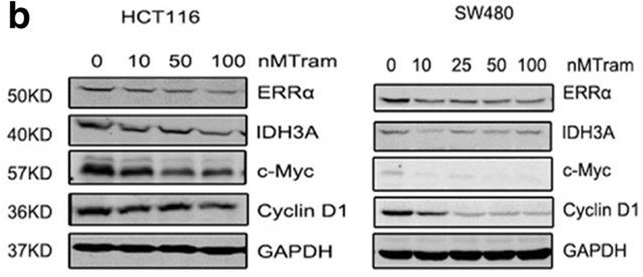
| Western blot | ERRα / IDH3 / c-Myc / Cyclin D1 pERK /ERK / pS6 / S6 β-catenin |
|
30185207 |
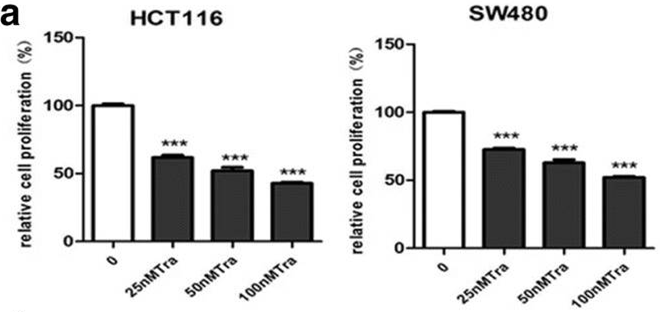
| Growth inhibition assay | Cell proliferation MTT assay |
|
30185207 |
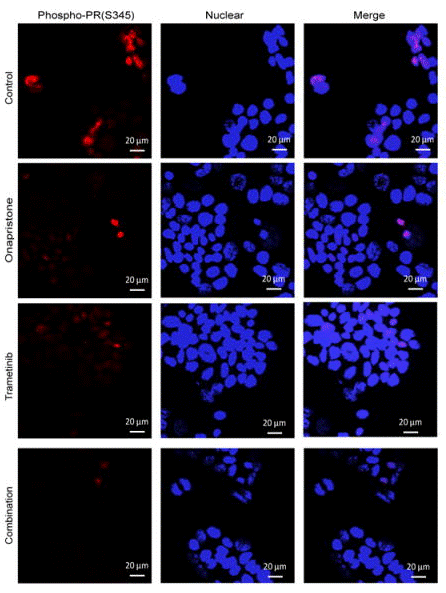
| Immunofluorescence | phospho-PR(S345) β-catenin |
|
29237804 |
Klinische Studieninformationen
(Daten von https://clinicaltrials.gov, aktualisiert am 2024-05-22)
| NCT-Nummer | Rekrutierung | Erkrankungen | Sponsor/Kooperationspartner | Startdatum | Phasen |
|---|---|---|---|---|---|
| NCT05275374 | Not yet recruiting | Cancer|BRAF V600 Mutation|Melanoma|Colorectal Cancer|Thyroid Cancer|Nonsmall Cell Lung Cancer |
Xynomic Pharmaceuticals Inc. |
December 2024 | Phase 1|Phase 2 |
| NCT06098872 | Not yet recruiting | Arteriovenous Malformations |
University Health Network Toronto |
November 2023 | Phase 2 |
| NCT05907304 | Recruiting | Advanced or Metastatic Solid Tumors |
Erasca Inc. |
August 17 2023 | Phase 1 |
| NCT05874414 | Recruiting | Cholangiocarcinoma |
Genfit |
August 21 2023 | Phase 1|Phase 2 |
Technischer Support
Tel: +1-832-582-8158 Ext:3
Wenn Sie weitere Fragen haben, hinterlassen Sie bitte eine Nachricht.
Häufig gestellte Fragen
Frage 1:
Could you help us with the best way to prepare it for in vivo i.p. injections?
Antwort:
It can be dissolved in 4% DMSO/corn oil at 3 mg/ml clearly.
Frage 2:
How to solve the problem that it didn't dissolve up to 10mM in DMSO at room temperature?
Antwort:
The solution can be heated up to 50 degrees to help dissolve it. Besides, sonication (with a probe sonicator) also greatly helps with this compound.

Produkte sind nur für Forschungszwecke bestimmt. Nicht für den menschlichen Gebrauch. Wir verkaufen nicht an Patienten.
©Copyright 2013 Selleck Chemicals. Alle Rechte vorbehalten.