
nur für Forschungszwecke
Tivozanib VEGFR Inhibitor
Kat.-Nr.S1207
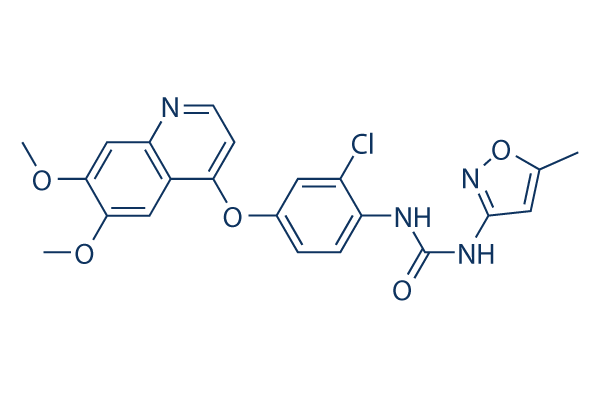
Chemische Struktur
Molekulargewicht: 454.86
Qualitätskontrolle
| Verwandte Ziele | EGFR PDGFR FGFR c-Met Src MEK CSF-1R FLT3 HER2 c-Kit |
|---|---|
| Weitere VEGFR Inhibitoren | SAR131675 SU 5402 Cediranib (AZD2171) Vatalanib (PTK787) 2HCl Anlotinib (AL3818) Dihydrochloride Linifanib (ABT-869) Apatinib (YN968D1) Apatinib (YN968D1) mesylate Ki8751 ZM 323881 HCl |
Zellkultur, Behandlung & Arbeitskonzentration
| Zelllinien | Assay-Typ | Konzentration | Inkubationszeit | Formulierung | Aktivitätsbeschreibung | PMID |
|---|---|---|---|---|---|---|
| MCF7 cells | Proliferation assay | Antiproliferative activity against human MCF7 cells, IC50=0.38 μM | 24583357 | |||
| DAOY | qHTS assay | qHTS of pediatric cancer cell lines to identify multiple opportunities for drug repurposing: Primary screen for DAOY cells | 29435139 | |||
| SJ-GBM2 | qHTS assay | qHTS of pediatric cancer cell lines to identify multiple opportunities for drug repurposing: Primary screen for SJ-GBM2 cells | 29435139 | |||
| BT-37 | qHTS assay | qHTS of pediatric cancer cell lines to identify multiple opportunities for drug repurposing: Primary screen for BT-37 cells | 29435139 | |||
| NB-EBc1 | qHTS assay | qHTS of pediatric cancer cell lines to identify multiple opportunities for drug repurposing: Primary screen for NB-EBc1 cells | 29435139 | |||
| U-2 OS | qHTS assay | qHTS of pediatric cancer cell lines to identify multiple opportunities for drug repurposing: Primary screen for U-2 OS cells | 29435139 | |||
| Saos-2 | qHTS assay | qHTS of pediatric cancer cell lines to identify multiple opportunities for drug repurposing: Primary screen for Saos-2 cells | 29435139 | |||
| SK-N-SH | qHTS assay | qHTS of pediatric cancer cell lines to identify multiple opportunities for drug repurposing: Primary screen for SK-N-SH cells | 29435139 | |||
| LAN-5 | qHTS assay | qHTS of pediatric cancer cell lines to identify multiple opportunities for drug repurposing: Primary screen for LAN-5 cells | 29435139 | |||
| Rh18 | qHTS assay | qHTS of pediatric cancer cell lines to identify multiple opportunities for drug repurposing: Primary screen for Rh18 cells | 29435139 | |||
| OHS-50 | qHTS assay | qHTS of pediatric cancer cell lines to identify multiple opportunities for drug repurposing: Primary screen for OHS-50 cells | 29435139 | |||
| RD | qHTS assay | qHTS of pediatric cancer cell lines to identify multiple opportunities for drug repurposing: Primary screen for RD cells | 29435139 | |||
| Rh41 | qHTS assay | qHTS of pediatric cancer cell lines to identify multiple opportunities for drug repurposing: Primary screen for Rh41 cells | 29435139 | |||
| A673 | qHTS assay | qHTS of pediatric cancer cell lines to identify multiple opportunities for drug repurposing: Confirmatory screen for A673 cells) | 29435139 | |||
| SK-N-MC | qHTS assay | qHTS of pediatric cancer cell lines to identify multiple opportunities for drug repurposing: Confirmatory screen for SK-N-MC cells | 29435139 | |||
| TC32 | qHTS assay | qHTS of pediatric cancer cell lines to identify multiple opportunities for drug repurposing: Confirmatory screen for TC32 cells | 29435139 | |||
| SK-N-SH | qHTS assay | qHTS of pediatric cancer cell lines to identify multiple opportunities for drug repurposing: Confirmatory screen for SK-N-SH cells | 29435139 | |||
| Klicken Sie hier, um weitere experimentelle Daten zu Zelllinien anzuzeigen | ||||||
Chemische Informationen, Lagerung & Stabilität
| Molekulargewicht | 454.86 | Formel | C22H19ClN4O5 |
Lagerung (Ab dem Eingangsdatum) | |
|---|---|---|---|---|---|
| CAS-Nr. | 475108-18-0 | SDF herunterladen | Lagerung von Stammlösungen |
|
|
| Synonyme | AV-951, KRN-951 | Smiles | CC1=CC(=NO1)NC(=O)NC2=C(C=C(C=C2)OC3=C4C=C(C(=CC4=NC=C3)OC)OC)Cl | ||
Löslichkeit
|
In vitro |
DMSO
: 20 mg/mL
(43.96 mM)
Water : Insoluble Ethanol : Insoluble |
Molaritätsrechner
|
In vivo |
|||||
In-vivo-Formulierungsrechner (Klare Lösung)
Schritt 1: Geben Sie die untenstehenden Informationen ein (Empfohlen: Ein zusätzliches Tier zur Berücksichtigung von Verlusten während des Experiments)
Schritt 2: Geben Sie die In-vivo-Formulierung ein (Dies ist nur der Rechner, keine Formulierung. Bitte kontaktieren Sie uns zuerst, wenn es im Abschnitt "Löslichkeit" keine In-vivo-Formulierung gibt.)
Berechnungsergebnisse:
Arbeitskonzentration: mg/ml;
Methode zur Herstellung der DMSO-Stammlösung: mg Wirkstoff vorgelöst in μL DMSO ( Konzentration der Stammlösung mg/mL, Bitte kontaktieren Sie uns zuerst, wenn die Konzentration die DMSO-Löslichkeit der Wirkstoffcharge überschreitet. )
Methode zur Herstellung der In-vivo-Formulierung: Nehmen Sie μL DMSO Stammlösung, dann hinzufügenμL PEG300, mischen und klären, dann hinzufügenμL Tween 80, mischen und klären, dann hinzufügen μL ddH2O, mischen und klären.
Methode zur Herstellung der In-vivo-Formulierung: Nehmen Sie μL DMSO Stammlösung, dann hinzufügen μL Maisöl, mischen und klären.
Hinweis: 1. Bitte stellen Sie sicher, dass die Flüssigkeit klar ist, bevor Sie das nächste Lösungsmittel hinzufügen.
2. Achten Sie darauf, das/die Lösungsmittel der Reihe nach hinzuzufügen. Sie müssen sicherstellen, dass die bei der vorherigen Zugabe erhaltene Lösung eine klare Lösung ist, bevor Sie mit der Zugabe des nächsten Lösungsmittels fortfahren. Physikalische Methoden wie Vortex, Ultraschall oder ein heißes Wasserbad können zur Unterstützung des Lösens verwendet werden.
Wirkmechanismus
| Targets/IC50/Ki |
VEGFR2
(Cell-free assay) 6.5 nM
VEGFR3
(Cell-free assay) 15 nM
EphB2
(Cell-free assay) 24 nM
VEGFR1
(Cell-free assay) 30 nM
PDGFRα
(Cell-free assay) 40 nM
PDGFRβ
(Cell-free assay) 49 nM
c-Kit
(Cell-free assay) 78 nM
Tie-2
(Cell-free assay) 78 nM
EphB4
(Cell-free assay) 480 nM
FGFR1
(Cell-free assay) 530 nM
c-Met
(Cell-free assay) 550 nM
Abl
(Cell-free assay) 620 nM
|
|---|---|
| In vitro |
AV-951 ist ein neues Chinolin-Harnstoff-Derivat. AV-951 blockiert die VEGF-abh
gige Aktivierung von Mitogen-aktivierten Proteinkinasen und die Proliferation von Endothelzellen.
|
| Kinase-Assay |
Kinase-Assays
|
|
Zellfreie Kinase-Assays werden in vierfacher Ausf
hrung mit 1
MATP durchgef
hrt, um die IC50-Werte von AV-951 gegen eine Vielzahl von rekombinanten Rezeptor- und Nicht-Rezeptor-Tyrosinkinasen, einschlie
lich VEGFR1, VEGFR2, VEGFR3, c-Kit, PDGFR
, Flt-3 und FGFR1, zu bestimmen.
|
|
| In vivo |
In-vivo-Studien zeigen, dass AV-951 auch die Mikrogendichte verringert und die VEGFR2-Phosphorylierungsniveaus in Tumor-Xenografts unterdr
ckt, insbesondere bei einer Konzentration von 1 mg/kg (p.o. Verabreichung). AV-951 zeigt eine fast vollst
ndige Hemmung des Wachstums von Tumor-Xenografts (TGI>85%) bei athymischen Ratten. Eine weitere Studie an einem Rattenmodell f
r peritoneale disseminierte Tumore zeigt, dass AV-951 das
berleben der tumorragenden Ratten mit einer MST von 53,5 Tagen verl
ngern konnte. AV-951 zeigt Antitumoraktivit
t gegen viele menschliche Tumor-Xenografts, einschlie
lich Lungen-, Brust-, Darm-, Eierstock-, Bauchspeicheldr
sen- und Prostatakrebs.
|
Literatur |
|
Klinische Studieninformationen
(Daten von https://clinicaltrials.gov, aktualisiert am 2024-05-22)
| NCT-Nummer | Rekrutierung | Erkrankungen | Sponsor/Kooperationspartner | Startdatum | Phasen |
|---|---|---|---|---|---|
| NCT04645160 | Recruiting | Cholangiocarcinoma|Bile Duct Neoplasm|Biliary Tract Malignancy |
National Cancer Institute (NCI)|National Institutes of Health Clinical Center (CC) |
March 4 2022 | Phase 1|Phase 2 |
| NCT03136627 | Completed | Carcinoma Renal Cell |
AVEO Pharmaceuticals Inc.|Bristol-Myers Squibb |
March 22 2017 | Phase 1|Phase 2 |
| NCT01853644 | Completed | Recurrent Epithelial Ovarian Cancer|Recurrent Fallopian Tube Cancer|Recurrent Primary Peritoneal Cancer |
Northwestern University|National Comprehensive Cancer Network |
June 6 2013 | Phase 2 |
| NCT01834183 | Withdrawn | Renal Cell Carcinoma |
Dana-Farber Cancer Institute |
June 2013 | Phase 2 |
| NCT01807156 | Terminated | Hepatocellular Cancer |
Emory University|AVEO Pharmaceuticals Inc. |
March 2013 | Phase 2 |
Technischer Support
Tel: +1-832-582-8158 Ext:3
Wenn Sie weitere Fragen haben, hinterlassen Sie bitte eine Nachricht.
Häufig gestellte Fragen
Frage 1:
Would you please provide a little bit more detail regarding how to prepare it for in vivo treatment and the storage condition?
Antwort:
For in vivo formula, we recommend to use 2% DMSO+30% PEG 300+ddH2O up to 1mg/mL. Once dissolved in solution, please make small aliquots and store them at -80C up to 6 months without repeated thawing and refreezing.

Produkte sind nur für Forschungszwecke bestimmt. Nicht für den menschlichen Gebrauch. Wir verkaufen nicht an Patienten.
©Copyright 2013 Selleck Chemicals. Alle Rechte vorbehalten.