
nur für Forschungszwecke
Cediranib (AZD2171) VEGFR Inhibitor
Kat.-Nr.S1017
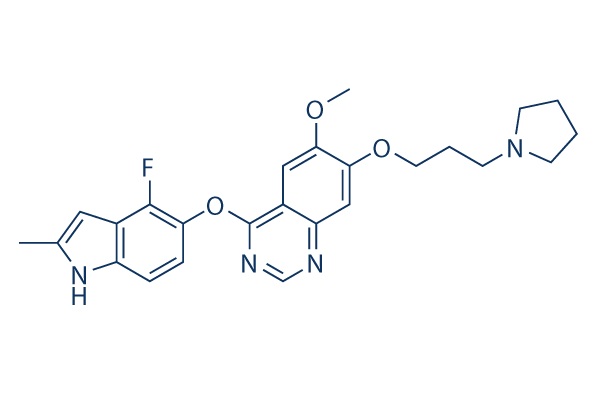
Chemische Struktur
Molekulargewicht: 450.51
Qualitätskontrolle
| Verwandte Ziele | EGFR PDGFR FGFR c-Met Src MEK CSF-1R FLT3 HER2 c-Kit |
|---|---|
| Weitere VEGFR Inhibitoren | SAR131675 SU 5402 Vatalanib (PTK787) 2HCl Anlotinib (AL3818) Dihydrochloride Linifanib (ABT-869) Apatinib (YN968D1) Apatinib (YN968D1) mesylate Ki8751 ZM 323881 HCl Semaxanib (SU5416) |
Zellkultur, Behandlung & Arbeitskonzentration
| Zelllinien | Assay-Typ | Konzentration | Inkubationszeit | Formulierung | Aktivitätsbeschreibung | PMID |
|---|---|---|---|---|---|---|
| HUVEC cell | Proliferation assay | 3 days | Inhibition of VEGF-stimulated HUVEC cell proliferation treated before 2 hrs of VEGF challenge assessed after 3 days by [3H]thymidine incorporation assay, ED50=12 nM | 19101155 | ||
| HeLa | Function assay | 4.5 hrs | Inhibition of Ebolavirus glycoprotein/matrix protein VP40 entry in human HeLa cells after 4.5 hrs beta-lactamase reporter assay, IC50=7.67μM | 29624387 | ||
| DAOY | qHTS assay | qHTS of pediatric cancer cell lines to identify multiple opportunities for drug repurposing: Primary screen for DAOY cells | 29435139 | |||
| SJ-GBM2 | qHTS assay | qHTS of pediatric cancer cell lines to identify multiple opportunities for drug repurposing: Primary screen for SJ-GBM2 cells | 29435139 | |||
| A673 | qHTS assay | qHTS of pediatric cancer cell lines to identify multiple opportunities for drug repurposing: Primary screen for A673 cells | 29435139 | |||
| BT-37 | qHTS assay | qHTS of pediatric cancer cell lines to identify multiple opportunities for drug repurposing: Primary screen for BT-37 cells | 29435139 | |||
| NB-EBc1 | qHTS assay | qHTS of pediatric cancer cell lines to identify multiple opportunities for drug repurposing: Primary screen for NB-EBc1 cells | 29435139 | |||
| Saos-2 | qHTS assay | qHTS of pediatric cancer cell lines to identify multiple opportunities for drug repurposing: Primary screen for Saos-2 cells | 29435139 | |||
| SK-N-SH | qHTS assay | qHTS of pediatric cancer cell lines to identify multiple opportunities for drug repurposing: Primary screen for SK-N-SH cells | 29435139 | |||
| LAN-5 | qHTS assay | qHTS of pediatric cancer cell lines to identify multiple opportunities for drug repurposing: Primary screen for LAN-5 cells | 29435139 | |||
| BT-12 | qHTS assay | qHTS of pediatric cancer cell lines to identify multiple opportunities for drug repurposing: Primary screen for BT-12 cells | 29435139 | |||
| Rh18 | qHTS assay | qHTS of pediatric cancer cell lines to identify multiple opportunities for drug repurposing: Primary screen for Rh18 cells | 29435139 | |||
| OHS-50 | qHTS assay | qHTS of pediatric cancer cell lines to identify multiple opportunities for drug repurposing: Primary screen for OHS-50 cells | 29435139 | |||
| RD | qHTS assay | qHTS of pediatric cancer cell lines to identify multiple opportunities for drug repurposing: Primary screen for RD cells | 29435139 | |||
| MG 63 (6-TG R) | qHTS assay | qHTS of pediatric cancer cell lines to identify multiple opportunities for drug repurposing: Primary screen for MG 63 (6-TG R) cells | 29435139 | |||
| fibroblast cells | qHTS assay | qHTS of pediatric cancer cell lines to identify multiple opportunities for drug repurposing: Primary screen for control Hh wild type fibroblast cells | 29435139 | |||
| Rh30 | qHTS assay | qHTS of pediatric cancer cell lines to identify multiple opportunities for drug repurposing: Primary screen for Rh30 cells | 29435139 | |||
| Rh41 | qHTS assay | qHTS of pediatric cancer cell lines to identify multiple opportunities for drug repurposing: Primary screen for Rh41 cells | 29435139 | |||
| Klicken Sie hier, um weitere experimentelle Daten zu Zelllinien anzuzeigen | ||||||
Chemische Informationen, Lagerung & Stabilität
| Molekulargewicht | 450.51 | Formel | C25H27FN4O3 |
Lagerung (Ab dem Eingangsdatum) | |
|---|---|---|---|---|---|
| CAS-Nr. | 288383-20-0 | SDF herunterladen | Lagerung von Stammlösungen |
|
|
| Synonyme | NSC-732208 | Smiles | CC1=CC2=C(N1)C=CC(=C2F)OC3=NC=NC4=CC(=C(C=C43)OC)OCCCN5CCCC5 | ||
Löslichkeit
|
In vitro |
DMSO
: 90 mg/mL
(199.77 mM)
Ethanol : 6 mg/mL Water : Insoluble |
Molaritätsrechner
|
In vivo |
|||||
In-vivo-Formulierungsrechner (Klare Lösung)
Schritt 1: Geben Sie die untenstehenden Informationen ein (Empfohlen: Ein zusätzliches Tier zur Berücksichtigung von Verlusten während des Experiments)
Schritt 2: Geben Sie die In-vivo-Formulierung ein (Dies ist nur der Rechner, keine Formulierung. Bitte kontaktieren Sie uns zuerst, wenn es im Abschnitt "Löslichkeit" keine In-vivo-Formulierung gibt.)
Berechnungsergebnisse:
Arbeitskonzentration: mg/ml;
Methode zur Herstellung der DMSO-Stammlösung: mg Wirkstoff vorgelöst in μL DMSO ( Konzentration der Stammlösung mg/mL, Bitte kontaktieren Sie uns zuerst, wenn die Konzentration die DMSO-Löslichkeit der Wirkstoffcharge überschreitet. )
Methode zur Herstellung der In-vivo-Formulierung: Nehmen Sie μL DMSO Stammlösung, dann hinzufügenμL PEG300, mischen und klären, dann hinzufügenμL Tween 80, mischen und klären, dann hinzufügen μL ddH2O, mischen und klären.
Methode zur Herstellung der In-vivo-Formulierung: Nehmen Sie μL DMSO Stammlösung, dann hinzufügen μL Maisöl, mischen und klären.
Hinweis: 1. Bitte stellen Sie sicher, dass die Flüssigkeit klar ist, bevor Sie das nächste Lösungsmittel hinzufügen.
2. Achten Sie darauf, das/die Lösungsmittel der Reihe nach hinzuzufügen. Sie müssen sicherstellen, dass die bei der vorherigen Zugabe erhaltene Lösung eine klare Lösung ist, bevor Sie mit der Zugabe des nächsten Lösungsmittels fortfahren. Physikalische Methoden wie Vortex, Ultraschall oder ein heißes Wasserbad können zur Unterstützung des Lösens verwendet werden.
Wirkmechanismus
| Targets/IC50/Ki |
VEGFR2/KDR
(HUVECs) 0.5 nM
c-Kit
(HUVECs) 2 nM
VEGFR3/FLT4
(HUVECs) <=3 nM
VEGFR1/FLT1
(HUVECs) 5 nM
PDGFRβ
(HUVECs) 5 nM
FGFR1
(HUVECs) 26 nM
PDGFRα
(HUVECs) 36 nM
|
|---|---|
| In vitro |
Cediranib (AZD2171) hemmt die VEGF-stimulierte Proliferation mit einer IC50 von 0,4 nM und unterdrückt PDGF-AA mit einer IC50 von 0,04 μM in MG63-Zelllinien. Es wurde gezeigt, dass es die Flt1-assoziierte Kinase mit einer IC50 von 5 nM und die VEGF-C- und VEGF-D-Rezeptor Flt-4 mit einer IC50 von weniger als 3 nM blockiert. Darüber hinaus liegen die IC50-Werte für die Hemmung der c-Kit- und PDGFRβ-Protein Tyrosine Kinase bei 2 nM bzw. 5 nM. Des Weiteren wird keine Hemmung der Enzymaktivität beobachtet, wenn 10 μM dieser Verbindung mit 100 μM ATP gegen AMPK, Chk1 Akt/PKB und andere getestet werden. Mikromolare Konzentrationen sind erforderlich, um die Tumorzellproliferation in vitro zu verhindern.
|
| Kinase-Assay |
Kinase-Hemmung
|
|
Cediranib (AZD2171) wird in DMSO in einer Konzentration von 10 mM gelöst. Alle Enzymtests werden bei oder knapp unter dem jeweiligen Km für ATP (0,2 - 30 μM) durchgeführt. Die hemmende Aktivität dieser Verbindung wird gegen eine Reihe rekombinanter Protein Tyrosine Kinase [KDR, Flt-1, Flt-4, c-Kit, PDGFRα, PDGFRβ, CSF-1R, Flt-3, FGFR1, Src, Abl, epidermaler Wachstumsfaktorrezeptor (EGFR), ErbB2, Aurora A und Aurora B] mittels ELISA bestimmt. Die Selektivität gegenüber CDK2- und CDK4-Serin/Threonin-Kinasen wird mittels Szintillationsnäherungsassays mit einem Retinoblastom-Substrat und [γ-sup>33P]ATP untersucht. Die Aktivität wird mit der der MAPK-Kinase (MEK) verglichen, die eine duale Spezifität aufweist. Sie wird unter Verwendung eines MAPK-Substrats, [γ-33P]ATP und Papierfang-/Szintillationszählung bestimmt.
|
|
| In vivo |
Cediranib (AZD2171) unterdrückt sogar die Tubulussprossung bei subnanomolaren Konzentrationen und hemmt die VEGF-induzierte Angiogenese. Diese Verbindung verursacht Hypertrophie in der Knochenwachstumsplatte und verhindert die Lutealentwicklung im Eierstock. Dies sind physiologische Prozesse, die von der Angiogenese abhängig sind. Sie zeigt eine breite Spektrumaktivität in menschlichen Tumormodellen bei gut verträglichen Dosen. Außerdem bewirkt sie eine Regression von Gefäßgeweben in menschlichen Lungentumor-Xenotransplantaten.
|
Literatur |
|
Anwendungen
| Methoden | Biomarker | Bilder | PMID |
|---|---|---|---|
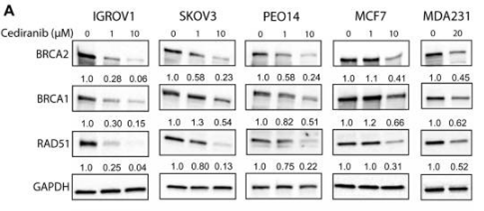
| Western blot | BRCA2 / BRCA1 / RAD51 p-VEGFR1 / p-VEGFR3 / p-AKT / p-ERK |
|
31092693 |
Klinische Studieninformationen
(Daten von https://clinicaltrials.gov, aktualisiert am 2024-05-22)
| NCT-Nummer | Rekrutierung | Erkrankungen | Sponsor/Kooperationspartner | Startdatum | Phasen |
|---|---|---|---|---|---|
| NCT04184518 | Withdrawn | Uveal Melanoma|Metastatic Cancer |
Grupo Español Multidisciplinar de Melanoma|MFAR |
May 2020 | Phase 2 |
| NCT02484404 | Recruiting | Colorectal Neoplasms|Breast Neoplasms |
National Cancer Institute (NCI)|National Institutes of Health Clinical Center (CC) |
June 29 2015 | Phase 1|Phase 2 |
| NCT01391962 | Active not recruiting | Sarcoma Alveolar Soft Part |
National Cancer Institute (NCI)|National Institutes of Health Clinical Center (CC) |
July 18 2011 | Phase 2 |
| NCT01337401 | Unknown status | Alveolar Soft-part Sarcoma |
Institute of Cancer Research United Kingdom|Royal Marsden NHS Foundation Trust |
July 2011 | Phase 2 |
| NCT01160926 | Terminated | Rectal Cancer |
The Christie NHS Foundation Trust|Cancer Research UK|AstraZeneca |
July 2010 | Phase 1 |
Technischer Support
Tel: +1-832-582-8158 Ext:3
Wenn Sie weitere Fragen haben, hinterlassen Sie bitte eine Nachricht.

Produkte sind nur für Forschungszwecke bestimmt. Nicht für den menschlichen Gebrauch. Wir verkaufen nicht an Patienten.
©Copyright 2013 Selleck Chemicals. Alle Rechte vorbehalten.