
nur für Forschungszwecke
BMS-536924 IGF-1R Inhibitor
Kat.-Nr.S1012
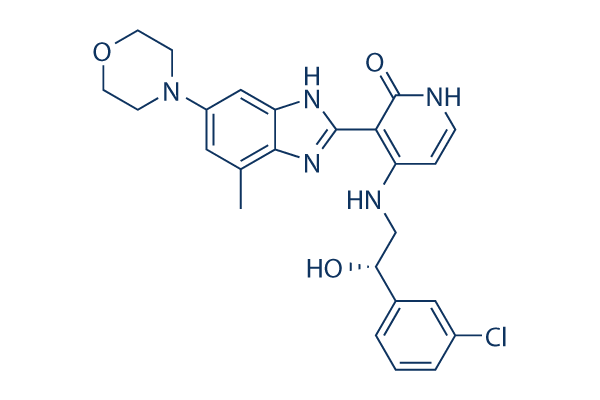
Chemische Struktur
Molekulargewicht: 479.96
Qualitätskontrolle
| Verwandte Ziele | EGFR VEGFR PDGFR FGFR c-Met Src MEK CSF-1R FLT3 HER2 |
|---|---|
| Weitere IGF-1R Inhibitoren | Linsitinib (OSI-906) NVP-AEW541 BMS-754807 Picropodophyllin (AXL1717) GSK1904529A AG-1024 NVP-ADW742 NT157 PQ 401 MSDC-0160 |
Chemische Informationen, Lagerung & Stabilität
| Molekulargewicht | 479.96 | Formel | C25H26ClN5O3 |
Lagerung (Ab dem Eingangsdatum) | |
|---|---|---|---|---|---|
| CAS-Nr. | 468740-43-4 | SDF herunterladen | Lagerung von Stammlösungen |
|
|
| Synonyme | CS-0117 | Smiles | CC1=CC(=CC2=C1N=C(N2)C3=C(C=CNC3=O)NCC(C4=CC(=CC=C4)Cl)O)N5CCOCC5 | ||
Löslichkeit
|
In vitro |
DMSO
: 96 mg/mL
(200.01 mM)
Water : Insoluble Ethanol : Insoluble |
Molaritätsrechner
|
In vivo |
|||||
In-vivo-Formulierungsrechner (Klare Lösung)
Schritt 1: Geben Sie die untenstehenden Informationen ein (Empfohlen: Ein zusätzliches Tier zur Berücksichtigung von Verlusten während des Experiments)
Schritt 2: Geben Sie die In-vivo-Formulierung ein (Dies ist nur der Rechner, keine Formulierung. Bitte kontaktieren Sie uns zuerst, wenn es im Abschnitt "Löslichkeit" keine In-vivo-Formulierung gibt.)
Berechnungsergebnisse:
Arbeitskonzentration: mg/ml;
Methode zur Herstellung der DMSO-Stammlösung: mg Wirkstoff vorgelöst in μL DMSO ( Konzentration der Stammlösung mg/mL, Bitte kontaktieren Sie uns zuerst, wenn die Konzentration die DMSO-Löslichkeit der Wirkstoffcharge überschreitet. )
Methode zur Herstellung der In-vivo-Formulierung: Nehmen Sie μL DMSO Stammlösung, dann hinzufügenμL PEG300, mischen und klären, dann hinzufügenμL Tween 80, mischen und klären, dann hinzufügen μL ddH2O, mischen und klären.
Methode zur Herstellung der In-vivo-Formulierung: Nehmen Sie μL DMSO Stammlösung, dann hinzufügen μL Maisöl, mischen und klären.
Hinweis: 1. Bitte stellen Sie sicher, dass die Flüssigkeit klar ist, bevor Sie das nächste Lösungsmittel hinzufügen.
2. Achten Sie darauf, das/die Lösungsmittel der Reihe nach hinzuzufügen. Sie müssen sicherstellen, dass die bei der vorherigen Zugabe erhaltene Lösung eine klare Lösung ist, bevor Sie mit der Zugabe des nächsten Lösungsmittels fortfahren. Physikalische Methoden wie Vortex, Ultraschall oder ein heißes Wasserbad können zur Unterstützung des Lösens verwendet werden.
Wirkmechanismus
| Targets/IC50/Ki |
Insulin Receptor
73 nM
IGF-1R
100 nM
FAK
150 nM
MEK
182 nM
LCK
341 nM
VEGFR2
1.4 μM
EGF
1.6 μM
Met
4.87 μM
|
|---|---|
| In vitro |
BMS-536924 hemmt auch FAK und Lck mit einer IC50 von 150 nM bzw. 341 nM. Diese Verbindung hemmt die Zellproliferation und stört die Akt- und MAPK-Phosphorylierung. Sie hemmt die IGF-I-stimulierte IGF-1R-Signalgebung in MCF10A-Zellen und blockiert die konstitutive IGF-1R-Aktivität in CD8-IGF-1R-MCF10A. Die Präinkubation von MCF10A-Zellen mit 1 μM dieser Chemikalie blockiert vollständig die Fähigkeit von IGF-I, die IGF-1R-Phosphorylierung zu stimulieren. Die IGF-I-Stimulation führt zu einer erhöhten Phosphorylierung von ERK1/2, GSK3β und Akt. Diese Verbindung hemmt diese Liganden-induzierte Phosphorylierung. Die Behandlung der CD8-IGF-1R-MCF10A-Zellen mit diesem Inhibitor führt zu einer dosisabhängigen Hemmung der Phosphorylierung mit partieller Hemmung bei 0,01 μM und 0,1 μM, aber vollständiger Rezeptorhemmung bei einer Konzentration von 1 μM. Die maximale Hemmung des phosphorylierten IGF-1R wird bereits nach 10 Minuten Inkubation beobachtet. Es behält seine Fähigkeit, die IGF-1R-Phosphorylierung für bis zu 48 Stunden zu hemmen. Die Zugabe dieses Agens hemmt die Akt-Phosphorylierung zeitabhängig, beginnend nach 1 Stunde. Nach 48 Stunden ist die Akt-Aktivierung vollständig blockiert. Die Behandlung mit dieser Verbindung zeigt eine antiproliferative Aktivität in einer Reihe von Krebszelllinien, einschließlich TC32-, HT1080/S-, SK-LMS-1-, H513- und CTR-Zellen. pIGF-1R/pIR wird nach IGF-I/Insulin-Stimulation aktiviert und die Aktivierung wird durch diese Chemikalie mit ähnlichen Potenzen in Rh41- und Rh36-Zelllinien gehemmt. Die Expression von programmed cell death 4 (PDCD4), die Spaltung von Poly(ADP-Ribose)-Polymerase (PARP) und Caspase-3 sind in Rh41-Zellen, die mit diesem Inhibitor behandelt wurden, hochreguliert.
|
| Kinase-Assay |
IGF-I-Signalweg-Aktivität
|
|
1 × 10⁶ pBabe-MCF10A-Zellen werden auf 60-mm-Schalen ausgesät. Nach 24 Stunden wird das Medium auf serumfreies Medium gewechselt und über Nacht bei 37 °C für 24 Stunden inkubiert. Die Zellen werden dann mit oder ohne 1 uM BMS-536924 für 1 Stunde in serumfreiem Medium vorinkubiert, gefolgt von einer Stimulation mit IGF-I (50 ng/mL) für 10 Minuten. Die Zellmonolayer werden zweimal mit PBS gewaschen und für die Immunoblot-Analyse geerntet.
|
|
| In vivo |
Die orale Verabreichung von BMS-536924 bei 100-300 mg/kg hemmt das IGR-1R Sal Tumormodell stark. Eine Wirksamkeit wird auch im nicht-genmanipulierten Colo205 humanen Dickdarmkarzinommodell beobachtet. Die orale Verabreichung dieser Verbindung einmal täglich (100-300 mg/kg) oder zweimal täglich (50, 100 mg/kg) zeigt Antitumoraktivität in diesem Tumormodell. Der orale Glukosetoleranztest (OGTT) zeigt, dass 100 mg/kg (zweimal täglich) nach einer Glukosebelastung einen signifikanten Anstieg der Glukosespiegel verursacht. Die pharmakokinetischen Parameter dieser Chemikalie, die oral in Poly(ethylenglykol) 400 und Wasser (80:20 v/v) verabreicht wurde, wurden in Maus, Ratte, Hund und Affe bestimmt. Eine gute Bioverfügbarkeit war in allen Spezies offensichtlich. Eine signifikante nichtlineare Pharmakokinetik wurde bei Nagetieren mit zunehmender oraler Dosis beobachtet. Diese Verbindung reduziert das Tumorxenograftvolumen von CD8-IGF-1R-MCF10A-Zellen nach zweiwöchiger Behandlung (100 mg/kg) auf 76 %. Die orale Verabreichung von 70 mg/kg dieser Chemikalie hemmt das Tumorwachstum (TGBC-1TKB-Zellen), die in Nacktmäuse inokuliert wurden, signifikant. Es reguliert die Apoptose in Xenograft-Tumoren hoch. Die Behandlung hatte keine nachteiligen Auswirkungen auf das Körpergewicht der Mäuse oder die Glukosespiegel zum Zeitpunkt des Todes, was auf eine tolerierbare Toxizität hindeutet.
|
Literatur |
|
Technischer Support
Tel: +1-832-582-8158 Ext:3
Wenn Sie weitere Fragen haben, hinterlassen Sie bitte eine Nachricht.
Häufig gestellte Fragen
Frage 1:
What are the differences between it and S1034?
Antwort:
The most remarkable difference between these two IGF-IR inhibitors is that S1012 is an ATP-competitive inhibitor. You will get more information about the differences between IR inhibitors in this reference: http://www.sciencedirect.com/science/article/pii/S1359644605035129.

Produkte sind nur für Forschungszwecke bestimmt. Nicht für den menschlichen Gebrauch. Wir verkaufen nicht an Patienten.
©Copyright 2013 Selleck Chemicals. Alle Rechte vorbehalten.