
nur für Forschungszwecke
BMS-777607 c-Met Inhibitor
Kat.-Nr.S1561
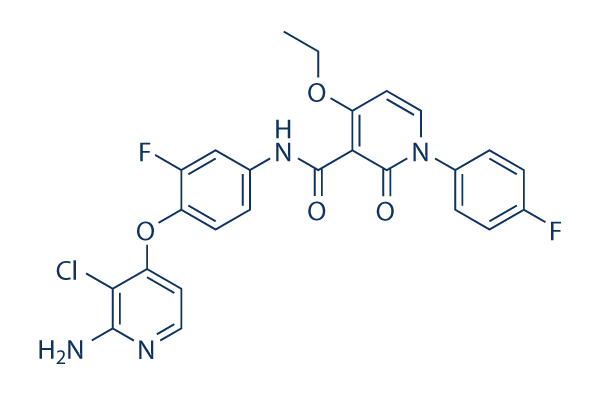
Chemische Struktur
Molekulargewicht: 512.89
Qualitätskontrolle
| Verwandte Ziele | EGFR VEGFR PDGFR FGFR Src MEK CSF-1R FLT3 HER2 c-Kit |
|---|---|
| Weitere c-Met Inhibitoren | Tepotinib Dihexa SGX-523 PHA-665752 Foretinib SU11274 JNJ-38877605 Tivantinib PF-04217903 Savolitinib (AZD6094) |
Zellkultur, Behandlung & Arbeitskonzentration
| Zelllinien | Assay-Typ | Konzentration | Inkubationszeit | Formulierung | Aktivitätsbeschreibung | PMID |
|---|---|---|---|---|---|---|
| PC-3 | Function assay | 0.1 μM | DMSO | exhibits inhibitory effect on HGF-induced cell scattering | 20515943 | |
| DU145 | Function assay | 0.1 μM | DMSO | exhibits inhibitory effect on HGF-induced cell scattering | 20515943 | |
| PC-3 | Function assay | 0.01 μM | DMSO | suppresses HGF-induced cell migration | 20515943 | |
| DU145 | Function assay | 0.01 μM | DMSO | suppresses HGF-induced cell migration | 20515943 | |
| PC-3 | Function assay | 0.1 μM | DMSO | impairs HGF-mediated cell invasion | 20515943 | |
| DU145 | Function assay | 0.1 μM | DMSO | impairs HGF-mediated cell invasion | 20515943 | |
| PC-3 | Growth inhibitory assay | ~10 μM | DMSO | reduces cell proliferation | 20515943 | |
| KHT | Kinase assay | DMSO | blocks the c-Met signaling pathway with IC50 of 10 nM | 22286523 | ||
| KHT | Function assay | ~1 μM | DMSO | prevents spontaneous KHT cell scattering with IC50 of 0.1-0.5 μM | 22286523 | |
| KHT | Function assay | ~0.5 μM | DMSO | inhibits cell migration | 22286523 | |
| KHT | Function assay | ~0.5 μM | DMSO | inhibits cell invasion | 22286523 | |
| KHT | Growth inhibitory assay | ~10 μM | DMSO | inhibits KHT cell proliferation | 22286523 | |
| T-47D | Growth inhibitory assay | ~5 μM | DMSO | inhibits cell proliferation | 23468529 | |
| ZR-75-1 | Growth inhibitory assay | ~5 μM | DMSO | inhibits cell proliferation | 23468529 | |
| T-47D | Function assay | 10 μM | DMSO | Induces polyploidy by 86 % | 23468529 | |
| ZR-75-1 | Function assay | 10 μM | DMSO | Induces polyploidy by 88% | 23468529 | |
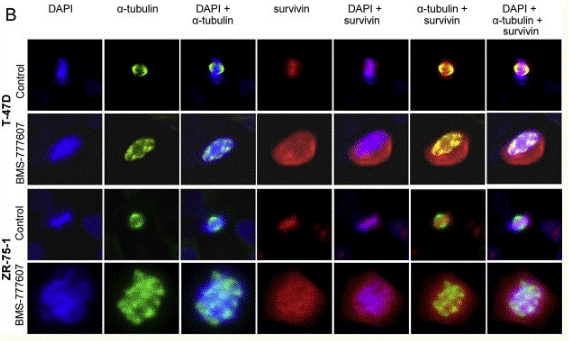
| T-47D | Function assay | 10 μM | DMSO | inhibits AURK-B function and induces its protein degradation | 23468529 | |
| CHRF | Function assay | 10 μM | DMSO | inhibits cell division | 25304900 | |
| HPDE | Function assay | 10 μM | DMSO | blocks constitutive activation and decreased AKT signaling | 26477314 | |
| U118MG | Kinase assay | ~3 μM | DMSO | blocks AXL phosphorylation | 26848524 | |
| SF126 | Kinase assay | ~3 μM | DMSO | blocks AXL phosphorylation | 26848524 | |
| U118MG | Cytoxicity assay | 12.5 μM | DMSO | decreases glioma cell viability | 26848524 | |
| SF126 | Cytoxicity assay | 12.5 μM | DMSO | decreases glioma cell viability | 26848524 | |
| U118MG | Apoptosis assay | 12.5 μM | DMSO | induces glioma cell apoptosis | 26848524 | |
| SF126 | Apoptosis assay | 12.5 μM | DMSO | induces glioma cell apoptosis | 26848524 | |
| U118MG | Function assay | 12.5 μM | DMSO | blocks glioma cell migration and invasive growth pattern | 26848524 | |
| SF126 | Function assay | 12.5 μM | DMSO | blocks glioma cell migration and invasive growth pattern | 26848524 | |
| GTL16 | Function assay | 30 mins | Inhibition of Met phosphorylation in human GTL16 cells after 30 mins, IC50 = 0.02 μM. | 19260711 | ||
| GTL16 | Antiproliferative assay | 72 hrs | Antiproliferative activity against Met-dependent human GTL16 cells after 72 hrs by MTS assay, IC50 = 0.1 μM. | 19260711 | ||
| NCI-H1993 | Antiproliferative assay | 72 hrs | Antiproliferative activity against Met-dependent human NCI-H1993 cells after 72 hrs by MTS assay, IC50 = 0.15 μM. | 19260711 | ||
| U87 | Antiproliferative assay | 72 hrs | Antiproliferative activity against Met-driven human U87 cells after 72 hrs by MTS assay, IC50 = 0.16 μM. | 19260711 | ||
| BAF3 | Cytotoxicity assay | 72 hrs | Cytotoxicity against mouse BAF3 cells expressing TPR-Met assessed as growth inhibition after 72 hrs, IC50 = 0.1884 μM. | 24792774 | ||
| DU145 | Antiinvasive assay | 1 hr | Antiinvasive activity in human DU145 cells assessed as inhibition of HGF-induced cell motility preincubated for 1 hr before HGF treatment measured after 24 hrs by cell scattering assay, IC50 = 0.2 μM. | 24900830 | ||
| MKN45 | Cytotoxicity assay | 72 hrs | Cytotoxicity against human MKN45 cells assessed as growth inhibition after 72 hrs, IC50 = 0.2858 μM. | 24792774 | ||
| NCI-H1993 | Cytotoxicity assay | 48 hrs | Cytotoxicity against human NCI-H1993 cells after 48 hrs by MTT assay, IC50 = 1.108 μM. | 24900830 | ||
| GTL16 | Function assay | 6.25 mg/kg | Cmax in human GTL16 cells xenografted athymic mouse at 6.25 mg/kg, po, Cmax = 4.5 μM. | 19260711 | ||
| GTL16 | Function assay | 50 mg/kg | Cmax in human GTL16 cells xenografted athymic mouse at 50 mg/kg, po, Cmax = 43.7 μM. | 19260711 | ||
| SJ-GBM2 | qHTS assay | qHTS of pediatric cancer cell lines to identify multiple opportunities for drug repurposing: Primary screen for SJ-GBM2 cells | 29435139 | |||
| A673 | qHTS assay | qHTS of pediatric cancer cell lines to identify multiple opportunities for drug repurposing: Primary screen for A673 cells | 29435139 | |||
| SK-N-MC | qHTS assay | qHTS of pediatric cancer cell lines to identify multiple opportunities for drug repurposing: Primary screen for SK-N-MC cells | 29435139 | |||
| Saos-2 | qHTS assay | qHTS of pediatric cancer cell lines to identify multiple opportunities for drug repurposing: Primary screen for Saos-2 cells | 29435139 | |||
| LAN-5 | qHTS assay | qHTS of pediatric cancer cell lines to identify multiple opportunities for drug repurposing: Primary screen for LAN-5 cells | 29435139 | |||
| OHS-50 | qHTS assay | qHTS of pediatric cancer cell lines to identify multiple opportunities for drug repurposing: Primary screen for OHS-50 cells | 29435139 | |||
| A673 | qHTS assay | qHTS of pediatric cancer cell lines to identify multiple opportunities for drug repurposing: Confirmatory screen for A673 cells) | 29435139 | |||
| SK-N-MC | qHTS assay | qHTS of pediatric cancer cell lines to identify multiple opportunities for drug repurposing: Confirmatory screen for SK-N-MC cells | 29435139 | |||
| SJ-GBM2 | qHTS assay | qHTS of pediatric cancer cell lines to identify multiple opportunities for drug repurposing: Confirmatory screen for SJ-GBM2 cells | 29435139 | |||
| TC32 | qHTS assay | qHTS of pediatric cancer cell lines to identify multiple opportunities for drug repurposing: Confirmatory screen for TC32 cells | 29435139 | |||
| MG 63 (6-TG R) | qHTS assay | qHTS of pediatric cancer cell lines to identify multiple opportunities for drug repurposing: Confirmatory screen for MG 63 (6-TG R) cells | 29435139 | |||
| MGHU3 | Antiproliferative assay | 72 hrs | Antiproliferative activity against human MGHU3 cells after 72 hrs by CellTiter-Glo assay | 30309671 | ||
| RT112 | Antiproliferative assay | 72 hrs | Antiproliferative activity against human RT112 cells after 72 hrs by CellTiter-Glo assay | 30309671 | ||
| Klicken Sie hier, um weitere experimentelle Daten zu Zelllinien anzuzeigen | ||||||
Chemische Informationen, Lagerung & Stabilität
| Molekulargewicht | 512.89 | Formel | C25H19ClF2N4O4 |
Lagerung (Ab dem Eingangsdatum) | |
|---|---|---|---|---|---|
| CAS-Nr. | 1025720-94-8 | SDF herunterladen | Lagerung von Stammlösungen |
|
|
| Synonyme | BMS 817378 | Smiles | CCOC1=C(C(=O)N(C=C1)C2=CC=C(C=C2)F)C(=O)NC3=CC(=C(C=C3)OC4=C(C(=NC=C4)N)Cl)F | ||
Löslichkeit
|
In vitro |
DMSO
: 100 mg/mL
(194.97 mM)
Water : Insoluble Ethanol : Insoluble |
Molaritätsrechner
|
In vivo |
|||||
In-vivo-Formulierungsrechner (Klare Lösung)
Schritt 1: Geben Sie die untenstehenden Informationen ein (Empfohlen: Ein zusätzliches Tier zur Berücksichtigung von Verlusten während des Experiments)
Schritt 2: Geben Sie die In-vivo-Formulierung ein (Dies ist nur der Rechner, keine Formulierung. Bitte kontaktieren Sie uns zuerst, wenn es im Abschnitt "Löslichkeit" keine In-vivo-Formulierung gibt.)
Berechnungsergebnisse:
Arbeitskonzentration: mg/ml;
Methode zur Herstellung der DMSO-Stammlösung: mg Wirkstoff vorgelöst in μL DMSO ( Konzentration der Stammlösung mg/mL, Bitte kontaktieren Sie uns zuerst, wenn die Konzentration die DMSO-Löslichkeit der Wirkstoffcharge überschreitet. )
Methode zur Herstellung der In-vivo-Formulierung: Nehmen Sie μL DMSO Stammlösung, dann hinzufügenμL PEG300, mischen und klären, dann hinzufügenμL Tween 80, mischen und klären, dann hinzufügen μL ddH2O, mischen und klären.
Methode zur Herstellung der In-vivo-Formulierung: Nehmen Sie μL DMSO Stammlösung, dann hinzufügen μL Maisöl, mischen und klären.
Hinweis: 1. Bitte stellen Sie sicher, dass die Flüssigkeit klar ist, bevor Sie das nächste Lösungsmittel hinzufügen.
2. Achten Sie darauf, das/die Lösungsmittel der Reihe nach hinzuzufügen. Sie müssen sicherstellen, dass die bei der vorherigen Zugabe erhaltene Lösung eine klare Lösung ist, bevor Sie mit der Zugabe des nächsten Lösungsmittels fortfahren. Physikalische Methoden wie Vortex, Ultraschall oder ein heißes Wasserbad können zur Unterstützung des Lösens verwendet werden.
Wirkmechanismus
| Merkmale |
A potent inhibitor of the Met family, and >40-fold selectivity vs. Lck, VEGFR2, and TrkA/B and >500-fold selective vs. other receptor and non-receptor kinases.
|
|---|---|
| Targets/IC50/Ki |
Axl
(Cell-free assay) 1.1 nM
RON
(Cell-free assay) 1.8 nM
Met
(Cell-free assay) 3.9 nM
Tyro3
(Cell-free assay) 4.3 nM
Mer
(Cell-free assay) 14 nM
FLT3
(Cell-free assay) 16 nM
Aurora B
(Cell-free assay) 78 nM
|
| In vitro |
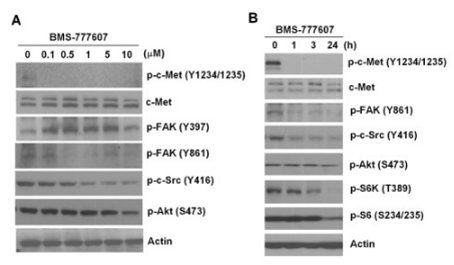
BMS-777607 ist ein selektiver ATP-kompetitiver Met-Kinaseinhibitor, der die Autophosphorylierung von c-Met mit einer IC50 von 20 nM in GTL-16-Zelllysaten potent blockiert und eine selektive Hemmung der Proliferation in Met-getriebenen Tumorzelllinien wie der GTL-16-Zelllinie, H1993 und U87 zeigt. Diese Verbindung hemmt die durch hepatocyte growth factor (HGF) ausgelöste c-Met-Autophosphorylierung mit einer IC50 von <1 nM in PC-3- und DU145-Prostatakrebszellen. Diese Verbindung hat wenig Einfluss auf das Wachstum von Tumorzellen, zeigt aber eine hemmende Wirkung auf die HGF-induzierte Zellstreuung in PC-3- und DU145-Zellen, mit fast vollständiger Hemmung bei 0,5 M. Sie unterdrückt auch die stimulierte Zellmigration und -invasion dosisabhängig (IC50 < 0,1 M) in beiden Zelllinien. Die Anwendung dieser Verbindung (~10 M) auf die hochmetastatischen murinen KHT-Zellen für 2 Stunden eliminiert potent die basalen Spiegel von autophosphoryliertem c-Met mit einer IC50 von 10 nM, ohne das gesamte c-Met zu beeinflussen, was zu einer dosisabhängigen Hemmung der Phosphorylierung nachgeschalteter Signalmoleküle einschließlich ERK, Akt, p70S6K und S6 führt. Die Behandlung mit dieser Verbindung (~1 M) für 24 Stunden hemmt potent die Streuung, Motilität und Invasion von KHT-Zellen in nanomolaren Dosen, was mit dem MET-Gen-Knockdown übereinstimmt, und beeinflusst die Zellproliferation und Koloniebildung mäßig. |
| Kinase-Assay |
Met-Kinase-Assay
|
|
Die Kinase-Reaktion besteht aus im Baculovirus exprimiertem GST-Met, 3
Lg Poly(Glu/Tyr), 0,12
Ci 33P
-ATP, 1
M ATP in 30
L Kinase-Puffer (20 mM Tris-Cl, 5 mM MnCl2, 0,1 mg/mL BSA, 0,5 mM DTT). Die Reaktionen werden 1 Stunde bei 30 °C inkubiert und durch Zugabe von kalter Trichloressigsäure (TCA) zu einer Endkonzentration von 8 % gestoppt. TCA-Präzipitate werden mittels eines Filtermate Universal Harvester auf GF/C-Unifilterplatten gesammelt, und die Filter werden mittels eines TopCount 96-Well Liquid Scintillation Counter quantifiziert. Dosis-Wirkungs-Kurven werden erstellt, um die Konzentration zu bestimmen, die erforderlich ist, um 50 % der Substratphosphorylierung zu hemmen (IC50). Diese Verbindung wird in 10 mM DMSO gelöst und in 10 Konzentrationen, doppelt, evaluiert.
|
|
| In vivo |
Die orale Verabreichung von BMS 777607 (6,25-50 mg/kg) reduziert signifikant das Tumorvolumen von GTL-16-Human-Tumor-Xenotransplantaten in athymischen Mäusen ohne beobachtete Toxizität. Die Verabreichung dieser Verbindung (25 mg/kg/Tag) verringert die Anzahl der KHT-Lungentumornoduli (28,3 %), verbessert die morphologische Hämorrhagie und beeinträchtigt signifikant den metastatischen Phänotyp bei 6-8 Wochen alten weiblichen C3H/HeJ-Mäusen, denen murine Fibrosarkom-KHT-Zellen injiziert wurden, ohne offensichtliche systemische Toxizität im Vergleich zur Kontrollbehandlung. Eine niedrige Dosis dieser Chemikalie (10 mg/kg) bietet auch eine milde, aber nicht signifikante Hemmung der Lungenknötchenbildung im Vergleich zur Vehikelkontrolle. |
Literatur |
|
Anwendungen
| Methoden | Biomarker | Bilder | PMID |
|---|---|---|---|
| Western blot | p-c-Met / c-Met / p-FAK / p-c-Src / p-Akt / p-S6K / p-S6 p53 / p21 / Survivin / p-Rb / Rb |
|
22639908 |
| Immunofluorescence | α-tubulin / survivin |
|
24444656 |
Klinische Studieninformationen
(Daten von https://clinicaltrials.gov, aktualisiert am 2024-05-22)
| NCT-Nummer | Rekrutierung | Erkrankungen | Sponsor/Kooperationspartner | Startdatum | Phasen |
|---|---|---|---|---|---|
| NCT01721148 | Completed | Malignant Solid Tumour |
ASLAN Pharmaceuticals |
October 2012 | Phase 1 |
| NCT00605618 | Completed | Advanced Solid Tumors |
Bristol-Myers Squibb |
March 2008 | Phase 1|Phase 2 |
Technischer Support
Tel: +1-832-582-8158 Ext:3
Wenn Sie weitere Fragen haben, hinterlassen Sie bitte eine Nachricht.
Häufig gestellte Fragen
Frage 1:
What formulation can we use to dissolve it for mice in vivo study?
Antwort:
S1561 in 1% DMSO+30% polyethylene glycol+1% Tween 80 at 30 mg/ml is a suspension. It is fine for oral gavage. If you are going to use it for injection, please try the following vehicle: 4% DMSO+30% PEG 300+ddH2O. This compound can be dissolved in it at 5 mg/ml as a clear solution.

Produkte sind nur für Forschungszwecke bestimmt. Nicht für den menschlichen Gebrauch. Wir verkaufen nicht an Patienten.
©Copyright 2013 Selleck Chemicals. Alle Rechte vorbehalten.