
nur für Forschungszwecke
PHA-665752 c-Met Inhibitor
Kat.-Nr.S1070
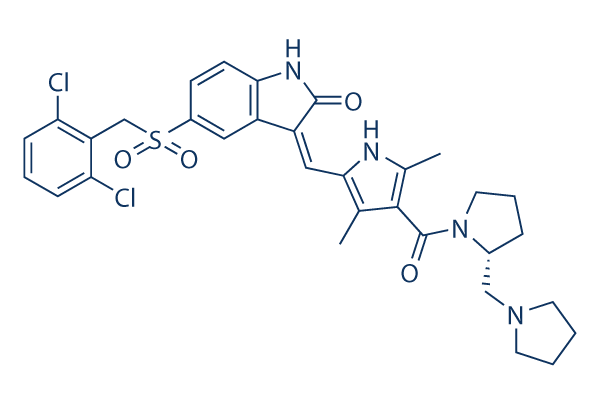
Chemische Struktur
Molekulargewicht: 641.61
Qualitätskontrolle
| Verwandte Ziele | EGFR VEGFR PDGFR FGFR Src MEK CSF-1R FLT3 HER2 c-Kit |
|---|---|
| Weitere c-Met Inhibitoren | Tepotinib Dihexa SGX-523 Foretinib SU11274 BMS-777607 JNJ-38877605 Tivantinib PF-04217903 Savolitinib (AZD6094) |
Zellkultur, Behandlung & Arbeitskonzentration
| Zelllinien | Assay-Typ | Konzentration | Inkubationszeit | Formulierung | Aktivitätsbeschreibung | PMID |
|---|---|---|---|---|---|---|
| NCI-SNU-5 | Growth Inhibition Assay | IC50=0.12375 μM | ||||
| LB2241-RCC | Growth Inhibition Assay | IC50=0.15702 μM | ||||
| KINGS-1 | Growth Inhibition Assay | IC50=0.35911 μM | ||||
| ALL-PO | Growth Inhibition Assay | IC50=0.81277 μM | ||||
| SK-LMS-1 | Growth Inhibition Assay | IC50=0.89846 μM | ||||
| MV-4-11 | Growth Inhibition Assay | IC50=1.2947 μM | ||||
| SUP-T1 | Growth Inhibition Assay | IC50=2.13964 μM | ||||
| MRK-nu-1 | Growth Inhibition Assay | IC50=2.40056 μM | ||||
| ES1 | Growth Inhibition Assay | IC50=3.34866 μM | ||||
| NOS-1 | Growth Inhibition Assay | IC50=4.39867 μM | ||||
| KM12 | Growth Inhibition Assay | IC50=4.418 μM | ||||
| Becker | Growth Inhibition Assay | IC50=5.2466 μM | ||||
| NCI-SNU-1 | Growth Inhibition Assay | IC50=5.63733 μM | ||||
| EW-22 | Growth Inhibition Assay | IC50=7.73614 μM | ||||
| ES6 | Growth Inhibition Assay | IC50=7.8195 μM | ||||
| A498 | Growth Inhibition Assay | IC50=8.28446 μM | ||||
| EW-16 | Growth Inhibition Assay | IC50=9.6543 μM | ||||
| CTV-1 | Growth Inhibition Assay | IC50=9.85024 μM | ||||
| ETK-1 | Growth Inhibition Assay | IC50=10.2931 μM | ||||
| NCI-H1395 | Growth Inhibition Assay | IC50=10.8024 μM | ||||
| DOHH-2 | Growth Inhibition Assay | IC50=10.9264 μM | ||||
| GI-1 | Growth Inhibition Assay | IC50=11.8596 μM | ||||
| HT-144 | Growth Inhibition Assay | IC50=14.2163 μM | ||||
| ES5 | Growth Inhibition Assay | IC50=14.467 μM | ||||
| NALM-6 | Growth Inhibition Assay | IC50=15.2196 μM | ||||
| KNS-81-FD | Growth Inhibition Assay | IC50=15.5849 μM | ||||
| TE-15 | Growth Inhibition Assay | IC50=16.5771 μM | ||||
| SCC-15 | Growth Inhibition Assay | IC50=18.3498 μM | ||||
| EoL-1-cell | Growth Inhibition Assay | IC50=18.4545 μM | ||||
| NCI-H720 | Growth Inhibition Assay | IC50=18.771 μM | ||||
| NB14 | Growth Inhibition Assay | IC50=19.5425 μM | ||||
| KE-37 | Growth Inhibition Assay | IC50=19.8233 μM | ||||
| LXF-289 | Growth Inhibition Assay | IC50=19.8629 μM | ||||
| RPMI-8402 | Growth Inhibition Assay | IC50=20.3269 μM | ||||
| SK-N-DZ | Growth Inhibition Assay | IC50=21.2131 μM | ||||
| ACN | Growth Inhibition Assay | IC50=22.2497 μM | ||||
| TE-11 | Growth Inhibition Assay | IC50=26.069 μM | ||||
| COLO-800 | Growth Inhibition Assay | IC50=27.17 μM | ||||
| MOLT-13 | Growth Inhibition Assay | IC50=27.1847 μM | ||||
| 697 | Growth Inhibition Assay | IC50=28.7633 μM | ||||
| VA-ES-BJ | Growth Inhibition Assay | IC50=29.3729 μM | ||||
| EW-13 | Growth Inhibition Assay | IC50=29.5045 μM | ||||
| NB7 | Growth Inhibition Assay | IC50=32.2665 μM | ||||
| MONO-MAC-6 | Growth Inhibition Assay | IC50=32.8795 μM | ||||
| SW962 | Growth Inhibition Assay | IC50=33.4513 μM | ||||
| KS-1 | Growth Inhibition Assay | IC50=33.9481 μM | ||||
| KU812 | Growth Inhibition Assay | IC50=34.5702 μM | ||||
| IMR-5 | Growth Inhibition Assay | IC50=37.4318 μM | ||||
| BC-1 | Growth Inhibition Assay | IC50=38.033 μM | ||||
| NCI-H510A | Growth Inhibition Assay | IC50=38.2032 μM | ||||
| EW-18 | Growth Inhibition Assay | IC50=40.8303 μM | ||||
| CCRF-CEM | Growth Inhibition Assay | IC50=42.2797 μM | ||||
| HH | Growth Inhibition Assay | IC50=43.5069 μM | ||||
| NCI-H2171 | Growth Inhibition Assay | IC50=46.0272 μM | ||||
| LC-2-ad | Growth Inhibition Assay | IC50=49.1413 μM | ||||
| Klicken Sie hier, um weitere experimentelle Daten zu Zelllinien anzuzeigen | ||||||
Chemische Informationen, Lagerung & Stabilität
| Molekulargewicht | 641.61 | Formel | C32H34Cl2N4O4S |
Lagerung (Ab dem Eingangsdatum) | |
|---|---|---|---|---|---|
| CAS-Nr. | 477575-56-7 | SDF herunterladen | Lagerung von Stammlösungen |
|
|
| Synonyme | N/A | Smiles | CC1=C(NC(=C1C(=O)N2CCCC2CN3CCCC3)C)C=C4C5=C(C=CC(=C5)S(=O)(=O)CC6=C(C=CC=C6Cl)Cl)NC4=O | ||
Löslichkeit
|
In vitro |
DMSO
: 128 mg/mL
(199.49 mM)
Ethanol : 10 mg/mL Water : Insoluble |
Molaritätsrechner
|
In vivo |
|||||
In-vivo-Formulierungsrechner (Klare Lösung)
Schritt 1: Geben Sie die untenstehenden Informationen ein (Empfohlen: Ein zusätzliches Tier zur Berücksichtigung von Verlusten während des Experiments)
Schritt 2: Geben Sie die In-vivo-Formulierung ein (Dies ist nur der Rechner, keine Formulierung. Bitte kontaktieren Sie uns zuerst, wenn es im Abschnitt "Löslichkeit" keine In-vivo-Formulierung gibt.)
Berechnungsergebnisse:
Arbeitskonzentration: mg/ml;
Methode zur Herstellung der DMSO-Stammlösung: mg Wirkstoff vorgelöst in μL DMSO ( Konzentration der Stammlösung mg/mL, Bitte kontaktieren Sie uns zuerst, wenn die Konzentration die DMSO-Löslichkeit der Wirkstoffcharge überschreitet. )
Methode zur Herstellung der In-vivo-Formulierung: Nehmen Sie μL DMSO Stammlösung, dann hinzufügenμL PEG300, mischen und klären, dann hinzufügenμL Tween 80, mischen und klären, dann hinzufügen μL ddH2O, mischen und klären.
Methode zur Herstellung der In-vivo-Formulierung: Nehmen Sie μL DMSO Stammlösung, dann hinzufügen μL Maisöl, mischen und klären.
Hinweis: 1. Bitte stellen Sie sicher, dass die Flüssigkeit klar ist, bevor Sie das nächste Lösungsmittel hinzufügen.
2. Achten Sie darauf, das/die Lösungsmittel der Reihe nach hinzuzufügen. Sie müssen sicherstellen, dass die bei der vorherigen Zugabe erhaltene Lösung eine klare Lösung ist, bevor Sie mit der Zugabe des nächsten Lösungsmittels fortfahren. Physikalische Methoden wie Vortex, Ultraschall oder ein heißes Wasserbad können zur Unterstützung des Lösens verwendet werden.
Wirkmechanismus
| Targets/IC50/Ki |
c-Met
(Cell-free assay) 9 nM
RON
(Cell-free assay) 68 nM
Flk1
(Cell-free assay) 200 nM
|
|---|---|
| In vitro |
PHA-665752 hemmt die c-Met-Kinaseaktivität signifikant mit einem Ki von 4 nM und zeigt eine >50-fache Selektivität für c-Met im Vergleich zu verschiedenen Tyrosin- und Serin-Threonin-Kinasen. Diese Verbindung hemmt die HGF-stimulierte c-Met-Autophosphorylierung potent mit einer IC50 von 25-50 nM. Sie blockiert auch signifikant HGF- und c-Met-abhängige Funktionen wie Zellmotilität und Zellproliferation mit IC50-Werten von 40-50 nM bzw. 18-42 nM. Darüber hinaus hemmt diese Chemikalie die HGF-stimulierte oder konstitutive Phosphorylierung von Mediatoren downstream von c-Met wie Gab-1, ERK, Akt, STAT3, PLC-γ und FAK in mehreren Tumorzelllinien potent. Es hemmt das Zellwachstum in TPR-MET-transformierten BaF3-Zellen mit einer IC50 von <60 nM und hemmt die konstitutive Zellmotilität und -migration um 92,5 % bei 0,2 μM. Die Hemmung von c-Met durch diese Verbindung (0,2 μM) induziert auch eine Zellapoptose von 33,1 % und einen G1-Zellzyklusarrest, wobei die Zellen in der G1-Phase von 42,4 % auf 77,0 % ansteigen. Es kann mit Rapamycin zusammenwirken, um das Zellwachstum von TPR-MET-transformierten BaF3-Zellen und nicht-kleinzelligen Lungenkrebs-H441-Zellen zu hemmen.
|
| Kinase-Assay |
In-vitro-Enzymtest
|
|
Das c-Met-Kinasedomänen-GST-Fusionsprotein wird für den c-Met-Assay verwendet. Der IC50-Wert von PHA-665752 für die Hemmung von c-Met basiert auf der Phosphorylierung von Kinase-Peptidsubstraten oder Poly-Glu-Tyr in Gegenwart von ATP und einem zweiwertigen Kation (MgCl2 oder MnCl2 10-20 mM). Der lineare Bereich (d.h. der Zeitraum, über den die Rate dem Anfangswert entspricht) wird für c-Met bestimmt, und die kinetische Messung und IC50-Bestimmung werden innerhalb dieses Bereichs durchgeführt.
|
|
| In vivo |
Die Verabreichung von PHA-665752 induziert eine dosisabhängige Tumorwachstumshemmung von S114-Xenotransplantaten um 20 %, 39 % und 68 % bei Dosen von 7,5, 15 bzw. 30 mg/kg/Tag. Diese Verbindung reduzierte das Tumorwachstum von NCI-H69, NCI-H441 und A549 in Maus-Xenotransplantaten signifikant um 99 %, 75 % bzw. 59 %. Sie hemmt auch die Angiogenese signifikant um >85 %, da sie die Produktion des vaskulären endothelialen Wachstumsfaktors verringert und die Produktion des Angiogenese-Inhibitors Thrombospondin-1 erhöht.
|
Literatur |
|
Anwendungen
| Methoden | Biomarker | Bilder | PMID |
|---|---|---|---|
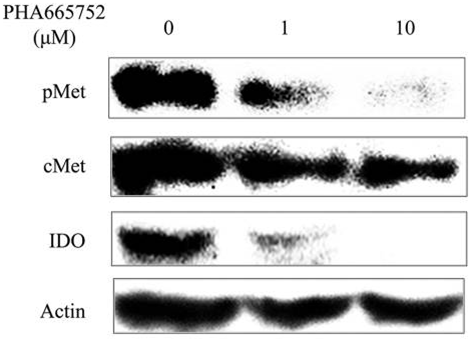
| Western blot | IDO p-Met / Met / p-Akt / Akt / p-ERK / ERK |
|
27082119 |
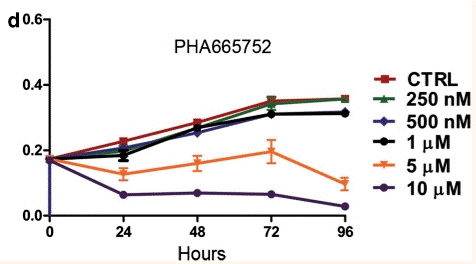
| Growth inhibition assay | Cell proliferation |
|
20603611 |
Technischer Support
Tel: +1-832-582-8158 Ext:3
Wenn Sie weitere Fragen haben, hinterlassen Sie bitte eine Nachricht.
Häufig gestellte Fragen
Frage 1:
I need to use it for intraperitoneal application in mice. Could you tell me the solvent you use, please?
Antwort:
The highest concentration of this compound (S1070) in 4% DMSO+30% PEG 300+5% Tween 80+ddH2O is 5mg/ml. If you want to get higher concentration, the concentration of DMSO and PEG will be higher. For example, it can be dissolved in 8% DMSO+50% PEG 300+5% Tween 80+ddH2O at 10mg/ml clearly.

Produkte sind nur für Forschungszwecke bestimmt. Nicht für den menschlichen Gebrauch. Wir verkaufen nicht an Patienten.
©Copyright 2013 Selleck Chemicals. Alle Rechte vorbehalten.