
nur für Forschungszwecke
SU11274 c-Met Inhibitor
Kat.-Nr.S1080
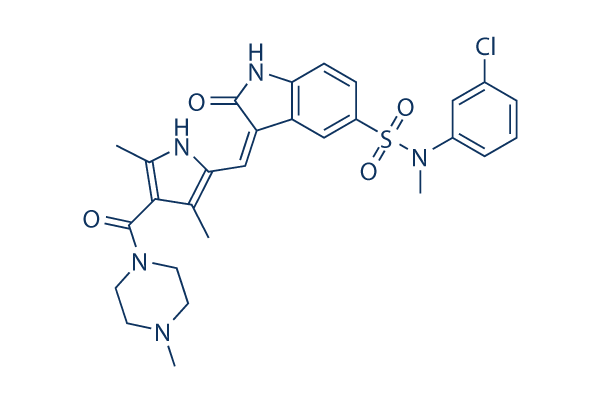
Chemische Struktur
Molekulargewicht: 568.09
Qualitätskontrolle
| Verwandte Ziele | EGFR VEGFR PDGFR FGFR Src MEK CSF-1R FLT3 HER2 c-Kit |
|---|---|
| Weitere c-Met Inhibitoren | Tepotinib Dihexa SGX-523 PHA-665752 Foretinib BMS-777607 JNJ-38877605 Tivantinib PF-04217903 Savolitinib (AZD6094) |
Zellkultur, Behandlung & Arbeitskonzentration
| Zelllinien | Assay-Typ | Konzentration | Inkubationszeit | Formulierung | Aktivitätsbeschreibung | PMID |
|---|---|---|---|---|---|---|
| A549 cells | Function assay | Inhibition of human recombinant c-MET kinase in A549 cells assessed as inhibition of HGF-induced cell growth, IC50=0.01 μM | ||||
| human MDCK cells | Function assay | 24 h | Inhibition of Met-mediated scattering in HGF-stimulated human MDCK cells pre-incubated overnight prior to HGF stimulation for 24 hrs measured after 24 to 48 hrs, IC50=0.152 μM | |||
| mouse BAF3 cells | Proliferation assay | 72 h | Antiproliferative activity against mouse BAF3 cells expressing TPR-Met after 72 hrs in absence of IL-3, IC50=0.53 μM | |||
| human SNU5 cells | Proliferation assay | 72 h | Antiproliferative activity against human SNU5 cells after 72 hrs, IC50=0.8 μM | |||
| human MKN45 cells | Proliferation assay | 72 h | Antiproliferative activity against human MKN45 cells after 72 hrs, IC50=1.3 μM | |||
| human HepG2 cells | Function assay | Inhibition of Met-mediated tumorigenesis in HGF-stimulated human HepG2 cells assessed as impairment in anchorage-independent growth by soft agar growth assay, IC50=1.561 μM | ||||
| mouse NIH/3T3 cells | Proliferation assay | 72 h | Antiproliferative activity against mouse NIH/3T3 cells expressing TPR-Met after 72 hrs, IC50=2 μM | |||
| human MCF7 cells | Proliferation assay | 72 h | Antiproliferative activity against human MCF7 cells after 72 hrs, IC50=6.2 μM | |||
| human SNU1 cells | Proliferation assay | 72 h | Antiproliferative activity against human SNU1 cells after 72 hrs, IC50=7 μM | |||
| human NCI-H1993 cells | Proliferation assay | 72 h | Antiproliferative activity against human NCI-H1993 cells after 72 hrs, IC50=7.3 μM | |||
| human MDA-MB-231 cells | Proliferation assay | 72 h | Antiproliferative activity against human MDA-MB-231 cells after 72 hrs | |||
| human NCI-H441 cells | Proliferation assay | 72 h | Antiproliferative activity against human NCI-H441 cells after 72 hrs | |||
| human BxPC3 cells | Proliferation assay | 72 h | Antiproliferative activity against human BxPC3 cells after 72 hrs | |||
| DLD1 cells | Function assay | 2.5 μM | Inhibition of human p38-alpha phosphorylation in DLD1 cells at 2.5 μM | |||
| DLD1 cells | Function assay | 2.5 μM | 16 h | Inhibition of human MET receptor in DLD1 cells at 2.5 uM after 16 hrs by Western blot | ||
| Klicken Sie hier, um weitere experimentelle Daten zu Zelllinien anzuzeigen | ||||||
Chemische Informationen, Lagerung & Stabilität
| Molekulargewicht | 568.09 | Formel | C28H30CIN5O4S |
Lagerung (Ab dem Eingangsdatum) | |
|---|---|---|---|---|---|
| CAS-Nr. | 658084-23-2 | SDF herunterladen | Lagerung von Stammlösungen |
|
|
| Synonyme | PKI-SU11274 | Smiles | CC1=C(NC(=C1C(=O)N2CCN(CC2)C)C)C=C3C4=C(C=CC(=C4)S(=O)(=O)N(C)C5=CC(=CC=C5)Cl)NC3=O | ||
Löslichkeit
|
In vitro |
DMSO
: 92 mg/mL
(161.94 mM)
Ethanol : 2 mg/mL Water : Insoluble |
Molaritätsrechner
|
In vivo |
|||||
In-vivo-Formulierungsrechner (Klare Lösung)
Schritt 1: Geben Sie die untenstehenden Informationen ein (Empfohlen: Ein zusätzliches Tier zur Berücksichtigung von Verlusten während des Experiments)
Schritt 2: Geben Sie die In-vivo-Formulierung ein (Dies ist nur der Rechner, keine Formulierung. Bitte kontaktieren Sie uns zuerst, wenn es im Abschnitt "Löslichkeit" keine In-vivo-Formulierung gibt.)
Berechnungsergebnisse:
Arbeitskonzentration: mg/ml;
Methode zur Herstellung der DMSO-Stammlösung: mg Wirkstoff vorgelöst in μL DMSO ( Konzentration der Stammlösung mg/mL, Bitte kontaktieren Sie uns zuerst, wenn die Konzentration die DMSO-Löslichkeit der Wirkstoffcharge überschreitet. )
Methode zur Herstellung der In-vivo-Formulierung: Nehmen Sie μL DMSO Stammlösung, dann hinzufügenμL PEG300, mischen und klären, dann hinzufügenμL Tween 80, mischen und klären, dann hinzufügen μL ddH2O, mischen und klären.
Methode zur Herstellung der In-vivo-Formulierung: Nehmen Sie μL DMSO Stammlösung, dann hinzufügen μL Maisöl, mischen und klären.
Hinweis: 1. Bitte stellen Sie sicher, dass die Flüssigkeit klar ist, bevor Sie das nächste Lösungsmittel hinzufügen.
2. Achten Sie darauf, das/die Lösungsmittel der Reihe nach hinzuzufügen. Sie müssen sicherstellen, dass die bei der vorherigen Zugabe erhaltene Lösung eine klare Lösung ist, bevor Sie mit der Zugabe des nächsten Lösungsmittels fortfahren. Physikalische Methoden wie Vortex, Ultraschall oder ein heißes Wasserbad können zur Unterstützung des Lösens verwendet werden.
Wirkmechanismus
| Targets/IC50/Ki |
Met
(Cell-free assay) 0.01 μM
|
|---|---|
| In vitro |
SU11274 zeigt eine über 50-fache Selektivität für Met gegenüber Flk und eine über 500-fache Selektivität gegenüber anderen Protein Tyrosine Kinase wie FGFR-1, c-src, PDGFbR und EGFR. Diese Verbindung hemmt die Phosphorylierung wichtiger Regulatoren des PI3K-Signalwegs, einschließlich AKT, FKHR oder GSK3β. Die Behandlung mit dieser Chemikalie hemmt das Wachstum von TPR-MET-transformierten BaF3-Zellen dosisabhängig mit einer IC50 von <3 μM in Abwesenheit von Interleukin 3, ohne Wachstumshemmung von BaF3-Zellen, die durch andere onkogene Protein Tyrosine Kinase, einschließlich BCR-ABL, TEL-JAK2, TEL-ABL und TEL-PDGFβR, transformiert wurden. Zusätzlich zum Zellwachstum hemmt die Behandlung mit dieser Verbindung die Migration von BaF3. TPR-MET-Zellen bei 1 μM und 5 μM um 44,8 % bzw. 80 % signifikant. Es hemmt die HGF-abhängige Phosphorylierung von Met sowie die HGF-abhängige Zellproliferation und Motilität mit einer IC50 von 1-1,5 μM. In H69- und H345-Zellen, die einen funktionellen Met-Rezeptor aufweisen, hemmt dieser Inhibitor das HGF-induzierte Zellwachstum mit einer IC50 von 3,4 μM bzw. 6,5 μM. Es induziert einen G1-Zellzyklusarrest, wobei die Zellen in der G1-Phase bei 5 μM von 42,4 % auf 70,6 % ansteigen, und induziert eine Caspase-abhängige Apoptosis um 24 % bei 1 μM. Diese Verbindung hemmt die Zellviabilität in c-Met-exprimierenden nicht-kleinzelligen Lungenkrebs (NSCLC)-Zellen mit IC50-Werten von 0,8-4,4 μM und hebt die durch Hepatozyten-Wachstumsfaktor induzierte Phosphorylierung von c-Met und seiner nachgeschalteten Signalgebung auf.
|
| Kinase-Assay |
In vitro Met-Kinase-Assay
|
|
Ein chimäres Protein wird konstruiert, das die zytoplasmatische Domäne des menschlichen c-Met enthält, fusioniert mit Glutathion-S-transferase (GST) und in SF9-Zellen exprimiert. Das c-Met-Kinase-GST-Fusionsprotein wird für einen ELISA-basierten biochemischen Met-Assay verwendet, wobei das statistische Copolymer Poly(Glu:Tyr) (4:1) auf Mikrotiterplatten als Substrat immobilisiert wird. Der IC50-Wert wird mit verschiedenen Konzentrationen von SU11274 in einem Puffer bestimmt, der 5 μM ATP und 10 mM MnCl2, 50 mM HEPES (pH 7.5), 25 mM NaCl, 0.01% BSA und 0.1 mM Na-Orthovanadat enthält. Die Kinase-Reaktion wird 5 Minuten bei Raumtemperatur durchgeführt. Das Ausmaß der Substratphosphorylierung wird unter Verwendung von Meerrettichperoxidase-konjugierten Anti-pTyr-Antikörpern gemessen.
|
Literatur |
|
Anwendungen
| Methoden | Biomarker | Bilder | PMID |
|---|---|---|---|
| Growth inhibition assay | Cell viability |
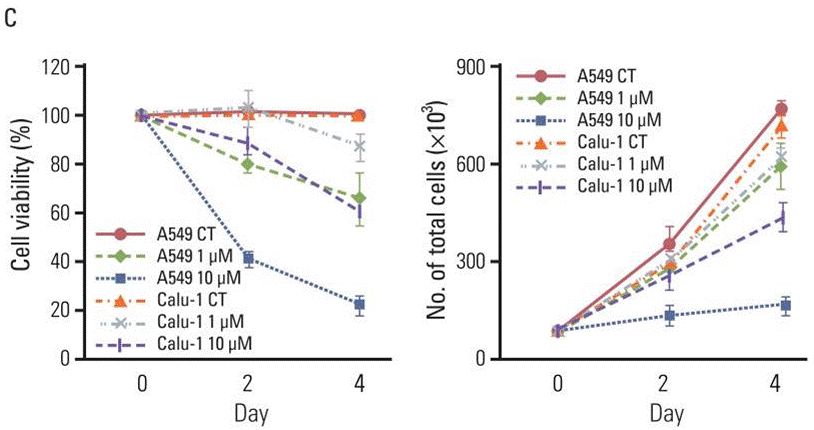
|
23341789 |
| Western blot | p-Met / Met / p-AKT / AKT / p-ERK / ERK PUMA / Bcl-2 / Bax |
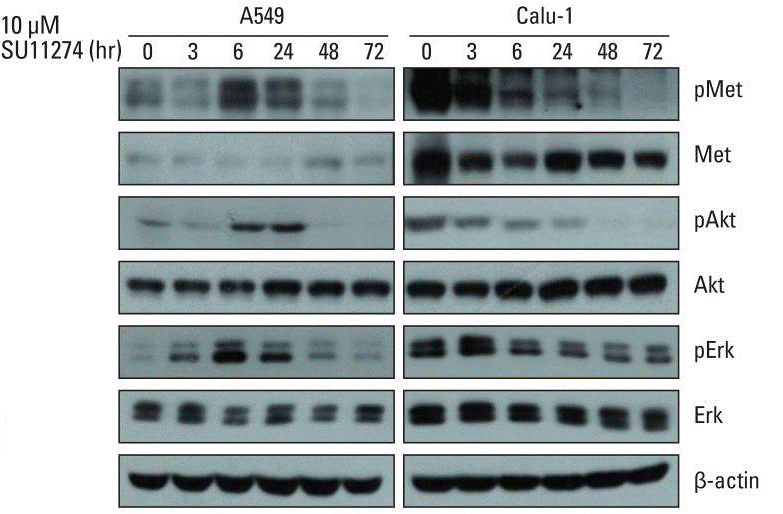
|
23341789 |
| Immunofluorescence | p-SphK1 |
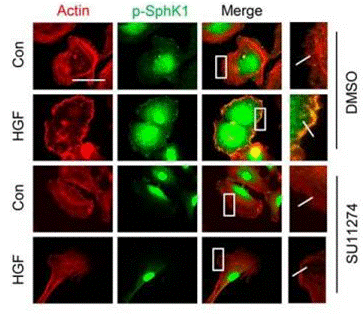
|
27864331 |
Technischer Support
Tel: +1-832-582-8158 Ext:3
Wenn Sie weitere Fragen haben, hinterlassen Sie bitte eine Nachricht.
Häufig gestellte Fragen
Frage 1:
What is the solubility of this compound in acetone?
Antwort:
The solubility of S1080 in acetone is 7 mg/mL.

Produkte sind nur für Forschungszwecke bestimmt. Nicht für den menschlichen Gebrauch. Wir verkaufen nicht an Patienten.
©Copyright 2013 Selleck Chemicals. Alle Rechte vorbehalten.