
nur für Forschungszwecke
KRN 633 VEGFR Inhibitor
Kat.-Nr.S1557
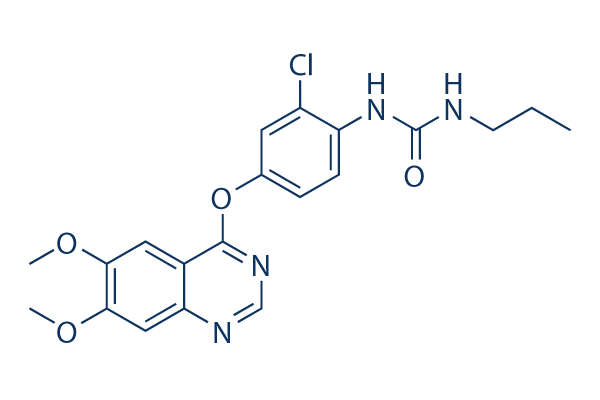
Chemische Struktur
Molekulargewicht: 416.86
Qualitätskontrolle
| Verwandte Ziele | EGFR PDGFR FGFR c-Met Src MEK CSF-1R FLT3 HER2 c-Kit |
|---|---|
| Weitere VEGFR Inhibitoren | SAR131675 SU 5402 Cediranib (AZD2171) Vatalanib (PTK787) 2HCl Anlotinib (AL3818) Dihydrochloride Linifanib (ABT-869) Apatinib (YN968D1) Apatinib (YN968D1) mesylate Ki8751 ZM 323881 HCl |
Chemische Informationen, Lagerung & Stabilität
| Molekulargewicht | 416.86 | Formel | C20H21ClN4O4 |
Lagerung (Ab dem Eingangsdatum) | |
|---|---|---|---|---|---|
| CAS-Nr. | 286370-15-8 | SDF herunterladen | Lagerung von Stammlösungen |
|
|
| Synonyme | N/A | Smiles | CCCNC(=O)NC1=C(C=C(C=C1)OC2=NC=NC3=CC(=C(C=C32)OC)OC)Cl | ||
Löslichkeit
|
In vitro |
DMSO
: 9 mg/mL
(21.58 mM)
Water : Insoluble Ethanol : Insoluble |
Molaritätsrechner
|
In vivo |
|||||
In-vivo-Formulierungsrechner (Klare Lösung)
Schritt 1: Geben Sie die untenstehenden Informationen ein (Empfohlen: Ein zusätzliches Tier zur Berücksichtigung von Verlusten während des Experiments)
Schritt 2: Geben Sie die In-vivo-Formulierung ein (Dies ist nur der Rechner, keine Formulierung. Bitte kontaktieren Sie uns zuerst, wenn es im Abschnitt "Löslichkeit" keine In-vivo-Formulierung gibt.)
Berechnungsergebnisse:
Arbeitskonzentration: mg/ml;
Methode zur Herstellung der DMSO-Stammlösung: mg Wirkstoff vorgelöst in μL DMSO ( Konzentration der Stammlösung mg/mL, Bitte kontaktieren Sie uns zuerst, wenn die Konzentration die DMSO-Löslichkeit der Wirkstoffcharge überschreitet. )
Methode zur Herstellung der In-vivo-Formulierung: Nehmen Sie μL DMSO Stammlösung, dann hinzufügenμL PEG300, mischen und klären, dann hinzufügenμL Tween 80, mischen und klären, dann hinzufügen μL ddH2O, mischen und klären.
Methode zur Herstellung der In-vivo-Formulierung: Nehmen Sie μL DMSO Stammlösung, dann hinzufügen μL Maisöl, mischen und klären.
Hinweis: 1. Bitte stellen Sie sicher, dass die Flüssigkeit klar ist, bevor Sie das nächste Lösungsmittel hinzufügen.
2. Achten Sie darauf, das/die Lösungsmittel der Reihe nach hinzuzufügen. Sie müssen sicherstellen, dass die bei der vorherigen Zugabe erhaltene Lösung eine klare Lösung ist, bevor Sie mit der Zugabe des nächsten Lösungsmittels fortfahren. Physikalische Methoden wie Vortex, Ultraschall oder ein heißes Wasserbad können zur Unterstützung des Lösens verwendet werden.
Wirkmechanismus
| Targets/IC50/Ki |
VEGFR3
125 nM
VEGFR2
160 nM
VEGFR1
170 nM
PDGFRα
965 nM
c-Kit
4330 nM
BTK
9200 nM
PDGFRβ
9850 nM
Tie-2
9900 nM
|
|---|---|
| In vitro |
KRN 633, ein neuartiges Chinazolin-Harnstoffderivat, hemmt stark die Rezeptoren VEGFR1, VEGFR2 und VEGFR3 mit IC50-Werten von 170 nM, 160 nM bzw. 125 nM. Es zeigt eine geringere Hemmaktivität gegenüber Nicht-RTKs, wie dem PDGF-Rezeptor (PDGFRα und β, c-Kit, Brusttumorkinase und Tunica interna Endothelzellkinasetyrosinkinasen (IC50 = 965, 9850, 4330, 9200 bzw. 9900 nM). Diese Verbindung hemmt potent die Liganden-VEGF-induzierte Phosphorylierung von VEGFR2 in HUVECs mit einer IC50 von 1,16 nM. Es hemmt auch die VEGF-abhängige, aber nicht bFGF-abhängige, Phosphorylierung der MAP-Kinasen in Endothelzellen, mit IC50-Werten von 3,51 nM und 6,08 nM für ERK1 bzw. ERK2. Diese Chemikalie wurde auch gezeigt, dass sie die VEGF-getriebene Proliferation von HUVECs mit einer IC50 von 14,9 nM hemmt, aber sie unterdrückt die FGF-getriebene Proliferation bei 3 μM nur schwach. Es hemmt die hypoxie-induzierte transkriptionelle Aktivierung von HIF-1α in einer konzentrationsabhängigen Weise mit einer IC50 von 3,79 μM, durch die Hemmung der Akt- und ERK-Phosphorylierungssignalwege.
|
| Kinase-Assay |
Zellfreie Kinase-Assays
|
|
Zellfreie Kinase-Assays werden durchgeführt, um IC50-Werte gegen eine Vielzahl von rekombinanten VEGF-Rezeptoren zu erhalten. KRN633 wird in Konzentrationen von 0,3 nM bis 10 μM getestet. Alle Assays werden in Vierfachbestimmung mit 1 μM ATP durchgeführt.
|
|
| In vivo |
Obwohl KRN633 in vitro nicht zytotoxisch für verschiedene Krebszellen ist, zeigt es in vivo eine ausgezeichnete Antitumoraktivität aufgrund seiner hemmenden Wirkung auf die Tumorgefäßbildung und vaskuläre Permeabilität. Die einmal tägliche Verabreichung dieser Verbindung in einer Dosis von 100 mg/kg/Tag führt zu einer signifikanten Hemmung des Tumorwachstums in A549-, LC-6-LCK-, HT29-, Ls174T-, LNCap- und Du145-Zellen, während die zweimal tägliche Verabreichung dieser Verbindung in einer Dosis von 100 mg/kg eine Wachstumshemmung von ~90 % bei HT29-Tumoren induziert. Die Behandlung von Mäusen in der mittleren Schwangerschaft mit dieser Chemikalie (300 mg/kg, p.o.) reduziert die Blutversorgung zu fötalem Gewebe aufgrund einer verminderten Vaskularisierung sowohl in der Plazenta als auch in den fötalen Organen und erhöht infolgedessen das Risiko der Induktion einer intrauterinen Wachstumsrestriktion (IUGR).
|
Literatur |
|
Technischer Support
Tel: +1-832-582-8158 Ext:3
Wenn Sie weitere Fragen haben, hinterlassen Sie bitte eine Nachricht.

Produkte sind nur für Forschungszwecke bestimmt. Nicht für den menschlichen Gebrauch. Wir verkaufen nicht an Patienten.
©Copyright 2013 Selleck Chemicals. Alle Rechte vorbehalten.