
nur für Forschungszwecke
Rabusertib (LY2603618) CHK1-Inhibitor
Kat.-Nr.: S2626
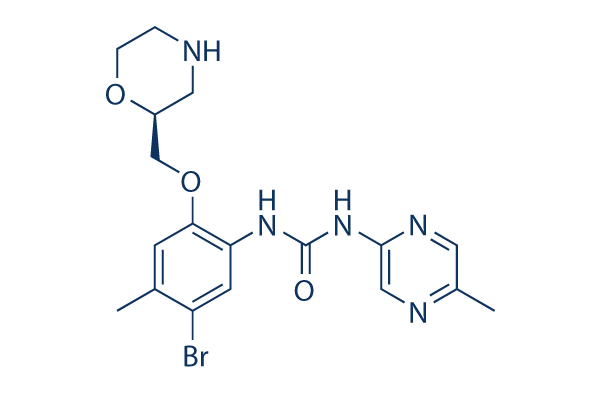
Chemische Struktur
Molekulargewicht: 436.3
Qualitätskontrolle (Quality Control)
Zellkultur, Behandlung & Arbeitskonzentration
(Cell Culture, Treatment & Working Concentration)
| Zelllinien | Assay-Typ | Konzentration | Inkubationszeit | Formulierung | Aktivitätsbeschreibung | PMID |
|---|---|---|---|---|---|---|
| BT474 | Kinase assay | 1 μM | DMSO | inhibits P-CHK1 levels | 23917378 | |
| MCF7 | Kinase assay | 1 μM | DMSO | inhibits P-CHK1 levels | 23917378 | |
| Hela | Kinase assay | 3300 nM | DMSO | inhibits Chk1 activity | 24114124 | |
| Calu6 | Kinase assay | 3300 nM | DMSO | inhibits Chk1 activity | 24114124 | |
| A549 | Function assay | ~10 μM | DMSO | induces cell cycle arrest | 24928205 | |
| H1299 | Function assay | ~10 μM | DMSO | induces cell cycle arrest | 24928205 | |
| A549 | Function assay | ~20 μM | DMSO | activates DNA damage sensor kinases | 24928205 | |
| H1299 | Function assay | ~20 μM | DMSO | activates DNA damage sensor kinases | 24928205 | |
| A549 | Apoptosis assay | ~20 μM | DMSO | induces apoptosis | 24928205 | |
| H1299 | Apoptosis assay | ~20 μM | DMSO | induces apoptosis | 24928205 | |
| A549 | Cytoxicity assay | ~20 μM | DMSO | induces autophagy | 24928205 | |
| H1299 | Cytoxicity assay | ~20 μM | DMSO | induces autophagy | 24928205 | |
| A549 | Function assay | ~20 μM | DMSO | increases JNK and p38 MAPK phosphorylation | 24928205 | |
| H1299 | Function assay | ~20 μM | DMSO | increases JNK and p38 MAPK phosphorylation | 24928205 | |
| OHS-50 | qHTS assay | qHTS of pediatric cancer cell lines to identify multiple opportunities for drug repurposing: Primary screen for OHS-50 cells | 29435139 | |||
| SJ-GBM2 | qHTS assay | qHTS of pediatric cancer cell lines to identify multiple opportunities for drug repurposing: Primary screen for SJ-GBM2 cells | 29435139 | |||
| SK-N-MC | qHTS assay | qHTS of pediatric cancer cell lines to identify multiple opportunities for drug repurposing: Primary screen for SK-N-MC cells | 29435139 | |||
| NB-EBc1 | qHTS assay | qHTS of pediatric cancer cell lines to identify multiple opportunities for drug repurposing: Primary screen for NB-EBc1 cells | 29435139 | |||
| LAN-5 | qHTS assay | qHTS of pediatric cancer cell lines to identify multiple opportunities for drug repurposing: Primary screen for LAN-5 cells | 29435139 | |||
| Klicken Sie hier, um weitere experimentelle Daten zu Zelllinien anzuzeigen | ||||||
Chemische Informationen, Lagerung & Stabilität (Chemical Information, Storage & Stability)
| Molekulargewicht | 436.3 | Formel | C18H22BrN5O3 |
Lagerung (Ab dem Eingangsdatum) | |
|---|---|---|---|---|---|
| CAS-Nr. | 911222-45-2 | SDF herunterladen | Lagerung von Stammlösungen |
|
|
| Synonyme | IC-83 | Smiles | CC1=CC(=C(C=C1Br)NC(=O)NC2=NC=C(N=C2)C)OCC3CNCCO3 | ||
Löslichkeit (Solubility)
|
In vitro |
DMSO
: 22 mg/mL
(50.42 mM)
Water : Insoluble Ethanol : Insoluble |
Molaritätsrechner
|
In vivo |
|||||
In-vivo-Formulierungsrechner (Klare Lösung)
Schritt 1: Geben Sie die untenstehenden Informationen ein (Empfohlen: Ein zusätzliches Tier zur Berücksichtigung von Verlusten während des Experiments)
Schritt 2: Geben Sie die In-vivo-Formulierung ein (Dies ist nur der Rechner, keine Formulierung. Bitte kontaktieren Sie uns zuerst, wenn es im Abschnitt "Löslichkeit" keine In-vivo-Formulierung gibt.)
Berechnungsergebnisse:
Arbeitskonzentration: mg/ml;
Methode zur Herstellung der DMSO-Stammlösung: mg Wirkstoff vorgelöst in μL DMSO ( Konzentration der Stammlösung mg/mL, Bitte kontaktieren Sie uns zuerst, wenn die Konzentration die DMSO-Löslichkeit der Wirkstoffcharge überschreitet. )
Methode zur Herstellung der In-vivo-Formulierung: Nehmen Sie μL DMSO Stammlösung, dann hinzufügenμL PEG300, mischen und klären, dann hinzufügenμL Tween 80, mischen und klären, dann hinzufügen μL ddH2O, mischen und klären.
Methode zur Herstellung der In-vivo-Formulierung: Nehmen Sie μL DMSO Stammlösung, dann hinzufügen μL Maisöl, mischen und klären.
Hinweis: 1. Bitte stellen Sie sicher, dass die Flüssigkeit klar ist, bevor Sie das nächste Lösungsmittel hinzufügen.
2. Achten Sie darauf, das/die Lösungsmittel der Reihe nach hinzuzufügen. Sie müssen sicherstellen, dass die bei der vorherigen Zugabe erhaltene Lösung eine klare Lösung ist, bevor Sie mit der Zugabe des nächsten Lösungsmittels fortfahren. Physikalische Methoden wie Vortex, Ultraschall oder ein heißes Wasserbad können zur Unterstützung des Lösens verwendet werden.
Wirkmechanismus (Mechanism of Action)
| Targets/IC50/Ki |
Chk1
(Cell-free assay) 7 nM
|
|---|---|
| In vitro |
Chk1 is an ATP-dependent serine-threonine kinase and a key component in the DNA replication-monitoring checkpoint system activated by double-stranded breaks (DSBs). Chk1 contributes to all currently defined cell cycle checkpoints, including G1/S, intra-S-phase, G2/M, and the mitotic spindle checkpoint. By inhibiting the activity of chk1, this compound prevents the repair of DNA caused by DNA-damaging agents, thus potentiating the antitumor efficacies of various chemotherapeutic agents. However, preclinical data involving this compound has not been published until now. Inhibition of Chk1 is predicted to enhance the effects of antimetabolites. This chemical treatment impairs DNA synthesis, increases DNA damage (via mitotic defects), induces apoptosis, and has synergistic activity, especially in p53 mutant tumor cells. |
| In vivo |
In xenograft models, this compound delays tumor growth when given in combination. |
Literatur |
|
Anwendungen (Applications)
| Methoden | Biomarker | Bilder | PMID |
|---|---|---|---|
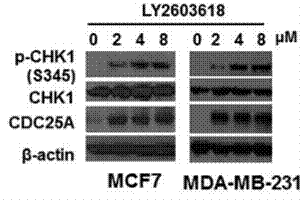
| Western blot | p-Chk1 / Chk1 / CDC25A PARP / CF-PARP / p-CDC25C / p-CDK1 / p-CDK2 |
|
29326282 |
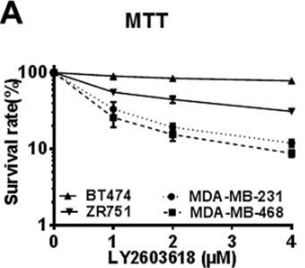
| Growth inhibition assay | Cell viability |
|
29326282 |
Klinische Studieninformationen (Clinical Trial Information)
(Daten von https://clinicaltrials.gov, aktualisiert am 2019-03-01)
| NCT-Nummer | Rekrutierung | Erkrankungen | Sponsor/Kooperationspartner | Startdatum | Phasen |
|---|---|---|---|---|---|
| NCT01341457 | COMPLETED | Solid Tumors |
Eli Lilly and Company |
2011-05 | PHASE1 |
| NCT01139775 | COMPLETED | Non Small Cell Lung Cancer |
Eli Lilly and Company |
2011-02 | PHASE1; PHASE2 |
| NCT00839332 | COMPLETED | Pancreatic Neoplasms |
Eli Lilly and Company |
2009-02 | PHASE1; PHASE2 |
| NCT00988858 | COMPLETED | Non Small Cell Lung Cancer |
Eli Lilly and Company |
2009-11 | PHASE2 |
| NCT01358968 | COMPLETED | Cancer |
Eli Lilly and Company |
2011-06 | PHASE1 |
| NCT01296568 | COMPLETED | Advanced Cancer |
Eli Lilly and Company |
2011-02 | PHASE1 |

Produkte sind nur für Forschungszwecke bestimmt. Nicht für den menschlichen Gebrauch. Wir verkaufen nicht an Patienten.
©Copyright 2013 Selleck Chemicals. Alle Rechte vorbehalten.