
nur für Forschungszwecke
PF-477736 Chk Inhibitor
Kat.-Nr.: S2904
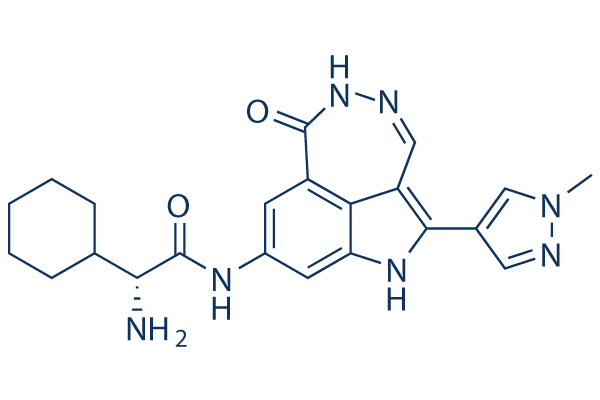
Chemische Struktur
Molekulargewicht: 419.48
Qualitätskontrolle (Quality Control)
Zellkultur, Behandlung & Arbeitskonzentration
(Cell Culture, Treatment & Working Concentration)
| Zelllinien | Assay-Typ | Konzentration | Inkubationszeit | Formulierung | Aktivitätsbeschreibung | PMID |
|---|---|---|---|---|---|---|
| TC32 | qHTS assay | qHTS of pediatric cancer cell lines to identify multiple opportunities for drug repurposing: Primary screen for TC32 cells | 29435139 | |||
| U-2 OS | qHTS assay | qHTS of pediatric cancer cell lines to identify multiple opportunities for drug repurposing: Primary screen for U-2 OS cells | 29435139 | |||
| A673 | qHTS assay | qHTS of pediatric cancer cell lines to identify multiple opportunities for drug repurposing: Primary screen for A673 cells | 29435139 | |||
| Saos-2 | qHTS assay | qHTS of pediatric cancer cell lines to identify multiple opportunities for drug repurposing: Primary screen for Saos-2 cells | 29435139 | |||
| RD | qHTS assay | qHTS of pediatric cancer cell lines to identify multiple opportunities for drug repurposing: Primary screen for RD cells | 29435139 | |||
| SK-N-SH | qHTS assay | qHTS of pediatric cancer cell lines to identify multiple opportunities for drug repurposing: Primary screen for SK-N-SH cells | 29435139 | |||
| OHS-50 | qHTS assay | qHTS of pediatric cancer cell lines to identify multiple opportunities for drug repurposing: Primary screen for OHS-50 cells | 29435139 | |||
| SJ-GBM2 | qHTS assay | qHTS of pediatric cancer cell lines to identify multiple opportunities for drug repurposing: Primary screen for SJ-GBM2 cells | 29435139 | |||
| SK-N-MC | qHTS assay | qHTS of pediatric cancer cell lines to identify multiple opportunities for drug repurposing: Primary screen for SK-N-MC cells | 29435139 | |||
| NB-EBc1 | qHTS assay | qHTS of pediatric cancer cell lines to identify multiple opportunities for drug repurposing: Primary screen for NB-EBc1 cells | 29435139 | |||
| LAN-5 | qHTS assay | qHTS of pediatric cancer cell lines to identify multiple opportunities for drug repurposing: Primary screen for LAN-5 cells | 29435139 | |||
| Klicken Sie hier, um weitere experimentelle Daten zu Zelllinien anzuzeigen | ||||||
Chemische Informationen, Lagerung & Stabilität (Chemical Information, Storage & Stability)
| Molekulargewicht | 419.48 | Formel | C22H25N7O2 |
Lagerung (Ab dem Eingangsdatum) | |
|---|---|---|---|---|---|
| CAS-Nr. | 952021-60-2 | SDF herunterladen | Lagerung von Stammlösungen |
|
|
| Synonyme | PF-736, PF-00477736 | Smiles | CN1C=C(C=N1)C2=C3C=NNC(=O)C4=C3C(=CC(=C4)NC(=O)C(C5CCCCC5)N)N2 | ||
Löslichkeit (Solubility)
|
In vitro |
DMSO
: 84 mg/mL
(200.24 mM)
Water : Insoluble Ethanol : Insoluble |
Molaritätsrechner
|
In vivo |
|||||
In-vivo-Formulierungsrechner (Klare Lösung)
Schritt 1: Geben Sie die untenstehenden Informationen ein (Empfohlen: Ein zusätzliches Tier zur Berücksichtigung von Verlusten während des Experiments)
Schritt 2: Geben Sie die In-vivo-Formulierung ein (Dies ist nur der Rechner, keine Formulierung. Bitte kontaktieren Sie uns zuerst, wenn es im Abschnitt "Löslichkeit" keine In-vivo-Formulierung gibt.)
Berechnungsergebnisse:
Arbeitskonzentration: mg/ml;
Methode zur Herstellung der DMSO-Stammlösung: mg Wirkstoff vorgelöst in μL DMSO ( Konzentration der Stammlösung mg/mL, Bitte kontaktieren Sie uns zuerst, wenn die Konzentration die DMSO-Löslichkeit der Wirkstoffcharge überschreitet. )
Methode zur Herstellung der In-vivo-Formulierung: Nehmen Sie μL DMSO Stammlösung, dann hinzufügenμL PEG300, mischen und klären, dann hinzufügenμL Tween 80, mischen und klären, dann hinzufügen μL ddH2O, mischen und klären.
Methode zur Herstellung der In-vivo-Formulierung: Nehmen Sie μL DMSO Stammlösung, dann hinzufügen μL Maisöl, mischen und klären.
Hinweis: 1. Bitte stellen Sie sicher, dass die Flüssigkeit klar ist, bevor Sie das nächste Lösungsmittel hinzufügen.
2. Achten Sie darauf, das/die Lösungsmittel der Reihe nach hinzuzufügen. Sie müssen sicherstellen, dass die bei der vorherigen Zugabe erhaltene Lösung eine klare Lösung ist, bevor Sie mit der Zugabe des nächsten Lösungsmittels fortfahren. Physikalische Methoden wie Vortex, Ultraschall oder ein heißes Wasserbad können zur Unterstützung des Lösens verwendet werden.
Wirkmechanismus (Mechanism of Action)
| Targets/IC50/Ki |
Chk1
(Cell-free assay) 0.49 nM(Ki)
VEGFR2
(Cell-free assay) 8 nM(Ki)
Fms
(Cell-free assay) 10 nM(Ki)
YES
(Cell-free assay) 14 nM(Ki)
Chk2
(Cell-free assay) 47 nM(Ki)
|
|---|---|
| In vitro |
PF-477736 (128 nM) abrogates the camptothecin-induced DNA damage checkpoint in a dose-dependent manner in CA46 and HeLa cells. This compound effectively abrogates the -induced S-phase arrest with a corresponding increase in apoptotic cell populations in HT29 cells. This chemical (540 nM) enhances -induced cytotoxicity in a time- and dose-dependent manner in HT29 cells. It potentiates the growth-inhibitory activity of a panel of chemotherapeutic agents across a broad spectrum of p53-deficient human cancer cell lines in the MTT assay. Addition of this compound (360 nM) to -arrested cells induces a dramatic increase in the intensity of H2AX phosphorylation, reflecting a greater number of γ-H2AX molecules near sites of DNA damage. This chemical (0.5 nM) selectively blocks p73 and P53 phosphorylation in presence of curcumin in HL-60 cells. It (360 nM) suppresses -induced phosphorylation of histone H3 (Ser10) and Cdc25C (Ser216) and potentiates apoptosis in COLO205 cells. This compound (250 nM) combined with MK-1775 has marked synergistic cytotoxic activity in OVCAR-5 cells. It (250 nM) combined with MK-1775 causes accumulation of cells with a DNA content between 2N and 4N in OVCAR-5 cells. This chemical (250 nM) combined with MK-1775 causes premature mitosis before the end of DNA replication, with damaged DNA leading to apoptotic cell death in OVCAR-5 cells. |
| Kinase-Assay |
Bindungstest
|
|
Der Assay wird in einer 96-Well-Platte für 20 Minuten bei 30℃ in 0,1 mL Assay-Puffer durchgeführt, der 50 mM TRIS pH 7,5, 0,4 M NaCl, 4 mM PEP, 0,15 mM NADH, 28 Einheiten Laktatdehydrogenase/mL, 16 Einheiten Pyruvatkinase/mL, 3 mM DTT, 0,125 mM Syntide-2, 0,15 mM ATP und 25 mM Magnesiumchlorid enthält. Die Assays werden mit 1 nM CHK1-Kinasedomäne initiiert. Die Hemmung der CHK1-Aktivität wird durch Messung der Anfangsgeschwindigkeiten in Gegenwart unterschiedlicher Konzentrationen dieser Verbindung bestimmt. Die Daten werden mit Enzymkinetik- und Excel-Software analysiert und an ein kinetisches Modell für kompetitive Hemmung angepasst, um einen Ki-Wert zu erhalten. Die Kinase-Selektivität dieser Chemikalie wird durch Screening bei 1 μM oder 10 μM gegen ein Panel von etwa 100 Proteinkinasen bewertet.
|
|
| In vivo |
PF-477736 (4 mg/kg i.v.) results in terminal half-life (T1/2) of 2.9 hours, AUC of 5.72 μg×hr/mL and CLp of 11.8 mL/min/kg in rats. This compound dose-dependently enhances the antitumor activity of a maximum tolerated dose in the Colo205 xenograft mouse model. This chemical (12 mg/kg) induces an increase in the phosphorylation of histone H3 (Ser10) and of phospho-histone H2AX in the Colo205 xenograft mouse model. This compound (15 mg/kg i.p.) enhances induced tumor growth inhibition and tumor growth delay in COLO205 and MDA-MB-231 xenograft models. This chemical (10 mg/kg once daily i.p.) combined with MK-1775 (30 mg/kg twice a day oral) leads to greater tumor growth inhibition in mice bearing OVCAR-5 xenografts. |
Literatur |
|
Anwendungen (Applications)
| Methoden | Biomarker | Bilder | PMID |
|---|---|---|---|
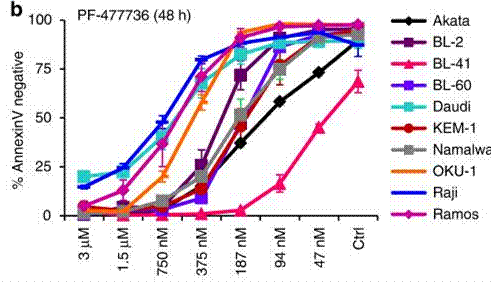
| Growth inhibition assay | Cell viability |
|
29167438 |
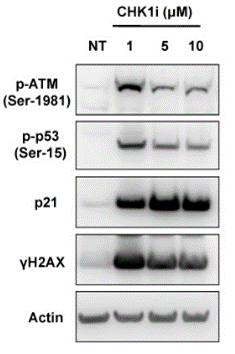
| Western blot | p-ATM / γ-H2AX p-53 / p-p53 / p21 / MDM2 |
|
31362335 |
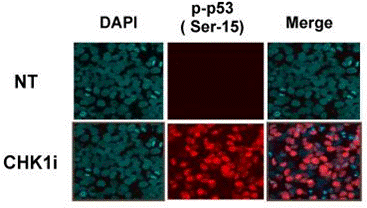
| Immunofluorescence | p-p53 |
|
31362335 |
Klinische Studieninformationen (Clinical Trial Information)
(Daten von https://clinicaltrials.gov, aktualisiert am 2024-05-22)
| NCT-Nummer | Rekrutierung | Erkrankungen | Sponsor/Kooperationspartner | Startdatum | Phasen |
|---|---|---|---|---|---|
| NCT00437203 | Terminated | Neoplasms |
Pfizer |
2006-12 | Phase 1 |
Häufig gestellte Fragen (Frequently Asked Questions)
Frage 1:
Can you advise the vehicle suggested for S2904: 2% DMSO/40% PEG 300 at 5mg/ml, is it a suspension or clear solution? I wanted to know how to dissolve it for an i.p. injection in mice.
Antwort:
It can dissolve in 2% DMSO/40% PEG 300 at 5mg/ml as a clear solution. If you are going to use this kind of vehicle, please dissolve this compound in DMSO clearly first, then add PEG300, then water.

Produkte sind nur für Forschungszwecke bestimmt. Nicht für den menschlichen Gebrauch. Wir verkaufen nicht an Patienten.
©Copyright 2013 Selleck Chemicals. Alle Rechte vorbehalten.