
nur für Forschungszwecke
MK-8776 (SCH 900776) Chk Inhibitor
Kat.-Nr.S2735
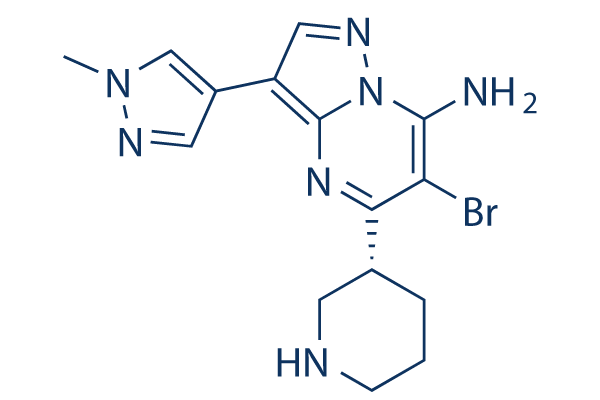
Chemische Struktur
Molekulargewicht: 376.25
Qualitätskontrolle
Zellkultur, Behandlung & Arbeitskonzentration
| Zelllinien | Assay-Typ | Konzentration | Inkubationszeit | Formulierung | Aktivitätsbeschreibung | PMID |
|---|---|---|---|---|---|---|
| SKOV3 | Growth Inhibition Assay | 0.3 µM | 8 d | sensitizes the cell lines to | 23548269 | |
| BxPC-3 | Growth Inhibition Assay | 10-1000 nM | 24-48h | enhances the chemosensitization to | 23804422 | |
| MiaPaCa-2 | Growth Inhibition Assay | 10-1000 nM | 24-48h | enhances the chemosensitization to | 23804422 | |
| AsPC-1 | Growth Inhibition Assay | 10-1000 nM | 24-48h | enhances the chemosensitization to | 23804422 | |
| H1299 | Growth Inhibition Assay | 500 nM | 24 h | DMSO | enhances the chemosensitization to PMX | 24113549 |
| H1993 | Growth Inhibition Assay | 500 nM | 24 h | DMSO | enhances the chemosensitization to PMX | 24113549 |
| H1437 | Growth Inhibition Assay | 500 nM | 24 h | DMSO | enhances the chemosensitization to PMX | 24113549 |
| H23 | Growth Inhibition Assay | 500 nM | 24 h | DMSO | enhances the chemosensitization to PMX | 24113549 |
| AsPC-1 | Growth Inhibition Assay | 200/2000 nM | 24 h | decreases the IC50 of | 24359526 | |
| TK10 | Growth Inhibition Assay | 200/2000 nM | 24 h | decreases the IC50 of | 24359526 | |
| A498 | Growth Inhibition Assay | 200/2000 nM | 24 h | decreases the IC50 of | 24359526 | |
| U20S | Growth Inhibition Assay | 200/2000 nM | 24 h | decreases the IC50 of | 24359526 | |
| SNB19 | Growth Inhibition Assay | 200/2000 nM | 24 h | decreases the IC50 of | 24359526 | |
| MDA-MB-435 | Growth Inhibition Assay | 200/2000 nM | 24 h | decreases the IC50 of | 24359526 | |
| U87 | Growth Inhibition Assay | 200/2000 nM | 24 h | decreases the IC50 of | 24359526 | |
| HCC2998 | Growth Inhibition Assay | 200/2000 nM | 24 h | decreases the IC50 of | 24359526 | |
| MDA-MB-231 | Growth Inhibition Assay | 200/2000 nM | 24 h | decreases the IC50 of | 24359526 | |
| MiaPaCa-2 | Growth Inhibition Assay | 200/2000 nM | 24 h | decreases the IC50 of | 24359526 | |
| MCF10A | Growth Inhibition Assay | 200/2000 nM | 24 h | decreases the IC50 of | 24359526 | |
| HCT116 | Growth Inhibition Assay | 200/2000 nM | 24 h | decreases the IC50 of | 24359526 | |
| IGROV-1 | Growth Inhibition Assay | 200/2000 nM | 24 h | decreases the IC50 of | 24359526 | |
| SW620 | Growth Inhibition Assay | 200/2000 nM | 24 h | decreases the IC50 of | 24359526 | |
| HCT115 | Growth Inhibition Assay | 200/2000 nM | 24 h | decreases the IC50 of | 24359526 | |
| U251 | Growth Inhibition Assay | 200/2000 nM | 24 h | decreases the IC50 of | 24359526 | |
| OVCAR-8 | Growth Inhibition Assay | 0.3 µM | 8 d | sensitizes the cell lines to | 23548269 | |
| MV-4-11 | Apoptosis Assay | 100-700 nM | 48 h | induces apoptosis dose dependently | 23536721 | |
| U937 | Apoptosis Assay | 100-700 nM | 48 h | induces apoptosis dose dependently | 23536721 | |
| MOLM-13 | Apoptosis Assay | 100-700 nM | 48 h | induces apoptosis dose dependently | 23536721 | |
| A2058 | Cell Viability Assay | 37.5-300 nM | 72 h | DMSO | reduces the MK-1775 EC50 by 5-fold to an average of 45 nM | 23148684 |
| H2009 | Cell Viability Assay | 500 nM | 72 h | DMSO | results in G1/S-phase accumulation combined with MK-1775 | 23148684 |
| Su.86.86 | Cell Viability Assay | 500 nM | 72 h | DMSO | results in G1/S-phase accumulation combined with MK-1775 | 23148684 |
| HRE | Cell Viability Assay | 500 nM | 72 h | DMSO | results in G1/S-phase accumulation combined with MK-1775 | 23148684 |
| HMEC | Cell Viability Assay | 500 nM | 72 h | DMSO | results in G1/S-phase accumulation combined with MK-1775 | 23148684 |
| U2OS | Function Assay | 2 µM | 0-24 h | induces phosphorylation of Chk1 at serine 345 at both concentrations as early as 2 h after administration | 22937147 | |
| U2OS | Growth Inhibition Assay | 0-10 µM | 24/48 h | inhibits cell growth dose dependently | 22937147 | |
| U937 | Function Assay | 100-500 nM | 4 h | decreases the cytarabine-induced Chk1 autophosphorylation at Ser296 and prevents Cdc25A downregulation | 22869869 | |
| U937 | Function Assay | 100 nM | 4 h | reverses the cytarabine-induced inhibition of 3H-thymidine incorporation into DNA | 22869869 | |
| U937 | Function Assay | 100-500 nM | 4 h | induces increased phosphorylation of H2AX | 22869869 | |
| HL-60 | Apoptosis Assay | 30/100/300 nM | 24 h | DMSO | enhances cytarabine-induced apoptosis | 22869869 |
| ML-1 | Apoptosis Assay | 25/50/100 nM | 24 h | DMSO | enhances cytarabine-induced apoptosis | 22869869 |
| HCT116 | Function Assay | 1 µM | 24 h | abrogates of cell cycle arrest | 22510560 | |
| U2OS | Function Assay | 1 µM | 24 h | abrogates of cell cycle arrest | 22510560 | |
| Sf9 | Function assay | Inhibition of recombinant CDK2/Cyclin A expressed in insect Sf9 cells assessed as inhibition of [33P]-ATP incorporation into biotinylated histone H1 after 1 hr by liquid scintillation counting, IC50 = 0.16 μM. | 21094607 | |||
| Klicken Sie hier, um weitere experimentelle Daten zu Zelllinien anzuzeigen | ||||||
Chemische Informationen, Lagerung & Stabilität
| Molekulargewicht | 376.25 | Formel | C15H18BrN7 |
Lagerung (Ab dem Eingangsdatum) | |
|---|---|---|---|---|---|
| CAS-Nr. | 891494-63-6 | SDF herunterladen | Lagerung von Stammlösungen |
|
|
| Synonyme | N/A | Smiles | CN1C=C(C=N1)C2=C3N=C(C(=C(N3N=C2)N)Br)C4CCCNC4 | ||
Löslichkeit
|
In vitro |
DMSO
: 75 mg/mL
(199.33 mM)
Water : Insoluble Ethanol : Insoluble |
Molaritätsrechner
|
In vivo |
|||||
In-vivo-Formulierungsrechner (Klare Lösung)
Schritt 1: Geben Sie die untenstehenden Informationen ein (Empfohlen: Ein zusätzliches Tier zur Berücksichtigung von Verlusten während des Experiments)
Schritt 2: Geben Sie die In-vivo-Formulierung ein (Dies ist nur der Rechner, keine Formulierung. Bitte kontaktieren Sie uns zuerst, wenn es im Abschnitt "Löslichkeit" keine In-vivo-Formulierung gibt.)
Berechnungsergebnisse:
Arbeitskonzentration: mg/ml;
Methode zur Herstellung der DMSO-Stammlösung: mg Wirkstoff vorgelöst in μL DMSO ( Konzentration der Stammlösung mg/mL, Bitte kontaktieren Sie uns zuerst, wenn die Konzentration die DMSO-Löslichkeit der Wirkstoffcharge überschreitet. )
Methode zur Herstellung der In-vivo-Formulierung: Nehmen Sie μL DMSO Stammlösung, dann hinzufügenμL PEG300, mischen und klären, dann hinzufügenμL Tween 80, mischen und klären, dann hinzufügen μL ddH2O, mischen und klären.
Methode zur Herstellung der In-vivo-Formulierung: Nehmen Sie μL DMSO Stammlösung, dann hinzufügen μL Maisöl, mischen und klären.
Hinweis: 1. Bitte stellen Sie sicher, dass die Flüssigkeit klar ist, bevor Sie das nächste Lösungsmittel hinzufügen.
2. Achten Sie darauf, das/die Lösungsmittel der Reihe nach hinzuzufügen. Sie müssen sicherstellen, dass die bei der vorherigen Zugabe erhaltene Lösung eine klare Lösung ist, bevor Sie mit der Zugabe des nächsten Lösungsmittels fortfahren. Physikalische Methoden wie Vortex, Ultraschall oder ein heißes Wasserbad können zur Unterstützung des Lösens verwendet werden.
Wirkmechanismus
| Targets/IC50/Ki |
Chk1
(Cell-free assay) 3 nM
CDK2
(Cell-free assay) 0.16 μM
|
|---|---|
| In vitro |
MK-8776 (SCH 900776) ist ein weniger potenter Inhibitor von Chk2 und CDK2 mit einer IC50 von 1,5 μM bzw. 0,16 μM. Es zeigt keine signifikante Hemmung der Cytochrom P450 humanen Lebermikrosomenisoformen 1A2, 2C9, 2C19, 2D6 und 3A4. In Kombination mit einem Antimetaboliten induziert diese Verbindung innerhalb von 2 Stunden die Akkumulation von γ-H2AX, was auf einen Kollaps der Replikationsgabel und Doppelstrang-DNA-Brüche hindeutet. Zusätzlich unterdrückt es die Akkumulation der Chk1 pS296 Autophosphorylierung dosisabhängig. Die Exposition proliferierender WS1-Zellen gegenüber SCH 900776 ist mit einer schnellen, dosisabhängigen Akkumulation von Chk1 pS345 verbunden, was darauf hindeutet, dass zyklische Populationen normaler Zellen nach Exposition gegenüber Chk1 pS345 als Teil eines nutzlosen Zyklus, möglicherweise angetrieben durch AT-Familienkinasen und DNA-PK, induzieren. |
| Kinase-Assay |
Chk1 SPA-Assay
|
|
Ein In-vitro-Assay unter Verwendung von rekombinantem His-Chk1, das im Baculovirus-Expressionssystem als Enzymquelle exprimiert wurde, und einem biotinylierten Peptid auf Basis von CDC25C als Substrat. His-Chk1 wird in Kinasepuffer, der 50 mM Tris pH 8,0, 10 mM MgCl2 und 1 mM DTT enthält, auf 32 nM verdünnt. CDC25C (CDC25 Ser216 C-terminal biotinyliertes Peptid)-Peptid wird in Kinasepuffer auf 1,93 μM verdünnt. Für jede Kinase-Reaktion werden 20 μL einer 32 nM Chk1-Enzymlösung und 20 μL von 1,926 μM CDC25C gemischt und mit 10 μL MK-8776 (SCH 900776), verdünnt in 10 % DMSO, kombiniert, wodurch nach Zugabe der Startlösung Endkonzentrationen von 6,2 nM Chk1, 385 nM CDC25C und 1 % DMSO entstehen. Die Reaktion wird durch Zugabe von 50 μL Startlösung, bestehend aus 2 μM ATP und 0,2 μCi 33P-ATP, gestartet, wodurch eine Endkonzentration von 1 μM ATP mit 0,2 μCi 33P-ATP pro Reaktion erreicht wird. Die Kinase-Reaktionen laufen 2 Stunden bei Raumtemperatur und werden durch Zugabe von 100 μL Stopplösung, bestehend aus 2 M NaCl, 1 % H3PO4 und 5 mg/mL Streptavidin-beschichteten SPA-Beads, gestoppt. Die SPA-Beads werden mit einer 96-Well-GF/B-Filterplatte und einem Filtermate Universal-Harvester gesammelt. Die Beads werden zweimal mit 2 M NaCl und zweimal mit 2 M NaCl mit 1 % Phosphorsäure gewaschen. Das Signal wird anschließend mit einem TopCount 96-Well-Flüssigszintillationszähler gemessen. Dosis-Wirkungs-Kurven werden aus doppelten 8-Punkt-Serienverdünnungen dieser Verbindung erstellt. Die IC50-Werte werden durch nichtlineare Regressionsanalyse abgeleitet.
|
|
| In vivo |
Eine Dosissteigerung von MK-8776 (SCH 900776) (16 mg/kg und 32 mg/kg) führt zu inkrementellen Verbesserungen des Tumoransprechens. Wichtig ist, dass Dosen dieser Verbindung, die mit einer robusten Biomarkeraktivierung und einem verbesserten Tumoransprechen einhergehen, nicht mit einer erhöhten Toxizität auf hämatologische Parameter bei BALB/c-Mäusen verbunden sind. |
Literatur |
|
Anwendungen
| Methoden | Biomarker | Bilder | PMID |
|---|---|---|---|
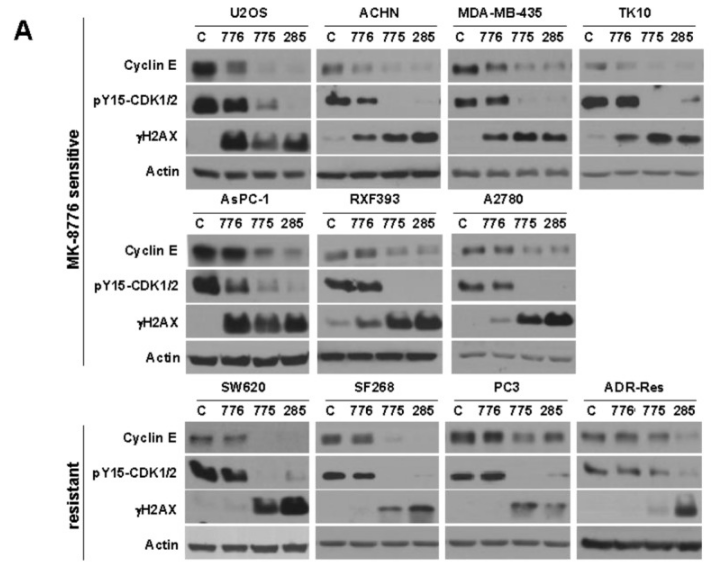
| Western blot | Cyclin E / pY15-CDK / γH2AX p-chk1(ser345) / CDC25A |
|
26595527 |
Klinische Studieninformationen
(Daten von https://clinicaltrials.gov, aktualisiert am 2024-05-22)
| NCT-Nummer | Rekrutierung | Erkrankungen | Sponsor/Kooperationspartner | Startdatum | Phasen |
|---|---|---|---|---|---|
| NCT00779584 | Completed | Hodgkin Disease|Lymphoma Non-Hodgkin|Neoplasms |
Merck Sharp & Dohme LLC |
October 17 2008 | Phase 1 |
Technischer Support
Tel: +1-832-582-8158 Ext:3
Wenn Sie weitere Fragen haben, hinterlassen Sie bitte eine Nachricht.
Häufig gestellte Fragen
Frage 1:
I would like to know whether your product S2735 is the optically pure R enantiomer or whether it is a racemic mix.
Antwort:
It is the R enantiomer of our S2735.

Produkte sind nur für Forschungszwecke bestimmt. Nicht für den menschlichen Gebrauch. Wir verkaufen nicht an Patienten.
©Copyright 2013 Selleck Chemicals. Alle Rechte vorbehalten.