
nur für Forschungszwecke
R406 Syk/FLT3 Inhibitor
Kat.-Nr.S2194
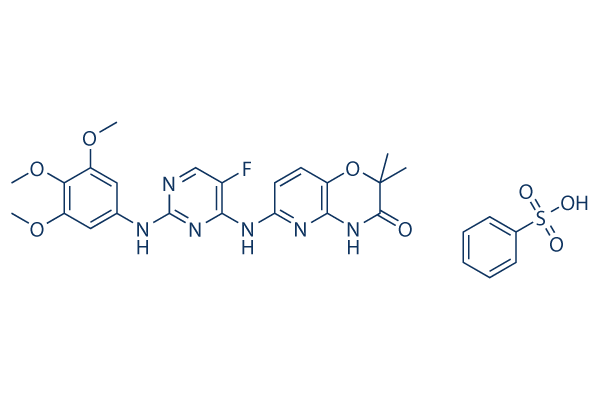
Chemische Struktur
Molekulargewicht: 628.63
Qualitätskontrolle
| Verwandte Ziele | EGFR VEGFR JAK PDGFR FGFR Src HIF FLT FLT3 HER2 |
|---|---|
| Weitere Syk Inhibitoren | R406 (free base) PRT062607 (P505-15) HCl Entospletinib (GS-9973) Piceatannol BAY 61-3606 dihydrochloride PRT-060318 2HCl TAK-659 Hydrochloride Lanraplenib (GS-SYK) RO9021 R112 |
Zellkultur, Behandlung & Arbeitskonzentration
| Zelllinien | Assay-Typ | Konzentration | Inkubationszeit | Formulierung | Aktivitätsbeschreibung | PMID |
|---|---|---|---|---|---|---|
| AMO-1 | Function Assay | 1 μM | 3 h | reduces migration | 26251761 | |
| U266 | Function Assay | 1 μM | 3 h | reduces migration | 26251761 | |
| Jeko-1 | Growth Inhibition Assay | 48 h | IC50=5.06826 μM | 25835755 | ||
| Mino | Growth Inhibition Assay | 48 h | IC50=5.70854 μM | 25835755 | ||
| Jeko-1 | Apoptosis Assay | 5 μM | 24 h | induces 25.1 ± 3.2 % apoptosis | 25835755 | |
| primary MCL | Apoptosis Assay | 2 µM | 24 h | increases significantly apoptosis | 25388373 | |
| PBMCs | Cell Viability Assay | 0-50 μM | 24 h | DMSO | inhibits cell viability dose dependently | 25127862 |
| PBMCs | Function Assay | 5 μM | 1 h | DMSO | decreases the cell migration | 25127862 |
| CFSE-CD4+ T | Growth Inhibition Assay | 0.0625-1 μM | 4 d | blocks proliferation of GVHD-derived CD4+ T cells and CD11b+ cells | 24679982 | |
| CFSE-CD11b+ | Growth Inhibition Assay | 0.0625-1 μM | 8 d | blocks proliferation of GVHD-derived CD4+ T cells and CD11b+ cells | 24679982 | |
| HMECs | Function Assay | 0-10 μM | 20 min | inhibits VEGF-stimulated release of NO | 24329544 | |
| AB5 | Apoptosis Assay | 0-2.5 μM | 48 h | DMSO | induces apoptosis | 23398911 |
| JB7 | Apoptosis Assay | 0-2.5 μM | 48 h | DMSO | induces apoptosis | 23398911 |
| AB5 | Growth Inhibition Assay | 0-2.5 μM | 48 h | DMSO | induces cell cycle arrest | 23398911 |
| JB7 | Growth Inhibition Assay | 0-2.5 μM | 48 h | DMSO | induces cell cycle arrest | 23398911 |
| RL | Function Assay | 2.5/5 μM | 24/48 h | DMSO | induces a potent decrease in MMP-9 mRNA expression | 21926965 |
| RL | Function Assay | 1/2.5 μM | 24 h | DMSO | reduces the activation of Akt and p70S6K | 21926965 |
| platelet | Function Assay | 1 μm | 5 min | inhibits FcγRIIA-mediated platelet aggregation | 21848694 | |
| platelet | Function Assay | 0.05/1/2.5 μM | 5 min | inhibits the signaling mechanisms downstream of FcγRIIA | 21848694 | |
| DoHH2 | Apoptosis Assay | 0/3/10 μM | 48 h | induces cell death significantly | 20875408 | |
| Jeko-1 | Apoptosis Assay | 0/3/10 μM | 48 h | induces cell death significantly | 20875408 | |
| Raji | Apoptosis Assay | 0/3/10 μM | 48 h | induces cell death significantly | 20875408 | |
| DHL4 | Apoptosis Assay | 0/1/4 μM | 96 h | induces apoptosis dose dependently | 18006696 | |
| LY7 | Apoptosis Assay | 0/1/4 μM | 96 h | induces apoptosis dose dependently | 18006696 | |
| LY3 | Apoptosis Assay | 0/1/4 μM | 96 h | induces apoptosis dose dependently | 18006696 | |
| DHL6 | Apoptosis Assay | 0/1/4 μM | 96 h | induces apoptosis dose dependently | 18006696 | |
| LY10 | Apoptosis Assay | 0/1/4 μM | 96 h | induces apoptosis dose dependently | 18006696 | |
| DHL10 | Apoptosis Assay | 0/1/4 μM | 96 h | induces apoptosis dose dependently | 18006696 | |
| Wsu-NHL | Apoptosis Assay | 0/1/4 μM | 96 h | induces apoptosis dose dependently | 18006696 | |
| LY18 | Apoptosis Assay | 0/1/4 μM | 96 h | induces apoptosis dose dependently | 18006696 | |
| LY1 | Apoptosis Assay | 0/1/4 μM | 96 h | induces apoptosis dose dependently | 18006696 | |
| DHL8 | Apoptosis Assay | 0/1/4 μM | 96 h | induces apoptosis dose dependently | 18006696 | |
| DHL4 | Apoptosis Assay | 4 μM | 96 h | induces cleavage of caspases 9 and 3, but not caspase 8 | 18006696 | |
| DHL6 | Apoptosis Assay | 4 μM | 96 h | induces cleavage of caspases 9 and 3, but not caspase 8 | 18006696 | |
| LY3 | Apoptosis Assay | 4 μM | 96 h | induces cleavage of caspases 9 and 3, but not caspase 8 | 18006696 | |
| LY7 | Apoptosis Assay | 4 μM | 96 h | induces cleavage of caspases 9 and 3, but not caspase 8 | 18006696 | |
| DHL4 | Function Assay | 4 μM | 16 h | inhibits tonic BLNK tyrosine phosphorylation | 18006696 | |
| LY7 | Function Assay | 4 μM | 16 h | inhibits tonic BLNK tyrosine phosphorylation | 18006696 | |
| LY3 | Function Assay | 4 μM | 16 h | inhibits tonic BLNK tyrosine phosphorylation | 18006696 | |
| DHL6 | Function Assay | 4 μM | 16 h | inhibits tonic BLNK tyrosine phosphorylation | 18006696 | |
| LY10 | Function Assay | 4 μM | 16 h | inhibits tonic BLNK tyrosine phosphorylation | 18006696 | |
| Wsu-NHL | Function Assay | 4 μM | 16 h | inhibits tonic BLNK tyrosine phosphorylation | 18006696 | |
| LY18 | Function Assay | 4 μM | 16 h | inhibits tonic BLNK tyrosine phosphorylation | 18006696 | |
| MV411 | Function assay | 72 hrs | Inhibition of Flt3 in human MV411 cells assessed as assessed as proliferation after 72 hrs incubation by spectrophotometry, EC50=0.01μM. | 24779514 | ||
| TF1 | Function assay | 1 hr | Inhibition of Jak2 in erythropoietin-stimulated human TF1 cells assessed as assessed as phospho-Stat5 after 1 hr incubation, EC50=0.013μM. | 24779514 | ||
| neutrophils | Function assay | Inhibition of SYK in human neutrophils cells assessed as reduction in FcepsilonR1/FcgammaR-mediated signaling responses, EC50=0.033μM. | 22257213 | |||
| SK-M-MC | Function assay | 1 hr | Inhibition of Ret in human SK-M-MC cells assessed as assessed as phosphorylation after 1 hr incubation, EC50=0.036μM. | 24779514 | ||
| mast cells | Function assay | 1 hr | Inhibition of cKit in stem cell factor-stimulated bone marrow derived mouse mast cells assessed as phosphorylation after 1 hr incubation, EC50=0.046μM. | 24779514 | ||
| B-cells | Function assay | Inhibition of SYK in human B-cells cells assessed as reduction in FcepsilonR1/FcgammaR-mediated signaling responses, EC50=0.048μM. | 22257213 | |||
| Ramos | Function assay | Inhibition of Syk in antihuman IgM-stimulated human Ramos cells assessed as decrease in BCR-mediated BLNK phosphorylation by cellular assay, EC50=0.053μM. | 24779514 | |||
| mesangial cells | Function assay | Inhibition of SYK in cultured human mesangial cells assessed as reduction in FcepsilonR1/FcgammaR-mediated signaling responses, EC50=0.056μM. | 22257213 | |||
| SK-N-SH | Function assay | Inhibition of Ret in human SK-N-SH cells, EC50=0.08μM. | 22257213 | |||
| mouse bone marrow cells | Function assay | Inhibition of IL3 dependent proliferation in C57/B16 mouse bone marrow cells using [3H]thymidine by liquid scintillation counting, IC50=0.147μM. | 24726806 | |||
| B-cells | Function assay | 1 hr | Inhibition of Syk in alphaIgM-stimulated human B cells assessed as cell proliferation after 1 hr incubation by flow cytometry, EC50=0.151μM. | 24779514 | ||
| THP1 | Function assay | Inhibition of SYK in human THP1 cells assessed as reduction in FcepsilonR1/FcgammaR-mediated signaling responses, EC50=0.171μM. | 22257213 | |||
| B-cells | Function assay | 1 hr | Inhibition of Syk in alphaIgM-stimulated human B cells assessed as CD86 expression after 1 hr incubation by flow cytometry, EC50=0.335μM. | 24779514 | ||
| Ramos | Function assay | Inhibition of Syk in anti IgM-stimulated human Ramos cells assessed as BLNK phosphorylation by cellular assay, IC50=0.457μM. | 24726806 | |||
| Rec1 | Function assay | 2.5 uM | 6 hrs | Inhibition of BTK phosphorylation in human Rec1 cells at 2.5 uM incubated for 6 hrs by Western blotting method | 25222877 | |
| Rec1 | Function assay | 2.5 uM | 6 hrs | Inhibition of Syk phosphorylation in human Rec1 cells at 2.5 uM incubated for 6 hrs by Western blotting method | 25222877 | |
| Rec1 | Function assay | 2.5 uM | 6 hrs | Inhibition of Lyn phosphorylation in human Rec1 cells at 2.5 uM incubated for 6 hrs by Western blotting method | 25222877 | |
| SJ-GBM2 | qHTS assay | qHTS of pediatric cancer cell lines to identify multiple opportunities for drug repurposing: Primary screen for SJ-GBM2 cells | 29435139 | |||
| A673 | qHTS assay | qHTS of pediatric cancer cell lines to identify multiple opportunities for drug repurposing: Primary screen for A673 cells | 29435139 | |||
| SK-N-MC | qHTS assay | qHTS of pediatric cancer cell lines to identify multiple opportunities for drug repurposing: Primary screen for SK-N-MC cells | 29435139 | |||
| NB-EBc1 | qHTS assay | qHTS of pediatric cancer cell lines to identify multiple opportunities for drug repurposing: Primary screen for NB-EBc1 cells | 29435139 | |||
| Saos-2 | qHTS assay | qHTS of pediatric cancer cell lines to identify multiple opportunities for drug repurposing: Primary screen for Saos-2 cells | 29435139 | |||
| OHS-50 | qHTS assay | qHTS of pediatric cancer cell lines to identify multiple opportunities for drug repurposing: Primary screen for OHS-50 cells | 29435139 | |||
| Rh41 | qHTS assay | qHTS of pediatric cancer cell lines to identify multiple opportunities for drug repurposing: Primary screen for Rh41 cells | 29435139 | |||
| Klicken Sie hier, um weitere experimentelle Daten zu Zelllinien anzuzeigen | ||||||
Chemische Informationen, Lagerung & Stabilität
| Molekulargewicht | 628.63 | Formel | C22H23FN6O5.C6H6O3S |
Lagerung (Ab dem Eingangsdatum) | |
|---|---|---|---|---|---|
| CAS-Nr. | 841290-81-1 | SDF herunterladen | Lagerung von Stammlösungen |
|
|
| Synonyme | R406 besylate | Smiles | CC1(C(=O)NC2=C(O1)C=CC(=N2)NC3=NC(=NC=C3F)NC4=CC(=C(C(=C4)OC)OC)OC)C.C1=CC=C(C=C1)S(=O)(=O)O | ||
Löslichkeit
|
In vitro |
DMSO
: 100 mg/mL
(159.07 mM)
Water : Insoluble Ethanol : 0 mg/mL |
Molaritätsrechner
|
In vivo |
|||||
In-vivo-Formulierungsrechner (Klare Lösung)
Schritt 1: Geben Sie die untenstehenden Informationen ein (Empfohlen: Ein zusätzliches Tier zur Berücksichtigung von Verlusten während des Experiments)
Schritt 2: Geben Sie die In-vivo-Formulierung ein (Dies ist nur der Rechner, keine Formulierung. Bitte kontaktieren Sie uns zuerst, wenn es im Abschnitt "Löslichkeit" keine In-vivo-Formulierung gibt.)
Berechnungsergebnisse:
Arbeitskonzentration: mg/ml;
Methode zur Herstellung der DMSO-Stammlösung: mg Wirkstoff vorgelöst in μL DMSO ( Konzentration der Stammlösung mg/mL, Bitte kontaktieren Sie uns zuerst, wenn die Konzentration die DMSO-Löslichkeit der Wirkstoffcharge überschreitet. )
Methode zur Herstellung der In-vivo-Formulierung: Nehmen Sie μL DMSO Stammlösung, dann hinzufügenμL PEG300, mischen und klären, dann hinzufügenμL Tween 80, mischen und klären, dann hinzufügen μL ddH2O, mischen und klären.
Methode zur Herstellung der In-vivo-Formulierung: Nehmen Sie μL DMSO Stammlösung, dann hinzufügen μL Maisöl, mischen und klären.
Hinweis: 1. Bitte stellen Sie sicher, dass die Flüssigkeit klar ist, bevor Sie das nächste Lösungsmittel hinzufügen.
2. Achten Sie darauf, das/die Lösungsmittel der Reihe nach hinzuzufügen. Sie müssen sicherstellen, dass die bei der vorherigen Zugabe erhaltene Lösung eine klare Lösung ist, bevor Sie mit der Zugabe des nächsten Lösungsmittels fortfahren. Physikalische Methoden wie Vortex, Ultraschall oder ein heißes Wasserbad können zur Unterstützung des Lösens verwendet werden.
Wirkmechanismus
| Merkmale |
Lead drug candidate for rheumatoid arthritis.
|
|---|---|
| Targets/IC50/Ki |
Flt3
(Cell-free assay) Syk
(Cell-free assay) 41 nM
|
| In vitro |
R406 ist ein potenter Inhibitor der Immunglobulin-E (IgE)- und IgG-vermittelten Aktivierung der Fc-Rezeptor-Signalisierung. Diese Verbindung hemmt die Anti-IgE-induzierte Produktion und Freisetzung von LTC4 sowie von Zytokinen und Chemokinen, einschließlich TNFα, IL-8 und GM-CSF. Sie hemmt die Phosphorylierung des Syk-Substrat-Linkers für die Aktivierung von T-Zellen in Mastzellen und des B-Zell-Linkerproteins/SLP65 in B-Zellen. Diese Chemikalie bindet an die ATP-Bindungstasche von Syk und hemmt dessen Kinaseaktivität als ATP-kompetitiver Inhibitor mit einem Ki von 30 nM. Sie blockiert die Syk-abhängige FcR-vermittelte Aktivierung von Monozyten/Makrophagen und Neutrophilen sowie die Bcr-vermittelte Aktivierung von B-Lymphozyten. Diese Verbindung induziert signifikant die Apoptose chronisch lymphatischer Leukämiezellen (CLL) in Kokulturen mit Nurselike-Zellen und blockiert die CCL3- und CCL4-Sekretion durch CLL-Zellen als Reaktion auf die B-Zell-Antigenrezeptor (Bcr)-Auslösung. Es ist ein potenter Inhibitor der Thrombozyten-Signalisierung und -Funktionen, die durch FcγRIIA-Vernetzung mittels spezifischer Antikörper oder durch Seren von HIT-Patienten ausgelöst werden. |
| Kinase-Assay |
In-vitro-Fluoreszenzpolarisations-Kinase-Assay
|
|
R406 wird in DMSO seriell verdünnt und dann auf 1% DMSO in Kinasepuffer (20 mM HEPES, pH 7,4, 5 mM MgCl2, 2 mM MnCl2, 1 mM DTT, 0,1 mg/mL acetyliertes BGG) verdünnt. ATP und Substrat in Kinasepuffer werden bei Raumtemperatur hinzugefügt, was zu einer finalen DMSO-Konzentration von 0,2% führt. Die Kinase-Reaktionen werden in einem Endvolumen von 20 μL durchgeführt, das 5 mM HS1-Peptidsubstrat, 4 mM ATP enthält und durch Zugabe von 0,125 ng Syk in Kinasepuffer gestartet wird. Die Reaktion wird 40 Minuten lang bei Raumtemperatur durchgeführt. Die Reaktion wird durch Zugabe von 20 μL PTK-Quench-Mix gestoppt, der EDTA/Anti-Phosphotyrosin-Antikörper (1X final)/fluoreszierenden Phosphopeptid-Tracer (0,5X final), verdünnt in FP-Dilutionspuffer, enthält. Die Platte wird 30 Minuten lang im Dunkeln bei Raumtemperatur inkubiert und dann auf einem Polarion-Fluoreszenzpolarisations-Plattenleser abgelesen. Die Daten werden unter Verwendung einer Kalibrierungskurve, die durch Konkurrenz mit dem im Tyrosinkinase-Assay-Kit bereitgestellten Phosphopeptid-Kompetitor erstellt wurde, in die Menge des vorhandenen Phosphopeptids umgewandelt. Zur Bestimmung der IC50 wird diese Verbindung in elf Konzentrationen getestet und die Kurvenanpassung erfolgt mittels nichtlinearer Regressionsanalyse.
|
|
| In vivo |
R406 reduziert die kutane reverse passive Arthus-Reaktion bei prophylaktisch behandelten Mäusen bei 5 mg/kg um etwa 86 %. Diese Verbindung zeigt auch Wirksamkeit bei der Hemmung der Pfotenentzündung in Antikörper-induzierten Arthritis-Mausmodellen. Es beeinträchtigt die Makrophagen- oder Neutrophilenfunktion in angeborenen Immunantworten nicht nachteilig und weist trotz seines lymphozytopenischen Effekts eine minimale funktionelle Immuntoxizität auf. |
Literatur |
|
Anwendungen
| Methoden | Biomarker | Bilder | PMID |
|---|---|---|---|
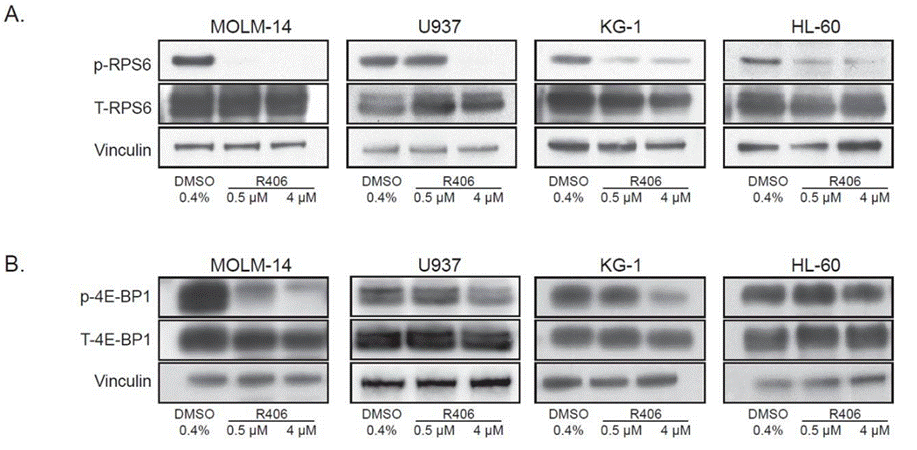
| Western blot | p-RPS6 / T-RPS6 / p-4E-BP1 / T-4E-BP1 p-MEK / T-MEK / p-ERK / T-ERK p-c-RAF / T-c-RAF p-AKT / T-AKT / p-mTOR / T-mTOR |
|
23535559 |
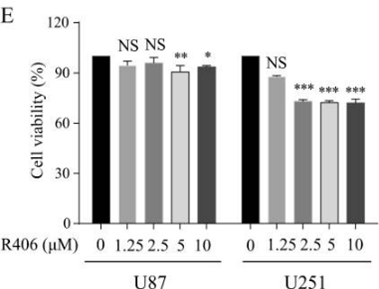
| Growth inhibition assay | Cell viability (U87, U251 cells) Cell viability (GSC lines) |
|
31043589 |
Klinische Studieninformationen
(Daten von https://clinicaltrials.gov, aktualisiert am 2024-05-22)
| NCT-Nummer | Rekrutierung | Erkrankungen | Sponsor/Kooperationspartner | Startdatum | Phasen |
|---|---|---|---|---|---|
| NCT01725230 | Completed | Rheumatoid Arthritis |
AstraZeneca |
November 2012 | Phase 1 |
| NCT01598571 | Completed | Healthy |
AstraZeneca |
May 2012 | Phase 1 |
| NCT01387308 | Completed | Healthy |
AstraZeneca |
August 2011 | Phase 1 |
| NCT01355354 | Completed | Healthy Volunteers|Rheumatoid Arthritis |
AstraZeneca |
June 2011 | Phase 1 |
Technischer Support
Tel: +1-832-582-8158 Ext:3
Wenn Sie weitere Fragen haben, hinterlassen Sie bitte eine Nachricht.
Häufig gestellte Fragen
Frage 1:
What’s the difference between S1533 and S2194?
Antwort:
S1533 and S2194 are two different forms of this compound. S1533 is the free base form, containing only its molecule without an acid added to it. S2194 has an additional C6H6O3S acid on it which makes the molecule a salt form. The free base and salt forms have same biology activities. Free base has a lower molecular weight and salt form has a better solubility in DMSO.

Produkte sind nur für Forschungszwecke bestimmt. Nicht für den menschlichen Gebrauch. Wir verkaufen nicht an Patienten.
©Copyright 2013 Selleck Chemicals. Alle Rechte vorbehalten.