
nur für Forschungszwecke
Fostamatinib (R788) Syk Inhibitor
Kat.-Nr.S2625
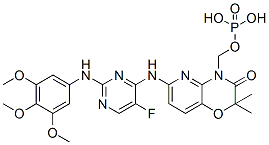
Chemische Struktur
Molekulargewicht: 580.46
Qualitätskontrolle
| Verwandte Ziele | EGFR VEGFR JAK PDGFR FGFR Src HIF FLT FLT3 HER2 |
|---|---|
| Weitere Syk Inhibitoren | R406 R406 (free base) PRT062607 (P505-15) HCl Entospletinib (GS-9973) Piceatannol BAY 61-3606 dihydrochloride PRT-060318 2HCl TAK-659 Hydrochloride Lanraplenib (GS-SYK) RO9021 |
Zellkultur, Behandlung & Arbeitskonzentration
| Zelllinien | Assay-Typ | Konzentration | Inkubationszeit | Formulierung | Aktivitätsbeschreibung | PMID |
|---|---|---|---|---|---|---|
| human Ramos cells | Function assay | Inhibition of SYK in human Ramos cells, IC50=0.267 μM | ||||
| Klicken Sie hier, um weitere experimentelle Daten zu Zelllinien anzuzeigen | ||||||
Chemische Informationen, Lagerung & Stabilität
| Molekulargewicht | 580.46 | Formel | C23H26FN6O9P |
Lagerung (Ab dem Eingangsdatum) | |
|---|---|---|---|---|---|
| CAS-Nr. | 901119-35-5 | SDF herunterladen | Lagerung von Stammlösungen |
|
|
| Synonyme | N/A | Smiles | CC1(C(=O)N(C2=C(O1)C=CC(=N2)NC3=NC(=NC=C3F)NC4=CC(=C(C(=C4)OC)OC)OC)COP(=O)(O)O)C | ||
Löslichkeit
|
In vitro |
DMSO
: 116 mg/mL
(199.84 mM)
Water : Insoluble Ethanol : Insoluble |
Molaritätsrechner
|
In vivo |
|||||
In-vivo-Formulierungsrechner (Klare Lösung)
Schritt 1: Geben Sie die untenstehenden Informationen ein (Empfohlen: Ein zusätzliches Tier zur Berücksichtigung von Verlusten während des Experiments)
Schritt 2: Geben Sie die In-vivo-Formulierung ein (Dies ist nur der Rechner, keine Formulierung. Bitte kontaktieren Sie uns zuerst, wenn es im Abschnitt "Löslichkeit" keine In-vivo-Formulierung gibt.)
Berechnungsergebnisse:
Arbeitskonzentration: mg/ml;
Methode zur Herstellung der DMSO-Stammlösung: mg Wirkstoff vorgelöst in μL DMSO ( Konzentration der Stammlösung mg/mL, Bitte kontaktieren Sie uns zuerst, wenn die Konzentration die DMSO-Löslichkeit der Wirkstoffcharge überschreitet. )
Methode zur Herstellung der In-vivo-Formulierung: Nehmen Sie μL DMSO Stammlösung, dann hinzufügenμL PEG300, mischen und klären, dann hinzufügenμL Tween 80, mischen und klären, dann hinzufügen μL ddH2O, mischen und klären.
Methode zur Herstellung der In-vivo-Formulierung: Nehmen Sie μL DMSO Stammlösung, dann hinzufügen μL Maisöl, mischen und klären.
Hinweis: 1. Bitte stellen Sie sicher, dass die Flüssigkeit klar ist, bevor Sie das nächste Lösungsmittel hinzufügen.
2. Achten Sie darauf, das/die Lösungsmittel der Reihe nach hinzuzufügen. Sie müssen sicherstellen, dass die bei der vorherigen Zugabe erhaltene Lösung eine klare Lösung ist, bevor Sie mit der Zugabe des nächsten Lösungsmittels fortfahren. Physikalische Methoden wie Vortex, Ultraschall oder ein heißes Wasserbad können zur Unterstützung des Lösens verwendet werden.
Wirkmechanismus
| Merkmale |
Converted into its active metabolite R406 in vivo.
|
|---|---|
| Targets/IC50/Ki |
Syk
41 nM
Adenosine A3 receptor
81 nM
Adenosine transporter
1.84 μM
Monoamine transporter
2.74 μM
|
| In vitro |
Fostamatinib (R788) ist ein Prodrug des Milztyrosinkinase (Syk)-Inhibitors R406. Es ist ein kompetitiver Inhibitor der ATP-Bindung mit einem Ki von 30 nM. Diese Verbindung hemmt dosisabhängig die anti-IgE-vermittelte CHMC-Degranulation mit einer EC50 von 56 nM. Sie hemmt auch die anti-IgE-induzierte Produktion und Freisetzung von LTC4 sowie von Zytokinen und Chemokinen, einschließlich TNFα, IL-8 und GM-CSF. Die Hemmung von Syk durch R788 führt zur Hemmung aller Phosphorylierungsereignisse nach der Syk-Signalgebung. Neben der FcϵRI-Signalgebung in CHMC hemmt es am stärksten die Signalgebung von IL-4- und IL-2-Rezeptoren. Es hemmt spezifisch die FcγR-Signalgebung in menschlichen Mastzellen, Makrophagen und Neutrophilen. R788 kann lokale entzündliche Verletzungen, die durch Immunkomplexe vermittelt werden, hemmen. Es induziert die Apoptose der Mehrheit der untersuchten DLBCL-Zelllinien. In R788-sensiblen DLBCL-Zelllinien hemmt diese Verbindung spezifisch sowohl die tonische als auch die Liganden-induzierte BCR-Signalgebung (Autophosphorylierung von SYK525/526 und SYK-abhängige Phosphorylierung des B-Zell-Linker-Proteins [BLNK]).
|
| Kinase-Assay |
Fluoreszenzpolarisations-Kinase-Assay und Ki-Bestimmung
|
|
Die Fluoreszenzpolarisationsreaktionen werden durchgeführt. Zur Ki-Bestimmung werden doppelte 200-μL-Reaktionen bei acht verschiedenen ATP-Konzentrationen von 200 μM (2-fache serielle Verdünnungen) in Gegenwart von entweder DMSO oder Fostamatinib (R788) bei 125, 62,5, 31,25, 15,5 oder 7,8 nM angesetzt. Zu verschiedenen Zeitpunkten werden 20 μL jeder Reaktion entnommen und gequencht, um die Reaktion zu stoppen. Für jede Konzentration dieser Verbindung wird die Reaktionsrate bei jeder ATP-Konzentration bestimmt und gegen die ATP-Konzentration aufgetragen, um den scheinbaren Km und Vmax (maximale Rate) zu bestimmen. Schließlich wird der scheinbare Km (oder scheinbare Ki/Vmax) gegen die Inhibitorkonzentration aufgetragen, um den Ki zu bestimmen.
|
|
| In vivo |
Die orale Verabreichung von Fostamatinib (R788) an Mäuse reduziert die immunkomplexvermittelte Entzündung bei einer inversen passiven Arthus-Reaktion und zwei antikörperinduzierten Arthritismodellen. In einer anderen Studie hemmt es effektiv die BCR-Signalgebung in vivo, was zu einer reduzierten Proliferation und Überleben der malignen B-Zellen führt und das Überleben der behandelten Tiere signifikant verlängert. Diese Verbindung zeigt auch eine signifikante Reduktion wichtiger Entzündungsmediatoren wie TNFalpha, IL-1, IL-6 und IL-18, was zu einer reduzierten Entzündung und Knochenzerstörung in Modellen der rheumatoiden Arthritis führt.
|
Literatur |
|
Klinische Studieninformationen
(Daten von https://clinicaltrials.gov, aktualisiert am 2024-05-22)
| NCT-Nummer | Rekrutierung | Erkrankungen | Sponsor/Kooperationspartner | Startdatum | Phasen |
|---|---|---|---|---|---|
| NCT05904093 | Not yet recruiting | Sickle Cell Disease|Hb-SS Disease|Hemoglobin S|Disease Sickle Cell Anemia|Sickle Cell Disorders|Hemoglobin Beta Thalassemia Disease |
National Heart Lung and Blood Institute (NHLBI)|National Institutes of Health Clinical Center (CC) |
May 15 2024 | Phase 1 |
| NCT05509582 | Enrolling by invitation | Immune Mediated Anemia|Immune Mediated Thrombocytopenia|Chronic GVHD |
National Heart Lung and Blood Institute (NHLBI)|National Institutes of Health Clinical Center (CC) |
May 15 2024 | Phase 2 |
| NCT06071520 | Completed | Primary Immune Thrombocytopenia |
Fundación Pública Andaluza para la gestión de la Investigación en Sevilla |
March 1 2023 | -- |
| NCT05613296 | Not yet recruiting | ITP - Immune Thrombocytopenia|Chronic ITP|Refractory ITP |
Gruppo Italiano Malattie EMatologiche dell''Adulto |
February 2023 | -- |
| NCT04543279 | Terminated | Myelofibrosis|Thrombocytopenia |
Washington University School of Medicine|Rigel Pharmaceuticals |
May 3 2021 | Phase 2 |
| NCT04904276 | Terminated | ITP|Immune Thrombocytopenia |
Rigel Pharmaceuticals |
May 18 2021 | -- |
Technischer Support
Tel: +1-832-582-8158 Ext:3
Wenn Sie weitere Fragen haben, hinterlassen Sie bitte eine Nachricht.
Häufig gestellte Fragen
Frage 1:
What’s the difference between S2625 and S2206?
Antwort:
It is more stable than S2625. Its water solubility is better than S2625. However, its absorption is harder than S2625, so you need to test the suitable dosage if you use the product in animal assays. The potency of it and S2625 is similar.

Produkte sind nur für Forschungszwecke bestimmt. Nicht für den menschlichen Gebrauch. Wir verkaufen nicht an Patienten.
©Copyright 2013 Selleck Chemicals. Alle Rechte vorbehalten.