
nur für Forschungszwecke
5-Azacytidine (5-Aza, Azacitidine) DNA Methyltransferase Inhibitor
Kat.-Nr.S1782
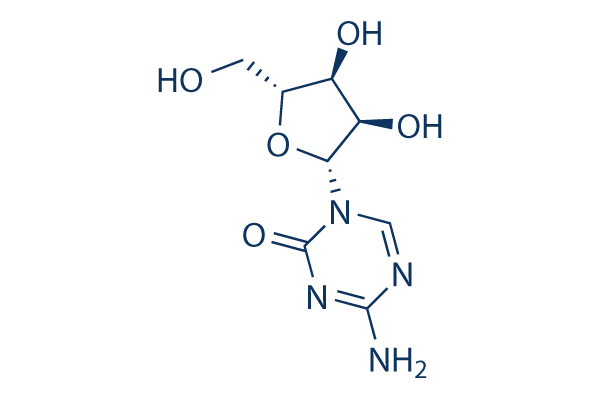
Chemische Struktur
Molekulargewicht: 244.2
Qualitätskontrolle
Produkte, die oft zusammen verwendet werden mit 5-Azacytidine (5-Aza, Azacitidine)
| Verwandte Ziele | HDAC PARP ATM/ATR DNA-PK WRN DNA/RNA Synthesis Topoisomerase PPAR Sirtuin Casein Kinase |
|---|---|
| Weitere DNA Methyltransferase Inhibitoren | RG108 SGI-1027 Zebularine (NSC 309132) GSK3685032 Gamma-Oryzanol CM272 β-thujaplicin Bobcat339 DC-05 2'-Deoxy-5-Fluorocytidine |
Zellkultur, Behandlung & Arbeitskonzentration
| Zelllinien | Assay-Typ | Konzentration | Inkubationszeit | Formulierung | Aktivitätsbeschreibung | PMID |
|---|---|---|---|---|---|---|
| Raji | Growth Inhibition Assay | 0.1-50 μM | 12-72 h | inhibits cell growth in a dose dependent manner | 26133246 | |
| Jurkat | Growth Inhibition Assay | 0.1-50 μM | 12-72 h | inhibits cell growth in a dose dependent manner | 26133246 | |
| CA46 | Function Assay | 20 µM | 48 h | increases PTPL1 mRNA expression | 26133246 | |
| Raji | Function Assay | 15 µM | 48 h | increases PTPL1 mRNA expression | 26133246 | |
| Jurkat | Function Assay | 3.5 µM | 48 h | increases PTPL1 mRNA expression | 26133246 | |
| MDA-MB-231 | Function Assay | 1/2.5/5 μM | 48 h | decreases the PTPN12 expression at the concerntration of 5 μM 48 h | 25817229 | |
| MDA-MB-231 | Function Assay | 1/2.5/5 μM | 48 h | increases the levels of E-cadherin mRNA at the concerntration of 2.5 μMfor 48 h | 25817229 | |
| MDA-MB-231 | Function Assay | 1/2.5/5 μM | 24/48 h | induces significant PARP cleavage after 48 h | 25817229 | |
| MCF-7 | Function Assay | 1/2.5/5 μM | 24/48 h | increases PARP cleavage | 25817229 | |
| MDA-MB-231 | Function Assay | 1/2.5/5 μM | 24/48 h | increases the expression of miRNA-124 at the concerntration of 5 μM | 25817229 | |
| A498 | Function Assay | 10 µM | 72 h | induces the ADAMTS18 gene expression | 25569086 | |
| CaKI-2 | Function Assay | 10 µM | 72 h | induces the ADAMTS18 gene expression | 25569086 | |
| Ketr-3 | Function Assay | 10 µM | 72 h | induces the ADAMTS18 gene expression | 25569086 | |
| A253 | Function Assay | 10 µM | 0-4 d | increases the mRNA expression level of the M3R after 24 h | 25485536 | |
| A253 | Function Assay | 10 µM | 72 h | increases the expression level of the M3R in both membrane and cytosolic preparations | 25485536 | |
| A253 | Function Assay | 10 µM | 0-4 d | reduces the 5-methylcytosine content | 25485536 | |
| PC3 | Function Assay | 0.2 μM | 4 d | increases the gene expression of IGFBP7, SFRP1 and SLC6A15 combined with GSK126 | 25477340 | |
| MCF7 | Function Assay | 0.3 μM | 4 d | increases the gene expression of IGFBP7, SFRP1 and SLC6A15 combined with GSK126 | 25477340 | |
| PC3 | Growth Inhibition Assay | 0.2 μM | 4 d | decreases the cell growth to 20.3% combined with GSK126 | 25477340 | |
| MCF7 | Growth Inhibition Assay | 0.3 μM | 4 d | decreases the cell growth 24.8% combined with GSK126 | 25477340 | |
| BGC-823 | Function Assay | 5 μM | 72 h | decreases the PRL-3 protein level signifcantly | 25475733 | |
| MKN28 | Function Assay | 5 μM | 72 h | decreases the PRL-3 protein level signifcantly | 25475733 | |
| SGC-7901 | Function Assay | 5 μM | 72 h | decreases the PRL-3 protein level signifcantly | 25475733 | |
| MKN45 | Function Assay | 5 μM | 72 h | decreases the PRL-3 protein level signifcantly | 25475733 | |
| BGC-823 | Function Assay | 5 μM | 72 h | decreases the mRNA expression of PRL-3 significantly | 25475733 | |
| MKN28 | Function Assay | 5 μM | 72 h | decreases the mRNA expression of PRL-3 significantly | 25475733 | |
| SGC-7901 | Function Assay | 5 μM | 72 h | decreases the mRNA expression of PRL-3 significantly | 25475733 | |
| MKN45 | Function Assay | 5 μM | 72 h | decreases the mRNA expression of PRL-3 significantly | 25475733 | |
| HREC | Function Assay | 5/10 μM | 48 h | induces PEDF in a dose-dependent manner | 25352747 | |
| HRPE | Function Assay | 5/10 μM | 48 h | induces PEDF in a dose-dependent manner | 25352747 | |
| HREC | Function Assay | 5/10 μM | 48 h | down-regulates of VEGF, ICAM-1 (not protein level in HRPE cells), IL-1β dose-dependently | 25352747 | |
| HRPE | Function Assay | 5/10 μM | 48 h | down-regulates of VEGF, IL-1β, and MMP2 dose-dependently | 25352747 | |
| MSCs | Function Assay | 10 μM | 24 h | promotes the commitment of MSCs to myocardial differentiation | 25351395 | |
| HL-60 | Function Assay | 5 μM | 72 h | DMSO | significantly upregulates ZNF382 expression | 25319049 |
| MV4-11 | Function Assay | 5 μM | 72 h | DMSO | significantly upregulates ZNF382 expression | 25319049 |
| A2780 | Function Assay | 5 µM | 7 d | increases DNA methylation level | 25299694 | |
| CP70 | Function Assay | 5 µM | 7 d | increases DNA methylation level | 25299694 | |
| A2780 | Function Assay | 5 µM | 7 d | weakens the level of methylation | 25299694 | |
| CP70 | Function Assay | 5 µM | 7 d | weakens the level of methylation | 25299694 | |
| OCM3 | Growth Inhibition Assay | 0.5/1/2 μM | 7 d | DMSO | inhibits cell growth in a dose dependent manner | 25146981 |
| 92.1 | Growth Inhibition Assay | 0.5/1/2 μM | 7 d | DMSO | inhibits cell growth in a dose dependent manner | 25146981 |
| OCM1 | Growth Inhibition Assay | 0.5/1/2 μM | 7 d | DMSO | inhibits cell growth in a dose dependent manner | 25146981 |
| OMM1 | Growth Inhibition Assay | 0.5/1/2 μM | 7 d | DMSO | inhibits cell growth in a dose dependent manner | 25146981 |
| Mel 285 | Growth Inhibition Assay | 0.5/1/2 μM | 7 d | DMSO | inhibits cell growth in a dose dependent manner | 25146981 |
| Mel 290 | Growth Inhibition Assay | 0.5/1/2 μM | 7 d | DMSO | inhibits cell growth in a dose dependent manner | 25146981 |
| OCM3 | Function Assay | 0.5/1 μM | 48 h | DMSO | decreases clonogenicity dose-dependently | 25146981 |
| 92.1 | Function Assay | 0.5/1 μM | 48 h | DMSO | decreases clonogenicity dose-dependently | 25146981 |
| OCM1 | Function Assay | 0.5/1 μM | 48 h | DMSO | decreases clonogenicity dose-dependently | 25146981 |
| OMM1 | Function Assay | 0.5/1 μM | 48 h | DMSO | decreases clonogenicity dose-dependently | 25146981 |
| Mel 285 | Function Assay | 0.5/1 μM | 48 h | DMSO | decreases clonogenicity dose-dependently | 25146981 |
| Mel 290 | Function Assay | 0.5/1 μM | 48 h | DMSO | decreases clonogenicity dose-dependently | 25146981 |
| OCM3 | Function Assay | 0.5/1 μM | 48 h | DMSO | decreases invasion dose dependently | 25146981 |
| Mel 290 | Function Assay | 0.5/1 μM | 48 h | DMSO | decreases invasion dose dependently | 25146981 |
| OMM1 | Function Assay | 0.5/1 μM | 48 h | DMSO | decreases invasion dose dependently | 25146981 |
| OCM1 | Cell Viability Assay | 0.5/1 μM | 5 d | DMSO | decreases radiation-induced cell viability inhibition | 25146981 |
| 92.1 | Cell Viability Assay | 0.5/1 μM | 5 d | DMSO | decreases radiation-induced cell viability inhibition | 25146981 |
| OCM1 | Function Assay | 0.5/1 μM | 48 h | DMSO | causes global DNA hypomethylation at L-1 repeat loci | 25146981 |
| OCM3 | Function Assay | 0.5/1 μM | 48 h | DMSO | causes global DNA hypomethylation at L-1 repeat loci | 25146981 |
| 92.1 | Function Assay | 0.5/1 μM | 48 h | DMSO | causes global DNA hypomethylation at L-1 repeat loci | 25146981 |
| IMR32 | Function Assay | 3 μM | 72 h | DMSO | induces p19-INK4d expression significantly | 25104850 |
| IMR5-75 | Function Assay | 3 μM | 72 h | DMSO | induces p19-INK4d expression significantly | 25104850 |
| Be(2)-C | Function Assay | 3 μM | 72 h | DMSO | induces p19-INK4d expression significantly | 25104850 |
| Bxpc-3 | Growth Inhibition Assay | 5/10 μM | 24/48/72 h | inhibits the proliferation of Bxpc-3 cells in time- and concentration-dependent manners | 25061731 | |
| Bxpc-3 | Apoptosis Assay | 5/10 μM | 24/48/72 h | induces apoptosis in time- and concerntration manners | 25061731 | |
| Bxpc-3 | Function Assay | 5/10 μM | 24/48/72 h | decreases β-catenin expression after 24 h | 25061731 | |
| Bxpc-3 | Function Assay | 5/10 μM | 24/48/72 h | decreases cyclinD1 expression at the concerntration of 10 μM | 25061731 | |
| Bxpc-3 | Function Assay | 5/10 μM | 24/48/72 h | down-regulateS c-myc mRNA expression in time- and concentration-dependent manners | 25061731 | |
| HL-60 | Growth Inhibition Assay | 1.0 μM | 48 h | significantly inhibits HL-60 cell growth | 25051119 | |
| HL-60 | Function Assay | 1.0 μM | 48 h | increases p21WAF1/CIP1 and caspase-3 expression | 25051119 | |
| HL-60 | Function Assay | 1.0 μM | 48 h | decreases Bcl-xL expression significantly | 25051119 | |
| HuTu-80 | Function Assay | 1/5/10 μM | 48/72 h | increases the expression of human NPC1L1 mRNA in a dose-dependent manner | 24904062 | |
| Caco2 | Function Assay | 10 μM | 48 h | increases NPC1L1 expression | 24904062 | |
| HepG2 | Function Assay | 0-25 μM | 24 h | decreases subtilisin/kexin type 9 (PCSK9) protein levels dose dependently | 24855646 | |
| HepG2 | Function Assay | 0-25 μM | 24 h | increases low density lipoprotein receptor (LDLR) gene expression | 24855646 | |
| HepG2 | Function Assay | 10 μm | 0-24 h | decreases PCSK9 and HMGCR expression and increases LDLR expression after 6 h | 24855646 | |
| HepG2 | Function Assay | 10 μm | 24 h | promotes cytosolic neutral lipid accumulation independently of exogenous lipoproteins | 24855646 | |
| HepG2 | Function Assay | 10 μm | 24 h | prevents SREBP processing | 24855646 | |
| HC45 | Function Assay | 5µM | 4 d | reduces the methylation levels of WIF1, P16, CXCL14, NKX2–3, CDH1, LAMA1, and CTNNB1 | 24762809 | |
| CNDT2 | Function Assay | 5µM | 4 d | reduces the methylation levels of WIF1, P16, CXCL14, NKX2–3, CDH1, LAMA1, and CTNNB1 | 24762809 | |
| CNDT2 | Function Assay | 5µM | 4 d | increases gene expression of WIF1, P16, CDH1, LAMA1, and CTNNB1 | 24762809 | |
| T-cells | Growth Inhibition Assay | 5/20 μM | 0-48 h | inhibits cell growth in a dose dependent manner | 24757283 | |
| CD3+ T-cells | Function Assay | 5/20 μM | 48 h | upregulates p15 expression | 24757283 | |
| CD4+ T-cells | Function Assay | 5/20 μM | 48 h | upregulates p15 expression | 24757283 | |
| CD8+ T-cells | Function Assay | 5/20 μM | 48 h | upregulates p15 expression | 24757283 | |
| CD3+ T-cells | Function Assay | 5/20 μM | 48 h | upregulates the expression of FOXP3 | 24757283 | |
| CD4+ T-cells | Function Assay | 5/20 μM | 48 h | upregulates the expression of FOXP3 | 24757283 | |
| CD4+ T-cells | Function Assay | 5/20 μM | 48 h | reduces TBET1 mRNA expression | 24757283 | |
| CD4+ T-cells | Function Assay | 5/20 μM | 48 h | upregulates the expression of RORγt | 24757283 | |
| CD4+ T-cells | Function Assay | 5/20 μM | 48 h | inhibits memory T-cells | 24757283 | |
| CD8+ T-cells | Function Assay | 5/20 μM | 48 h | inhibits memory T-cells | 24757283 | |
| CD3+ T-cells | Function Assay | 5 μM | 48 h | reduces long-term memory cell phenotype | 24757283 | |
| U937 | Apoptosis Assay | 10 μM | 72 h | induces apoptosis significantly | 24680865 | |
| HL-60 | Apoptosis Assay | 10 μM | 72 h | induces apoptosis significantly | 24680865 | |
| MCF7 | Function Assay | 5 μM | 48 h | displays selective toxicity toward suspended MCF-7 cells | 24633350 | |
| MCF7 | Function Assay | 10 μM | 24 h | induces the cleavage of caspase 7 and PARP | 24633350 | |
| MCF7 | Function Assay | 0–0.5 μM | 7 d | inhibits the growth MCF-7 tumorspheres in suspension cultures | 24633350 | |
| MCF7 | Function Assay | 0.5 μM | 14 d | reduces the size of MCF-7 colonies embedded in soft agar | 24633350 | |
| MCF7 | Function Assay | 0.05–20 μM | 1 d | reduces the clonal survival of MCF-7 cells in monolayer cultures | 24633350 | |
| T47D | Function Assay | 0.5 μM | 4 d | inhibits tumorsphere formation | 24633350 | |
| MCF7 | Function Assay | 0.5–10 μM | 48 h | inhibits the gap closure in the wound healing assay | 24633350 | |
| MCF7 | Function Assay | 0/10 μM | 24 h | inhibits the activity of MMP9 | 24633350 | |
| MDA-MB-231 | Function Assay | 0.5–10 μM | 36 h | inhibits the migration | 24633350 | |
| SKM1-S | Antiproliferative assay | 48 hrs | Antiproliferative activity against human SKM1-S cells after 48 hrs by XTT assay, IC50 = 0.5 μM. | 28094938 | ||
| SKM1-S | Antiproliferative assay | 48 hrs | Antiproliferative activity against human SKM1-S cells after 48 hrs by DAPI-staining-based flow cytometric method, EC50 = 0.51 μM. | 28094938 | ||
| A427 | Antiproliferative assay | 96 hrs | Antiproliferative activity against human A427 cells after 96 hrs by crystal violet assay, IC50 = 0.63 μM. | 18434163 | ||
| KYSE70 | Antiproliferative assay | 96 hrs | Antiproliferative activity against human KYSE70 cells after 96 hrs by crystal violet assay, IC50 = 1.59 μM. | 18434163 | ||
| 5637 | Antiproliferative assay | 96 hrs | Antiproliferative activity against human 5637 cells after 96 hrs by crystal violet assay, IC50 = 1.73 μM. | 18434163 | ||
| HT-29 | Antiproliferative assay | 96 hrs | Antiproliferative activity against human HT-29 cells after 96 hrs by MTT assay, IC50 = 3.8 μM. | 2778449 | ||
| P388 | Antiproliferative assay | 48 hrs | Antiproliferative activity against mouse P388 cells after 48 hrs by MTT assay, IC50 = 5 μM. | 2778449 | ||
| MCF7 | Antiproliferative assay | 96 hrs | Antiproliferative activity against human MCF7 cells after 96 hrs by crystal violet assay, IC50 = 6.78 μM. | 18434163 | ||
| U373-MAGI | Antiviral assay | 25 to 400 uM | 2 to 72 hrs | Antiviral activity against VSV-G pseudotyped HIV-1 NL4-3 infected in human U373-MAGI cells assessed as reduction in gag level at 25 to 400 uM after 2 to 72 hrs by qPCR method | 27117260 | |
| U373-MAGI | Antiviral assay | 25 to 400 uM | 2 to 72 hrs | Antiviral activity against VSV-G pseudotyped HIV-1 NL4-3 infected in human U373-MAGI cells assessed as reduction in U5-gag level at 25 to 400 uM after 2 to 72 hrs by qPCR method | 27117260 | |
| L1210 | Cytotoxicity assay | Cytotoxicity against mouse L1210 cells assessed as cessation of growth | 69026 | |||
| TC32 | qHTS assay | qHTS of pediatric cancer cell lines to identify multiple opportunities for drug repurposing: Primary screen for TC32 cells | 29435139 | |||
| A673 | qHTS assay | qHTS of pediatric cancer cell lines to identify multiple opportunities for drug repurposing: Primary screen for A673 cells | 29435139 | |||
| BT-37 | qHTS assay | qHTS of pediatric cancer cell lines to identify multiple opportunities for drug repurposing: Primary screen for BT-37 cells | 29435139 | |||
| RD | qHTS assay | qHTS of pediatric cancer cell lines to identify multiple opportunities for drug repurposing: Primary screen for RD cells | 29435139 | |||
| BT-12 | qHTS assay | qHTS of pediatric cancer cell lines to identify multiple opportunities for drug repurposing: Primary screen for BT-12 cells | 29435139 | |||
| NB1643 | qHTS assay | qHTS of pediatric cancer cell lines to identify multiple opportunities for drug repurposing: Primary screen for NB1643 cells | 29435139 | |||
| OHS-50 | qHTS assay | qHTS of pediatric cancer cell lines to identify multiple opportunities for drug repurposing: Primary screen for OHS-50 cells | 29435139 | |||
| SK-N-MC | qHTS assay | qHTS of pediatric cancer cell lines to identify multiple opportunities for drug repurposing: Primary screen for SK-N-MC cells | 29435139 | |||
| SKM1-S | Apoptosis assay | 1 uM | Induction of apoptosis in human SKM1-S cells assessed as caspase 3 cleavage at 1 uM by Western blot method | 28094938 | ||
| MCF7 | Function assay | 15 uM | 72 hrs | Inhibition of UHRF1 in human MCF7 cells assessed as decrease in methylation at RAR beta exon at 15 uM after 72 hrs by methylation specific-PCR method | 27049577 | |
| Klicken Sie hier, um weitere experimentelle Daten zu Zelllinien anzuzeigen | ||||||
Chemische Informationen, Lagerung & Stabilität
| Molekulargewicht | 244.2 | Formel | C8H12N4O5 |
Lagerung (Ab dem Eingangsdatum) | |
|---|---|---|---|---|---|
| CAS-Nr. | 320-67-2 | SDF herunterladen | Lagerung von Stammlösungen |
|
|
| Synonyme | 5-AzaC,Ladakamycin, AZA,5-Aza, CC-486,NSC 102816,5-Azacytidine | Smiles | C1=NC(=NC(=O)N1C2C(C(C(O2)CO)O)O)N | ||
Löslichkeit
|
In vitro |
DMSO
: 48 mg/mL
(196.56 mM)
Water : Insoluble Ethanol : Insoluble |
Molaritätsrechner
|
In vivo |
|||||
In-vivo-Formulierungsrechner (Klare Lösung)
Schritt 1: Geben Sie die untenstehenden Informationen ein (Empfohlen: Ein zusätzliches Tier zur Berücksichtigung von Verlusten während des Experiments)
Schritt 2: Geben Sie die In-vivo-Formulierung ein (Dies ist nur der Rechner, keine Formulierung. Bitte kontaktieren Sie uns zuerst, wenn es im Abschnitt "Löslichkeit" keine In-vivo-Formulierung gibt.)
Berechnungsergebnisse:
Arbeitskonzentration: mg/ml;
Methode zur Herstellung der DMSO-Stammlösung: mg Wirkstoff vorgelöst in μL DMSO ( Konzentration der Stammlösung mg/mL, Bitte kontaktieren Sie uns zuerst, wenn die Konzentration die DMSO-Löslichkeit der Wirkstoffcharge überschreitet. )
Methode zur Herstellung der In-vivo-Formulierung: Nehmen Sie μL DMSO Stammlösung, dann hinzufügenμL PEG300, mischen und klären, dann hinzufügenμL Tween 80, mischen und klären, dann hinzufügen μL ddH2O, mischen und klären.
Methode zur Herstellung der In-vivo-Formulierung: Nehmen Sie μL DMSO Stammlösung, dann hinzufügen μL Maisöl, mischen und klären.
Hinweis: 1. Bitte stellen Sie sicher, dass die Flüssigkeit klar ist, bevor Sie das nächste Lösungsmittel hinzufügen.
2. Achten Sie darauf, das/die Lösungsmittel der Reihe nach hinzuzufügen. Sie müssen sicherstellen, dass die bei der vorherigen Zugabe erhaltene Lösung eine klare Lösung ist, bevor Sie mit der Zugabe des nächsten Lösungsmittels fortfahren. Physikalische Methoden wie Vortex, Ultraschall oder ein heißes Wasserbad können zur Unterstützung des Lösens verwendet werden.
Wirkmechanismus
| Targets/IC50/Ki |
DNA methyltransferase
(Cell-free assay) |
|---|---|
| In vitro |
Azacitidine (5-Azacytidine) wird häufig verwendet, um die Korrelation zwischen dem Verlust der Methylierung in spezifischen Genregionen und der Aktivierung der zugehörigen Gene nachzuweisen. Nach der Incorporation in die DNA hemmt es die DNA Methyltransferase nichtkompetitiv, was zu einer Blockierung der Cytosinmethylierung in neu replizierter DNA führt, jedoch nicht in ruhenden, nicht-teilenden Zellen. Diese Verbindung induziert die Differenzierung von Friend Erythroleukämie-Zellen C3H10T1/2 mit Myotubenbildung. Es kann zu Nucleosid-Triphosphat aktiviert und sowohl in DNA als auch in RNA eingebaut werden, was zu einer Hemmung der DNA-, RNA- und Proteinsynthese in normalen eukaryotischen Zellen und in Krebszelllinien führt, was schließlich zum Zelltod führen kann. Azacitidine hemmt auch die Incorporation von Purinmetaboliten in Makromoleküle. Es hemmt das Wachstum von L1210-Zellen mit einem IC50-Wert von 0,019 μg/mL. |
| In vivo |
Azacitidine (5-Azacytidine) hemmt die Polynucleotidsynthese in leukämischen BDF1-Mäusen. Bei einer Dosis von 3 mg/kg (i.p.) erhöht es die mittlere Überlebenszeit bei leukämischen BDF1-Mäusen, die mit Ll210-Aszites-Tumorzellen inokuliert wurden. Diese Verbindung unterdrückt alle Enzymaktivitäten im Polyamin-biosynthetischen Weg erheblich, einschließlich der Ornithin-Decarboxylase-Aktivität, der Putrescin-abhängigen S-Adenosyl-L-Methionin-Decarboxylase-Aktivität und der Spermidin-abhängigen S-Adenosyl-L-Methionin-Decarboxylase-Aktivität. Es hemmt auch die Akkumulation von Polyaminen in leukämischen Mäusen. |
Literatur |
|
Anwendungen
| Methoden | Biomarker | Bilder | PMID |
|---|---|---|---|
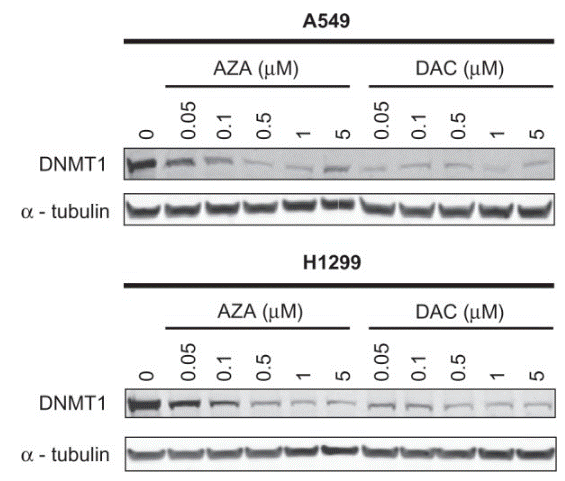
| Western blot | DNMT1 c-PARP / p-H2AX / H2AX |
|
28210112 |
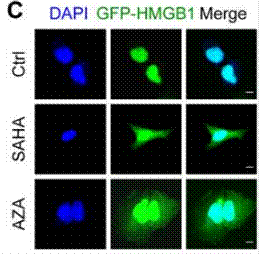
| Immunofluorescence | HMGB1 |
|
29097772 |
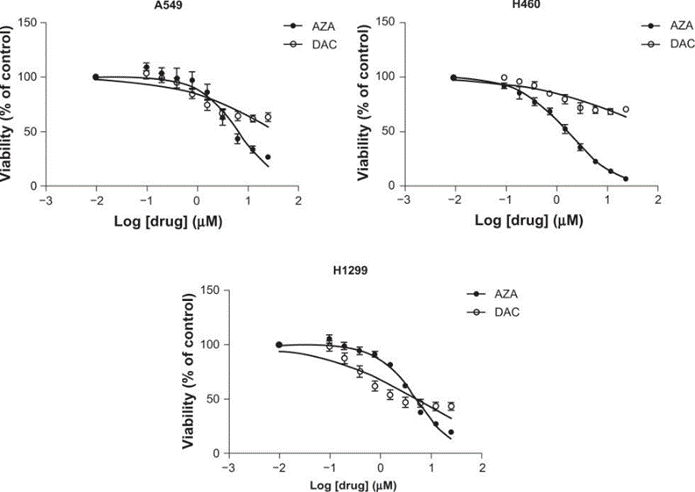
| Growth inhibition assay | Cell viability |
|
28210112 |
Klinische Studieninformationen
(Daten von https://clinicaltrials.gov, aktualisiert am 2024-05-22)
| NCT-Nummer | Rekrutierung | Erkrankungen | Sponsor/Kooperationspartner | Startdatum | Phasen |
|---|---|---|---|---|---|
| NCT06372717 | Not yet recruiting | Acute Myeloid Leukemia Refractory|Myelodysplastic Syndrome Acute Myeloid Leukemia|Myelodysplastic Syndrome With Excess Blasts|Acute Myeloid Leukemia in Relapse |
Apollo Therapeutics Ltd |
April 2024 | Phase 1|Phase 2 |
| NCT06263387 | Not yet recruiting | AML Adult |
French Innovative Leukemia Organisation|Acute Leukemia French Association |
April 29 2024 | -- |
| NCT06159491 | Not yet recruiting | Chronic Myelomonocytic Leukemia |
Douglas Tremblay|Sobi Inc.|Icahn School of Medicine at Mount Sinai |
January 2 2024 | Phase 1|Phase 2 |
| NCT06022003 | Recruiting | AML Adult|Refractory AML|Relapsed Adult AML|FLT3-TKD Mutation|FLT3-ITD |
French Innovative Leukemia Organisation|Acute Leukemia French Association |
January 13 2024 | Phase 2 |
| NCT06014489 | Recruiting | AML Adult |
Stichting Hemato-Oncologie voor Volwassenen Nederland |
January 17 2024 | Phase 2 |
Technischer Support
Tel: +1-832-582-8158 Ext:3
Wenn Sie weitere Fragen haben, hinterlassen Sie bitte eine Nachricht.
Häufig gestellte Fragen
Frage 1:
Is the vehicle (30% Propylene glycol, 5% Tween 80, 65% D5W) for it (Catalog No.S1782) safe for subcutaneous dosing?
Antwort:
S1782 in 30% Propylene glycol+5% Tween 80+65% D5W at 30mg/ml is a suspension. If you are going to administrate this compound for oral gavage, it is fine. But if you administrate it via injection, you need a clear solution and it can be dissolved in 5% DMSO+30% PEG 300+ddH2O at 10mg/ml clearly.

Produkte sind nur für Forschungszwecke bestimmt. Nicht für den menschlichen Gebrauch. Wir verkaufen nicht an Patienten.
©Copyright 2013 Selleck Chemicals. Alle Rechte vorbehalten.