
nur für Forschungszwecke
Crenolanib (CP-868596) PDGFR/FLT3 Inhibitor
Kat.-Nr.: S2730
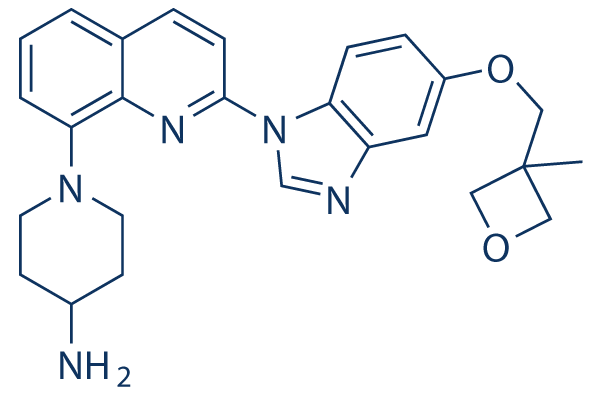
Chemische Struktur
Molekulargewicht: 443.54
Qualitätskontrolle (Quality Control)
| Verwandte Ziele | EGFR VEGFR JAK FGFR PDGFR Src HIF HER2 FLT Bcr-Abl |
|---|---|
| Weitere FLT3 Inhibitoren | UNC2025 Dovitinib (TKI-258) Dovitinib (TKI258) Lactate monohydrate Tandutinib (MLN518) ENMD-2076 KW-2449 AST-487 (NVP-AST487) TCS 359 G-749 FF-10101 |
Zellkultur, Behandlung & Arbeitskonzentration
(Cell Culture, Treatment & Working Concentration)
| Zelllinien | Assay-Typ | Konzentration | Inkubationszeit | Formulierung | Aktivitätsbeschreibung | PMID |
|---|---|---|---|---|---|---|
| A549 cells | Cell viability assay | 3.9-1000 nM | 72 h | a dose-dependent inhibition of cancer cell viability | 25328409 | |
| MV4-11 | Function assay | a decrease in mitochondrial matrix protein aconitase hydratase 2 (ACO2) | 25328409 | |||
| MV4-11 | Cytotoxicity assay | Cytotoxicity against human MV4-11 cells expressing FLT3 ITD mutant, IC50=0.0015μM | 31207462 | |||
| MOLM13 | Cytotoxicity assay | Cytotoxicity against human MOLM13 cells expressing FLT3 ITD mutant, IC50=0.0049μM | 31207462 | |||
| MV4-11 | Cytotoxicity assay | 72 hrs | Cytotoxicity in human MV4-11 cells assessed as inhibition of cellular viability incubated for 72 hrs by CellTiter-Blue assay, IC50=0.012μM | 30742435 | ||
| DAOY | qHTS assay | qHTS of pediatric cancer cell lines to identify multiple opportunities for drug repurposing: Primary screen for DAOY cells | 29435139 | |||
| SJ-GBM2 | qHTS assay | qHTS of pediatric cancer cell lines to identify multiple opportunities for drug repurposing: Primary screen for SJ-GBM2 cells | 29435139 | |||
| SK-N-MC | qHTS assay | qHTS of pediatric cancer cell lines to identify multiple opportunities for drug repurposing: Primary screen for SK-N-MC cells | 29435139 | |||
| BT-37 | qHTS assay | qHTS of pediatric cancer cell lines to identify multiple opportunities for drug repurposing: Primary screen for BT-37 cells | 29435139 | |||
| NB-EBc1 | qHTS assay | qHTS of pediatric cancer cell lines to identify multiple opportunities for drug repurposing: Primary screen for NB-EBc1 cells | 29435139 | |||
| U-2 OS | qHTS assay | qHTS of pediatric cancer cell lines to identify multiple opportunities for drug repurposing: Primary screen for U-2 OS cells | 29435139 | |||
| Saos-2 | qHTS assay | qHTS of pediatric cancer cell lines to identify multiple opportunities for drug repurposing: Primary screen for Saos-2 cells | 29435139 | |||
| LAN-5 | qHTS assay | qHTS of pediatric cancer cell lines to identify multiple opportunities for drug repurposing: Primary screen for LAN-5 cells | 29435139 | |||
| BT-12 | qHTS assay | qHTS of pediatric cancer cell lines to identify multiple opportunities for drug repurposing: Primary screen for BT-12 cells | 29435139 | |||
| Rh18 | qHTS assay | qHTS of pediatric cancer cell lines to identify multiple opportunities for drug repurposing: Primary screen for Rh18 cells | 29435139 | |||
| OHS-50 | qHTS assay | qHTS of pediatric cancer cell lines to identify multiple opportunities for drug repurposing: Primary screen for OHS-50 cells | 29435139 | |||
| RD | qHTS assay | qHTS of pediatric cancer cell lines to identify multiple opportunities for drug repurposing: Primary screen for RD cells | 29435139 | |||
| A673 | qHTS assay | qHTS of pediatric cancer cell lines to identify multiple opportunities for drug repurposing: Confirmatory screen for A673 cells) | 29435139 | |||
| DAOY | qHTS assay | qHTS of pediatric cancer cell lines to identify multiple opportunities for drug repurposing: Confirmatory screen for DAOY cells | 29435139 | |||
| U-2 OS | qHTS assay | qHTS of pediatric cancer cell lines to identify multiple opportunities for drug repurposing: Confirmatory screen for U-2 OS cells | 29435139 | |||
| Rh41 | qHTS assay | qHTS of pediatric cancer cell lines to identify multiple opportunities for drug repurposing: Confirmatory screen for Rh41 cells | 29435139 | |||
| SK-N-SH | qHTS assay | qHTS of pediatric cancer cell lines to identify multiple opportunities for drug repurposing: Confirmatory screen for SK-N-SH cells | 29435139 | |||
| MV4-11 | Cytotoxicity assay | 0.5 to 5000 nM | 2 to 8 hrs | Cytotoxicity in human MV4-11 cells assessed as inhibition of cellular viability at 0.5 to 5000 nM incubated for 2 to 8 hrs followed by compound washout by CellTiter-Glo luminescent assay | 30742435 | |
| Klicken Sie hier, um weitere experimentelle Daten zu Zelllinien anzuzeigen | ||||||
Chemische Informationen, Lagerung & Stabilität (Chemical Information, Storage & Stability)
| Molekulargewicht | 443.54 | Formel | C26H29N5O2 |
Lagerung (Ab dem Eingangsdatum) | |
|---|---|---|---|---|---|
| CAS-Nr. | 670220-88-9 | SDF herunterladen | Lagerung von Stammlösungen |
|
|
| Synonyme | CP-868596, ARO 002 | Smiles | CC1(COC1)COC2=CC3=C(C=C2)N(C=N3)C4=NC5=C(C=CC=C5N6CCC(CC6)N)C=C4 | ||
Löslichkeit (Solubility)
|
In vitro |
DMSO
: 88 mg/mL
(198.4 mM)
Ethanol : 88 mg/mL Water : Insoluble |
Molaritätsrechner
|
In vivo |
|||||
In-vivo-Formulierungsrechner (Klare Lösung)
Schritt 1: Geben Sie die untenstehenden Informationen ein (Empfohlen: Ein zusätzliches Tier zur Berücksichtigung von Verlusten während des Experiments)
Schritt 2: Geben Sie die In-vivo-Formulierung ein (Dies ist nur der Rechner, keine Formulierung. Bitte kontaktieren Sie uns zuerst, wenn es im Abschnitt "Löslichkeit" keine In-vivo-Formulierung gibt.)
Berechnungsergebnisse:
Arbeitskonzentration: mg/ml;
Methode zur Herstellung der DMSO-Stammlösung: mg Wirkstoff vorgelöst in μL DMSO ( Konzentration der Stammlösung mg/mL, Bitte kontaktieren Sie uns zuerst, wenn die Konzentration die DMSO-Löslichkeit der Wirkstoffcharge überschreitet. )
Methode zur Herstellung der In-vivo-Formulierung: Nehmen Sie μL DMSO Stammlösung, dann hinzufügenμL PEG300, mischen und klären, dann hinzufügenμL Tween 80, mischen und klären, dann hinzufügen μL ddH2O, mischen und klären.
Methode zur Herstellung der In-vivo-Formulierung: Nehmen Sie μL DMSO Stammlösung, dann hinzufügen μL Maisöl, mischen und klären.
Hinweis: 1. Bitte stellen Sie sicher, dass die Flüssigkeit klar ist, bevor Sie das nächste Lösungsmittel hinzufügen.
2. Achten Sie darauf, das/die Lösungsmittel der Reihe nach hinzuzufügen. Sie müssen sicherstellen, dass die bei der vorherigen Zugabe erhaltene Lösung eine klare Lösung ist, bevor Sie mit der Zugabe des nächsten Lösungsmittels fortfahren. Physikalische Methoden wie Vortex, Ultraschall oder ein heißes Wasserbad können zur Unterstützung des Lösens verwendet werden.
Wirkmechanismus (Mechanism of Action)
| Targets/IC50/Ki |
FLT3
(CHO cells) 0.74 nM(Kd)
PDGFRα
(CHO cells) 2.1 nM(Kd)
PDGFRβ
(CHO cells) 3.2 nM(Kd)
|
|---|---|
| In vitro |
Crenolanib is significantly more potent in inhibiting the kinase activity of resistant PDGFRα kinases (D842I, D842V, D842Y, D1842-843IM, and deletion I843). This compound is more potent against D842V in the isogenic model system, with an IC50 of approximately 10 nM. It inhibits the kinase activity of the fusion oncogene in EOL-1 cell line, which is derived from a patient with chronic eosinophilic leukemia and expresses the constitutively activated FIP1L1- PDGFRα fusion kinase, with IC50 = 21 nM. This chemical also inhibits the proliferation of EOL-1 cells with IC50 = 0.2 pM. It inhibits the activation of V561D or D842V-mutant kinases expressed in BaF3 cells with IC50 with 85 nM or 272 nM, respectively. This compound inhibits PDGFRα activation in H1703 non-small cell lung cancer cell line which has 24-fold amplification of the 4q12 region that contains the PDGFRα locus, with IC50 with 26 nM. It is an orally bioavailable, highly potent and selective PDGFR TKI. This benzimidazole compound has IC50s of 0.9 nM and 1.8 nM for PDGFRA and PDGFRB, respectively. |
| Kinase-Assay |
Biochemische Bewertung der PDGFRα-Kinaseaktivität
|
|
Chinesische Hamster-Ovarialzellen (CHO) werden transient mit mutierten oder Wildtyp-PDGFRα-Konstrukten transfiziert und mit verschiedenen Konzentrationen von Crenolanib behandelt. Experimente mit rekombinanter DNA werden unter Biosicherheitsstufe 2 gemäß den Richtlinien durchgeführt. Proteinlysate aus Zelllinien werden hergestellt und einer Immunpräzipitation unterzogen, wobei Anti-PDGFRα-Antikörper verwendet werden, gefolgt von einem sequenziellen Immunblotting für PDGFRα. Die Densitometrie wird zur Quantifizierung des Arzneimitteleffekts mit Photoshop-Software durchgeführt, wobei der Phosphor-PDGFRα-Spiegel auf das Gesamtprotein normalisiert wird. Densitometrie- und Proliferationsexperimentergebnisse werden mit Calcusyn 2.1-Software analysiert, um die IC50-Werte mathematisch zu bestimmen. Der Wilcoxon-Rangsummentest wird verwendet, um die IC50-Werte dieser Verbindung für eine gegebene Mutation zu vergleichen.
|
|
| In vivo |
This compound, a PDGFR inhibitor, suppresses lung cancer cell proliferation and inhibits tumor growth in vivo |
Literatur |
|
Anwendungen (Applications)
| Methoden | Biomarker | Bilder | PMID |
|---|---|---|---|
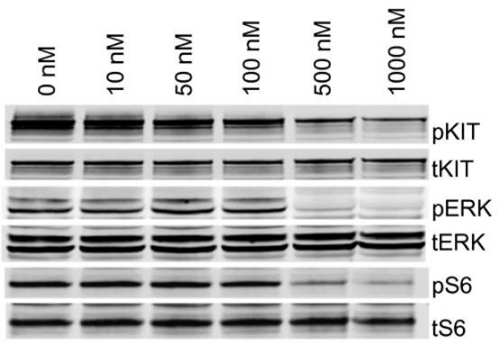
| Western blot | pKIT / KIT pFLT3 / FLT3 / pERK / ERK / pS6 / S6 pAKT / AKT / pMAPK / MAPK / pSTAT5 / STAT5 |
|
24623852 |
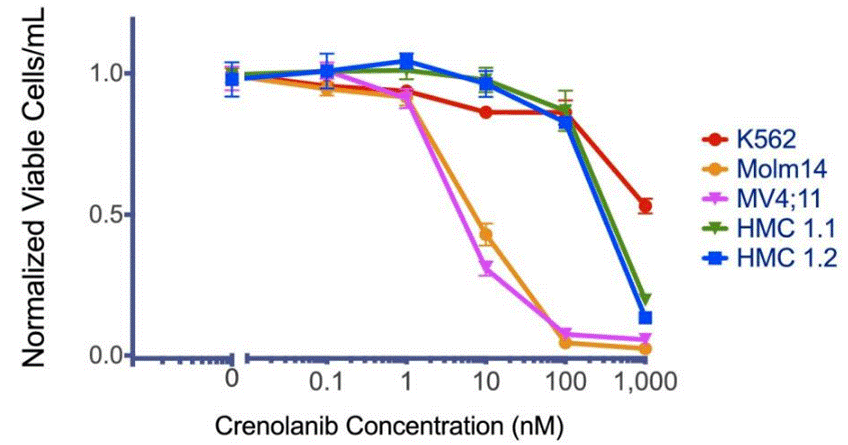
| Growth inhibition assay | Cell viability |
|
24623852 |
Klinische Studieninformationen (Clinical Trial Information)
(Daten von https://clinicaltrials.gov, aktualisiert am 2026-04-09)
| NCT-Nummer | Rekrutierung | Erkrankungen | Sponsor/Kooperationspartner | Startdatum | Phasen |
|---|---|---|---|---|---|
| NCT03258931 | COMPLETED | Newly Diagnosed FLT3 Mutated AML |
Arog Pharmaceuticals, Inc. |
2018-08-15 | PHASE3 |
| NCT03250338 | COMPLETED | Relapsed/Refractory Acute Myeloid Leukemia With FLT3 Activating Mutations |
Arog Pharmaceuticals, Inc. |
2018-08-16 | PHASE3 |
| NCT02400255 | COMPLETED | Acute Myeloid Leukemia |
Arog Pharmaceuticals, Inc. |
2015-09 | PHASE2 |
| NCT02847429 | UNKNOWN | GIST With D842V Mutated PDGFRA Gene |
Arog Pharmaceuticals, Inc. |
2016-08 | PHASE3 |
| NCT03324243 | WITHDRAWN | Relapsed/Refractory FLT3-mutated AML |
Arog Pharmaceuticals, Inc. |
2018-01 | PHASE2 |
| NCT03193918 | COMPLETED | Esophagogastric Adenocarcinoma |
Arog Pharmaceuticals, Inc. |
2017-04-14 | PHASE1 |

Produkte sind nur für Forschungszwecke bestimmt. Nicht für den menschlichen Gebrauch. Wir verkaufen nicht an Patienten.
©Copyright 2013 Selleck Chemicals. Alle Rechte vorbehalten.