
nur für Forschungszwecke
LY3009120 Raf Inhibitor
Kat.-Nr.S7842
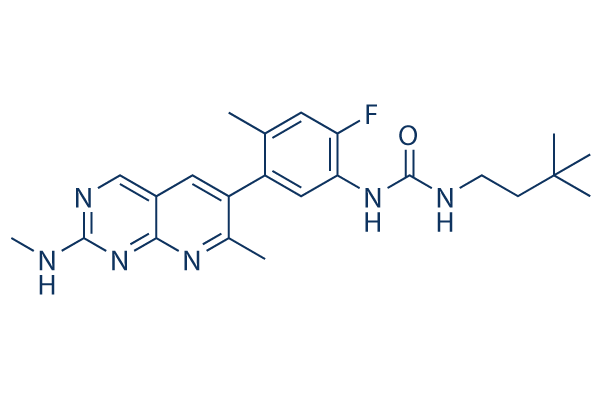
Chemische Struktur
Molekulargewicht: 424.51
Qualitätskontrolle
| Verwandte Ziele | ERK p38 MAPK JNK MEK Ras KRas S6 Kinase MAP4K TAK1 Mixed Lineage Kinase |
|---|---|
| Weitere Raf Inhibitoren | Exarafenib (KIN-2787) GDC-0879 Avutometinib (Ro5126766, CH5126766) PLX-4720 AZ 628 SB590885 TAK-632 GW5074 RAF265 (CHIR-265) PLX8394 (Plixorafenib, FORE8394) |
Zellkultur, Behandlung & Arbeitskonzentration
| Zelllinien | Assay-Typ | Konzentration | Inkubationszeit | Formulierung | Aktivitätsbeschreibung | PMID |
|---|---|---|---|---|---|---|
| A375 | Antiproliferative assay | 72 hrs | Antiproliferative activity against human A375 cells after 72 hrs by resazurin assay, IC50=0.0092μM. | 25965804 | ||
| A375 | Function assay | 15 mins | Competitive binding affinity to EphA2 in human A375 cells after 15 mins in presence of ATP analogue, IC50=0.02μM. | 25965804 | ||
| A375 | Function assay | 15 mins | Competitive binding affinity to BRAF in human A375 cells after 15 mins in presence of ATP analogue, IC50=0.031μM. | 25965804 | ||
| A375 | Function assay | 72 hrs | Inhibition of BRAF V600E mutant in human A375 cells assessed as inhibition of ERK phosphorylation measured after 72 hrs by ELISA assay, IC50=0.037μM. | 25965804 | ||
| A375 | Function assay | 15 mins | Competitive binding affinity to ZAK in human A375 cells after 15 mins in presence of ATP analogue, IC50=0.039μM. | 25965804 | ||
| A375 | Function assay | 15 mins | Competitive binding affinity to CRAF in human A375 cells after 15 mins in presence of ATP analogue, IC50=0.042μM. | 25965804 | ||
| A375 | Function assay | 15 mins | Competitive binding affinity to ARAF in human A375 cells after 15 mins in presence of ATP analogue, IC50=0.044μM. | 25965804 | ||
| A375 | Function assay | 15 mins | Competitive binding affinity to p38 in human A375 cells after 15 mins in presence of ATP analogue, IC50=0.061μM. | 25965804 | ||
| A375 | Function assay | 15 mins | Competitive binding affinity to FYN in human A375 cells after 15 mins in presence of ATP analogue, IC50=0.091μM. | 25965804 | ||
| A375 | Function assay | 15 mins | Competitive binding affinity to MAP3K1 in human A375 cells after 15 mins in presence of ATP analogue, IC50=0.098μM. | 25965804 | ||
| A375 | Function assay | 15 mins | Competitive binding affinity to EphB4 in human A375 cells after 15 mins in presence of ATP analogue, IC50=0.1μM. | 25965804 | ||
| HCT116 | Function assay | Inhibition of KRAS G13D mutant in human HCT116 cells assessed as inhibition of ERK phosphorylation by ELISA, IC50=0.15μM. | 25965804 | |||
| A375 | Function assay | In vivo inhibition of BRAF V600E mutant in human A375 cells xenografted in po dosed NIH nude rat assessed as plasma concentration required to inhibit ERK phosphorylation by 50%, INH=0.165μM. | 25965804 | |||
| HCT116 | Antiproliferative assay | 67 hrs | Antiproliferative activity against human HCT116 cells after 67 hrs by resazurin assay, IC50=0.22μM. | 25965804 | ||
| A375 | Function assay | 15 mins | Competitive binding affinity to CSK in human A375 cells after 15 mins in presence of ATP analogue, IC50=0.29μM. | 25965804 | ||
| A375 | Function assay | 15 mins | Competitive binding affinity to SRC in human A375 cells after 15 mins in presence of ATP analogue, IC50=0.31μM. | 25965804 | ||
| A375 | Function assay | 15 mins | Competitive binding affinity to ABL in human A375 cells after 15 mins in presence of ATP analogue, IC50=0.38μM. | 25965804 | ||
| A375 | Function assay | 15 mins | Competitive binding affinity to IRAK1 in human A375 cells after 15 mins in presence of ATP analogue, IC50=0.39μM. | 25965804 | ||
| A375 | Function assay | 15 mins | Competitive binding affinity to GCN2 in human A375 cells after 15 mins in presence of ATP analogue, IC50=0.45μM. | 25965804 | ||
| A375 | Function assay | 15 mins | Competitive binding affinity to JNK in human A375 cells after 15 mins in presence of ATP analogue, IC50=0.47μM. | 25965804 | ||
| A375 | Function assay | 15 mins | Competitive binding affinity to MAP2K5 in human A375 cells after 15 mins in presence of ATP analogue, IC50=0.8μM. | 25965804 | ||
| A375 | Function assay | 15 mins | Competitive binding affinity to KHS1 in human A375 cells after 15 mins in presence of ATP analogue, IC50=0.97μM. | 25965804 | ||
| HCT116 | Function assay | <100 nM | Paradoxical activation of RAS/RAF/MEK signaling pathway in human HCT116 cells expressing wild type BRAF assessed as ERK phosphorylation at <100 nM | 25965804 | ||
| A375 | Function assay | Inhibition of desthiobiotin-ATP acylphosphate probe binding to B-Raf in human A375 cells by MS analysis, IC50=0.031μM. | 30529543 | |||
| A375 | Function assay | Inhibition of desthiobiotin-ATP acylphosphate probe binding to C-Raf in human A375 cells by MS analysis, IC50=0.042μM. | 30529543 | |||
| A375 | Function assay | Inhibition of desthiobiotin-ATP acylphosphate probe binding to A-Raf in human A375 cells by MS analysis, IC50=0.044μM. | 30529543 | |||
| MV4-11 | Antiproliferative assay | 72 hrs | Antiproliferative activity against human MV4-11 cells after 72 hrs by Cell-Titer Glo assay, IC50=0.1μM. | 30529543 | ||
| SK-MEL-2 | Antiproliferative assay | 72 hrs | Antiproliferative activity against human SK-MEL-2 cells after 72 hrs by Cell-Titer Glo assay, IC50=0.2μM. | 30529543 | ||
| A375 | Antiproliferative assay | 72 hrs | Antiproliferative activity against human A375 cells after 72 hrs by Cell-Titer Glo assay, IC50=0.3μM. | 30529543 | ||
| SW579 | Antiproliferative assay | 72 hrs | Antiproliferative activity against human SW579 cells after 72 hrs by Cell-Titer Glo assay, IC50=0.9μM. | 30529543 | ||
| HT-29 | Antiproliferative assay | 72 hrs | Antiproliferative activity against human HT-29 cells after 72 hrs by Cell-Titer Glo assay, IC50=0.9μM. | 30529543 | ||
| HepG2 | Antiproliferative assay | 72 hrs | Antiproliferative activity against human HepG2 cells after 72 hrs by Cell-Titer Glo assay, IC50=2.6μM. | 30529543 | ||
| Klicken Sie hier, um weitere experimentelle Daten zu Zelllinien anzuzeigen | ||||||
Chemische Informationen, Lagerung & Stabilität
| Molekulargewicht | 424.51 | Formel | C23H29FN6O |
Lagerung (Ab dem Eingangsdatum) | |
|---|---|---|---|---|---|
| CAS-Nr. | 1454682-72-4 | SDF herunterladen | Lagerung von Stammlösungen |
|
|
| Synonyme | DP-4978 | Smiles | CC1=CC(=C(C=C1C2=C(N=C3C(=C2)C=NC(=N3)NC)C)NC(=O)NCCC(C)(C)C)F | ||
Löslichkeit
|
In vitro |
DMSO
: 20 mg/mL
(47.11 mM)
Water : Insoluble Ethanol : Insoluble |
Molaritätsrechner
|
In vivo |
|||||
In-vivo-Formulierungsrechner (Klare Lösung)
Schritt 1: Geben Sie die untenstehenden Informationen ein (Empfohlen: Ein zusätzliches Tier zur Berücksichtigung von Verlusten während des Experiments)
Schritt 2: Geben Sie die In-vivo-Formulierung ein (Dies ist nur der Rechner, keine Formulierung. Bitte kontaktieren Sie uns zuerst, wenn es im Abschnitt "Löslichkeit" keine In-vivo-Formulierung gibt.)
Berechnungsergebnisse:
Arbeitskonzentration: mg/ml;
Methode zur Herstellung der DMSO-Stammlösung: mg Wirkstoff vorgelöst in μL DMSO ( Konzentration der Stammlösung mg/mL, Bitte kontaktieren Sie uns zuerst, wenn die Konzentration die DMSO-Löslichkeit der Wirkstoffcharge überschreitet. )
Methode zur Herstellung der In-vivo-Formulierung: Nehmen Sie μL DMSO Stammlösung, dann hinzufügenμL PEG300, mischen und klären, dann hinzufügenμL Tween 80, mischen und klären, dann hinzufügen μL ddH2O, mischen und klären.
Methode zur Herstellung der In-vivo-Formulierung: Nehmen Sie μL DMSO Stammlösung, dann hinzufügen μL Maisöl, mischen und klären.
Hinweis: 1. Bitte stellen Sie sicher, dass die Flüssigkeit klar ist, bevor Sie das nächste Lösungsmittel hinzufügen.
2. Achten Sie darauf, das/die Lösungsmittel der Reihe nach hinzuzufügen. Sie müssen sicherstellen, dass die bei der vorherigen Zugabe erhaltene Lösung eine klare Lösung ist, bevor Sie mit der Zugabe des nächsten Lösungsmittels fortfahren. Physikalische Methoden wie Vortex, Ultraschall oder ein heißes Wasserbad können zur Unterstützung des Lösens verwendet werden.
Wirkmechanismus
| Targets/IC50/Ki |
C-Raf
(Cell-free assay) 4.3 nM
BRAF(V600E)
(Cell-free assay) 5.8 nM
BRAF WT
(Cell-free assay) 15 nM
|
|---|---|
| In vitro |
LY3009120 hemmt das Zellwachstum von A375- und HCT116-Zellen mit einer IC50 von 9,2 bzw. 220 μM. Diese Verbindung hemmt die Tyrosinkinase KDR mit einer IC50 von 3,9 μM.
|
| Kinase-Assay |
Messung der Kinaseaktivität mittels KiNativ-Assays
|
|
Verbindungen werden in A375-Zelllysaten unter Verwendung der ATP-basierten Sonde bei 5 µM gescreent. Die IC50-Werte werden in Mikromol-Einheiten angegeben. Zellpellets werden in vier Volumina Lysepuffer [25 mM Tris pH 7,6, 150 mM NaCl, 1 % CHAPS, 1 % Tergitol NP-40 Typ, 1 % v/v Phosphataseinhibitor-Cocktail II] resuspendiert, mit einem Spitzensonikator beschallt und mit einem Dounce-Homogenisator homogenisiert. Lysate werden durch Zentrifugation bei 100.000 g für 30 Minuten geklärt. Die geklärten Lysate werden durch einen 0,22 μM Spritzenfilter filtriert und in den Reaktionspuffer [20 mM Hepes pH 7,8, 150 mM NaCl, 0,1 % Triton X-100, 1 % v/v Phosphataseinhibitor-Cocktail II] gelfiltriert. Anschließend wird MnCl2 dem Lysat zu einer Endkonzentration von 20 mM vor der Inhibitorbehandlung und Sondenmarkierung zugesetzt. Die für die IC50-Bestimmungen verwendeten finalen Inhibitorkonzentrationen betragen 10, 1, 0,1 und 0,01 μM. ATP-Kompetitionsexperimente werden bei 1.000, 100, 10 und 1 μM ATP durchgeführt. Alle Inhibitorbehandlungen werden bei Raumtemperatur durchgeführt.
|
|
| In vivo |
Bei Ratten mit BRAF V600E ST019VR PDX-Tumoren zeigt LY3009120 (15 oder 30 mg/kg, p.o.) eine dosisabhängige Tumorwachstumshemmung. Bei Nacktratten mit A375-Xenotransplantat zeigt die orale Einzeldosisbehandlung mit dieser Verbindung (3 bis 50 mg/kg, p.o.) eine dosisabhängige Hemmung von Phospho-ERK, mit einer Dosis für 50 % Hemmung von Phospho-ERK (EC50) von 4,36 mg/kg, wobei die Plasmakonzentration zur Erzielung einer 50 %igen Hemmung von Phospho-ERK (EC50) 68,9 ng/mL oder 165 nM beträgt.
|
Literatur |
|
Anwendungen
| Methoden | Biomarker | Bilder | PMID |
|---|---|---|---|
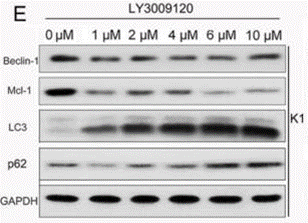
| Western blot | Beclin-1 / Mcl-1 / LC3 / p62 p-EGFR / EGFR / p-BRAF / BRAF / p-CRAF / CRAF / p-MEK / MEK / p-AKT / AKT |
|
28382170 |
Klinische Studieninformationen
(Daten von https://clinicaltrials.gov, aktualisiert am 2024-05-22)
| NCT-Nummer | Rekrutierung | Erkrankungen | Sponsor/Kooperationspartner | Startdatum | Phasen |
|---|---|---|---|---|---|
| NCT02014116 | Terminated | Neoplasms|Neoplasm Metastasis|Melanoma|Carcinoma Non-Small-Cell Lung|Colorectal Neoplasms |
Eli Lilly and Company |
November 26 2013 | Phase 1 |
Technischer Support
Tel: +1-832-582-8158 Ext:3
Wenn Sie weitere Fragen haben, hinterlassen Sie bitte eine Nachricht.
Häufig gestellte Fragen
Frage 1:
I am trying to figure out solubility of this compound for in vivo studies. I need some details on the formulation and how it is made to dissolve the chemical?
Antwort:
It can dissolve in 4% DMSO/30% PEG 300/5% Tween 80/ddH2O at 1 mg/ml clearly, and in 0.5% CMC Na at 30 mg/ml as a suspension.

Produkte sind nur für Forschungszwecke bestimmt. Nicht für den menschlichen Gebrauch. Wir verkaufen nicht an Patienten.
©Copyright 2013 Selleck Chemicals. Alle Rechte vorbehalten.