
nur für Forschungszwecke
TAE226 (NVP-TAE226) FAK Inhibitor
Kat.-Nr.: S2820
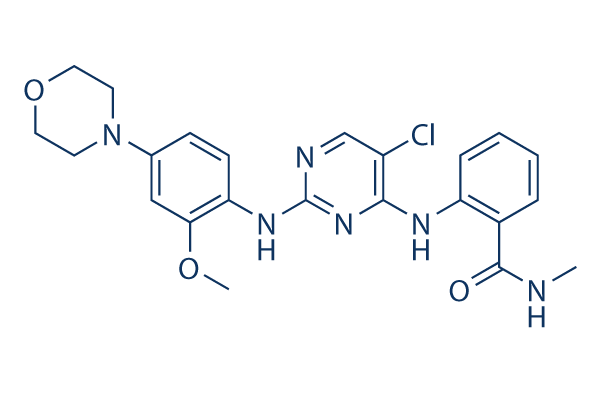
Chemische Struktur
Molekulargewicht: 468.94
Qualitätskontrolle (Quality Control)
| Verwandte Ziele | EGFR VEGFR JAK FGFR PDGFR Src HIF FLT3 HER2 FLT |
|---|---|
| Weitere FAK Inhibitoren | Defactinib (VS-6063) PF-562271 (VS-6062) PF-573228 VS-4718 (PND-1186) PF-562271 HCl PF-562271 Besylate GSK2256098 PF-431396 Y15 Solanesol (Nonaisoprenol) |
Zellkultur, Behandlung & Arbeitskonzentration
(Cell Culture, Treatment & Working Concentration)
| Zelllinien | Assay-Typ | Konzentration | Inkubationszeit | Formulierung | Aktivitätsbeschreibung | PMID |
|---|---|---|---|---|---|---|
| HCT116 cells | Proliferation assay | 48 h | Antiproliferative activity against human HCT116 cells after 48 hrs by WST-1 assay, IC50=0.4 μM | |||
| HUVEC | Function assay | 72 h | Antiangiogenic activity in HUVEC assessed as inhibition of VEGF-stimulated proliferation after 72 hrs by WST-1 assay, IC50=1 μM | |||
| U87MG cells | Proliferation assay | 48 h | Antiproliferative activity against human U87MG cells after 48 hrs by WST-1 assay, IC50=1.2 μM | |||
| PC3 cells | Proliferation assay | 48 h | Antiproliferative activity against human PC3 cells after 48 hrs by WST-1 assay, IC50=1.6 μM | |||
| MDA-MB-231 cells | Proliferation assay | 48 h | Antiproliferative activity against human MDA-MB-231 cells after 48 hrs by WST-1 assay, IC50=2.8 μM | |||
| BT474 cells | Function assay | 1 μM | 24 h | Induction of apoptosis in human BT474 cells assessed as cleavage of 89 kDa PARP at 1 uM after 24 hrs by Western blotting | ||
| Klicken Sie hier, um weitere experimentelle Daten zu Zelllinien anzuzeigen | ||||||
Chemische Informationen, Lagerung & Stabilität (Chemical Information, Storage & Stability)
| Molekulargewicht | 468.94 | Formel | C23H25ClN6O3 |
Lagerung (Ab dem Eingangsdatum) | |
|---|---|---|---|---|---|
| CAS-Nr. | 761437-28-9 | SDF herunterladen | Lagerung von Stammlösungen |
|
|
| Synonyme | N/A | Smiles | CNC(=O)C1=CC=CC=C1NC2=NC(=NC=C2Cl)NC3=C(C=C(C=C3)N4CCOCC4)OC | ||
Löslichkeit (Solubility)
|
In vitro |
DMSO
: 94 mg/mL
(200.45 mM)
Water : Insoluble Ethanol : Insoluble |
Molaritätsrechner
|
In vivo |
|||||
In-vivo-Formulierungsrechner (Klare Lösung)
Schritt 1: Geben Sie die untenstehenden Informationen ein (Empfohlen: Ein zusätzliches Tier zur Berücksichtigung von Verlusten während des Experiments)
Schritt 2: Geben Sie die In-vivo-Formulierung ein (Dies ist nur der Rechner, keine Formulierung. Bitte kontaktieren Sie uns zuerst, wenn es im Abschnitt "Löslichkeit" keine In-vivo-Formulierung gibt.)
Berechnungsergebnisse:
Arbeitskonzentration: mg/ml;
Methode zur Herstellung der DMSO-Stammlösung: mg Wirkstoff vorgelöst in μL DMSO ( Konzentration der Stammlösung mg/mL, Bitte kontaktieren Sie uns zuerst, wenn die Konzentration die DMSO-Löslichkeit der Wirkstoffcharge überschreitet. )
Methode zur Herstellung der In-vivo-Formulierung: Nehmen Sie μL DMSO Stammlösung, dann hinzufügenμL PEG300, mischen und klären, dann hinzufügenμL Tween 80, mischen und klären, dann hinzufügen μL ddH2O, mischen und klären.
Methode zur Herstellung der In-vivo-Formulierung: Nehmen Sie μL DMSO Stammlösung, dann hinzufügen μL Maisöl, mischen und klären.
Hinweis: 1. Bitte stellen Sie sicher, dass die Flüssigkeit klar ist, bevor Sie das nächste Lösungsmittel hinzufügen.
2. Achten Sie darauf, das/die Lösungsmittel der Reihe nach hinzuzufügen. Sie müssen sicherstellen, dass die bei der vorherigen Zugabe erhaltene Lösung eine klare Lösung ist, bevor Sie mit der Zugabe des nächsten Lösungsmittels fortfahren. Physikalische Methoden wie Vortex, Ultraschall oder ein heißes Wasserbad können zur Unterstützung des Lösens verwendet werden.
Wirkmechanismus (Mechanism of Action)
| Targets/IC50/Ki |
PYK2
(cell-free assay) 3.5 nM
FAK
(cell-free assay) 5.5 nM
Insulin Receptor
(cell-free assay) 43.5 nM
IGF-1R
(cell-free assay) 140 nM
c-Met
(cell-free assay) 160 nM
FLT4
(cell-free assay) 220 nM
FLT1
(cell-free assay) 3.4 μM
|
|---|---|
| In vitro |
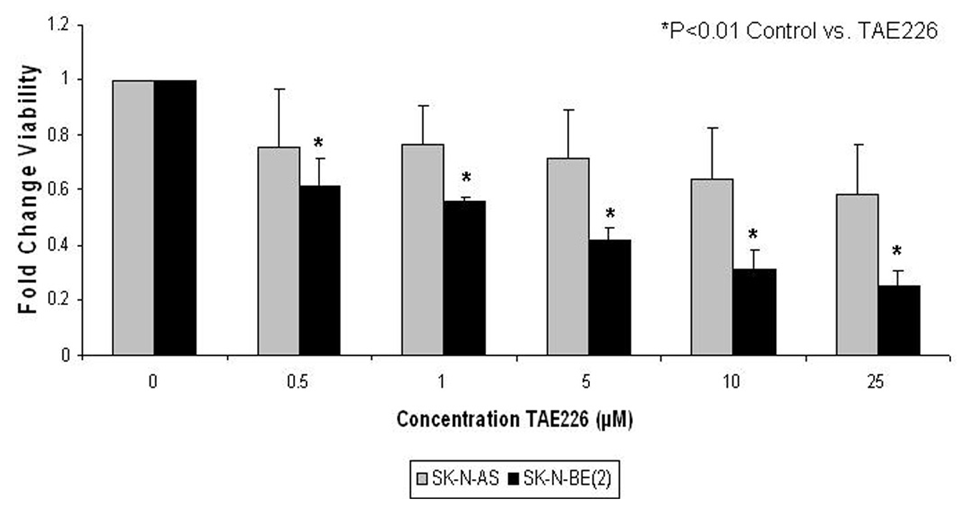
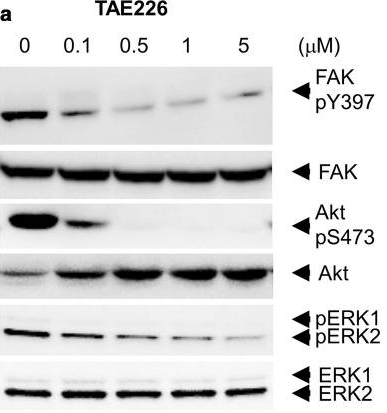
NVP-TAE226 (< 1 μM) inhibits extracellular matrix-induced autophosphorylation of FAK (Tyr397) in serum-starved U87 cells. This compound (< 1 μM) also inhibits IGF-I-induced phosphorylation of IGF-1R and activity of its downstream target genes such as MAPK and Akt in both U87 and U251 cells. This chemical (<10 μM) retards tumor cell growth and attenuats G(2)-M cell cycle progression associated with a decrease in cyclin B1 and phosphorylated cdc2 (Tyr15) protein expression in both U87 and U251 cells. This compound (1 μM) inhibits tumor cell invasion by at least 50% compared with the control in an in vitro Matrigel invasion assay in glioma cell lines. This chemical (1 μM) treatment of glioma cell lines containing wild-type p53 mainly exhibits G(2)-M arrest, whereas glioma cell lines bearing mutant p53 undergoes apoptosis, as evidence by detection of caspase-3/7 activation and poly(ADP-ribose) polymerase cleavage and by an Annexin V apoptosis assay. This compound (5 μM) inhibits phosphorylation of FAK in the human neuroblastoma cell line SK-N-AS. This chemical (<10 μM) treatment of the human neuroblastoma cell line SK-N-AS leads to decrease in cellular viability, cell cycle arrest, and an increase in apoptosis. This compound (0.1 μM-10 μM) inhibits tube formation of HMEC1 cells.
|
| In vivo |
NVP-TAE226 (75 mg/kg) significantly increases the survival rate of mice bearing intracranial glioma xenografts. This compound (100 mg/kg, oral) exerts significant decrease in microvessel density in a human colon cancer model in SCID mice. This chemical (100 mg/kg, oral) efficiently inhibits MIA PaCa-2 human pancreatic tumor growth without body weight loss in vivo model. It inhibits 4T1 murine breast tumor growth and metastasis to the lung in a dose-dependent manner in vivo model, associated with inhibition of FAK autophosphorylation at Y397 and Akt phosphorylation at Serine473.
|
Literatur |
|
Anwendungen (Applications)
| Methoden | Biomarker | Bilder | PMID |
|---|---|---|---|
| Growth inhibition assay | Cell viability |
|
21196322 |
| Western blot | FAK / p-FAK(Y397) / p-AKT(S473) / AKT / pERK / ERK |
|
31215459 |

Produkte sind nur für Forschungszwecke bestimmt. Nicht für den menschlichen Gebrauch. Wir verkaufen nicht an Patienten.
©Copyright 2013 Selleck Chemicals. Alle Rechte vorbehalten.