
nur für Forschungszwecke
PF-573228 FAK inhibitor
Kat.-Nr.S2013
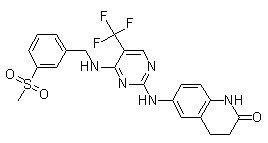
Chemische Struktur
Molekulargewicht: 491.49
Qualitätskontrolle
| Verwandte Ziele | EGFR VEGFR JAK PDGFR FGFR Src HIF FLT FLT3 HER2 |
|---|---|
| Weitere FAK Inhibitoren | Defactinib (VS-6063) PF-562271 (VS-6062) VS-4718 (PND-1186) PF-562271 HCl PF-562271 Besylate TAE226 (NVP-TAE226) GSK2256098 PF-431396 Y15 Solanesol (Nonaisoprenol) |
Zellkultur, Behandlung & Arbeitskonzentration
| Zelllinien | Assay-Typ | Konzentration | Inkubationszeit | Formulierung | Aktivitätsbeschreibung | PMID |
|---|---|---|---|---|---|---|
| A431 | Kinase assay | ~10 μM | DMSO | inhibits FAK phosphorylation with IC50 of 11 nM | 17395594 | |
| REF52 | Kinase assay | ~10 μM | DMSO | inhibits the phosphorylation of FAK Tyr397 with IC50 of ~100 nM | 17395594 | |
| PC3 | Kinase assay | ~10 μM | DMSO | inhibits the phosphorylation of FAK Tyr397 with IC50 of 100 nM | 17395594 | |
| SKOV-3 | Kinase assay | ~10 μM | DMSO | inhibits the phosphorylation of FAK Tyr397 with IC50 of 50 nM | 17395594 | |
| L3.6p1 | Kinase assay | ~10 μM | DMSO | inhibits the phosphorylation of FAK Tyr397 with IC50 of 300 nM | 17395594 | |
| F-G | Kinase assay | ~10 μM | DMSO | inhibits the phosphorylation of FAK Tyr397 with IC50 of 30 nM | 17395594 | |
| MDCK | Kinase assay | ~10 μM | DMSO | inhibits the phosphorylation of FAK Tyr397 with IC50 of 500 nM | 17395594 | |
| PC3 | Growth inhibitory assay | 10 μM | DMSO | significantly inhibits cell growth. | 17395594 | |
| REF52 | Growth inhibitory assay | 10 μM | DMSO | significantly inhibits cell growth. | 17395594 | |
| MDCK | Apoptosis assay | 10 μM | DMSO | induces apoptosis | 17395594 | |
| REF52 | Apoptosis assay | 10 μM | DMSO | induces apoptosis | 17395594 | |
| REF52 | Function assay | 10 μM | DMSO | blocks serum and FN-stimulated migration | 17395594 | |
| platelet | Function assay | 1 μM | DMSO | inhibits platelet aggregation and spreading | 19716803 | |
| platelet | Function assay | 1 μM | DMSO | leads to inhibition of PAK and AKT | 19716803 | |
| platelet | Function assay | 1 μM | DMSO | blocks calcium mobilization and dense granule secretion | 19716803 | |
| 4T1 | Function assay | DMSO | abolishes the interaction between β3 integrin and TβR-II | 19740433 | ||
| MCF7 | Kinase assay | ~10 μM | DMSO | inhibits the phosphorylation of FAK Tyr397 with IC50 of 430 nM | 20354780 | |
| TamR | Kinase assay | ~10 μM | DMSO | inhibits the phosphorylation of FAK Tyr397 with IC50 of 50 nM | 20354780 | |
| FasR | Kinase assay | ~10 μM | DMSO | inhibits the phosphorylation of FAK Tyr397 with IC50 of 130 nM | 20354780 | |
| TamR | Function assay | 1 μM | DMSO | inhibits cell migration | 20354780 | |
| FasR | Function assay | 1 μM | DMSO | inhibits cell migration | 20354780 | |
| endothelial cell | Kinase assay | 40 nM | DMSO | inhibits H2O2-induced phosphorylation of FAK | 21212402 | |
| endothelial cell | Function assay | 40 nM | DMSO | inhibits H2O2-induced stress fiber formation | 21212402 | |
| endothelial cell | Apoptosis assay | 40 nM | DMSO | inhibits apoptosis | 21212402 | |
| GH3 | Function assay | 3 μM | DMSO | increases IK(Ca) amplitude | 21925512 | |
| GH3 | Function assay | 3 μM | DMSO | enhances BKCa-channel activity | 21925512 | |
| HUVEC | cytotoxicity assay | ~10 μM | DMSO | impairs endothelial cell viability | 22075057 | |
| HUVEC | Kinase assay | 5 μM | DMSO | inhibits FAK kinase activity | 22075057 | |
| HUVEC | Function assay | 5 μM | DMSO | induces cell cycle arrest | 22075057 | |
| HUVEC | Apoptosis assay | 5 μM | DMSO | induces apoptosis | 22075057 | |
| HUVEC | Function assay | 5 μM | DMSO | impedes endothelial cell migration and alters the cellular actin cytoskeleton | 22075057 | |
| HUVEC | Function assay | 5 μM | DMSO | blocks HUVEC sprouting on collagen I gels | 22075057 | |
| human peripheral blood T cells | Kinase assay | ~10 μM | DMSO | inhibits site-specific phosphorylation of FAK | 23928188 | |
| human peripheral blood T cells | Function assay | ~10 μM | DMSO | impairs TCR-induced T cell morphological changes and alters activity of RhoA | 23928188 | |
| human peripheral blood T cells | Function assay | ~10 μM | DMSO | inhibits phosphorylation of ZAP-70 and LAT | 23928188 | |
| human peripheral blood T cells | Function assay | ~10 μM | DMSO | impairs Antigen-dependent T cell conjugation | 23928188 | |
| U-2 OS | qHTS assay | qHTS of pediatric cancer cell lines to identify multiple opportunities for drug repurposing: Primary screen for U-2 OS cells | 29435139 | |||
| A673 | qHTS assay | qHTS of pediatric cancer cell lines to identify multiple opportunities for drug repurposing: Primary screen for A673 cells | 29435139 | |||
| Saos-2 | qHTS assay | qHTS of pediatric cancer cell lines to identify multiple opportunities for drug repurposing: Primary screen for Saos-2 cells | 29435139 | |||
| BT-37 | qHTS assay | qHTS of pediatric cancer cell lines to identify multiple opportunities for drug repurposing: Primary screen for BT-37 cells | 29435139 | |||
| RD | qHTS assay | qHTS of pediatric cancer cell lines to identify multiple opportunities for drug repurposing: Primary screen for RD cells | 29435139 | |||
| SK-N-SH | qHTS assay | qHTS of pediatric cancer cell lines to identify multiple opportunities for drug repurposing: Primary screen for SK-N-SH cells | 29435139 | |||
| MG 63 (6-TG R) | qHTS assay | qHTS of pediatric cancer cell lines to identify multiple opportunities for drug repurposing: Primary screen for MG 63 (6-TG R) cells | 29435139 | |||
| NB1643 | qHTS assay | qHTS of pediatric cancer cell lines to identify multiple opportunities for drug repurposing: Primary screen for NB1643 cells | 29435139 | |||
| OHS-50 | qHTS assay | qHTS of pediatric cancer cell lines to identify multiple opportunities for drug repurposing: Primary screen for OHS-50 cells | 29435139 | |||
| SJ-GBM2 | qHTS assay | qHTS of pediatric cancer cell lines to identify multiple opportunities for drug repurposing: Primary screen for SJ-GBM2 cells | 29435139 | |||
| SK-N-MC | qHTS assay | qHTS of pediatric cancer cell lines to identify multiple opportunities for drug repurposing: Primary screen for SK-N-MC cells | 29435139 | |||
| NB-EBc1 | qHTS assay | qHTS of pediatric cancer cell lines to identify multiple opportunities for drug repurposing: Primary screen for NB-EBc1 cells | 29435139 | |||
| LAN-5 | qHTS assay | qHTS of pediatric cancer cell lines to identify multiple opportunities for drug repurposing: Primary screen for LAN-5 cells | 29435139 | |||
| Klicken Sie hier, um weitere experimentelle Daten zu Zelllinien anzuzeigen | ||||||
Chemische Informationen, Lagerung & Stabilität
| Molekulargewicht | 491.49 | Formel | C22H20F3N5O3S |
Lagerung (Ab dem Eingangsdatum) | |
|---|---|---|---|---|---|
| CAS-Nr. | 869288-64-2 | SDF herunterladen | Lagerung von Stammlösungen |
|
|
| Synonyme | N/A | Smiles | CS(=O)(=O)C1=CC=CC(=C1)CNC2=NC(=NC=C2C(F)(F)F)NC3=CC4=C(C=C3)NC(=O)CC4 | ||
Löslichkeit
|
In vitro |
DMSO
: 26 mg/mL
(52.9 mM)
Water : Insoluble Ethanol : Insoluble |
Molaritätsrechner
|
In vivo |
|||||
In-vivo-Formulierungsrechner (Klare Lösung)
Schritt 1: Geben Sie die untenstehenden Informationen ein (Empfohlen: Ein zusätzliches Tier zur Berücksichtigung von Verlusten während des Experiments)
Schritt 2: Geben Sie die In-vivo-Formulierung ein (Dies ist nur der Rechner, keine Formulierung. Bitte kontaktieren Sie uns zuerst, wenn es im Abschnitt "Löslichkeit" keine In-vivo-Formulierung gibt.)
Berechnungsergebnisse:
Arbeitskonzentration: mg/ml;
Methode zur Herstellung der DMSO-Stammlösung: mg Wirkstoff vorgelöst in μL DMSO ( Konzentration der Stammlösung mg/mL, Bitte kontaktieren Sie uns zuerst, wenn die Konzentration die DMSO-Löslichkeit der Wirkstoffcharge überschreitet. )
Methode zur Herstellung der In-vivo-Formulierung: Nehmen Sie μL DMSO Stammlösung, dann hinzufügenμL PEG300, mischen und klären, dann hinzufügenμL Tween 80, mischen und klären, dann hinzufügen μL ddH2O, mischen und klären.
Methode zur Herstellung der In-vivo-Formulierung: Nehmen Sie μL DMSO Stammlösung, dann hinzufügen μL Maisöl, mischen und klären.
Hinweis: 1. Bitte stellen Sie sicher, dass die Flüssigkeit klar ist, bevor Sie das nächste Lösungsmittel hinzufügen.
2. Achten Sie darauf, das/die Lösungsmittel der Reihe nach hinzuzufügen. Sie müssen sicherstellen, dass die bei der vorherigen Zugabe erhaltene Lösung eine klare Lösung ist, bevor Sie mit der Zugabe des nächsten Lösungsmittels fortfahren. Physikalische Methoden wie Vortex, Ultraschall oder ein heißes Wasserbad können zur Unterstützung des Lösens verwendet werden.
Wirkmechanismus
| Targets/IC50/Ki |
FAK
(Cell-free assay) 4 nM
|
|---|---|
| In vitro |
PF-573228 blockiert die Phosphorylierung von FAK Tyr397 in REF52-Zellen, PC3-Zellen, SKOV-3-Zellen, L3.6p1 und F-G, MDCK-Zellen mit einer IC50 von 30-500 nM. Diese Verbindung (1 μM) mit 80%iger Hemmung der FAK-Phosphorylierung hemmt jedoch weder das Zellwachstum noch die apoptosis. Eine ähnliche Behandlung von Zellen mit dieser Chemikalie führte zur Hemmung der Serum- oder FN-gesteuerten Migration und einem verringerten Umsatz von fokalen Adhäsionen.
|
| Kinase-Assay |
Affinitätsbestimmung
|
|
Die gereinigte aktivierte FAK-Kinasedomäne (Aminosäuren 410–689) wird mit 50 μM ATP und 10 μg/Well eines zufälligen Peptidpolymers aus Glu und Tyr (Molverhältnis 4:1), poly(Glu/Tyr) in Kinasepuffer (50 mM HEPES, pH 7,5, 125 mM NaCl, 48 mM MgCl2) für 15 min umgesetzt. Die Phosphorylierung von poly(Glu/Tyr) wird mit seriell verdünnten Verbindungen in 1/2-Log-Konzentrationen beginnend bei einer Top-Konzentration von 1 μM herausgefordert. Jede Konzentration wird dreifach durchgeführt. Die Phosphorylierung von poly(Glu/Tyr) wird mit einem allgemeinen Anti-Phospho-Tyrosin (PY20)-Antikörper nachgewiesen, gefolgt von einem Meerrettichperoxidase-konjugierten Ziegen-Anti-Maus-IgG-Antikörper. Das Standard-Meerrettichperoxidase-Substrat 3, 3
|
|
| In vivo |
Die Hemmung von FAK durch PF-573,228 bei Ctrl-MT-Mäusen führt zu einer signifikanten Unterdrückung der Mammakarzinogenese sowie der Lungenmetastasierung. Im Gegensatz dazu hatte die Behandlung von MFCKO-MT-Mäusen mit dieser Verbindung keinen Einfluss auf die Initiierung von Mammatumoren bei diesen Mäusen, was aufgrund der Abwesenheit von FAK in den Brustepithelzellen dieser Mäuse zu erwarten wäre .
|
Literatur |
|
Anwendungen
| Methoden | Biomarker | Bilder | PMID |
|---|---|---|---|
| Western blot | cyclin B1 p-FAK / FAK Lamin A / Lamin C |

|
30761269 |
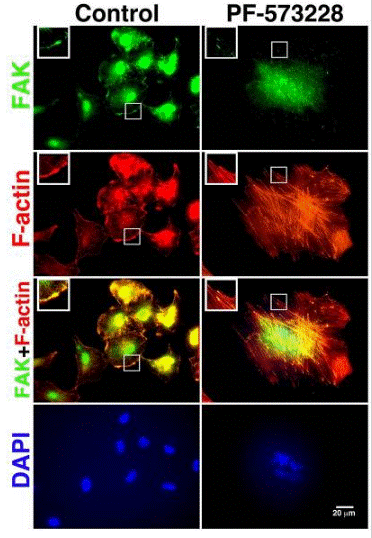
| Immunofluorescence | FAK / F-actin Emerin |
|
30761269 |
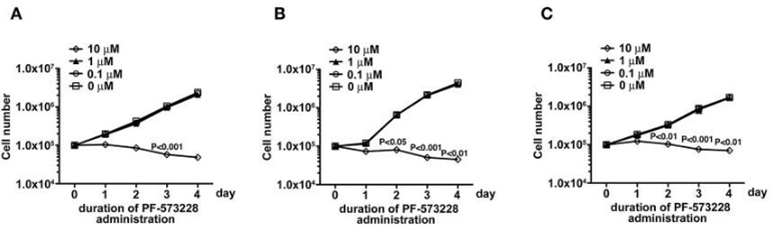
| Growth inhibition assay | Cell viability |
|
30761269 |
Technischer Support
Tel: +1-832-582-8158 Ext:3
Wenn Sie weitere Fragen haben, hinterlassen Sie bitte eine Nachricht.
Häufig gestellte Fragen
Frage 1:
Would you please let me know the detail of how to dissolve it for in vivo study (oral administration)? This compound is referred to as Catalog No.S2013.
Antwort:
A suspension of this compound in 30% PEG400+0.5% Tween80+ 5% Propylene glycol at 30mg/ml is fine for oral gavage.

Produkte sind nur für Forschungszwecke bestimmt. Nicht für den menschlichen Gebrauch. Wir verkaufen nicht an Patienten.
©Copyright 2013 Selleck Chemicals. Alle Rechte vorbehalten.