
nur für Forschungszwecke
Regorafenib (BAY-734506) Monohydrate VEGFR Inhibitor
Kat.-Nr.S5077
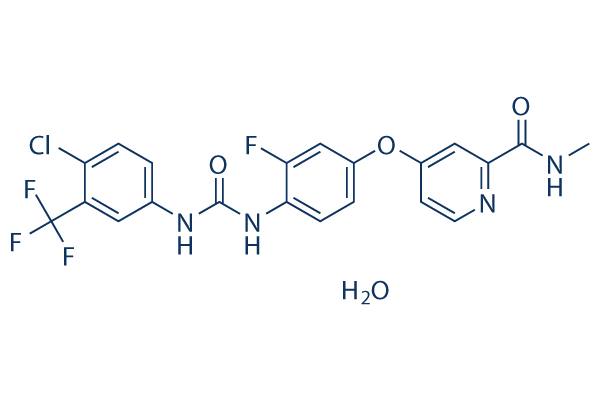
Chemische Struktur
Molekulargewicht: 500.83
Qualitätskontrolle
| Verwandte Ziele | EGFR PDGFR FGFR c-Met Src MEK CSF-1R FLT3 HER2 c-Kit |
|---|---|
| Weitere VEGFR Inhibitoren | SAR131675 SU 5402 Cediranib (AZD2171) Vatalanib (PTK787) 2HCl Anlotinib (AL3818) Dihydrochloride Linifanib (ABT-869) Apatinib (YN968D1) Apatinib (YN968D1) mesylate Ki8751 ZM 323881 HCl |
Zellkultur, Behandlung & Arbeitskonzentration
| Zelllinien | Assay-Typ | Konzentration | Inkubationszeit | Formulierung | Aktivitätsbeschreibung | PMID |
|---|---|---|---|---|---|---|
| GISTT1 | Cytotoxicity assay | 72 hrs | Cytotoxicity against human GISTT1 cells assessed as cell growth inhibition after 72 hrs by CellTiterGlo assay, GI50=0.13μM | 28991465 | ||
| GISTT1 | Cytotoxicity assay | 72 hrs | Cytotoxicity against human GISTT1 cells harboring KIT T670I mutant assessed as cell growth inhibition after 72 hrs by CellTiterGlo assay, GI50=0.38μM | 28991465 | ||
| GISTT1 | Cytotoxicity assay | 72 hrs | Cytotoxicity against human GISTT1 cells harboring KIT D816E mutant assessed as cell growth inhibition after 72 hrs by CellTiterGlo assay, GI50=1.35μM | 28991465 | ||
| GIST430 | Cytotoxicity assay | 72 hrs | Cytotoxicity against human GIST430 cells harboring KIT V654A mutant assessed as cell growth inhibition after 72 hrs by CellTiterGlo assay, GI50=3μM | 28991465 | ||
| DAOY | qHTS assay | qHTS of pediatric cancer cell lines to identify multiple opportunities for drug repurposing: Primary screen for DAOY cells | 29435139 | |||
| SJ-GBM2 | qHTS assay | qHTS of pediatric cancer cell lines to identify multiple opportunities for drug repurposing: Primary screen for SJ-GBM2 cells | 29435139 | |||
| A673 | qHTS assay | qHTS of pediatric cancer cell lines to identify multiple opportunities for drug repurposing: Primary screen for A673 cells | 29435139 | |||
| SK-N-MC | qHTS assay | qHTS of pediatric cancer cell lines to identify multiple opportunities for drug repurposing: Primary screen for SK-N-MC cells | 29435139 | |||
| BT-37 | qHTS assay | qHTS of pediatric cancer cell lines to identify multiple opportunities for drug repurposing: Primary screen for BT-37 cells | 29435139 | |||
| NB-EBc1 | qHTS assay | qHTS of pediatric cancer cell lines to identify multiple opportunities for drug repurposing: Primary screen for NB-EBc1 cells | 29435139 | |||
| U-2 OS | qHTS assay | qHTS of pediatric cancer cell lines to identify multiple opportunities for drug repurposing: Primary screen for U-2 OS cells | 29435139 | |||
| Saos-2 | qHTS assay | qHTS of pediatric cancer cell lines to identify multiple opportunities for drug repurposing: Primary screen for Saos-2 cells | 29435139 | |||
| NB1643 | qHTS assay | qHTS of pediatric cancer cell lines to identify multiple opportunities for drug repurposing: Primary screen for NB1643 cells | 29435139 | |||
| LAN-5 | qHTS assay | qHTS of pediatric cancer cell lines to identify multiple opportunities for drug repurposing: Primary screen for LAN-5 cells | 29435139 | |||
| BT-12 | qHTS assay | qHTS of pediatric cancer cell lines to identify multiple opportunities for drug repurposing: Primary screen for BT-12 cells | 29435139 | |||
| Rh18 | qHTS assay | qHTS of pediatric cancer cell lines to identify multiple opportunities for drug repurposing: Primary screen for Rh18 cells | 29435139 | |||
| OHS-50 | qHTS assay | qHTS of pediatric cancer cell lines to identify multiple opportunities for drug repurposing: Primary screen for OHS-50 cells | 29435139 | |||
| RD | qHTS assay | qHTS of pediatric cancer cell lines to identify multiple opportunities for drug repurposing: Primary screen for RD cells | 29435139 | |||
| MG 63 (6-TG R) | qHTS assay | qHTS of pediatric cancer cell lines to identify multiple opportunities for drug repurposing: Primary screen for MG 63 (6-TG R) cells | 29435139 | |||
| BA/F3 | Function assay | 72 hrs | Inhibition of Kit exon 11 deletion (557 to 558 residues) mutant (unknown origin) transfected in mouse BA/F3 cells assessed as inhibition of cell growth incubated for 72 hrs by MTS assay, GI50=0.021μM | 30204441 | ||
| BA/F3 | Function assay | 72 hrs | Inhibition of TEL-fused PDGFRbeta (unknown origin) transfected in mouse BA/F3 cells assessed as inhibition of cell growth incubated for 72 hrs by MTS assay, GI50=0.029μM | 30204441 | ||
| BA/F3 | Function assay | 72 hrs | Inhibition of Kit exon 11 deletion (557 to 558 residues) and D816H mutant and T670I mutant (unknown origin) transfected in mouse BA/F3 cells assessed as inhibition of cell growth incubated for 72 hrs by MTS assay, GI50=0.033μM | 30204441 | ||
| BA/F3 | Function assay | 72 hrs | Inhibition of Kit exon 11 deletion (557 to 558 residues) and A829P mutant and Y823D mutant (unknown origin) transfected in mouse BA/F3 cells assessed as inhibition of cell growth incubated for 72 hrs by MTS assay, GI50=0.047μM | 30204441 | ||
| BA/F3 | Function assay | 72 hrs | Inhibition of Kit exon 11 deletion (557 to 558 residues) and N822K mutant and Y823D mutant (unknown origin) transfected in mouse BA/F3 cells assessed as inhibition of cell growth incubated for 72 hrs by MTS assay, GI50=0.049μM | 30204441 | ||
| BA/F3 | Function assay | 72 hrs | Inhibition of TEL-fused PDGFRalpha (unknown origin) transfected in mouse BA/F3 cells assessed as inhibition of cell growth incubated for 72 hrs by MTS assay, GI50=0.051μM | 30204441 | ||
| BA/F3 | Function assay | 72 hrs | Inhibition of Kit exon 11 deletion (557 to 558 residues) and D820A mutant and D820A mutant (unknown origin) transfected in mouse BA/F3 cells assessed as inhibition of cell growth incubated for 72 hrs by MTS assay, GI50=0.063μM | 30204441 | ||
| BA/F3 | Function assay | 72 hrs | Inhibition of Kit exon 11 deletion (557 to 558 residues) and Y823D mutant (unknown origin) transfected in mouse BA/F3 cells assessed as inhibition of cell growth incubated for 72 hrs by MTS assay, GI50=0.094μM | 30204441 | ||
| BA/F3 | Function assay | 72 hrs | Inhibition of Kit V560D mutant (unknown origin) transfected in mouse BA/F3 cells assessed as inhibition of cell growth incubated for 72 hrs by MTS assay, GI50=0.108μM | 30204441 | ||
| BA/F3 | Function assay | 72 hrs | Inhibition of KDR (unknown origin) transfected in mouse BA/F3 cells assessed as inhibition of cell growth incubated for 72 hrs by MTS assay, GI50=0.114μM | 30204441 | ||
| BA/F3 | Function assay | 72 hrs | Inhibition of Kit exon 9 AY502 to 503 insertion mutant (unknown origin) transfected in mouse BA/F3 cells assessed as inhibition of cell growth incubated for 72 hrs by MTS assay, GI50=0.114μM | 30204441 | ||
| BA/F3 | Function assay | 72 hrs | Inhibition of Kit exon 11 deletion (557 to 558 residues) and V654A mutant (unknown origin) transfected in mouse BA/F3 cells assessed as inhibition of cell growth incubated for 72 hrs by MTS assay, GI50=0.231μM | 30204441 | ||
| BA/F3 | Function assay | 72 hrs | Inhibition of Kit exon 11 deletion (557 to 558 residues) and D816H mutant (unknown origin) transfected in mouse BA/F3 cells assessed as inhibition of cell growth incubated for 72 hrs by MTS assay, GI50=0.29μM | 30204441 | ||
| BA/F3 | Function assay | 72 hrs | Inhibition of PDGFRalpha V561D/D842V mutant (unknown origin) transfected in mouse BA/F3 cells assessed as inhibition of cell growth incubated for 72 hrs by MTS assay, GI50=0.522μM | 30204441 | ||
| BA/F3 | Function assay | 72 hrs | Inhibition of Kit V560D/V654A mutant (unknown origin) transfected in mouse BA/F3 cells assessed as inhibition of cell growth incubated for 72 hrs by MTS assay, GI50=0.549μM | 30204441 | ||
| BA/F3 | Function assay | 72 hrs | Inhibition of Kit exon 9 AY502 to 503 insertion and D816 mutant (unknown origin) transfected in mouse BA/F3 cells assessed as inhibition of cell growth incubated for 72 hrs by MTS assay, GI50=0.833μM | 30204441 | ||
| BA/F3 | Function assay | 72 hrs | Inhibition of Kit V560D/D816H mutant (unknown origin) transfected in mouse BA/F3 cells assessed as inhibition of cell growth incubated for 72 hrs by MTS assay, GI50=0.834μM | 30204441 | ||
| BA/F3 | Function assay | 72 hrs | Inhibition of Kit exon 11 deletion (560 to 578 residues) mutant (unknown origin) transfected in mouse BA/F3 cells assessed as inhibition of cell growth incubated for 72 hrs by MTS assay, GI50=0.943μM | 30204441 | ||
| BA/F3 | Function assay | 72 hrs | Inhibition of Kit exon 9 AY502 to 503 insertion and V654 mutant (unknown origin) transfected in mouse BA/F3 cells assessed as inhibition of cell growth incubated for 72 hrs by MTS assay, GI50=1.27μM | 30204441 | ||
| BA/F3 | Function assay | 72 hrs | Inhibition of Kit D816V mutant (unknown origin) transfected in mouse BA/F3 cells assessed as inhibition of cell growth incubated for 72 hrs by MTS assay, GI50=2.371μM | 30204441 | ||
| BA/F3 | Cytotoxicity assay | 72 hrs | Cytotoxicity in mouse parental BA/F3 cells incubated for 72 hrs by MTS assay, GI50=9.953μM | 30204441 | ||
| Sf9 | Function assay | Inhibition of human N-terminal GST tagged VEGFR-2 expressed in baculovirus infected Sf9 cells using poly (Glu,Tyr) 4:1 as substrate in presence of ATP by Kinase-Glo luminescence assay, IC50=0.005μM | 31284081 | |||
| Sf9 | Function assay | 4 hrs | Inhibition of wild type recombinant GST-tagged FLT3 (Y567 to S993 residues) (unknown origin) expressed in baculovirus infected Sf9 insect cells using Her2 peptide as substrate measured after 4 hrs in presence of ATP by Kinase-Glo Plus reagent-based lumine, IC50=0.082μM | 31721578 | ||
| Sf9 | Function assay | 150 mins | Inhibition of recombinant N-terminal 6x-His-tagged c-KIT (547 to 935 residues)/(694 to 753 residues deletion) (unknown origin) expressed in baculovirus infected Sf9 insect cells using poly (Glu,Tyr) 4:1 as substrate measured after 150 mins in presence of , IC50=0.116μM | 31721578 | ||
| GISTT1 | Antiproliferative assay | 72 hrs | Antiproliferative activity against human GISTT1 cells harboring heterozygous deletion mutation at C-kit exon 11 assessed as cell growth inhibition after 72 hrs by CellTiter 96 AQueous One Solution Cell Proliferation assay, GI50=0.119μM | 31721578 | ||
| GIST882 | Antiproliferative assay | 144 hrs | Antiproliferative activity against human GIST882 cells harboring c-KIT exon 13 homozygous primary K642E mutant assessed as cell growth inhibition after 144 hrs by methylene blue staining based assay, GI50=0.285μM | 31721578 | ||
| GIST48 | Antiproliferative assay | 120 hrs | Antiproliferative activity against human GIST48 cells harboring c-KIT exon 11 homozygous primary missense V560D mutant and exon 17 heterozygous secondary D820A mutant assessed as cell growth inhibition after 120 hrs by methylene blue staining based assay, GI50=0.785μM | 31721578 | ||
| Caco-2 | Toxicity assay | 48 hrs | Toxicity against Caco-2 cells determined at 48 hours by intracellular ATP concentration using the CellTiter-Glo Luminescent Cell Viability Assay, CC50=0.97μM | ChEMBL | ||
| Caco-2 | Function assay | 48 hrs | Determination of IC50 values for inhibition of SARS-CoV-2 induced cytotoxicity of Caco-2 cells after 48 hours by high content imaging, IC50=1.67μM | ChEMBL | ||
| VERO-E6 | Toxicity assay | 48 hrs | Toxicity CC50 against VERO-E6 cells determined at 48 hours by high content imaging (same conditions as 2_LEY without exposure to 0.01 MOI SARS CoV-2 virus), CC50=8.31μM | ChEMBL | ||
| VERO-E6 | Function assay | 48 hrs | Determination of IC50 values for inhibition of SARS-CoV-2 induced cytotoxicity of VERO-E6 cells after 48 hours exposure to 0.01 MOI SARS CoV-2 virus by high content imaging, IC50=24.95μM | ChEMBL | ||
| Klicken Sie hier, um weitere experimentelle Daten zu Zelllinien anzuzeigen | ||||||
Chemische Informationen, Lagerung & Stabilität
| Molekulargewicht | 500.83 | Formel | C21H15ClF4N4O3.H2O |
Lagerung (Ab dem Eingangsdatum) | |
|---|---|---|---|---|---|
| CAS-Nr. | 1019206-88-2 | -- | Lagerung von Stammlösungen |
|
|
| Synonyme | Fluoro-sorafenib, Resihance, Stivarga, regorafaenib monohydrate | Smiles | CNC(=O)C1=NC=CC(=C1)OC2=CC(=C(C=C2)NC(=O)NC3=CC(=C(C=C3)Cl)C(F)(F)F)F.O | ||
Löslichkeit
|
In vitro |
DMSO
: 100 mg/mL
(199.66 mM)
Water : Insoluble Ethanol : Insoluble |
Molaritätsrechner
|
In vivo |
|||||
In-vivo-Formulierungsrechner (Klare Lösung)
Schritt 1: Geben Sie die untenstehenden Informationen ein (Empfohlen: Ein zusätzliches Tier zur Berücksichtigung von Verlusten während des Experiments)
Schritt 2: Geben Sie die In-vivo-Formulierung ein (Dies ist nur der Rechner, keine Formulierung. Bitte kontaktieren Sie uns zuerst, wenn es im Abschnitt "Löslichkeit" keine In-vivo-Formulierung gibt.)
Berechnungsergebnisse:
Arbeitskonzentration: mg/ml;
Methode zur Herstellung der DMSO-Stammlösung: mg Wirkstoff vorgelöst in μL DMSO ( Konzentration der Stammlösung mg/mL, Bitte kontaktieren Sie uns zuerst, wenn die Konzentration die DMSO-Löslichkeit der Wirkstoffcharge überschreitet. )
Methode zur Herstellung der In-vivo-Formulierung: Nehmen Sie μL DMSO Stammlösung, dann hinzufügenμL PEG300, mischen und klären, dann hinzufügenμL Tween 80, mischen und klären, dann hinzufügen μL ddH2O, mischen und klären.
Methode zur Herstellung der In-vivo-Formulierung: Nehmen Sie μL DMSO Stammlösung, dann hinzufügen μL Maisöl, mischen und klären.
Hinweis: 1. Bitte stellen Sie sicher, dass die Flüssigkeit klar ist, bevor Sie das nächste Lösungsmittel hinzufügen.
2. Achten Sie darauf, das/die Lösungsmittel der Reihe nach hinzuzufügen. Sie müssen sicherstellen, dass die bei der vorherigen Zugabe erhaltene Lösung eine klare Lösung ist, bevor Sie mit der Zugabe des nächsten Lösungsmittels fortfahren. Physikalische Methoden wie Vortex, Ultraschall oder ein heißes Wasserbad können zur Unterstützung des Lösens verwendet werden.
Wirkmechanismus
| Targets/IC50/Ki |
PDGFRβ
(Cell-free) RET
(Cell-free) 1.5 nM
Raf-1
(Cell-free) 2.5 nM
murine VEGFR2
(Cell-free) 4.2 nM
KIT
(Cell-free) 7 nM
VEGFR1
(Cell-free) 13 nM
B-Raf (V600E)
(Cell-free) 19 nM
PDGFRβ
(Cell-free) 22 nM
B-Raf
(Cell-free) 28 nM
murine VEGFR3
(Cell-free) 46 nM
|
|---|---|
| In vitro |
Regorafenib verhindert stark die VEGFR2-Autophosphorylierung in NIH-3T3/VEGFR2-Zellen mit einem IC50 von 3 nM. In HAoSMCs unterdrückt Regorafenib die PDGFR-β-Autophosphorylierung nach Stimulation mit PDGF-BB, mit einem IC50 von 90 nM. Regorafenib hemmt auch die FGFR-Signalübertragung in MCF-7-Brustkrebszellen (BC), die mit FGF10 stimuliert wurden. Regorafenib hemmte sehr potent die mutierten Rezeptoren KITK642E und RETC634W mit IC50-Werten von ungefähr 20 nM bzw. 10 nM. Regorafenib hemmt die Proliferation von VEGF165-stimulierten HUVECs mit einem IC50 von ungefähr 3 nM. Regorafenib verhindert die Proliferation von FGF2-stimulierten HUVECs und von PDGF-BB-stimulierten HAoSMCs mit IC50-Werten von 127 nM bzw. 146 nM. Regorafenib zielt sowohl auf die Tumorzellproliferation als auch auf die Tumorvaskulatur durch Hemmung von Rezeptoren von Tyrosinkinasen (VEGFR, KIT, RET, FGFR und PDGFR) und Serin/Threonin-Kinasen (Raf und p38MAPK) ab. Regorafenib unterdrückt das Wachstum menschlicher Hep3B-, PLC/PRF/5- und HepG2-Zellen konzentrations- und zeitabhängig.
|
| Kinase-Assay |
Kinase-Assays
|
|
In-vitro-Assays unter Verwendung rekombinanter VEGFR2 (murine aa785-aa1367), VEGFR3 (murine aa818-aa1363), PDGFRβ (aa561-aa1106), Raf-1 (aa305-aa648) und BRafV600E (aa409-aa765) Kinasedomänen werden durchgeführt. Das anfängliche In-vitro-Kinaseinhibitions-Profiling wird bei einer festen Regorafenib-Konzentration von 1 μM durchgeführt. Inhibitorische Konzentration von 50 % (IC50)-Werte werden von ausgewählten reagierenden Kinasen, z. B. VEGFR1 und RET, bestimmt. Die TIE2-Kinasehemmung wird mit einem homogenen zeitaufgelösten Fluoreszenz (HTRF)-Assay unter Verwendung eines rekombinanten Fusionsproteins aus Glutathion-S-Transferase, der intrazellulären Domäne von TIE2 und dem Peptid Biotin-Ahx-EPKDDAYPLYSDFG als Substrat gemessen.
|
|
| In vivo |
Regorafenib zeigt eine potente dosisabhängige TGI in verschiedenen präklinischen humanen Xenograftmodellen bei Mäusen mit Tumorschrumpfungen in Brust-MDA-MB-231- und Nieren-786-O-Karzinommodellen. Regorafenib verhindert nicht nur das Wachstum syngener primärer 4T1-Brusttumoren, die orthotop im Fettpolster wachsen, sondern unterdrückt auch die Bildung von Tumormetastasen in der Lunge.
|
Literatur |
|
Klinische Studieninformationen
(Daten von https://clinicaltrials.gov, aktualisiert am 2024-05-22)
| NCT-Nummer | Rekrutierung | Erkrankungen | Sponsor/Kooperationspartner | Startdatum | Phasen |
|---|---|---|---|---|---|
| NCT03386825 | Completed | Colorectal Neoplasms |
Bayer |
January 31 2018 | -- |
| NCT01959269 | Completed | Colorectal Neoplasm |
Bayer |
October 31 2013 | -- |
Technischer Support
Tel: +1-832-582-8158 Ext:3
Wenn Sie weitere Fragen haben, hinterlassen Sie bitte eine Nachricht.

Produkte sind nur für Forschungszwecke bestimmt. Nicht für den menschlichen Gebrauch. Wir verkaufen nicht an Patienten.
©Copyright 2013 Selleck Chemicals. Alle Rechte vorbehalten.