
nur für Forschungszwecke
Tucidinostat (Chidamide) HDAC Inhibitor
Kat.-Nr.S8567
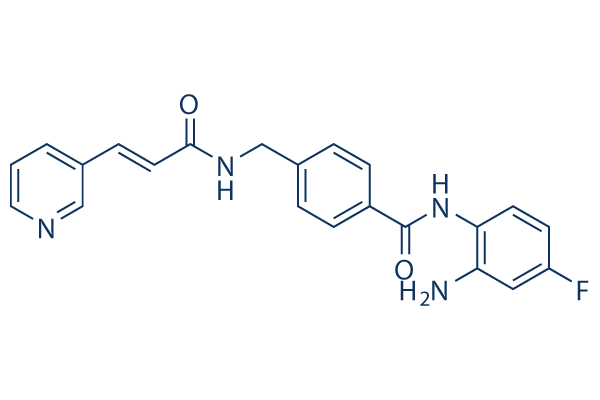
Chemische Struktur
Molekulargewicht: 390.41
Qualitätskontrolle
Zellkultur, Behandlung & Arbeitskonzentration
| Zelllinien | Assay-Typ | Konzentration | Inkubationszeit | Formulierung | Aktivitätsbeschreibung | PMID |
|---|---|---|---|---|---|---|
| Sf9 | Function assay | 5 mins | Inhibition of recombinant human full length HDAC1 expressed in baculovirus infected Sf9 insect cells using biotinylated lysine 9 acetylated histone H3 (1 to 21 residues) as substrate incubated for 5 mins followed by substrate addition measured after 60 mi, IC50 = 0.112 μM. | 28835797 | ||
| EBC1 | Antiproliferative assay | 72 hrs | Antiproliferative activity against human EBC1 cells after 72 hrs by SRB assay, IC50 = 2.9 μM. | 28835797 | ||
| HCT116 | Antiproliferative assay | 72 hrs | Antiproliferative activity against human HCT116 cells after 72 hrs by SRB assay, IC50 = 7.8 μM. | 28835797 | ||
| HL60 | Growth inhibition assay | 48 hrs | Growth inhibition of human HL60 cells incubated for 48 hrs by MTS method, GI50 = 0.4 μM. | ChEMBL | ||
| Jurkat | Growth inhibition assay | 48 hrs | Growth inhibition of human Jurkat cells incubated for 48 hrs by MTS method, GI50 = 1.5 μM. | ChEMBL | ||
| hematopoietic malignant cells | Cytotoxicity assay | Cytotoxicity against human hematopoietic malignant cells assessed as growth inhibition, GI50 = 1.86 μM. | ChEMBL | |||
| U2OS | Growth inhibition assay | 48 hrs | Growth inhibition of human U2OS cells incubated for 48 hrs by MTS method, GI50 = 2 μM. | ChEMBL | ||
| HepG2 | Growth inhibition assay | 48 hrs | Growth inhibition of human HepG2 cells incubated for 48 hrs by MTS method, GI50 = 4 μM. | ChEMBL | ||
| LNCAP | Growth inhibition assay | 48 hrs | Growth inhibition of human LNCAP cells incubated for 48 hrs by MTS method, GI50 = 4 μM. | ChEMBL | ||
| Raji | Growth inhibition assay | 48 hrs | Growth inhibition of human Raji cells incubated for 48 hrs by MTS method, GI50 = 4 μM. | ChEMBL | ||
| MCF7 | Growth inhibition assay | 48 hrs | Growth inhibition of human MCF7 cells incubated for 48 hrs by MTS method, GI50 = 5 μM. | ChEMBL | ||
| 28SC | Growth inhibition assay | 48 hrs | Growth inhibition of human 28SC cells incubated for 48 hrs by MTS method, GI50 = 5.8 μM. | ChEMBL | ||
| PANC1 | Growth inhibition assay | 48 hrs | Growth inhibition of human PANC1 cells incubated for 48 hrs by MTS method, GI50 = 6.3 μM. | ChEMBL | ||
| human solid tumor cells | Cytotoxicity assay | Cytotoxicity against human solid tumor cells assessed as growth inhibition, GI50 = 6.65 μM. | ChEMBL | |||
| HeLa | Function assay | 10 mins | Inhibition of HDAC enzymatic activity in human HeLa cells incubated for 10 mins in presence of substrate by colorimetric activity assay, IC50 = 7.2 μM. | ChEMBL | ||
| MDA-MB-231 | Growth inhibition assay | 48 hrs | Growth inhibition of human MDA-MB-231 cells incubated for 48 hrs by MTS method, GI50 = 7.9 μM. | ChEMBL | ||
| SMMC7721 | Growth inhibition assay | 48 hrs | Growth inhibition of human SMMC7721 cells incubated for 48 hrs by MTS method, GI50 = 16 μM. | ChEMBL | ||
| DU145 | Growth inhibition assay | 48 hrs | Growth inhibition of human DU145 cells incubated for 48 hrs by MTS method, GI50 = 25 μM. | ChEMBL | ||
| HeLa | Growth inhibition assay | 48 hrs | Growth inhibition of human HeLa cells incubated for 48 hrs by MTS method, GI50 = 40 μM. | ChEMBL | ||
| U2OS | Function assay | 1 uM | 24 hrs | Activation of PPARG (unknown origin) expressed in human U2OS cells at 1 uM in presence of 10 uM rosiglitazone incubated for 24 hrs by luciferase reporter gene assay | ChEMBL | |
| U2OS | Function assay | 1 uM | 24 hrs | Activation of ERbeta (unknown origin) expressed in human U2OS cells at 1 uM in presence of 0.01 uM E2 incubated for 24 hrs by luciferase reporter gene assay | ChEMBL | |
| U2OS | Function assay | 1 uM | 24 hrs | Activation of glulcocorticoid receptor (unknown origin) expressed in human U2OS cells at 1 uM in presence of 0.1 uM dexamethasone incubated for 24 hrs by luciferase reporter gene assay | ChEMBL | |
| U2OS | Function assay | 1 uM | 24 hrs | Activation of ERalpha (unknown origin) expressed in human U2OS cells at 1 uM in presence of 0.01 uM E2 incubated for 24 hrs by luciferase reporter gene assay | ChEMBL | |
| U2OS | Function assay | 1 uM | 24 hrs | Activation of glulcocorticoid receptor (unknown origin) expressed in human U2OS cells at 1 uM incubated for 24 hrs by luciferase reporter gene assay | ChEMBL | |
| U2OS | Function assay | 1 uM | 24 hrs | Activation of PPARG (unknown origin) expressed in human U2OS cells at 1 uM incubated for 24 hrs by luciferase reporter gene assay | ChEMBL | |
| U2OS | Function assay | 1 uM | 24 hrs | Activation of ERalpha (unknown origin) expressed in human U2OS cells at 1 uM incubated for 24 hrs by luciferase reporter gene assay | ChEMBL | |
| U2OS | Function assay | 1 uM | 24 hrs | Activation of ERbeta (unknown origin) expressed in human U2OS cells at 1 uM incubated for 24 hrs by luciferase reporter gene assay | ChEMBL | |
| Klicken Sie hier, um weitere experimentelle Daten zu Zelllinien anzuzeigen | ||||||
Chemische Informationen, Lagerung & Stabilität
| Molekulargewicht | 390.41 | Formel | C22H19FN4O2 |
Lagerung (Ab dem Eingangsdatum) | |
|---|---|---|---|---|---|
| CAS-Nr. | 1616493-44-7 | SDF herunterladen | Lagerung von Stammlösungen |
|
|
| Synonyme | HBI-8000, CS-055 | Smiles | C1=CC(=CN=C1)C=CC(=O)NCC2=CC=C(C=C2)C(=O)NC3=C(C=C(C=C3)F)N | ||
Löslichkeit
|
In vitro |
DMSO
: 78 mg/mL
(199.78 mM)
Ethanol : 1 mg/mL Water : Insoluble |
Molaritätsrechner
|
In vivo |
|||||
In-vivo-Formulierungsrechner (Klare Lösung)
Schritt 1: Geben Sie die untenstehenden Informationen ein (Empfohlen: Ein zusätzliches Tier zur Berücksichtigung von Verlusten während des Experiments)
Schritt 2: Geben Sie die In-vivo-Formulierung ein (Dies ist nur der Rechner, keine Formulierung. Bitte kontaktieren Sie uns zuerst, wenn es im Abschnitt "Löslichkeit" keine In-vivo-Formulierung gibt.)
Berechnungsergebnisse:
Arbeitskonzentration: mg/ml;
Methode zur Herstellung der DMSO-Stammlösung: mg Wirkstoff vorgelöst in μL DMSO ( Konzentration der Stammlösung mg/mL, Bitte kontaktieren Sie uns zuerst, wenn die Konzentration die DMSO-Löslichkeit der Wirkstoffcharge überschreitet. )
Methode zur Herstellung der In-vivo-Formulierung: Nehmen Sie μL DMSO Stammlösung, dann hinzufügenμL PEG300, mischen und klären, dann hinzufügenμL Tween 80, mischen und klären, dann hinzufügen μL ddH2O, mischen und klären.
Methode zur Herstellung der In-vivo-Formulierung: Nehmen Sie μL DMSO Stammlösung, dann hinzufügen μL Maisöl, mischen und klären.
Hinweis: 1. Bitte stellen Sie sicher, dass die Flüssigkeit klar ist, bevor Sie das nächste Lösungsmittel hinzufügen.
2. Achten Sie darauf, das/die Lösungsmittel der Reihe nach hinzuzufügen. Sie müssen sicherstellen, dass die bei der vorherigen Zugabe erhaltene Lösung eine klare Lösung ist, bevor Sie mit der Zugabe des nächsten Lösungsmittels fortfahren. Physikalische Methoden wie Vortex, Ultraschall oder ein heißes Wasserbad können zur Unterstützung des Lösens verwendet werden.
Wirkmechanismus
| Targets/IC50/Ki |
HDAC3
(Cell-free) 67 nM
HDAC10
(Cell-free) 78 nM
HDAC1
(Cell-free) 95 nM
HDAC2
(Cell-free) 160 nM
|
|---|---|
| In vitro |
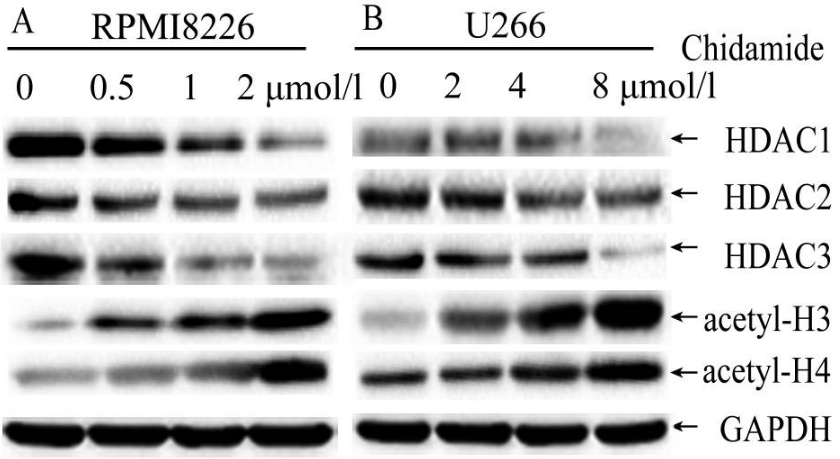
Tucidinostat (Chidamide) hemmt Klasse-I-HDACs 1-3 sowie Klasse-IIb-HDAC10 in niedrigen nanomolaren Konzentrationen. Es induziert signifikant die Histon-H3-Acetylierung sowohl in menschlichen HeLa-Zervixadenokarzinomzellen als auch in menschlichen PBMC. Zellwachstumshemmungsstudien, die mit 18 von Menschen stammenden Tumorzelllinien durchgeführt wurden, zeigen, dass diese Verbindung und MS-275 das In-vitro-Wachstum der meisten, aber nicht aller Tumorzellen im niedrigen mikromolaren Konzentrationsbereich ähnlich hemmen. Es ist jedoch, und in geringerem Maße MS-275, signifikant weniger toxisch für normale Zellen aus menschlicher fötaler Niere (CCC-HEK) und Leber (CCC-HEL), was auf eine differentielle zytotoxische Reaktion von normalen Zellen im Vergleich zu Krebszellen auf Chidamid hinweist. |
| In vivo |
In HCT-8-Kolorektalkarzinom-Mäuse-Xenografts zeigt Tucidinostat (Chidamide) eine In-vivo-Antitumoraktivität. Es wird jedoch bei den oben genannten Dosen in den tumortragenden Tieren gut vertragen, während die Kontrollmedikamente einen signifikanten Gewichtsverlust verursachen. |
Literatur |
Anwendungen
| Methoden | Biomarker | Bilder | PMID |
|---|---|---|---|
| Western blot | HDAC1 / HDAC2 / HDAC3 / acetyl-H3 / acetyl-H4 Mcl-1 / Myc / Bcl-xl / p21 / p27 / CDK6 / CDK4 / Cyclin D2 Ace-H3K18 / Ace-H3K9 / Ac-H4K8 p-EGFR / EGFR / p-STAT3 / STAT3 / p-AKT / AKT / p-AMPK / MAPK PARP / Cleaved PARP / Caspase-3 / Cleaved caspase-3 |
|
31289512 |
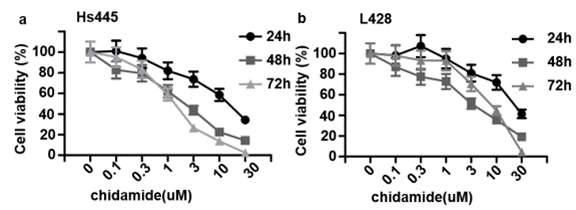
| Growth inhibition assay | Cell viability |
|
29100410 |
Klinische Studieninformationen
(Daten von https://clinicaltrials.gov, aktualisiert am 2024-05-22)
| NCT-Nummer | Rekrutierung | Erkrankungen | Sponsor/Kooperationspartner | Startdatum | Phasen |
|---|---|---|---|---|---|
| NCT05586841 | Not yet recruiting | HR+/HER2- Advanced Breast Cancer |
Beijing 302 Hospital |
November 1 2022 | Phase 1 |
| NCT05141357 | Terminated | Non Small Cell Lung Cancer |
HUYABIO International LLC. |
March 14 2022 | Phase 2 |
| NCT04994210 | Recruiting | Safety and Efficacy |
Sun Yat-sen University |
October 4 2021 | Phase 2 |
| NCT05140616 | Recruiting | Safety and Efficacy |
The First Affiliated Hospital of Soochow University |
May 31 2021 | Phase 1|Phase 2 |
| NCT04651127 | Unknown status | Cervical Cancer|Cervix Cancer|Cervix Neoplasm |
Sun Yat-sen University |
November 9 2020 | Phase 1|Phase 2 |
Technischer Support
Tel: +1-832-582-8158 Ext:3
Wenn Sie weitere Fragen haben, hinterlassen Sie bitte eine Nachricht.

Produkte sind nur für Forschungszwecke bestimmt. Nicht für den menschlichen Gebrauch. Wir verkaufen nicht an Patienten.
©Copyright 2013 Selleck Chemicals. Alle Rechte vorbehalten.