
nur für Forschungszwecke
Barasertib-HQPA (AZD2811) Aurora B Inhibitor
Kat.-Nr.S1147
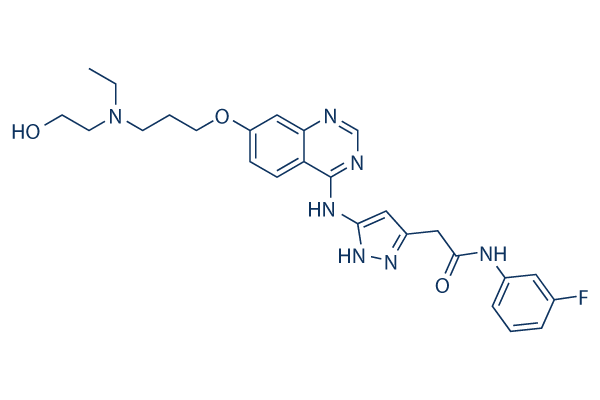
Chemische Struktur
Molekulargewicht: 507.56
Qualitätskontrolle
| Verwandte Ziele | CDK HSP PD-1/PD-L1 ROCK Wee1 DNA/RNA Synthesis Microtubule Associated Ras KRas Casein Kinase |
|---|---|
| Weitere Aurora Kinase Inhibitoren | Hesperadin Alisertib (MLN8237) Tozasertib (VX-680) ZM 447439 MLN8054 Danusertib (PHA-739358) MK-5108 TCS7010 (Aurora A Inhibitor I) AMG-900 PHA-680632 |
Zellkultur, Behandlung & Arbeitskonzentration
| Zelllinien | Assay-Typ | Konzentration | Inkubationszeit | Formulierung | Aktivitätsbeschreibung | PMID |
|---|---|---|---|---|---|---|
| LNCaP | Growth Inhibition Assay | 0-500 nM | 48 h | IC50=25 nM | 25277659 | |
| LNCaP | Apoptosis Assay | 0-500 nM | 48 h | induces apoptotic cell death through caspase-3 upregulation | 25277659 | |
| LNCaP | Function Assay | 50 nM | 48 h | induces micronuclei with aneugenic mechanism | 25277659 | |
| Ramos | Function Assay | 500 nM | 0-72 h | inhibits Aurora B kinase | 21371446 | |
| Daudi | Function Assay | 500 nM | 0-72 h | inhibits Aurora B kinase | 21371446 | |
| L540 | Function Assay | 500 nM | 0-72 h | inhibits Aurora B kinase | 21371446 | |
| BJAJ | Growth Inhibition Assay | 500 nM | 0-72 h | inhibits cell growth significantly | 21371446 | |
| Ramos | Growth Inhibition Assay | 500 nM | 0-72 h | inhibits cell growth significantly | 21371446 | |
| Raji | Growth Inhibition Assay | 500 nM | 0-72 h | inhibits cell growth significantly | 21371446 | |
| Daudi | Growth Inhibition Assay | 500 nM | 0-72 h | inhibits cell growth significantly | 21371446 | |
| L428 | Growth Inhibition Assay | 500 nM | 0-72 h | inhibits cell growth | 21371446 | |
| KM-H2 | Growth Inhibition Assay | 500 nM | 0-72 h | inhibits cell growth | 21371446 | |
| HDLM-2 | Growth Inhibition Assay | 500 nM | 0-72 h | inhibits cell growth | 21371446 | |
| L450 | Growth Inhibition Assay | 500 nM | 0-72 h | inhibits cell growth | 21371446 | |
| BJAJ | Apoptosis Assay | 500 nM | 0-72 h | induces apoptosis in a time-dependent manner | 21371446 | |
| Ramos | Apoptosis Assay | 500 nM | 0-72 h | induces apoptosis in a time-dependent manner | 21371446 | |
| Raji | Apoptosis Assay | 500 nM | 0-72 h | induces apoptosis in a time-dependent manner | 21371446 | |
| Daudi | Apoptosis Assay | 500 nM | 0-72 h | induces apoptosis in a time-dependent manner | 21371446 | |
| L428 | Apoptosis Assay | 500 nM | 0-72 h | induces apoptosis in a time-dependent manner | 21371446 | |
| KM-H2 | Apoptosis Assay | 500 nM | 0-72 h | induces apoptosis in a time-dependent manner | 21371446 | |
| HDLM-2 | Apoptosis Assay | 500 nM | 0-72 h | induces apoptosis in a time-dependent manner | 21371446 | |
| L450 | Apoptosis Assay | 500 nM | 0-72 h | induces apoptosis in a time-dependent manner | 21371446 | |
| SW620 | Growth Inhibition Assay | EC50=10±2.1 nM | 21245090 | |||
| HCT116 | Growth Inhibition Assay | EC50=11±3.3 nM | 21245090 | |||
| MDA-MB-435 | Growth Inhibition Assay | 0-10000 nM | 2-5 d | DMSO | IC50=125 nM | 20175926 |
| MDA-MB-468 | Growth Inhibition Assay | 0-10000 nM | 2-5 d | DMSO | IC50=14 nM | 20175926 |
| MDA-MB-231 | Growth Inhibition Assay | 0-10000 nM | 2-5 d | DMSO | IC50=105 nM | 20175926 |
| BT474 | Growth Inhibition Assay | 0-10000 nM | 2-5 d | DMSO | IC50=8 nM | 20175926 |
| MDA-MB-361 | Growth Inhibition Assay | 0-10000 nM | 2-5 d | DMSO | IC50=70 nM | 20175926 |
| HER18 | Growth Inhibition Assay | 0-10000 nM | 2-5 d | DMSO | IC50=20 nM | 20175926 |
| HER18 | Apoptosis Assay | 100 nM | 0/24/48 h | DMSO | induces apoptosis and reduces clonogenic potential | 20175926 |
| MDA-MB-231 | Apoptosis Assay | 105 nM | 0/24/48 h | DMSO | induces apoptosis and reduces clonogenic potential | 20175926 |
| JHH-1 | Growth Inhibition Assay | 0.3–1000 nM | 72 h | EC50=17.4±1.0 nM | 19913935 | |
| JHH-2 | Growth Inhibition Assay | 0.3–1000 nM | 72 h | EC50=218.0±10.8 nM | 19913935 | |
| JHH-4 | Growth Inhibition Assay | 0.3–1000 nM | 72 h | EC50=155.6±16.8 nM | 19913935 | |
| HuH-1 | Growth Inhibition Assay | 0.3–1000 nM | 72 h | EC50=27.3±5.0 nM | 19913935 | |
| HuH-6 | Growth Inhibition Assay | 0.3–1000 nM | 72 h | EC50=3.7±0.6 nM | 19913935 | |
| HuH-7 | Growth Inhibition Assay | 0.3–1000 nM | 72 h | EC50=6.8±0.3 nM | 19913935 | |
| HLE | Growth Inhibition Assay | 0.3–1000 nM | 72 h | EC50=45.9±6.4 nM | 19913935 | |
| HLF | Growth Inhibition Assay | 0.3–1000 nM | 72 h | EC50=126.1±12.2 nM | 19913935 | |
| PLC/PRF/5 | Growth Inhibition Assay | 0.3–1000 nM | 72 h | EC50=76.9±9.9 nM | 19913935 | |
| SK-Hep1 | Growth Inhibition Assay | 0.3–1000 nM | 72 h | EC50=21.9±1.2 nM | 19913935 | |
| Hep3B | Growth Inhibition Assay | 0.3–1000 nM | 72 h | EC50=7.6±1.2 nM | 19913935 | |
| HepG2 | Growth Inhibition Assay | 0.3–1000 nM | 72 h | EC50=14.7±1.7 nM | 19913935 | |
| Ramos | Apoptosis Assay | 25/50/100 nM | 48 h | increases the levels of the cleaved forms of PARP and caspase 3 | 19823168 | |
| Daudi | Apoptosis Assay | 25/50/100 nM | 48 h | increases the levels of the cleaved forms of PARP and caspase 3 | 19823168 | |
| BALM-14 | Apoptosis Assay | 12.5/25/50 nM | 48 h | increases the levels of the cleaved forms of PARP and caspase 3 | 19823168 | |
| BALM-27 | Apoptosis Assay | 12.5/25/50 nM | 48 h | increases the levels of the cleaved forms of PARP and caspase 3 | 19823168 | |
| NB4 | Growth Inhibition Assay | 0.01/0.1/1 μM | 48 h | inhibits cell growth significantly | 18367484 | |
| HeLa | Function Assay | 1 uM | 24 hrs | Inhibition of aurora B autophosphorylation in human HeLa cells at 1 uM after 24 hrs by Western blotting | 20684549 | |
| Klicken Sie hier, um weitere experimentelle Daten zu Zelllinien anzuzeigen | ||||||
Chemische Informationen, Lagerung & Stabilität
| Molekulargewicht | 507.56 | Formel | C26H30FN7O3 |
Lagerung (Ab dem Eingangsdatum) | |
|---|---|---|---|---|---|
| CAS-Nr. | 722544-51-6 | SDF herunterladen | Lagerung von Stammlösungen |
|
|
| Synonyme | AZD2811, INH-34, Barasertib-HQPA , Defosbarasertib | Smiles | CCN(CCCOC1=CC2=C(C=C1)C(=NC=N2)NC3=NNC(=C3)CC(=O)NC4=CC(=CC=C4)F)CCO | ||
Löslichkeit
|
In vitro |
DMSO
: 100 mg/mL
(197.02 mM)
Water : Insoluble Ethanol : Insoluble |
Molaritätsrechner
|
In vivo |
|||||
In-vivo-Formulierungsrechner (Klare Lösung)
Schritt 1: Geben Sie die untenstehenden Informationen ein (Empfohlen: Ein zusätzliches Tier zur Berücksichtigung von Verlusten während des Experiments)
Schritt 2: Geben Sie die In-vivo-Formulierung ein (Dies ist nur der Rechner, keine Formulierung. Bitte kontaktieren Sie uns zuerst, wenn es im Abschnitt "Löslichkeit" keine In-vivo-Formulierung gibt.)
Berechnungsergebnisse:
Arbeitskonzentration: mg/ml;
Methode zur Herstellung der DMSO-Stammlösung: mg Wirkstoff vorgelöst in μL DMSO ( Konzentration der Stammlösung mg/mL, Bitte kontaktieren Sie uns zuerst, wenn die Konzentration die DMSO-Löslichkeit der Wirkstoffcharge überschreitet. )
Methode zur Herstellung der In-vivo-Formulierung: Nehmen Sie μL DMSO Stammlösung, dann hinzufügenμL PEG300, mischen und klären, dann hinzufügenμL Tween 80, mischen und klären, dann hinzufügen μL ddH2O, mischen und klären.
Methode zur Herstellung der In-vivo-Formulierung: Nehmen Sie μL DMSO Stammlösung, dann hinzufügen μL Maisöl, mischen und klären.
Hinweis: 1. Bitte stellen Sie sicher, dass die Flüssigkeit klar ist, bevor Sie das nächste Lösungsmittel hinzufügen.
2. Achten Sie darauf, das/die Lösungsmittel der Reihe nach hinzuzufügen. Sie müssen sicherstellen, dass die bei der vorherigen Zugabe erhaltene Lösung eine klare Lösung ist, bevor Sie mit der Zugabe des nächsten Lösungsmittels fortfahren. Physikalische Methoden wie Vortex, Ultraschall oder ein heißes Wasserbad können zur Unterstützung des Lösens verwendet werden.
Wirkmechanismus
| Targets/IC50/Ki |
Aurora B
(Cell-free assay) 0.37 nM
|
|---|---|
| In vitro |
Barasertib (AZD1152-HQPA), ein hochselektiver Aurora B Inhibitor, verursacht Polyploidie und Apoptose in vielen Krebszelllinien. |
| In vivo |
Barasertib (AZD1152-HQPA) ist ein Aurora B Kinase-Inhibitor und hat Wirksamkeit gegen RB1 / SCLC-Zelllinien-Xenografts, RB1 / SCLC PDXs und autochthone Rb1 / neuroendokrine Tumoren. |
Literatur |
|
Anwendungen
| Methoden | Biomarker | Bilder | PMID |
|---|---|---|---|
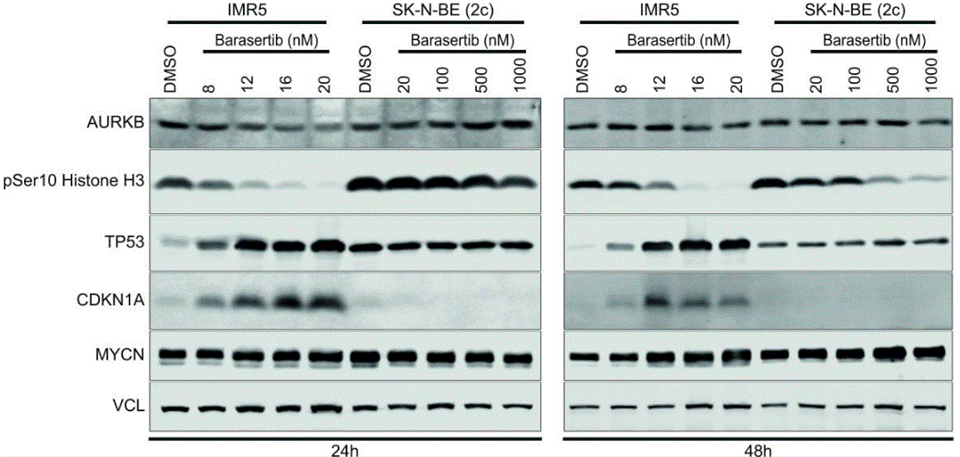
| Western blot | AURKB / pSer10 Histone H3 / TP53 / CDKN1A / MYCN p53 / p21 / p-p38 / p38 |
|
26497213 |
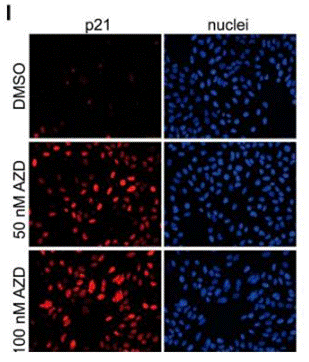
| Immunofluorescence | p21 |
|
24782314 |
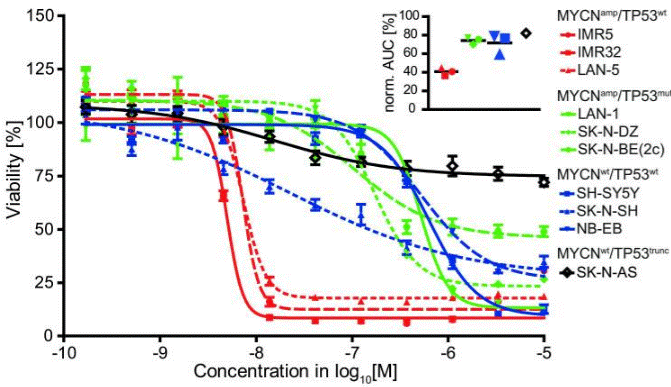
| Growth inhibition assay | Cell viability |
|
26497213 |
Klinische Studieninformationen
(Daten von https://clinicaltrials.gov, aktualisiert am 2024-05-22)
| NCT-Nummer | Rekrutierung | Erkrankungen | Sponsor/Kooperationspartner | Startdatum | Phasen |
|---|---|---|---|---|---|
| NCT02579226 | Completed | Advanced Solid Tumours |
AstraZeneca |
October 28 2015 | Phase 1 |
Technischer Support
Tel: +1-832-582-8158 Ext:3
Wenn Sie weitere Fragen haben, hinterlassen Sie bitte eine Nachricht.
Häufig gestellte Fragen
Frage 1:
Can you let me know what solvent I can use for it, cat # S1147, for in vivo use? (IP injection in mice)
Antwort:
S1147 can be dissolved in 30% PEG400/0.5% Tween80/5% Propylene glycol at 30mg/ml as a clear solution. Usually, when prepare the solution, we will add organic solvents first, then add Tween 80, then water. But this compound can not dissolve in 30% PEG400/0.5% Tween80/5% Propylene glycol clearly. After water was added, it became a clear solution.

Produkte sind nur für Forschungszwecke bestimmt. Nicht für den menschlichen Gebrauch. Wir verkaufen nicht an Patienten.
©Copyright 2013 Selleck Chemicals. Alle Rechte vorbehalten.