
nur für Forschungszwecke
MLN8054 Aurora Kinase Inhibitor
Kat.-Nr.: S1100
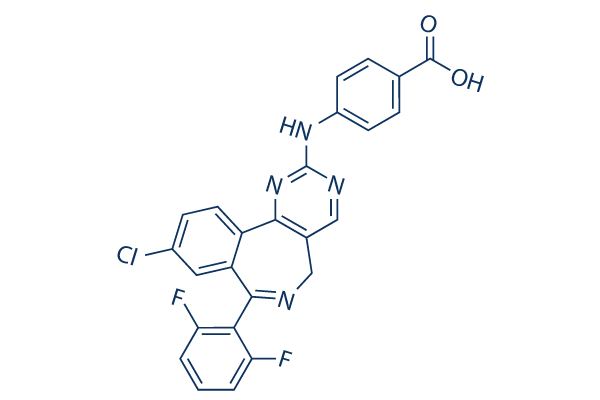
Chemische Struktur
Molekulargewicht: 476.86
Qualitätskontrolle (Quality Control)
| Verwandte Ziele | CDK HSP PD-1/PD-L1 ROCK Wee1 DNA/RNA Synthesis Microtubule Associated Ras KRas Casein Kinase |
|---|---|
| Weitere Aurora Kinase Inhibitoren | Hesperadin Barasertib-HQPA (AZD2811) Alisertib (MLN8237) Tozasertib (VX-680, MK-0457) ZM 447439 Danusertib (PHA-739358) MK-5108 TCS7010 (Aurora A Inhibitor I) AMG-900 CCT137690 |
Zellkultur, Behandlung & Arbeitskonzentration
(Cell Culture, Treatment & Working Concentration)
| Zelllinien | Assay-Typ | Konzentration | Inkubationszeit | Formulierung | Aktivitätsbeschreibung | PMID |
|---|---|---|---|---|---|---|
| Sf9 cells | Function assay | Inhibition of mouse recombinant Aurora A kinase expressed in insect Sf9 cells by radioactive flashplate assay, IC50=4 nM | ||||
| human HCT116 cells | Function assay | Inhibition of aurora kinase A autophosphorylation at T288 in human HCT116 cells by immunofluorescence analysis, IC50=0.034 μM | ||||
| human HeLa cells | Function assay | 1 h | Inhibition of Aurora A Thr288 autophosphorylation in human HeLa cells after 1 hr, IC50=0.034 μM | |||
| human H460 cells | Proliferation assay | 96 h | Antiproliferative activity against human H460 cells after 96 hrs by BrdU cell proliferation ELISA, IC50=0.11 μM | |||
| human HT-29 cells | Proliferation assay | 4 days | Antiproliferative activity against human HT-29 cells after 4 days by celltiter assay, IC50=0.15 μM | |||
| human Calu6 cells | Proliferation assay | 96 h | Antiproliferative activity against human Calu6 cells after 96 hrs by BrdU cell proliferation ELISA, IC50=0.22 μM | |||
| human SKOV3 cells | Proliferation assay | 96 h | Antiproliferative activity against human SKOV3 cells after 96 hrs by BrdU cell proliferation ELISA, IC50=0.53 μM | |||
| human MCF7 cells | Proliferation assay | 96 h | Antiproliferative activity against human MCF7 cells after 96 hrs by BrdU cell proliferation ELISA, IC50=0.67 μM | |||
| human MDAMB231 cells | Proliferation assay | 96 h | Antiproliferative activity against human MDAMB231 cells after 96 hrs by BrdU cell proliferation ELISA, IC50=0.74 μM | |||
| human PC3 cells | Proliferation assay | 96 h | Antiproliferative activity against human PC3 cells after 96 hrs by BrdU cell proliferation ELISA, IC50=0.79 μM | |||
| human SW480 cells | Proliferation assay | 96 h | Antiproliferative activity against human SW480 cells after 96 hrs by BrdU cell proliferation ELISA, IC50=0.86 μM | |||
| human DLD1 cells | Proliferation assay | 96 h | Antiproliferative activity against human DLD1 cells after 96 hrs by BrdU cell proliferation ELISA, IC50=1.43 μM | |||
| DU-145 prostate cancer cell | Function assay | 96 h | Inhibitory concentration against DU-145 prostate cancer cell proliferation over 96 hr, IC50=0.11 μM | |||
| Klicken Sie hier, um weitere experimentelle Daten zu Zelllinien anzuzeigen | ||||||
Chemische Informationen, Lagerung & Stabilität (Chemical Information, Storage & Stability)
| Molekulargewicht | 476.86 | Formel | C25H15ClF2N4O2 |
Lagerung (Ab dem Eingangsdatum) | |
|---|---|---|---|---|---|
| CAS-Nr. | 869363-13-3 | SDF herunterladen | Lagerung von Stammlösungen |
|
|
| Synonyme | N/A | Smiles | C1C2=CN=C(N=C2C3=C(C=C(C=C3)Cl)C(=N1)C4=C(C=CC=C4F)F)NC5=CC=C(C=C5)C(=O)O | ||
Löslichkeit (Solubility)
|
In vitro |
DMSO
: 95 mg/mL
(199.21 mM)
Water : Insoluble Ethanol : Insoluble |
Molaritätsrechner
|
In vivo |
|||||
In-vivo-Formulierungsrechner (Klare Lösung)
Schritt 1: Geben Sie die untenstehenden Informationen ein (Empfohlen: Ein zusätzliches Tier zur Berücksichtigung von Verlusten während des Experiments)
Schritt 2: Geben Sie die In-vivo-Formulierung ein (Dies ist nur der Rechner, keine Formulierung. Bitte kontaktieren Sie uns zuerst, wenn es im Abschnitt "Löslichkeit" keine In-vivo-Formulierung gibt.)
Berechnungsergebnisse:
Arbeitskonzentration: mg/ml;
Methode zur Herstellung der DMSO-Stammlösung: mg Wirkstoff vorgelöst in μL DMSO ( Konzentration der Stammlösung mg/mL, Bitte kontaktieren Sie uns zuerst, wenn die Konzentration die DMSO-Löslichkeit der Wirkstoffcharge überschreitet. )
Methode zur Herstellung der In-vivo-Formulierung: Nehmen Sie μL DMSO Stammlösung, dann hinzufügenμL PEG300, mischen und klären, dann hinzufügenμL Tween 80, mischen und klären, dann hinzufügen μL ddH2O, mischen und klären.
Methode zur Herstellung der In-vivo-Formulierung: Nehmen Sie μL DMSO Stammlösung, dann hinzufügen μL Maisöl, mischen und klären.
Hinweis: 1. Bitte stellen Sie sicher, dass die Flüssigkeit klar ist, bevor Sie das nächste Lösungsmittel hinzufügen.
2. Achten Sie darauf, das/die Lösungsmittel der Reihe nach hinzuzufügen. Sie müssen sicherstellen, dass die bei der vorherigen Zugabe erhaltene Lösung eine klare Lösung ist, bevor Sie mit der Zugabe des nächsten Lösungsmittels fortfahren. Physikalische Methoden wie Vortex, Ultraschall oder ein heißes Wasserbad können zur Unterstützung des Lösens verwendet werden.
Wirkmechanismus (Mechanism of Action)
| Targets/IC50/Ki |
Aurora A
(Sf9 cells) 4 nM
Aurora B
(Sf9 cells) 172 nM
|
|---|---|
| In vitro |
MLN8054 is an ATP-competitive, reversible inhibitor of recombinant Aurora A kinase with an IC50 of 4 nM, which shows >40-fold more selective inhibitory activity for Aurora A compared with Aurora B. In vitro, this compound exhibits the activity of growth inhibition across various cell lines from diverse tissue origins with IC50 values ranging from 0.11 μM to 1.43 μM. In addition, it selectively inhibits Aurora A over Aurora B in cultured cells, and inhibits cell proliferation by promoting G2/M accumulation and spindle defects in multiple cultured human tumor cells lines. A recent study shows that this chemical sensitizes androgen-resistant prostate cancer to radiation by inhibiting Aurora A kinase, which is associated with sustained DNA double-strand breaks.
|
| Kinase-Assay |
Enzymtests
|
|
Rekombinante murine Aurora A- und Aurora B-Proteine werden in Sf9-Zellen exprimiert und mittels GST-Affinitätschromatographie gereinigt. Das Peptidsubstrat für Aurora A ist mit Biotin konjugiert (Biotin-GLRRASLG). Aurora A-Kinase (5 nM) wird in 50 mM Hepes (pH 7,5)/10 mM MgCl2/5 mM DTT/0,05 % Tween 20/2 μM Peptidsubstrat/3,3 μCi/ml [γ-33P]ATP bei 2 μM unter Verwendung von Image FlashPlates getestet. Aurora B-Kinase (2 nM) wird mit 10 μM biotinyliertem Peptid Biotin-TKQTARKSTGGKAPR in 50 mM Tricin (pH 8,0)/2,5 mM MgCl2/5 mM DTT/10 % Glycerin/2 % BSA/40 μCi/ml [γ-33P]ATP bei 250 μM getestet. Die Bedingungen für alle anderen in vitro-Kinase-Assays sind auf Anfrage erhältlich. Diese Verbindung wird in einem 226-Kinase-Screen bei einer Verbindungskonzentration von 1 μM und einer ATP-Konzentration von 10 μM für alle Assays eingesetzt.
|
|
| In vivo |
In the HCT-116 tumor-bearing mice, MLN8054, administered orally at 3 mg/kg, 10 mg/kg, and 30 mg/kg once a day, leads to dose-dependent tumor growth inhibition (TGI: 76% and 84% for 10 mg/kg and 30 mg/kg). This compound also shows similar antitumor activity in the PC-3 tumor xenograft in nude mice. In the HCT-116 xenograft-bearing animals, it induces DNA and tubulin staining of tumor tissue in nuclear and cell body area, consistent with a senescent phenotype by increasing senescence-associated beta-galactosidase activity.
|
Literatur |
|
Klinische Studieninformationen (Clinical Trial Information)
(Daten von https://clinicaltrials.gov, aktualisiert am 2013-09-23)
| NCT-Nummer | Rekrutierung | Erkrankungen | Sponsor/Kooperationspartner | Startdatum | Phasen |
|---|---|---|---|---|---|
| NCT00652158 | TERMINATED | Advanced Malignancies |
Millennium Pharmaceuticals, Inc. |
2006-04 | PHASE1 |
| NCT00249301 | TERMINATED | Breast Neoplasm; Colon Neoplasm; Pancreatic Neoplasm; Bladder Neoplasm |
Millennium Pharmaceuticals, Inc. |
2005-10 | PHASE1 |
| NCT00652158 | Terminated | Advanced Malignancies |
Millennium Pharmaceuticals Inc. |
2006-04 | Phase 1 |
| NCT00249301 | Terminated | Breast Neoplasm|Colon Neoplasm|Pancreatic Neoplasm|Bladder Neoplasm |
Millennium Pharmaceuticals Inc. |
2005-10 | Phase 1 |

Produkte sind nur für Forschungszwecke bestimmt. Nicht für den menschlichen Gebrauch. Wir verkaufen nicht an Patienten.
©Copyright 2013 Selleck Chemicals. Alle Rechte vorbehalten.