
nur für Forschungszwecke
Danusertib (PHA-739358) Aurora Kinase Inhibitor
Kat.-Nr.S1107
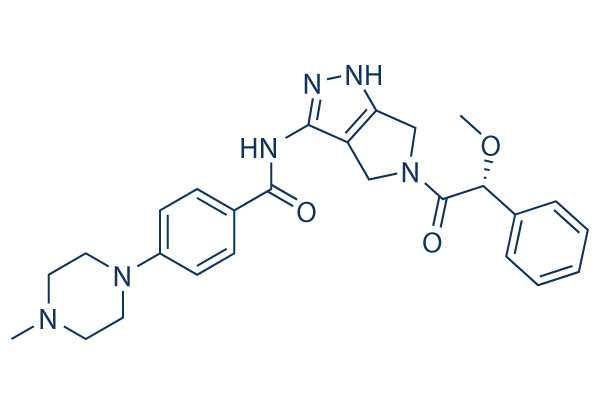
Chemische Struktur
Molekulargewicht: 474.55
Qualitätskontrolle
| Verwandte Ziele | CDK HSP PD-1/PD-L1 ROCK Wee1 DNA/RNA Synthesis Microtubule Associated Ras KRas Casein Kinase |
|---|---|
| Weitere Aurora Kinase Inhibitoren | Hesperadin Barasertib-HQPA (AZD2811) Alisertib (MLN8237) Tozasertib (VX-680) ZM 447439 MLN8054 MK-5108 TCS7010 (Aurora A Inhibitor I) AMG-900 PHA-680632 |
Zellkultur, Behandlung & Arbeitskonzentration
| Zelllinien | Assay-Typ | Konzentration | Inkubationszeit | Formulierung | Aktivitätsbeschreibung | PMID |
|---|---|---|---|---|---|---|
| A2780 cells | Proliferation assay | Antiproliferative activity against A2780 cells, IC50=28 nM | ||||
| HCT116 cells | Proliferation assay | Antiproliferative activity against HCT116 cells, IC50=31 nM | ||||
| human HCT116 cells | Proliferation assay | Antiproliferative activity against human HCT116 cells assessed as BrdU incorporation after 72 hrs, IC50=31 nM | ||||
| HCT116 cells | Function assay | Cell cycle arrest in HCT116 cells by accumulation at G2/M phase, EC50=80 nM | ||||
| MCF7 cells | Proliferation assay | Antiproliferative activity against MCF7 cells, IC50=80 nM | ||||
| HeLa cells | Proliferation assay | Antiproliferative activity against HeLa cells, IC50=0.14 μM | ||||
| human MOLT4 cells | Cytotoxic assay | Cytotoxicity against human MOLT4 cells assessed as inhibition of cell growth after 4 days by Cell Titer Blue end-point assay, EC50=0.15 μM | ||||
| human HepG2 cells | Cytotoxic assay | Cytotoxicity against human HepG2 cells after 48 hrs by MTT assay, TC50=4 μM | ||||
| human A2780 cells | Proliferation assay | Antiproliferative activity against human A2780 cells assessed as accumulation of 4N DNA, IC50=28 μM | ||||
| HCT116 cells | Function assay | Inhibition of histone h3 phosphorylation in HCT116 cells by Western blot analysis | ||||
| Klicken Sie hier, um weitere experimentelle Daten zu Zelllinien anzuzeigen | ||||||
Chemische Informationen, Lagerung & Stabilität
| Molekulargewicht | 474.55 | Formel | C26H30N6O3 |
Lagerung (Ab dem Eingangsdatum) | |
|---|---|---|---|---|---|
| CAS-Nr. | 827318-97-8 | SDF herunterladen | Lagerung von Stammlösungen |
|
|
| Synonyme | N/A | Smiles | CN1CCN(CC1)C2=CC=C(C=C2)C(=O)NC3=NNC4=C3CN(C4)C(=O)C(C5=CC=CC=C5)OC | ||
Löslichkeit
|
In vitro |
DMSO
: 95 mg/mL
(200.18 mM)
Water : Insoluble Ethanol : Insoluble |
Molaritätsrechner
|
In vivo |
|||||
In-vivo-Formulierungsrechner (Klare Lösung)
Schritt 1: Geben Sie die untenstehenden Informationen ein (Empfohlen: Ein zusätzliches Tier zur Berücksichtigung von Verlusten während des Experiments)
Schritt 2: Geben Sie die In-vivo-Formulierung ein (Dies ist nur der Rechner, keine Formulierung. Bitte kontaktieren Sie uns zuerst, wenn es im Abschnitt "Löslichkeit" keine In-vivo-Formulierung gibt.)
Berechnungsergebnisse:
Arbeitskonzentration: mg/ml;
Methode zur Herstellung der DMSO-Stammlösung: mg Wirkstoff vorgelöst in μL DMSO ( Konzentration der Stammlösung mg/mL, Bitte kontaktieren Sie uns zuerst, wenn die Konzentration die DMSO-Löslichkeit der Wirkstoffcharge überschreitet. )
Methode zur Herstellung der In-vivo-Formulierung: Nehmen Sie μL DMSO Stammlösung, dann hinzufügenμL PEG300, mischen und klären, dann hinzufügenμL Tween 80, mischen und klären, dann hinzufügen μL ddH2O, mischen und klären.
Methode zur Herstellung der In-vivo-Formulierung: Nehmen Sie μL DMSO Stammlösung, dann hinzufügen μL Maisöl, mischen und klären.
Hinweis: 1. Bitte stellen Sie sicher, dass die Flüssigkeit klar ist, bevor Sie das nächste Lösungsmittel hinzufügen.
2. Achten Sie darauf, das/die Lösungsmittel der Reihe nach hinzuzufügen. Sie müssen sicherstellen, dass die bei der vorherigen Zugabe erhaltene Lösung eine klare Lösung ist, bevor Sie mit der Zugabe des nächsten Lösungsmittels fortfahren. Physikalische Methoden wie Vortex, Ultraschall oder ein heißes Wasserbad können zur Unterstützung des Lösens verwendet werden.
Wirkmechanismus
| Targets/IC50/Ki |
Aurora A
(Cell-free assay) 13 nM
Abl
(Cell-free assay) 25 nM
RET
(Cell-free assay) 31 nM
TrkA
(Cell-free assay) 31 nM
FGFR1
(Cell-free assay) 47 nM
Aurora C
(Cell-free assay) 61 nM
Aurora B
(Cell-free assay) 79 nM
|
|---|---|
| In vitro |
Danusertib (PHA-739358) hemmt die Aktivitäten anderer Kinasen wie FGFR1, Abl, Ret und Trka, mit IC50 von 47 nM, 25 nM, 31 nM bzw. 31 nM. In einem Zellassay durchlaufen nach Behandlung von Wildtyp- und p53-defizienten MEFs mit dieser Verbindung die Wildtyp-Zellen einen Arrest in der Mitose (4N), der bis zu 48 Stunden anhält. Die p53-defizienten Zellen verharren dagegen nicht im 4N-DNA-Stadium, sondern fahren mit zusätzlichen Runden der DNA-Synthese fort, um >8N zu werden. Die Behandlung damit führt zu einem Anstieg der p53-Proteinspiegel und einem damit verbundenen Anstieg des p21-Proteins, das bekanntermaßen transkriptionell durch p53 reguliert wird. Steigende Konzentrationen von Danusertib führen nach 48 Stunden zu einer dosisabhängigen Reduktion des Zellwachstums in BCR-ABL-positiven (K562, BV173) und BCR-ABL-negativen (HL60) Zellen.
|
| Kinase-Assay |
Biochemische Kinase-Assays
|
|
Die Km-Werte für ATP und das spezifische Substrat werden zunächst bestimmt, und jeder Assay wird dann bei optimierten ATP- (2Km) und Substrat-Konzentrationen (5Km) durchgeführt. Diese Einstellung ermöglichte den direkten Vergleich der IC50-Werte von Danusertib über das angewandte Kinase-Selektivitätsscreening-Panel zur Bewertung des Selektivitätsprofils.
|
|
| In vivo |
Die Verabreichung von 25 mg/kg S1107 an HL-60 Xenograft-Ratten führt zu einer 75%igen Hemmung des Tumorwachstums mit vollständiger Regression bei einem Tier. S1107 führt zu einer Biomarker-Modulation, begleitet von einer Hemmung des Tumorwachstums. Dies ist vereinbar mit einem erwarteten Wirkmechanismus der Aurora Kinase-Hemmung. S1107 hemmt signifikant die Proliferation von K562-Zellen und unterdrückt das Tumorwachstum während der 10-tägigen Behandlungsperiode praktisch vollständig.
|
Literatur |
|
Technischer Support
Tel: +1-832-582-8158 Ext:3
Wenn Sie weitere Fragen haben, hinterlassen Sie bitte eine Nachricht.

Produkte sind nur für Forschungszwecke bestimmt. Nicht für den menschlichen Gebrauch. Wir verkaufen nicht an Patienten.
©Copyright 2013 Selleck Chemicals. Alle Rechte vorbehalten.