
nur für Forschungszwecke
Belinostat (PXD101) HDAC Inhibitor
Kat.-Nr.S1085
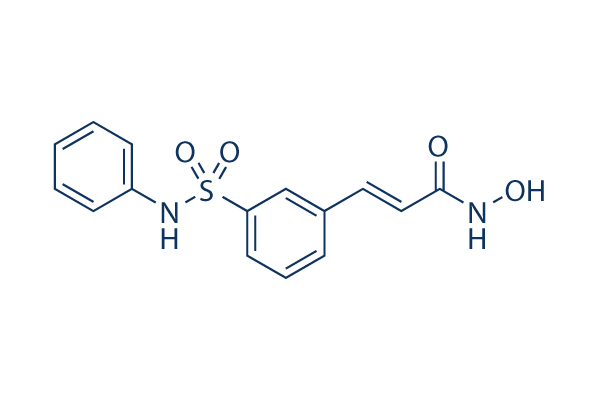
Chemische Struktur
Molekulargewicht: 318.35
Qualitätskontrolle
Zellkultur, Behandlung & Arbeitskonzentration
| Zelllinien | Assay-Typ | Konzentration | Inkubationszeit | Formulierung | Aktivitätsbeschreibung | PMID |
|---|---|---|---|---|---|---|
| HCT116 | Function Assay | 0.9 μM | 24 h | down-regulats TS protein levels after 6 h incubation | 17124594 | |
| HCT116 | Growth Inhibition Assay | 48 h | EC50=0.28 μM | 17124594 | ||
| Granta-519 | Growth Inhibition Assay | 24 h | IC50=56.3 μM | 20068080 | ||
| Jeko-1 | Growth Inhibition Assay | 24 h | IC50=0.2 μM | 20068080 | ||
| HBL-2 | Growth Inhibition Assay | 24 h | IC50=0.4 μM | 20068080 | ||
| Panc-1 | Apoptosis Assay | 100/500/1000 nM | 48 h | induces dose dependent apoptosis | 22681698 | |
| AsPC-1 | Apoptosis Assay | 100/500/1000 nM | 48 h | induces dose dependent apoptosis | 22681698 | |
| T3M4 | Apoptosis Assay | 100/500/1000 nM | 48 h | induces dose dependent apoptosis | 22681698 | |
| Panc-1 | Growth Inhibition Assay | 0-800 nM | 48 h | inhibits cell proliferation in a dose dependent manner | 22681698 | |
| AsPC-1 | Growth Inhibition Assay | 0-800 nM | 48 h | inhibits cell proliferation in a dose dependent manner | 22681698 | |
| T3M4 | Growth Inhibition Assay | 0-800 nM | 48 h | inhibits cell proliferation in a dose dependent manner | 22681698 | |
| MiaPaCa2 | Function Assay | 1/10 μM | 24 h | induces growth arrested in G2/M | 23475695 | |
| AsPc1 | Function Assay | 1/10 μM | 24 h | induces growth arrested in G2/M | 23475695 | |
| Panc0403 | Apoptosis Assay | 1 μM | 24 h | induces apoptosis | 23475695 | |
| Panc1005 | Apoptosis Assay | 1 μM | 24 h | induces apoptosis | 23475695 | |
| Panc0327 | Apoptosis Assay | 1 μM | 24 h | induces apoptosis | 23475695 | |
| Panc0203 | Growth Inhibition Assay | 48 h | EC50=22.2 μM | 23475695 | ||
| PL45 | Growth Inhibition Assay | 48 h | EC50=20.8 μM | 23475695 | ||
| Panc1005 | Growth Inhibition Assay | 48 h | EC50=1.1 μM | 23475695 | ||
| Panc0403 | Growth Inhibition Assay | 48 h | EC50=1.1 μM | 23475695 | ||
| BxPc3 | Growth Inhibition Assay | 48 h | EC50=1.0 μM | 23475695 | ||
| MiaPaCa2 | Growth Inhibition Assay | 48 h | EC50=0.7 μM | 23475695 | ||
| Panc0327 | Growth Inhibition Assay | 48 h | EC50=0.5 μM | 23475695 | ||
| AsPc1 | Growth Inhibition Assay | 48 h | EC50=0.3 μM | 23475695 | ||
| PC9 | Function Assay | 0.5/1/2 μM | 4 h | DMSO | inhibits the levels of Akt (p-Akt) and EGFR | 23515752 |
| H1650 | Function Assay | 0.5/1/2 μM | 4 h | DMSO | inhibits the levels of Akt (p-Akt) and EGFR | 23515752 |
| H460 | Function Assay | 0.5/1/2 μM | 4 h | DMSO | inhibits the levels of Akt (p-Akt) and EGFR | 23515752 |
| PC9 | Function Assay | 500 nM | 24 h | DMSO | decreases EGFR expression | 23515752 |
| H1650 | Function Assay | 500 nM | 24 h | DMSO | decreases EGFR expression | 23515752 |
| H460 | Function Assay | 500 nM | 24 h | DMSO | decreases EGFR expression | 23515752 |
| HCC4006 | Growth Inhibition Assay | 72 h | DMSO | IC50=0.46 μM | 23515752 | |
| HCC2935 | Growth Inhibition Assay | 72 h | DMSO | IC50=0.97 μM | 23515752 | |
| HCC827 | Growth Inhibition Assay | 72 h | DMSO | IC50=0.29 μM | 23515752 | |
| HCC2279 | Growth Inhibition Assay | 72 h | DMSO | IC50=0.4 μM | 23515752 | |
| PC9 | Growth Inhibition Assay | 72 h | DMSO | IC50=0.29 μM | 23515752 | |
| H820 | Growth Inhibition Assay | 72 h | DMSO | IC50=0.4 μM | 23515752 | |
| H1650 | Growth Inhibition Assay | 72 h | DMSO | IC50=0.88 μM | 23515752 | |
| H1975 | Growth Inhibition Assay | 72 h | DMSO | IC50=0.68 μM | 23515752 | |
| H520 | Growth Inhibition Assay | 72 h | DMSO | IC50=0.75 μM | 23515752 | |
| H1299 | Growth Inhibition Assay | 72 h | DMSO | IC50=1.2 μM | 23515752 | |
| H460 | Growth Inhibition Assay | 72 h | DMSO | IC50=0.86 μM | 23515752 | |
| H1666 | Growth Inhibition Assay | 72 h | DMSO | IC50>10 μM | 23515752 | |
| PANC-1 | Function Assay | 10 μM | 2/4 h | DMSO | increases intracellular ROS level | 23743198 |
| PANC-1 | Cell Viability Assay | 1/10 μM | 48 h | DMSO | decreases cell viability in a dose dependent manner | 23743198 |
| PANC-1 | Function Assay | 10 μM | 2/4/6 h | DMSO | induces AMPK activation | 23743198 |
| HL-60 | Function Assay | 0.2 μM | 24/48/72 h | enhances RA-induced granulocytic differentiation | 25864732 | |
| NB4 | Function Assay | 0.2 μM | 24/48/72 h | enhances RA-induced granulocytic differentiation | 25864732 | |
| HL-60 | Function Assay | 2 μM | 24/48 h | blocks cell cycle in S phase | 25864732 | |
| NB4 | Function Assay | 2 μM | 24/48 h | blocks cell cycle in S phase | 25864732 | |
| HL-60 | Cell Viability Assay | 0.2/2 μM | 24/48/72 h | decreases cell viability in both time and dose dependent manner | 25864732 | |
| NB4 | Cell Viability Assay | 0.2/2 μM | 24/48/72 h | decreases cell viability in both time and dose dependent manner | 25864732 | |
| RAW264.7 | Anti-inflammatory assay | 1 hr | Anti-inflammatory activity in LPS-stimulated mouse RAW264.7 cells assessed as suppression of IL6 production pre-incubated for 1 hr before LPS stimulation for 24 hrs by ELISA method, IC50 = 0.000059 μM. | 25113875 | ||
| HEK293 | Function assay | Inhibition of HDAC6 in HEK293 cells, IC50 = 0.015 μM. | 18308563 | |||
| HEK293 | Function assay | Inhibition of HDAC1 in HEK293 cells, IC50 = 0.018 μM. | 18308563 | |||
| HeLa | Function assay | 30 mins | Inhibition of HDAC in human HeLa cells nuclear extracts incubated for 30 mins by fluorescent assay, IC50 = 0.0264 μM. | 25113875 | ||
| HeLa | Function assay | Inhibition of HDAC in human HeLa cells using Fluor de Lys as substrate by fluorescence assay, IC50 = 0.027 μM. | 23639537 | |||
| HeLa | Function assay | Inhibition of HDAC from human HeLa cells, IC50 = 0.028 μM. | 18247554 | |||
| HEK293 | Function assay | Inhibition of HDAC3 in HEK293 cells, IC50 = 0.046 μM. | 18308563 | |||
| MDA-MB-231 | Antiproliferative assay | 72 hrs | Antiproliferative activity against human MDA-MB-231 cells after 72 hrs by resazurin dye based fluorescence assay, IC50 = 0.062 μM. | 29456804 | ||
| Jurkat | Antiproliferative assay | 48 hrs | Antiproliferative activity against human Jurkat cells after 48 hrs by MTT assay, IC50 = 0.07 μM. | 29533873 | ||
| A549 | Antiproliferative assay | 72 hrs | Antiproliferative activity against human A549 cells after 72 hrs by resazurin dye based fluorescence assay, IC50 = 0.077 μM. | 29456804 | ||
| HeLa | Antiproliferative assay | 72 hrs | Antiproliferative activity against human HeLa cells after 72 hrs by resazurin dye based fluorescence assay, IC50 = 0.087 μM. | 29456804 | ||
| MCF7 | Antiproliferative assay | 72 hrs | Antiproliferative activity against human MCF7 cells after 72 hrs by resazurin dye based fluorescence assay, IC50 = 0.096 μM. | 29456804 | ||
| HEL | Antiproliferative assay | 48 hrs | Antiproliferative activity against human HEL cells after 48 hrs by MTT assay, IC50 = 0.1 μM. | 29533873 | ||
| Huh7 | Antiviral assay | 3 days | Antiviral activity against HCV genotype 1b infected in human Huh7 cells after 3 days by luciferase reporter gene assay, EC50 = 0.12 μM. | 25490700 | ||
| HCT116 | Antiproliferative assay | 48 hrs | Antiproliferative activity against human HCT116 cells after 48 hrs by SRB assay, GI50 = 0.13 μM. | 27344487 | ||
| MOLT4 | Antiproliferative assay | 48 hrs | Antiproliferative activity against human MOLT4 cells after 48 hrs by MTT assay, IC50 = 0.14 μM. | 29533873 | ||
| HCT116 | Antiproliferative assay | Antiproliferative activity against human HCT116 cells assessed as growth inhibition, IC50 = 0.16 μM. | 21650221 | |||
| HCT116 | Antiproliferative assay | Antiproliferative activity against human HCT116 cells, IC50 = 0.16 μM. | 21742496 | |||
| SK-N-BE(2) | Antiproliferative assay | 48 hrs | Antiproliferative activity against human SK-N-BE(2) cells after 48 hrs by MTT assay, IC50 = 0.31 μM. | 29533873 | ||
| PC3 | Antiproliferative assay | 48 hrs | Antiproliferative activity against human PC3 cells after 48 hrs by SRB assay, GI50 = 0.39 μM. | 27344487 | ||
| PC3 | Antiproliferative assay | 96 hrs | Antiproliferative activity against human PC3 cells after 96 hrs by celltiter 96 assay, IC50 = 0.45 μM. | 21634430 | ||
| H1299 | Antiproliferative assay | Antiproliferative activity against human H1299 cells, IC50 = 0.46 μM. | 21650221 | |||
| HeLa | Antiproliferative assay | 48 hrs | Antiproliferative activity against human HeLa cells after 48 hrs by MTT assay, IC50 = 0.51 μM. | 29533873 | ||
| HCT116 | Antiproliferative assay | 96 hrs | Antiproliferative activity against human HCT116 cells after 96 hrs by celltiter 96 assay, IC50 = 0.6 μM. | 21634430 | ||
| A2780 | Antiproliferative assay | 96 hrs | Antiproliferative activity against human A2780 cells after 96 hrs by celltiter 96 assay, IC50 = 0.67 μM. | 21634430 | ||
| HuH7 | Cytotoxicity assay | 3 days | Cytotoxicity against human HuH7 cells assessed as inhibition of cell viability after 3 days by CellTiter 96 assay, CC50 = 0.68 μM. | 25490700 | ||
| COLO205 | Antiproliferative assay | 96 hrs | Antiproliferative activity against human COLO205 cells after 96 hrs by celltiter 96 assay, IC50 = 0.7 μM. | 21634430 | ||
| A549 | Antiproliferative assay | 48 hrs | Antiproliferative activity against human A549 cells after 48 hrs by SRB assay, GI50 = 0.78 μM. | 27344487 | ||
| HL60 | Antiproliferative assay | 48 hrs | Antiproliferative activity against human HL60 cells after 48 hrs by SRB assay, GI50 = 1.09 μM. | 27344487 | ||
| K562 | Antiproliferative assay | 48 hrs | Antiproliferative activity against human K562 cells after 48 hrs by MTT assay, IC50 = 1.1 μM. | 29533873 | ||
| PC3 | Antiproliferative assay | 48 hrs | Antiproliferative activity against human PC3 cells after 48 hrs by MTT assay, IC50 = 1.3 μM. | 29533873 | ||
| NFF | Cytotoxicity assay | 72 hrs | Cytotoxicity against human NFF cells after 72 hrs by SRB assay, IC50 = 1.4 μM. | 28241112 | ||
| HEK293 | Cytotoxicity assay | 48 hrs | Cytotoxicity against HEK293 cells after 48 hrs by resazurin assay, IC50 = 1.4 μM. | 28241112 | ||
| NFF | Cytotoxicity assay | 72 hrs | Cytotoxicity against human NFF cells after 72 hrs by sulforhodamine B assay, IC50 = 1.42 μM. | 30245402 | ||
| HEK293 | Cytotoxicity assay | 48 hrs | Cytotoxicity against HEK293 cells after 48 hrs by resazurin dye based assay, IC50 = 1.42 μM. | 30245402 | ||
| RAW264.7 | Anti-inflammatory assay | 1 hr | Anti-inflammatory activity in LPS-stimulated mouse RAW264.7 cells assessed as suppression of nitric oxide production pre-incubated for 1 hr before LPS stimulation for 24 hrs by Griess reagent based assay, IC50 = 2.2 μM. | 25113875 | ||
| RAW264.7 | Anti-inflammatory assay | 1 hr | Anti-inflammatory activity in LPS-stimulated mouse RAW264.7 cells assessed as suppression of TNFalpha production pre-incubated for 1 hr before LPS stimulation for 24 hrs by ELISA method, IC50 = 4.7 μM. | 25113875 | ||
| RAW264.7 | Anti-inflammatory assay | 1 hr | Anti-inflammatory activity in LPS-stimulated mouse RAW264.7 cells assessed as suppression of PGE2 production pre-incubated for 1 hr before LPS stimulation for 24 hrs by enzyme immunoassay method, IC50 = 8.28 μM. | 25113875 | ||
| Huh-luc/neo7 | Function assay | 1 uM | 1 to 3 hrs | Inhibition of HDAC class 1 in human Huh-luc/neo7 cells assessed as histone H3 acetylation at 1 uM after 1 to 3 hrs by Western blotting analysis | 25937017 | |
| PC3 | Function assay | 0.3 uM | 48 hrs | Inhibition of HDAC in human PC3 cells assessed as increase in amount of acetylated histone H3 at 0.3 uM after 48 hrs by Western blot analysis | 27344487 | |
| HCT116 | Function assay | 0.3 uM | 48 hrs | Inhibition of HDAC in human HCT116 cells assessed as increase in amount of acetylated histone H3 at 0.3 uM after 48 hrs by Western blot analysis | 27344487 | |
| Klicken Sie hier, um weitere experimentelle Daten zu Zelllinien anzuzeigen | ||||||
Chemische Informationen, Lagerung & Stabilität
| Molekulargewicht | 318.35 | Formel | C15H14N2O4S |
Lagerung (Ab dem Eingangsdatum) | |
|---|---|---|---|---|---|
| CAS-Nr. | 866323-14-0 | SDF herunterladen | Lagerung von Stammlösungen |
|
|
| Synonyme | PXD101,NSC726630, PX-105684 | Smiles | C1=CC=C(C=C1)NS(=O)(=O)C2=CC=CC(=C2)C=CC(=O)NO | ||
Löslichkeit
|
In vitro |
DMSO
: 64 mg/mL
(201.03 mM)
Water : Insoluble Ethanol : Insoluble |
Molaritätsrechner
|
In vivo |
|||||
In-vivo-Formulierungsrechner (Klare Lösung)
Schritt 1: Geben Sie die untenstehenden Informationen ein (Empfohlen: Ein zusätzliches Tier zur Berücksichtigung von Verlusten während des Experiments)
Schritt 2: Geben Sie die In-vivo-Formulierung ein (Dies ist nur der Rechner, keine Formulierung. Bitte kontaktieren Sie uns zuerst, wenn es im Abschnitt "Löslichkeit" keine In-vivo-Formulierung gibt.)
Berechnungsergebnisse:
Arbeitskonzentration: mg/ml;
Methode zur Herstellung der DMSO-Stammlösung: mg Wirkstoff vorgelöst in μL DMSO ( Konzentration der Stammlösung mg/mL, Bitte kontaktieren Sie uns zuerst, wenn die Konzentration die DMSO-Löslichkeit der Wirkstoffcharge überschreitet. )
Methode zur Herstellung der In-vivo-Formulierung: Nehmen Sie μL DMSO Stammlösung, dann hinzufügenμL PEG300, mischen und klären, dann hinzufügenμL Tween 80, mischen und klären, dann hinzufügen μL ddH2O, mischen und klären.
Methode zur Herstellung der In-vivo-Formulierung: Nehmen Sie μL DMSO Stammlösung, dann hinzufügen μL Maisöl, mischen und klären.
Hinweis: 1. Bitte stellen Sie sicher, dass die Flüssigkeit klar ist, bevor Sie das nächste Lösungsmittel hinzufügen.
2. Achten Sie darauf, das/die Lösungsmittel der Reihe nach hinzuzufügen. Sie müssen sicherstellen, dass die bei der vorherigen Zugabe erhaltene Lösung eine klare Lösung ist, bevor Sie mit der Zugabe des nächsten Lösungsmittels fortfahren. Physikalische Methoden wie Vortex, Ultraschall oder ein heißes Wasserbad können zur Unterstützung des Lösens verwendet werden.
Wirkmechanismus
| Merkmale |
Lead compound of Topotarget.
|
|---|---|
| Targets/IC50/Ki |
HDAC
(Cell-free assay) 27 nM
|
| In vitro |
Belinostat hemmt das Wachstum von Tumorzellen (A2780, HCT116, HT29, WIL, CALU-3, MCF7, PC3 und HS852) mit einer IC50 von 0,2–0,66 μM. PD101 zeigt eine geringe Aktivität in A2780/cp70- und 2780AD-Zellen, die Cisplatin- und Doxorubicin-resistente Derivate von A2780-Zellen sind. Diese Verbindung könnte die Apoptose durch PARP-Spaltung und Acetylierung von Histonen H3/H4 induzieren. Sie hemmt das Wachstum von Blasenkrebszellen, insbesondere in 5637-Zellen, die eine Akkumulation in der G0-G1-Phase, eine Abnahme in der S-Phase und eine Zunahme in der G2-M-Phase zeigen. Die wachstumshemmende Aktivität dieser Chemikalie auf Zelllinien wird durch den Multidrug-Resistenzphänotyp nicht stark beeinflusst, während die Aktivität von Docetaxel deutlich beeinträchtigt wird. Sie könnte die wachstumshemmende Aktivität von Docetaxel oder Carboplatin in OVCAR-3- und A2780-Zellen verstärken. Diese Verbindung zeigt auch eine erhöhte Tubulinacetylierung in Eierstockkrebszelllinien. Eine aktuelle Studie zeigt, dass sie die Proteinkinase A in einem TGF-β-Signalweg-abhängigen Mechanismus aktiviert und die Survivin-mRNA verringert.
|
| Kinase-Assay |
Histon-Deacetylase-Aktivität
|
|
Subkonfluente Kulturen werden geerntet und zweimal in eiskaltem PBS gewaschen und durch Zentrifugation bei 200 × g für 5 min pelletiert. Das Zellpellet wird in zwei Volumina Lysepuffer [60 mM Tris-Puffer (pH 7,4) mit 30 % Glycerin und 450 mM NaCl] resuspendiert und durch drei Gefrier- (Trockeneis) Tau- (30 °C Wasserbad) Zyklen lysiert. Zelltrümmer werden durch Zentrifugation bei 1,2 × 10⁴ g für 5 min entfernt, und der Überstand wird bei –80 °C gelagert. Histon-H4-Peptid (Sequenz SGRGKGGKGLGKGGAKRHRK, entsprechend den 20 NH2-terminalen Resten) wird durch ein rekombinantes Protein, das die Hypoxanthin-Aminopterin-Thymidin-Domäne von p300 enthält, unter Verwendung von [3H]-Acetyl-CoA als Acetatquelle acetyliert. H4-Peptid (100 μg) wird mit Hypoxanthin-Aminopterin-Thymidin-Puffer (50 mM Tris HCl pH 8,0, 5 % Glycerin, 50 mM KCl und 0,1 mM EDTA), 1 mM DTT, 1 mM 4-(2-Aminoethyl)benzolsulfonylfluorid, 1 × kompletten Proteaseinhibitoren, 50 μL gereinigtem p300 und 1,85 m [3H]-Acetyl-CoA (4,50 Ci/mmol) in einem Endvolumen von 300 μL gemischt und bei 30 °C für 45 min inkubiert. Das p300-Protein wird durch Inkubation mit 20 μL 50 % Ni-Agarose-Beads für 1 Stunde bei 4 °C und Zentrifugation entfernt. Der Überstand wird auf eine 2 mL Sephadex G15-Säule aufgetragen, und der Durchfluss wird gesammelt. Ein Milliliter destilliertes H2O wird vorsichtig aufgetragen, und drei Tropfenfraktionen werden gesammelt; dies wird wiederholt, bis 4–5 mL destilliertes H2O hinzugefügt wurden und ~40 Fraktionen gesammelt werden. Drei Mikroliter jeder Fraktion werden in 2 mL Szintillationsflüssigkeit verdünnt und in einem Szintillationszähler gezählt, um die Fraktionen mit dem markierten Peptid zu identifizieren. Diese Fraktionen werden gepoolt, und 1 μL der kombinierten Probe wird gemessen, um die Radioaktivität in jeder Peptidcharge zu bestimmen (3-7×10³ cpm/μL). Für Aktivitätstests wird die Reaktion in einem Gesamtvolumen von 150 μL Puffer [60 mM Tris (pH 7,4) mit 30 % Glycerin] mit 2 μL Zellextrakt und, falls verwendet, 2 μL dieser Verbindung durchgeführt. Die Reaktion wird durch Zugabe von 2 μL [3H]-markiertem Substrat (acetyliertes Histon-H4-Peptid, das den 20 NH2-terminalen Resten entspricht) gestartet. Die Proben werden 45 min bei 37 °C inkubiert, und die Reaktion wird durch Zugabe von HCl und Essigsäure (Endkonzentrationen von 0,72 bzw. 0,12 M) gestoppt. Freigesetztes [3H]-Acetat wird in 750 μL Ethylacetat extrahiert, und die Proben werden bei 1,2 × 10⁴ g für 5 min zentrifugiert. Die obere Phase (600 μL) wird in 3 mL Szintillationsflüssigkeit überführt und gezählt.
|
|
| In vivo |
Belinostat zeigt eine signifikante Tumorwachstumsverzögerung bei A2780- und A2780/cp70-Xenografts bei einer Dosis von 10 mg/kg ohne Auswirkungen auf das Körpergewicht. Diese Verbindung induziert auch p21WAF1, HDAC core und Zellkommunikationsgene in Mausblasentumoren. Ihre Monotherapie induziert dosisproportionale Antitumorwirkungen mit einem TGI von 47 % bei einer Dosis von 100 mg/kg im A2780-Xenograft. Die Kombination dieser Chemikalie (100 mg/kg) mit Carboplatin (40 mg/kg) könnte das Tumorwachstum von 18,6 Tagen auf 22,5 Tage verzögern. In Kombination mit Bortezomib führt sie zu einer starken Tumorhemmung und gastrointestinalen Toxizität bei Mäusen mit Bortezomib-resistentem UMSCC-11A-Xenograft.
|
Literatur |
|
Anwendungen
| Methoden | Biomarker | Bilder | PMID |
|---|---|---|---|
| Western blot | p-H2AX(Ser139) / KU70 / KU80 / RAD51 / RAD52 / ERCC1 Acetyl Histone H3 / Acetyl Histone H4 / Acetyl tubulin p21 / p27 SOS1 / SOS2 PARP / p-ERK / p-p38 / p38 / p-BRAF / p-MEK / MEK |

|
24155971 |
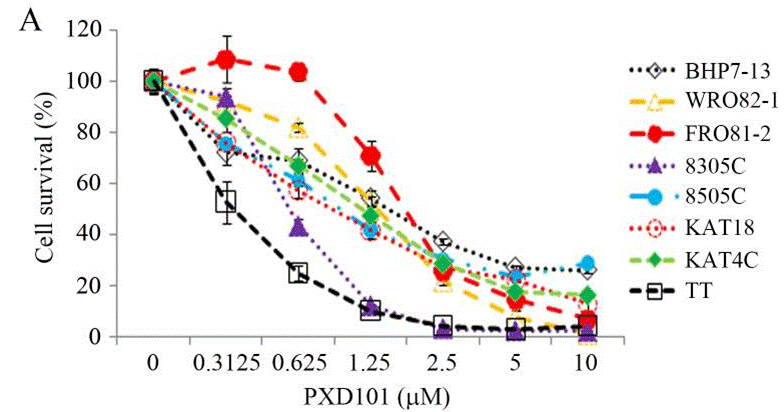
| Growth inhibition assay | Cell viability IC50 |
|
24155971 |
Klinische Studieninformationen
(Daten von https://clinicaltrials.gov, aktualisiert am 2024-05-22)
| NCT-Nummer | Rekrutierung | Erkrankungen | Sponsor/Kooperationspartner | Startdatum | Phasen |
|---|---|---|---|---|---|
| NCT06406465 | Not yet recruiting | Carcinoma Neuroendocrine|Tumor Neuroendocrine|Tumors Neuroendocrine|Neuroendocrine; Carcinoma|Small Cell; Receptors |
National Cancer Institute (NCI)|National Institutes of Health Clinical Center (CC) |
May 15 2024 | Phase 2 |
| NCT04315233 | Recruiting | Metastatic Breast Cancer|Recurrent Ovarian Carcinoma |
University of Utah|Novartis|Acrotech Biopharma |
May 3 2021 | Phase 1 |
| NCT04703920 | Recruiting | Metastatic Breast Cancer|Metastatic Castration-resistant Prostate Cancer|Metastatic Ovarian Carcinoma |
University of Michigan Rogel Cancer Center|Pfizer|Acrotech Biopharma Inc. |
March 4 2021 | Phase 1 |
| NCT03772925 | Active not recruiting | Recurrent Acute Myeloid Leukemia|Recurrent Myelodysplastic Syndrome|Refractory Acute Myeloid Leukemia|Refractory Myelodysplastic Syndrome |
National Cancer Institute (NCI) |
June 20 2019 | Phase 1 |
Technischer Support
Tel: +1-832-582-8158 Ext:3
Wenn Sie weitere Fragen haben, hinterlassen Sie bitte eine Nachricht.
Häufig gestellte Fragen
Frage 1:
Could you please give some suggestions for the use of it in vivo (i.p. injection)?
Antwort:
For I.P. injection, it can be dissolved in 2% DMSO+30% PEG 300+ddH2O at 10 mg/ml clearly. When preparing the solution, please dissolve this compound in DMSO clearly first. Then add PEG, after they mixed well, then dilute with water. Hope this information is useful to you.

Produkte sind nur für Forschungszwecke bestimmt. Nicht für den menschlichen Gebrauch. Wir verkaufen nicht an Patienten.
©Copyright 2013 Selleck Chemicals. Alle Rechte vorbehalten.