
nur für Forschungszwecke
Ralimetinib (LY2228820) dimesylate p38 MAPK Inhibitor
Kat.-Nr.S1494
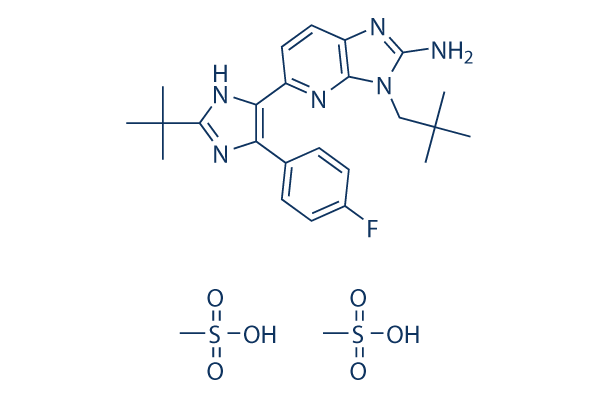
Chemische Struktur
Molekulargewicht: 612.74
Qualitätskontrolle
| Verwandte Ziele | ERK Raf JNK MEK Ras KRas S6 Kinase MAP4K TAK1 Mixed Lineage Kinase |
|---|---|
| Weitere p38 MAPK Inhibitoren | SB202190 SB203580 (Adezmapimod) PH-797804 Doramapimod (BIRB 796) VX-702 Losmapimod SB239063 Neflamapimod (VX-745) BMS-582949 Skepinone-L |
Zellkultur, Behandlung & Arbeitskonzentration
| Zelllinien | Assay-Typ | Konzentration | Inkubationszeit | Formulierung | Aktivitätsbeschreibung | PMID |
|---|---|---|---|---|---|---|
| RPMI-8226 | Kinase assay | ~800 nM | DMSO | inhibits phosphorylation of HSP27 | 18397345 | |
| U266 | Kinase assay | ~800 nM | DMSO | inhibits phosphorylation of HSP27 | 18397345 | |
| MM.1S | Kinase assay | ~800 nM | DMSO | inhibits phosphorylation of HSP27 | 18397345 | |
| RPMI-Dox40 | Kinase assay | ~800 nM | DMSO | inhibits phosphorylation of HSP27 | 18397345 | |
| RPMI-LR5 | Kinase assay | ~800 nM | DMSO | inhibits phosphorylation of HSP27 | 18397345 | |
| INA-6 | Kinase assay | ~800 nM | DMSO | inhibits phosphorylation of HSP27 | 18397345 | |
| RPMI-8226 | Cytoxicity assay | ~1000 nM | DMSO | no significant cytotoxicity | 18397345 | |
| U266 | Cytoxicity assay | ~1000 nM | DMSO | no significant cytotoxicity | 18397345 | |
| MM.1S | Cytoxicity assay | ~1000 nM | DMSO | no significant cytotoxicity | 18397345 | |
| RPMI-Dox40 | Cytoxicity assay | ~1000 nM | DMSO | no significant cytotoxicity | 18397345 | |
| RPMI-LR5 | Cytoxicity assay | ~1000 nM | DMSO | no significant cytotoxicity | 18397345 | |
| INA-6 | Cytoxicity assay | ~1000 nM | DMSO | no significant cytotoxicity | 18397345 | |
| CD14+ | Function assay | ~800 nM | DMSO | inhibits osteoclastogenesis from CD14 positive cells | 18397345 | |
| U-87-MG | Function assay | 1 μM | DMSO | reduces tumor-driven cord formation | 23335506 | |
| MDA-MB-231 | Function assay | 1 μM | DMSO | reduces tumor-driven cord formation | 23335506 | |
| A-2780 | Function assay | 1 μM | DMSO | reduces tumor-driven cord formation | 23335506 | |
| SK-OV-3 | Function assay | 1 μM | DMSO | reduces tumor-driven cord formation | 23335506 | |
| LXFA-629 | Function assay | 1 μM | DMSO | reduces tumor-driven cord formation | 23335506 | |
| NCI-H1650 | Function assay | 1 μM | DMSO | reduces tumor-driven cord formation | 23335506 | |
| PC-3 | Function assay | 1 μM | DMSO | reduces tumor-driven cord formation | 23335506 | |
| RAW264.7 | Function assay | ~20 μM | DMSO | inhibits Anisomycin-stimulated MK2 phosphorylation with IC50 of 35.3 nM | 24356814 | |
| mouse peritoneal macrophages | Function assay | ~20 μM | DMSO | LPS/IFN-γ–stimulated TNF-α production with IC50 of 6.3 nM | 24356814 | |
| A549 | Function assay | ~20 μM | DMSO | inhibits LPS-induced CXCL8 production with IC50 of 144.9 nM | 24356814 | |
| MDA-231 | Function assay | ~10 μM | suppresses DKK-1 expression | 26407843 | ||
| MCF-7 | Function assay | ~10 μM | suppresses DKK-1 expression | 26407843 | ||
| MDA-435 | Function assay | ~10 μM | suppresses DKK-1 expression | 26407843 | ||
| PC3 | Function assay | ~10 μM | DMSO | suppresses DKK-1 expression | 26913608 | |
| TC32 | qHTS assay | qHTS of pediatric cancer cell lines to identify multiple opportunities for drug repurposing: Primary screen for TC32 cells | 29435139 | |||
| A673 | qHTS assay | qHTS of pediatric cancer cell lines to identify multiple opportunities for drug repurposing: Primary screen for A673 cells | 29435139 | |||
| DAOY | qHTS assay | qHTS of pediatric cancer cell lines to identify multiple opportunities for drug repurposing: Primary screen for DAOY cells | 29435139 | |||
| BT-37 | qHTS assay | qHTS of pediatric cancer cell lines to identify multiple opportunities for drug repurposing: Primary screen for BT-37 cells | 29435139 | |||
| RD | qHTS assay | qHTS of pediatric cancer cell lines to identify multiple opportunities for drug repurposing: Primary screen for RD cells | 29435139 | |||
| BT-12 | qHTS assay | qHTS of pediatric cancer cell lines to identify multiple opportunities for drug repurposing: Primary screen for BT-12 cells | 29435139 | |||
| NB1643 | qHTS assay | qHTS of pediatric cancer cell lines to identify multiple opportunities for drug repurposing: Primary screen for NB1643 cells | 29435139 | |||
| OHS-50 | qHTS assay | qHTS of pediatric cancer cell lines to identify multiple opportunities for drug repurposing: Primary screen for OHS-50 cells | 29435139 | |||
| Rh41 | qHTS assay | qHTS of pediatric cancer cell lines to identify multiple opportunities for drug repurposing: Primary screen for Rh41 cells | 29435139 | |||
| Rh30 | qHTS assay | qHTS of pediatric cancer cell lines to identify multiple opportunities for drug repurposing: Primary screen for Rh30 cells | 29435139 | |||
| Klicken Sie hier, um weitere experimentelle Daten zu Zelllinien anzuzeigen | ||||||
Chemische Informationen, Lagerung & Stabilität
| Molekulargewicht | 612.74 | Formel | C24H29FN6.2CH4O3S |
Lagerung (Ab dem Eingangsdatum) | |
|---|---|---|---|---|---|
| CAS-Nr. | 862507-23-1 | SDF herunterladen | Lagerung von Stammlösungen |
|
|
| Synonyme | N/A | Smiles | CC(C)(C)CN1C2=C(C=CC(=N2)C3=C(N=C(N3)C(C)(C)C)C4=CC=C(C=C4)F)N=C1N.CS(=O)(=O)O.CS(=O)(=O)O | ||
Löslichkeit
|
In vitro |
Water : 123 mg/mL
DMSO
: 35 mg/mL
(57.12 mM)
Ethanol : 3 mg/mL |
Molaritätsrechner
|
In vivo |
|||||
In-vivo-Formulierungsrechner (Klare Lösung)
Schritt 1: Geben Sie die untenstehenden Informationen ein (Empfohlen: Ein zusätzliches Tier zur Berücksichtigung von Verlusten während des Experiments)
Schritt 2: Geben Sie die In-vivo-Formulierung ein (Dies ist nur der Rechner, keine Formulierung. Bitte kontaktieren Sie uns zuerst, wenn es im Abschnitt "Löslichkeit" keine In-vivo-Formulierung gibt.)
Berechnungsergebnisse:
Arbeitskonzentration: mg/ml;
Methode zur Herstellung der DMSO-Stammlösung: mg Wirkstoff vorgelöst in μL DMSO ( Konzentration der Stammlösung mg/mL, Bitte kontaktieren Sie uns zuerst, wenn die Konzentration die DMSO-Löslichkeit der Wirkstoffcharge überschreitet. )
Methode zur Herstellung der In-vivo-Formulierung: Nehmen Sie μL DMSO Stammlösung, dann hinzufügenμL PEG300, mischen und klären, dann hinzufügenμL Tween 80, mischen und klären, dann hinzufügen μL ddH2O, mischen und klären.
Methode zur Herstellung der In-vivo-Formulierung: Nehmen Sie μL DMSO Stammlösung, dann hinzufügen μL Maisöl, mischen und klären.
Hinweis: 1. Bitte stellen Sie sicher, dass die Flüssigkeit klar ist, bevor Sie das nächste Lösungsmittel hinzufügen.
2. Achten Sie darauf, das/die Lösungsmittel der Reihe nach hinzuzufügen. Sie müssen sicherstellen, dass die bei der vorherigen Zugabe erhaltene Lösung eine klare Lösung ist, bevor Sie mit der Zugabe des nächsten Lösungsmittels fortfahren. Physikalische Methoden wie Vortex, Ultraschall oder ein heißes Wasserbad können zur Unterstützung des Lösens verwendet werden.
Wirkmechanismus
| Targets/IC50/Ki |
p38α
(Cell-free assay) 7 nM
|
|---|---|
| In vitro |
LY2228820 hemmt p38α sowie den PhosphoMAPKAPK-2 (pMK2)-Spiegel in RAW 264.7-Zellen mit IC50-Werten von 7 nM bzw. 34,3 nM. Darüber hinaus hemmt LY2228820 die Lipopolysaccharid (LPS)-induzierte TNFα-Bildung in murinen Peritonealmakrophagen mit einer IC50 von 5,2 nM. In multiplen Myelom (MM)-Zellen, einschließlich INA6, RPMI-8226, U266 und RPMI-Dox40, blockiert LY2228820 (200 nM–800 nM) signifikant die p38MAPK-Signalübertragung, was durch seine Hemmung der Phosphorylierung von HSP27, einem nachgeschalteten Ziel von p38MAPK, ohne Beeinflussung des Expressionsniveaus von HSP27, deutlich wird. LY2228820 (200 nM–400 nM) verstärkt Zytotoxizität und Apoptose, aber LY2228820 allein hemmt das Wachstum von MM.1S-Zellen nicht. LY2228820 (200 nM–800 nM) hemmt auch die Sekretion von IL-6 und MIP-1α in langfristigen BM-Stroma-Zellen (LT-BMSCs), BM-Mononukleären Zellen (BMMNCs), peripheren Blut (PB) CD138+, CD138− oder PB CD14+-Zellen. LY2228820 (400 nM–800 nM) blockiert auch die Osteoklastogenese aus CD14+-Zellen. |
| Kinase-Assay |
Hemmung von p38α
|
|
Die Hemmung von p38α wird unter Verwendung von rekombinantem humanem p38α in einem Standard-Filterbindungsprotokoll unter Verwendung von ATP[γ-33P] und EGFR 21-mer-Peptid als Substrat bestimmt. Die funktionelle Hemmung von TNFα in murinen Peritonealmakrophagen wird unter Verwendung von LPS-Stimulation in Anwesenheit von LY2228820 bestimmt. Um die p38α-Aktivität in Zellen direkter zu beurteilen, werden RAW 264.7-Zellen mit LY2228820 behandelt und dann mit Anisomycin stimuliert. Der Grad der p38α-Aktivität wird unter Verwendung eines PhosphoMAPKAPK-2 (pMK2) (Thr 334)-Antikörpers nachgewiesen, der mit einem Rest reagiert, der spezifisch durch p38α phosphoryliert wird.
|
|
| In vivo |
In LPS-induzierten Mäusen hemmt LY2228820 effektiv die Bildung von TNFα mit einer Schwellen-Mindest-50%-Effektiven Dosis (TMED50) von weniger als 1 mg/kg. In einem Rattenmodell der kollageninduzierten Arthritis (CIA) zeigt LY2228820 potente Effekte auf Pfotenschwellung, Knochenerosion und Knorpelzerstörung mit einer Schwellen-Mindest-50%-Effektiven Dosis (TMED50) von 1,5 mg/kg. |
Literatur |
|
Anwendungen
| Methoden | Biomarker | Bilder | PMID |
|---|---|---|---|
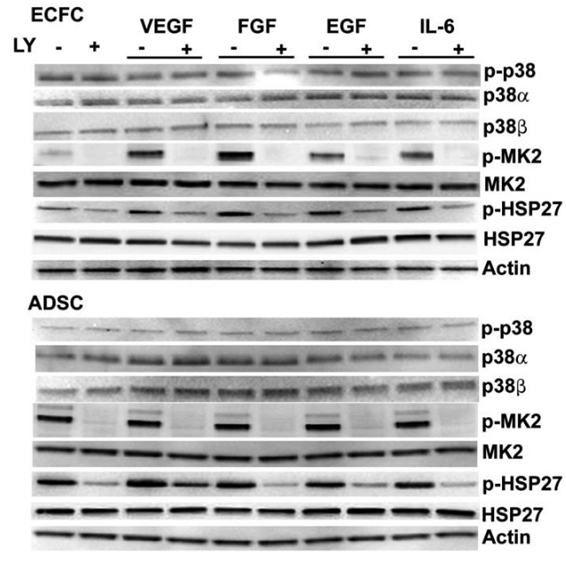
| Western blot | p-p38 / p38α / p38β / p-MK2 / MK2 / p-HSP27 / HSP27 p-S6K |
|
23335506 |
Klinische Studieninformationen
(Daten von https://clinicaltrials.gov, aktualisiert am 2024-05-22)
| NCT-Nummer | Rekrutierung | Erkrankungen | Sponsor/Kooperationspartner | Startdatum | Phasen |
|---|---|---|---|---|---|
| NCT02860780 | Completed | Advanced Cancer|Metastatic Cancer|Colorectal Cancer|Non-small Cell Lung Cancer |
Eli Lilly and Company |
August 10 2016 | Phase 1 |
| NCT02364206 | Completed | Adult Glioblastoma |
Centre Jean Perrin|National Cancer Institute France|ARC Foundation for Cancer Research |
June 8 2015 | Phase 1|Phase 2 |
| NCT02322853 | Terminated | Postmenopausal|Metastatic Breast Cancer |
Centre Francois Baclesse|National Cancer Institute France|ARC Foundation for Cancer Research |
January 2015 | Phase 2 |
| NCT01393990 | Completed | Advanced Cancer |
Eli Lilly and Company |
September 4 2008 | Phase 1 |
Technischer Support
Tel: +1-832-582-8158 Ext:3
Wenn Sie weitere Fragen haben, hinterlassen Sie bitte eine Nachricht.

Produkte sind nur für Forschungszwecke bestimmt. Nicht für den menschlichen Gebrauch. Wir verkaufen nicht an Patienten.
©Copyright 2013 Selleck Chemicals. Alle Rechte vorbehalten.