
nur für Forschungszwecke
Nutlin-3 p53-MDM2 Inhibitor
Kat.-Nr.S1061
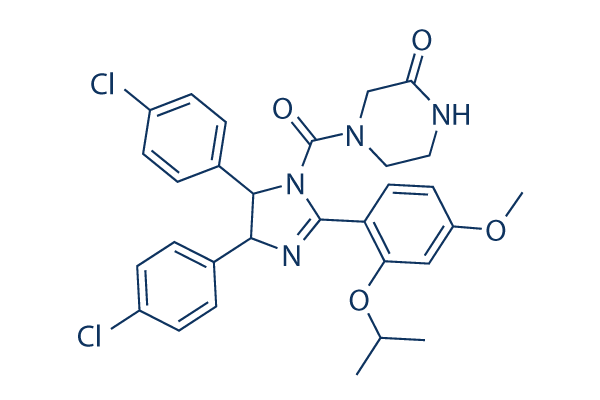
Chemische Struktur
Molekulargewicht: 581.5
Qualitätskontrolle
Produkte, die oft zusammen verwendet werden mit Nutlin-3
| Verwandte Ziele | Bcl-2 Caspase PD-1/PD-L1 Ferroptosis p53 Apoptosis related Synthetic Lethality STAT TNF-alpha Ras |
|---|---|
| Weitere MDM2/MDMX Inhibitoren | RG-7112 Nutlin-3a Brigimadlin Idasanutlin (RG7388) SAR405838 NSC 207895 NVP-CGM097 Siremadlin (HDM201) Nutlin-3b MX69 |
Zellkultur, Behandlung & Arbeitskonzentration
| Zelllinien | Assay-Typ | Konzentration | Inkubationszeit | Formulierung | Aktivitätsbeschreibung | PMID |
|---|---|---|---|---|---|---|
| SMMC-7721 | Function Assay | 10 μM | 36 h | DMSO | down-regulates the protein expression level of phospho-Ser392-p53 | 24286312 |
| HuH-7 | Apoptosis Assay | 20 μM | 48 h | DMSO | induces apoptosis | 24286312 |
| SMMC-7721 | Apoptosis Assay | 20 μM | 48 h | DMSO | induces apoptosis | 24286312 |
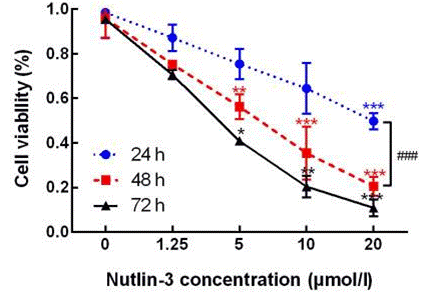
| HuH-7 | Cell Viability Assay | 1.25-20 μM | 24/48/72 h | DMSO | inhibits cell proliferation dose and time dependently | 24286312 |
| SMMC-7721 | Cell Viability Assay | 1.25-20 μM | 24/48/72 h | DMSO | inhibits cell proliferation dose and time dependently | 24286312 |
| RKO | Function Assay | 20 μM | 24 h | induces HO-1 expression at the level of transcription | 24366007 | |
| U2OS | Function Assay | 20 μM | 24 h | induces HO-1 expression at the level of transcription | 24366007 | |
| RKO | Function Assay | 20 μM | 24 h | increases the levels of the HO-1 protein as well as the p53 protein | 24366007 | |
| U2OS | Function Assay | 20 μM | 24 h | increases the levels of the HO-1 protein as well as the p53 protein | 24366007 | |
| MOLM | Function Assay | 10 μM | 24 h | upregulates the SOCS-1 expression | 24473562 | |
| OCI | Function Assay | 10 μM | 24 h | upregulates the SOCS-1 expression | 24473562 | |
| BeWo | Apoptosis Assay | 30 µM | 24 h | increases apoptosis | 24498154 | |
| BeWo | Function Assay | 30 µM | 24 h | increases p53, Mdm2, p21 and Puma at the protein level | 24498154 | |
| MOML13 | Function Assay | 10μM | 2/4 h | increases the level of p53 | 24659749 | |
| AML3 | Function Assay | 10μM | 2/4 h | increases the level of p53 | 24659749 | |
| AML2 | Function Assay | 10μM | 2/4 h | increases the level of p53 | 24659749 | |
| MOML13 | Apoptosis Assay | 2/10 μM | 24/48 h | induces apoptosis | 24659749 | |
| AML2 | Apoptosis Assay | 2/10 μM | 24/48 h | induces apoptosis | 24659749 | |
| U2OS | Function Assay | 20 μM | 24 h | increases the mRNA levels of BCL2A1, BCLXL andBCLW | 24867259 | |
| Hep3B | Apoptosis Assay | induces apoptosis | 24884809 | |||
| Huh-7 | Apoptosis Assay | induces apoptosis | 24884809 | |||
| SMMC7721 | Apoptosis Assay | induces apoptosis | 24884809 | |||
| HepG2 | Apoptosis Assay | induces apoptosis | 24884809 | |||
| Hep3B | Growth Inhibition Assay | 72 h | DMSO | IC50=20.18 ± 1.84 μM | 24884809 | |
| Huh-7 | Growth Inhibition Assay | 72 h | DMSO | IC50=33.96 ± 3.9 μM | 24884809 | |
| SMMC7721/Ac | Growth Inhibition Assay | 72 h | DMSO | IC50=55.21 ± 5.03 μM | 24884809 | |
| SMMC7721 | Growth Inhibition Assay | 72 h | DMSO | IC50=31.28 ± 4.2 μM | 24884809 | |
| HepG2/As | Growth Inhibition Assay | 72 h | DMSO | IC50=68.13 ± 9.6 μM | 24884809 | |
| HepG2 | Growth Inhibition Assay | 72 h | DMSO | IC50=35.86 ± 2.9 μM | 24884809 | |
| MOLM-13 | Function Assay | 6 μM | 6 h | DMSO | enhances the acetylation of histone H2B and heat shock proteins Hsp27 and Hsp90 | 24885082 |
| MOLM-13 | Function Assay | 6 μM | 0-8 h | DMSO | increases the levels of p53, MDM2, p21 and acetylated p53 | 24885082 |
| 115 | Function Assay | 5 μM | 48 h | DMSO | induces p53-dependent senescence | 25067787 |
| A498 | Function Assay | 5 μM | 48 h | DMSO | induces p53-dependent senescence | 25067787 |
| Caki-2 | Function Assay | 5 μM | 48 h | DMSO | induces p53-dependent senescence | 25067787 |
| ACHN | Function Assay | 5 μM | 48 h | DMSO | induces p53-dependent senescence | 25067787 |
| 115 | Growth Inhibition Assay | 5 μM | 48 h | DMSO | induces cell cycle arrest | 25067787 |
| A498 | Growth Inhibition Assay | 5 μM | 48 h | DMSO | induces cell cycle arrest | 25067787 |
| Caki-2 | Growth Inhibition Assay | 5 μM | 48 h | DMSO | induces cell cycle arrest | 25067787 |
| ACHN | Growth Inhibition Assay | 5 μM | 48 h | DMSO | induces cell cycle arrest | 25067787 |
| 115 | Function Assay | 0.5/1/5 μM | 48 h | DMSO | leads to increased expression of p53 and some p53 target genes: MDM2, and p21 | 25067787 |
| A498 | Function Assay | 0.5/1/5 μM | 48 h | DMSO | leads to increased expression of p53 and some p53 target genes: MDM2, and p21 | 25067787 |
| Caki-2 | Function Assay | 0.5/1/5 μM | 48 h | DMSO | leads to increased expression of p53 and some p53 target genes: MDM2, and p21 | 25067787 |
| ACHN | Function Assay | 0.5/1/5 μM | 48 h | DMSO | leads to increased expression of p53 and some p53 target genes: MDM2, and p21 | 25067787 |
| 117 | Cell Viability Assay | 0.5-10 μM | 0-6 d | DMSO | inhibits proliferation in a dose-dependent manner | 25067787 |
| 115 | Cell Viability Assay | 0.5-10 μM | 0-6 d | DMSO | inhibits proliferation in a dose-dependent manner | 25067787 |
| A498 | Cell Viability Assay | 0.5-10 μM | 0-6 d | DMSO | inhibits proliferation in a dose-dependent manner | 25067787 |
| Caki-2 | Cell Viability Assay | 0.5-10 μM | 0-6 d | DMSO | inhibits proliferation in a dose-dependent manner | 25067787 |
| ACHN | Cell Viability Assay | 0.5-10 μM | 0-6 d | DMSO | inhibits proliferation in a dose-dependent manner | 25067787 |
| MCF7 | Function Assay | 2.5 µM | 48 h | DMSO | decreases the homologous DSB repair frequencies | 25085902 |
| MCF7 | Cell Viability Assay | 2.5 µM | 5 d | DMSO | sensitizes MCF7 to PARP inhibition | 25085902 |
| RAW 264.7 | Function Assay | 10 μM | 30 min | inhibits LPS-induced NO production | 25172547 | |
| RAW 264.7 | Function Assay | 10 μM | 30 min | reduces the LPS-augmented the NF-κB luciferase reporter gene activity | 25172547 | |
| RAW 264.7 | Function Assay | 10 μM | 30 min | prevents the p53 reduction in response to LPS | 25172547 | |
| SUM102PT | Function Assay | 10 μM | 24 h | DMSO | inhibits TGF-β3-induced EPHB2 mRNA and protein expression | 25257729 |
| SK-BR-7 | Function Assay | 10 μM | 24 h | DMSO | inhibits TGF-β3-induced EPHB2 mRNA and protein expression | 25257729 |
| MCF-10CA1a | Function Assay | 10 μM | 24 h | DMSO | inhibits TGF-β3-induced EPHB2 mRNA and protein expression | 25257729 |
| MCF-10CA1a | Function Assay | 10 μM | 24 h | DMSO | decreases the TGF-β3-induced mRNA levels ofMMP2, MMP9, and integrin β 3 | 25257729 |
| MCF-10A1 | Function Assay | 10 μM | 24/48 h | DMSO | inhibits migration of normal breast epithelial | 25257729 |
| MCF-10CA1a | Function Assay | 10 μM | 48 h | DMSO | inhibits basal invasion and reduced TGF-β3-induced invasion to basal levels | 25257729 |
| HCT116 | Function Assay | 10 µM | 24 h | causes a p53-dependent tetraploid G1-arrest in diploid HCT116 clones D3 and D8 | 25380055 | |
| A2780 | Function Assay | 10 μM | 21h | DMSO | decreases the FoxM1 levels | 25426548 |
| NCI-H23 | Function Assay | 10 μM | 21h | DMSO | decreases the FoxM1 levels | 25426548 |
| A2780 | Function Assay | 10 μM | 21h | DMSO | increases p53 protein levels | 25426548 |
| NCI-H23 | Function Assay | 10 μM | 21h | DMSO | increases p53 protein levels | 25426548 |
| OVCAR10 | Function Assay | 10 μM | 21h | DMSO | increases p53 protein levels | 25426548 |
| MCF-7 | Function Assay | 10 μM | 0-24 h | induces p53 and p21/Cip1 | 25482373 | |
| SMMC-7721 | Function Assay | 10 μM | 36 h | DMSO | causes the ectopic expression of IFI16 | 25544361 |
| SMMC-7721 | Function Assay | 10 μM | 48 h | DMSO | increases the expression level of IFNB1 mRNA | 25544361 |
| SMMC-7721 | Function Assay | 10 μM | 48 h | DMSO | induces the chromatin-bound protein IFI16 to partially localize in the cytoplasm | 25544361 |
| SMMC-7721 | Function Assay | 10 μM | 48 h | DMSO | causes DNA DSB damage | 25544361 |
| DU4475 | Function Assay | 5/10/20 μM | 24 h | downregulates Toca-1 dose dependently | 25547174 | |
| MCF-7 | Function Assay | 10 μM | DMSO | inhibits cyclin D1 and Dicer | 25702703 | |
| C2C12 | Growth Inhibition Assay | 10 μM | 24/48/72 h | DMSO | inhibits cells proliferation and differentiation | 25871794 |
| L6 | Growth Inhibition Assay | 10 μM | 24/48/72 h | DMSO | inhibits cells proliferation and differentiation | 25871794 |
| CRL-5908 | Growth Inhibition Assay | 24 h | IC50=38.71 ± 2.43 μM | 26125230 | ||
| A549-920 | Growth Inhibition Assay | 24 h | IC50=33.85 ± 4.84 μM | 26125230 | ||
| A549-NTC | Growth Inhibition Assay | 24 h | IC50=19.42 ± 1.96 μM | 26125230 | ||
| A549 | Growth Inhibition Assay | 24 h | IC50=17.68 ± 4.52 μM | 26125230 | ||
| C666-1 | Apoptosis Assay | 10 µM | 48/72 h | DMSO | sensitizes C666-1 cells to cisplatin-induced apoptosis | 26252575 |
| C666-1 | Function Assay | 10 µM | 24 h | DMSO | activates the p53 pathway, upregulating p53, p21 and Mdm2 | 26252575 |
| C666-1 | Cell Viability Assay | 10 µM | 48 h | DMSO | sensitizes C666-1 cells to the cytotoxic effect of cisplatin | 26252575 |
| C666-1 | Growth Inhibition Assay | IC50=19.95±8.93 μM | 26252575 | |||
| NP460 | Growth Inhibition Assay | IC50=22.85±1.18 μM | 26252575 | |||
| NP69 | Growth Inhibition Assay | IC50=31.69±2.54 μM | 26252575 | |||
| MCF7 | Growth Inhibition Assay | 5 μM | 48 h | blocks 27-OHC-induced cell proliferation comparable to that of basal levels | 26350565 | |
| HuH-7 | Function Assay | 10 μM | 36 h | DMSO | down-regulates the protein expression level of phospho-Ser392-p53 | 24286312 |
| AT2 | Function Assay | 5/10 μM | leads to a substantial accumulation of the p53 protein as well as the expression of its direct targets p21, MDM2 and the pro-apoptotic BAX and PUMA proteins | 24240203 | ||
| REH | Function Assay | 5/10 μM | leads to a substantial accumulation of the p53 protein as well as the expression of its direct targets p21, MDM2 and the pro-apoptotic BAX and PUMA proteins | 24240203 | ||
| UoCB6 | Function Assay | 5/10 μM | leads to a substantial accumulation of the p53 protein as well as the expression of its direct targets p21, MDM2 and the pro-apoptotic BAX and PUMA proteins | 24240203 | ||
| AT2 | Cell Viability Assay | 0-25 μM | inhibits cell viability dose dependently | 24240203 | ||
| REH | Cell Viability Assay | 0-25 μM | inhibits cell viability dose dependently | 24240203 | ||
| UoCB6 | Cell Viability Assay | 0-25 μM | inhibits cell viability dose dependently | 24240203 | ||
| A2780 | Function Assay | 5/10/20 μM | 24 h | upregulates p53, MDM2, p21 and DR5 protein levels dose dependently | 24136147 | |
| H460 | Function Assay | 5/10/20 μM | 24 h | upregulates p53, MDM2, p21 and DR5 protein levels dose dependently | 24136147 | |
| Lovo | Function Assay | 5/10/20 μM | 24 h | upregulates p53, MDM2, p21 and DR5 protein levels dose dependently | 24136147 | |
| A2780 | Apoptosis Assay | 5/10/20 μM | 24 h | enhances apoptosis induction by D269H/E195R over rhTRAIL | 24136147 | |
| H460 | Apoptosis Assay | 5/10/20 μM | 24 h | enhances apoptosis induction by D269H/E195R over rhTRAIL | 24136147 | |
| Lovo | Apoptosis Assay | 5/10/20 μM | 24 h | enhances apoptosis induction by D269H/E195R over rhTRAIL | 24136147 | |
| U87MG | Function assay | 10 mins | Binding affinity to MDM2 in human U87MG cells assessed as inhibition of MDM2/p53 protein interaction after 10 mins by quantitative sandwich immuno assay, IC50 = 0.1045 μM. | 27050782 | ||
| U87MG | Antiproliferative assay | 48 hrs | Antiproliferative activity against human U87MG cells expressing wild type p53 after 48 hrs by MTS assay, IC50 = 6.5 μM. | 27050782 | ||
| U343MG | Antiproliferative assay | 48 hrs | Antiproliferative activity against human U343MG cells expressing wild type p53 after 48 hrs by MTS assay, IC50 = 12.6 μM. | 27050782 | ||
| SW620 | Cytotoxicity assay | 72 hrs | Cytotoxicity against human SW620 cells after 72 hrs by SRB assay, IC50 = 0.38 μM. | ChEMBL | ||
| A549 | Cytotoxicity assay | 72 hrs | Cytotoxicity against human A549 cells after 72 hrs by SRB assay, IC50 = 0.41 μM. | ChEMBL | ||
| SJSA1 | Cytotoxicity assay | 72 hrs | Cytotoxicity against human SJSA1 cells after 72 hrs by SRB assay, IC50 = 1.81 μM. | ChEMBL | ||
| HCT116 | Cytotoxicity assay | 72 hrs | Cytotoxicity against human HCT116 cells after 72 hrs by SRB assay, IC50 = 4.63 μM. | ChEMBL | ||
| PC3 | Cytotoxicity assay | 72 hrs | Cytotoxicity against human PC3 cells after 72 hrs by SRB assay, IC50 = 6.37 μM. | ChEMBL | ||
| Klicken Sie hier, um weitere experimentelle Daten zu Zelllinien anzuzeigen | ||||||
Chemische Informationen, Lagerung & Stabilität
| Molekulargewicht | 581.5 | Formel | C30H30Cl2N4O4 |
Lagerung (Ab dem Eingangsdatum) | |
|---|---|---|---|---|---|
| CAS-Nr. | 890090-75-2 | SDF herunterladen | Lagerung von Stammlösungen |
|
|
| Synonyme | N/A | Smiles | CC(C)OC1=C(C=CC(=C1)OC)C2=NC(C(N2C(=O)N3CCNC(=O)C3)C4=CC=C(C=C4)Cl)C5=CC=C(C=C5)Cl | ||
Löslichkeit
|
In vitro |
DMSO
: 100 mg/mL
(171.96 mM)
Ethanol : 100 mg/mL Water : Insoluble |
Molaritätsrechner
|
In vivo |
|||||
In-vivo-Formulierungsrechner (Klare Lösung)
Schritt 1: Geben Sie die untenstehenden Informationen ein (Empfohlen: Ein zusätzliches Tier zur Berücksichtigung von Verlusten während des Experiments)
Schritt 2: Geben Sie die In-vivo-Formulierung ein (Dies ist nur der Rechner, keine Formulierung. Bitte kontaktieren Sie uns zuerst, wenn es im Abschnitt "Löslichkeit" keine In-vivo-Formulierung gibt.)
Berechnungsergebnisse:
Arbeitskonzentration: mg/ml;
Methode zur Herstellung der DMSO-Stammlösung: mg Wirkstoff vorgelöst in μL DMSO ( Konzentration der Stammlösung mg/mL, Bitte kontaktieren Sie uns zuerst, wenn die Konzentration die DMSO-Löslichkeit der Wirkstoffcharge überschreitet. )
Methode zur Herstellung der In-vivo-Formulierung: Nehmen Sie μL DMSO Stammlösung, dann hinzufügenμL PEG300, mischen und klären, dann hinzufügenμL Tween 80, mischen und klären, dann hinzufügen μL ddH2O, mischen und klären.
Methode zur Herstellung der In-vivo-Formulierung: Nehmen Sie μL DMSO Stammlösung, dann hinzufügen μL Maisöl, mischen und klären.
Hinweis: 1. Bitte stellen Sie sicher, dass die Flüssigkeit klar ist, bevor Sie das nächste Lösungsmittel hinzufügen.
2. Achten Sie darauf, das/die Lösungsmittel der Reihe nach hinzuzufügen. Sie müssen sicherstellen, dass die bei der vorherigen Zugabe erhaltene Lösung eine klare Lösung ist, bevor Sie mit der Zugabe des nächsten Lösungsmittels fortfahren. Physikalische Methoden wie Vortex, Ultraschall oder ein heißes Wasserbad können zur Unterstützung des Lösens verwendet werden.
Wirkmechanismus
| Targets/IC50/Ki |
MDM2
(Cell-free assay) 180 nM
|
|---|---|
| In vitro |
Nutlin-3 hemmt potent die MDM2-p53-Interaktion, was zur Aktivierung des p53-Signalwegs führt. Diese Verbindung induziert die Expression von MDM2 und p21 und zeigt eine potente antiproliferative Aktivität mit einer IC50 von ~1,5 μM, ausschließlich in Zellen mit Wildtyp-p53 wie HCT116, RKO und SJSA-1, aber nicht in den p53-Mutantenzelllinien SW480 und MDA-MB-435. In SJSA-1-Zellen induziert diese Verbindung bei 10 μM über 48 Stunden signifikant eine Caspase-abhängige Zell-Apoptosis um ~45 %. Obwohl sie auch das Wachstum und die Lebensfähigkeit der menschlichen Haut (1043SK) und des Mausembryos (NIH/3T3) mit IC50-Werten von 2,2 μM bzw. 1,3 μM hemmt, bleiben die Zellen 1 Woche nach der Behandlung selbst bei 10 μM dieser Chemikalie lebensfähig, im Gegensatz zu den SJSA-1-Zellen, bei denen die Lebensfähigkeit bei 3 μM dieser Chemikalie verloren geht. Sie induziert keine Phosphorylierung von p53 an wichtigen Serinresten und zeigt keinen Unterschied in ihrer sequenzspezifischen DNA-Bindung und Fähigkeit, p53-Zielgene zu transaktivieren, im Vergleich zu phosphoryliertem p53, das durch die genotoxischen Medikamente Doxorubicin induziert wird, was zeigt, dass die Phosphorylierung von p53 an wichtigen Serinen für die transkriptionelle Aktivierung und Apoptosis entbehrlich ist. Obwohl sie MDMX weniger effizient bindet als MDM2, kann diese Verbindung die MDMX–p53-Interaktion blockieren und den p53-Signalweg in Retinoblastomzellen (Weri1) mit einer IC50 von 0,7 μM induzieren. Diese Chemikalie stört bei 30 μM auch die endogene p73-HDM2-Interaktion und verbessert die Stabilität und proapoptotische Aktivitäten von p73, was zu einer dosisabhängigen Zellwachstumshemmung und Apoptosis-Induktion in Zellen ohne Wildtyp-p53 führt. |
| Kinase-Assay |
Biacore-Studie
|
|
Kompetitionsassay wird auf einem Biacore S51 durchgeführt. Ein Series S Sensorchip CM5 wird für die Immobilisierung eines PentaHis-Antikörpers zur Erfassung des His-markierten p53 verwendet. Die Erfassungsrate beträgt ~200 Responseeinheiten (1 Responseeinheit entspricht 1 pg Protein pro mm2). Die Konzentration des MDM2-Proteins wird konstant bei 300 nM gehalten. Nutlin-3 wird in DMSO bei 10 mM gelöst und weiter verdünnt, um eine Konzentrationsreihe dieser Verbindung in jeder MDM2-Testprobe herzustellen. Der Assay wird bei 25 °C in Laufpuffer (10 mM Hepes, 0,15 M NaCl, 2 % DMSO) durchgeführt. Die MDM2-p53-Bindung in Anwesenheit dieser Chemikalie wird als Prozentsatz der Bindung in Abwesenheit davon berechnet und die IC50 wird berechnet.
|
|
| In vivo |
Die orale Verabreichung von Nutlin-3 bei 200 mg/kg zweimal täglich für 3 Wochen hemmt das Tumorwachstum von SJAS-1-Xenotransplantaten signifikant um 90 %, vergleichbar mit dem Effekt der Doxorubicin-Behandlung mit 81 % Hemmung des Tumorwachstums. |
Literatur |
|
Anwendungen
| Methoden | Biomarker | Bilder | PMID |
|---|---|---|---|
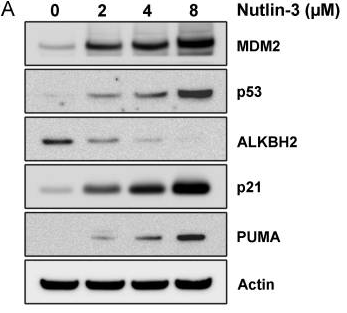
| Western blot | MDM2 / p53 / ALKBH2 / p21 / PUMA RRM1 / RRM2 / p53R2 / p21 / p53 / pS6 / S6 |
|
23258843 |
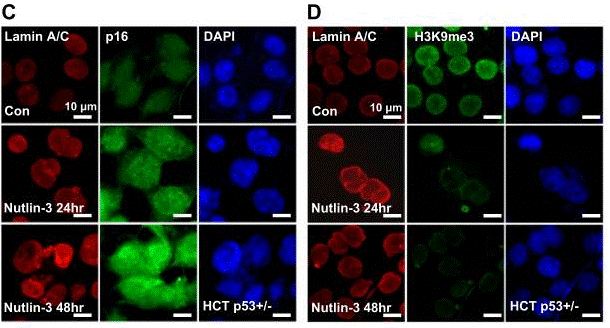
| Immunofluorescence | Lamin A / Lamin C / p16 / H3K9me3 Merlin / cyclin D1 / p53 / MDM2 p53 |
|
30728349 |
| Growth inhibition assay | Cell viability |
|
29286113 |
Technischer Support
Tel: +1-832-582-8158 Ext:3
Wenn Sie weitere Fragen haben, hinterlassen Sie bitte eine Nachricht.
Häufig gestellte Fragen
Frage 1:
Is this a racemic mixture of its enantiomers or just the Nutlin-3a enantiomer?
Antwort:
It is a racemate.

Produkte sind nur für Forschungszwecke bestimmt. Nicht für den menschlichen Gebrauch. Wir verkaufen nicht an Patienten.
©Copyright 2013 Selleck Chemicals. Alle Rechte vorbehalten.