
nur für Forschungszwecke
RG-7112 MDM2/MDMX Inhibitor
Kat.-Nr.S7030
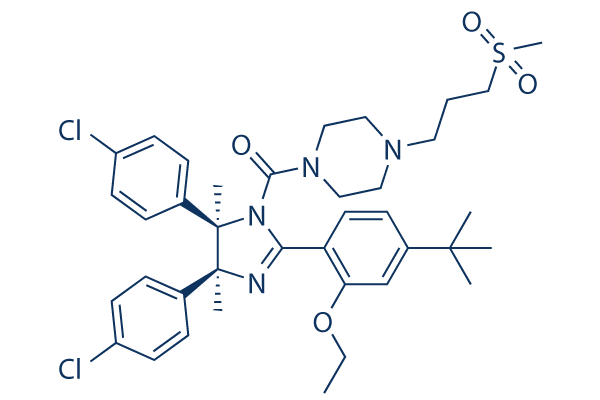
Chemische Struktur
Molekulargewicht: 726.28
Qualitätskontrolle
| Verwandte Ziele | Bcl-2 Caspase PD-1/PD-L1 Ferroptosis p53 Apoptosis related Synthetic Lethality STAT TNF-alpha Ras |
|---|---|
| Weitere MDM2/MDMX Inhibitoren | Nutlin-3 Nutlin-3a Brigimadlin Idasanutlin (RG7388) SAR405838 NSC 207895 NVP-CGM097 Siremadlin (HDM201) Nutlin-3b MX69 |
Zellkultur, Behandlung & Arbeitskonzentration
| Zelllinien | Assay-Typ | Konzentration | Inkubationszeit | Formulierung | Aktivitätsbeschreibung | PMID |
|---|---|---|---|---|---|---|
| SJSA1 | Cytotoxicity assay | 5 days | Cytotoxicity against human SJSA1 cells expressing wild type p53 assessed as cell viability after 5 days by MTT assay, IC50 = 0.3 μM. | 24900694 | ||
| RKO | Cytotoxicity assay | 5 days | Cytotoxicity against human RKO cells expressing wild type p53 assessed as cell viability after 5 days by MTT assay, IC50 = 0.4 μM. | 24900694 | ||
| HCT116 | Cytotoxicity assay | 5 days | Cytotoxicity against human HCT116 cells expressing wild type p53 assessed as cell viability after 5 days by MTT assay, IC50 = 0.5 μM. | 24900694 | ||
| SJSA1 | Antiproliferative assay | 1 hr | Antiproliferative activity against human SJSA1 cells assessed as inhibition of EdU incorporation after 1 hr by Click-iT EdU HCS assay in presence of 10% human serum, IC50 = 0.581 μM. | 24456472 | ||
| SJSA1 | Cytotoxicity assay | 16 hrs | Cytotoxicity against human SJSA1 cells assessed as growth inhibition after 16 hrs by EdU incorporation assay in presence of 10% human serum, IC50 = 0.581 μM. | 24601644 | ||
| MDA-MB-435 | Cytotoxicity assay | 5 days | Cytotoxicity against human MDA-MB-435 cells expressing p53 mutant assessed as cell viability after 5 days by MTT assay, IC50 = 9.9 μM. | 24900694 | ||
| SW480 | Cytotoxicity assay | 5 days | Cytotoxicity against human SW480 cells expressing p53 mutant assessed as cell viability after 5 days by MTT assay, IC50 = 16.6 μM. | 24900694 | ||
| Klicken Sie hier, um weitere experimentelle Daten zu Zelllinien anzuzeigen | ||||||
Chemische Informationen, Lagerung & Stabilität
| Molekulargewicht | 726.28 | Formel | C38H48Cl2N4O4S |
Lagerung (Ab dem Eingangsdatum) | |
|---|---|---|---|---|---|
| CAS-Nr. | 939981-39-2 | SDF herunterladen | Lagerung von Stammlösungen |
|
|
| Synonyme | RO5045337 | Smiles | CCOC1=C(C=CC(=C1)C(C)(C)C)C2=NC(C(N2C(=O)N3CCN(CC3)CCCS(=O)(=O)C)(C)C4=CC=C(C=C4)Cl)(C)C5=CC=C(C=C5)Cl | ||
Löslichkeit
|
In vitro |
DMSO
: 100 mg/mL
(137.68 mM)
Ethanol : 100 mg/mL Water : Insoluble |
Molaritätsrechner
|
In vivo |
|||||
In-vivo-Formulierungsrechner (Klare Lösung)
Schritt 1: Geben Sie die untenstehenden Informationen ein (Empfohlen: Ein zusätzliches Tier zur Berücksichtigung von Verlusten während des Experiments)
Schritt 2: Geben Sie die In-vivo-Formulierung ein (Dies ist nur der Rechner, keine Formulierung. Bitte kontaktieren Sie uns zuerst, wenn es im Abschnitt "Löslichkeit" keine In-vivo-Formulierung gibt.)
Berechnungsergebnisse:
Arbeitskonzentration: mg/ml;
Methode zur Herstellung der DMSO-Stammlösung: mg Wirkstoff vorgelöst in μL DMSO ( Konzentration der Stammlösung mg/mL, Bitte kontaktieren Sie uns zuerst, wenn die Konzentration die DMSO-Löslichkeit der Wirkstoffcharge überschreitet. )
Methode zur Herstellung der In-vivo-Formulierung: Nehmen Sie μL DMSO Stammlösung, dann hinzufügenμL PEG300, mischen und klären, dann hinzufügenμL Tween 80, mischen und klären, dann hinzufügen μL ddH2O, mischen und klären.
Methode zur Herstellung der In-vivo-Formulierung: Nehmen Sie μL DMSO Stammlösung, dann hinzufügen μL Maisöl, mischen und klären.
Hinweis: 1. Bitte stellen Sie sicher, dass die Flüssigkeit klar ist, bevor Sie das nächste Lösungsmittel hinzufügen.
2. Achten Sie darauf, das/die Lösungsmittel der Reihe nach hinzuzufügen. Sie müssen sicherstellen, dass die bei der vorherigen Zugabe erhaltene Lösung eine klare Lösung ist, bevor Sie mit der Zugabe des nächsten Lösungsmittels fortfahren. Physikalische Methoden wie Vortex, Ultraschall oder ein heißes Wasserbad können zur Unterstützung des Lösens verwendet werden.
Wirkmechanismus
| Targets/IC50/Ki |
MDM2
(Cell-free assay) 11 nM(Kd)
p53-MDM2 interaction
(Cell-free assay) 18 nM
|
|---|---|
| In vitro |
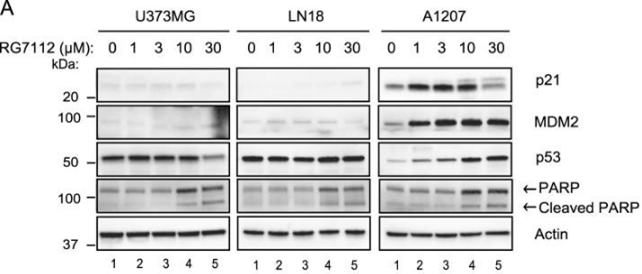
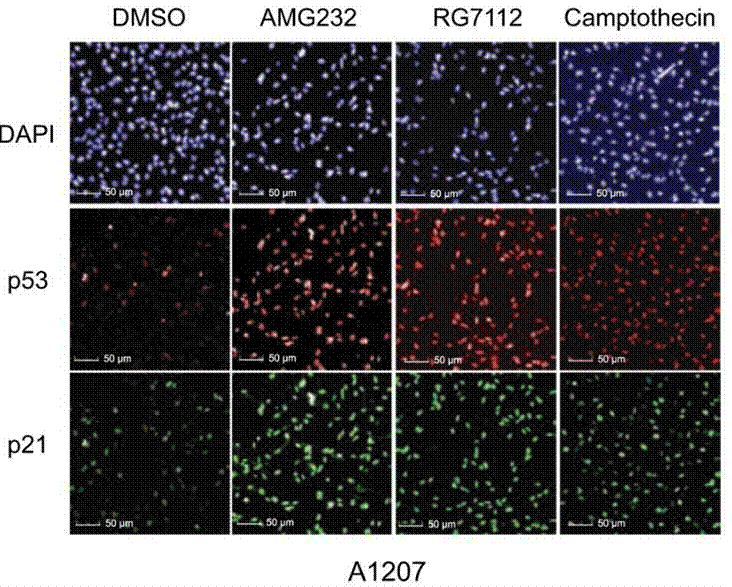
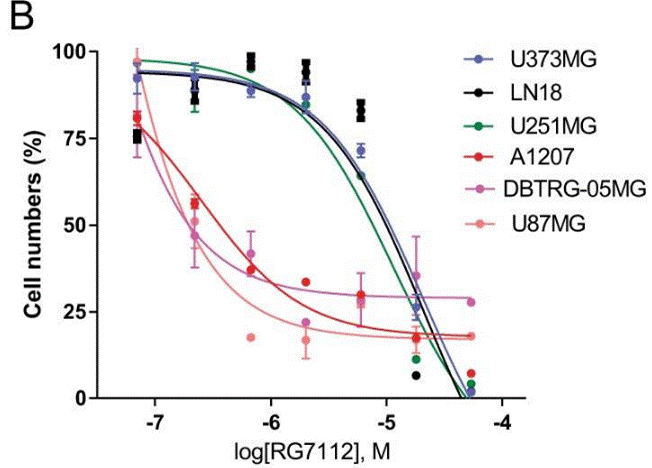
RG7112 ist ein potenter und selektiver Vertreter der Nutlin-Familie von MDM2-Antagonisten, der sich derzeit in klinischen Phase-I-Studien befindet. RG7112 bindet MDM2 mit hoher Affinität (KD von 10,7 nM) und blockiert dessen Wechselwirkungen mit p53 in vitro. Eine Kristallstruktur des RG7112–MDM2-Komplexes zeigt, dass das kleine Molekül in die p53-Tasche von MDM2 bindet und die Wechselwirkungen kritischer p53-Aminosäurereste nachahmt. Die Behandlung von Krebszellen, die Wildtyp-p53 exprimieren, mit RG7112 aktiviert den p53-Signalweg, was zu Zellzyklusarrest und Apoptosis führt. RG7112 zeigt eine potente Antitumoraktivität gegen eine Reihe von soliden Tumorzelllinien. Seine apoptotische Aktivität variiert jedoch stark, wobei die beste Reaktion in Osteosarkomzellen mit MDM2-Genamplifikation beobachtet wird.
|
| In vivo |
RG7112 aktiviert den p53-Signalweg und induziert Apoptosis in Tumorzellen in vivo. Die orale Verabreichung von RG7112 an Mäuse mit menschlichen Xenotransplantaten in nicht-toxischen Konzentrationen führte zu dosisabhängigen Veränderungen der Proliferations-/Apoptosis-Biomarker sowie zu Tumorhemmung und -regression. Insbesondere ist RG7112 hochsynergistisch mit Androgenentzug bei LNCaP-Xenotransplantattumoren.
|
Literatur |
Anwendungen
| Methoden | Biomarker | Bilder | PMID |
|---|---|---|---|
| Western blot | MDM2 / PARP / Cleaved PARP p-TP53 / PUMA / Survivin |
|
30022047 |
| Immunofluorescence | p53 / p21 |
|
30022047 |
| Growth inhibition assay | Cell viability |
|
30022047 |
Technischer Support
Tel: +1-832-582-8158 Ext:3
Wenn Sie weitere Fragen haben, hinterlassen Sie bitte eine Nachricht.

Produkte sind nur für Forschungszwecke bestimmt. Nicht für den menschlichen Gebrauch. Wir verkaufen nicht an Patienten.
©Copyright 2013 Selleck Chemicals. Alle Rechte vorbehalten.