
nur für Forschungszwecke
Bestatin (Ubenimex) Immunology & Inflammation related Inhibitor
Kat.-Nr.: S1591
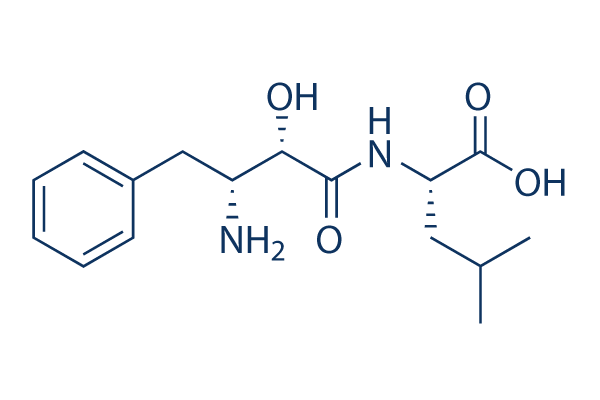
Chemische Struktur
Molekulargewicht: 308.37
Qualitätskontrolle (Quality Control)
| Verwandte Ziele | PD-1/PD-L1 CXCR STING AhR CD markers Interleukins Anti-infection Antioxidant COX Histamine Receptor |
|---|---|
| Weitere Immunology & Inflammation related Inhibitoren | Cl-amidine Bindarit (AF 2838) Tempol Tranilast Sinomenine GI254023X (GI4023) Geniposidic acid CORM-3 Oxymatrine Germacrone |
Chemische Informationen, Lagerung & Stabilität (Chemical Information, Storage & Stability)
| Molekulargewicht | 308.37 | Formel | C16H24N2O4 |
Lagerung (Ab dem Eingangsdatum) | |
|---|---|---|---|---|---|
| CAS-Nr. | 58970-76-6 | SDF herunterladen | Lagerung von Stammlösungen |
|
|
| Synonyme | NK421 | Smiles | CC(C)CC(C(=O)O)NC(=O)C(C(CC1=CC=CC=C1)N)O | ||
Löslichkeit (Solubility)
|
In vitro |
DMSO
: 7 mg/mL
(22.7 mM)
Water : Insoluble Ethanol : Insoluble |
Molaritätsrechner
|
In vivo |
|||||
In-vivo-Formulierungsrechner (Klare Lösung)
Schritt 1: Geben Sie die untenstehenden Informationen ein (Empfohlen: Ein zusätzliches Tier zur Berücksichtigung von Verlusten während des Experiments)
Schritt 2: Geben Sie die In-vivo-Formulierung ein (Dies ist nur der Rechner, keine Formulierung. Bitte kontaktieren Sie uns zuerst, wenn es im Abschnitt "Löslichkeit" keine In-vivo-Formulierung gibt.)
Berechnungsergebnisse:
Arbeitskonzentration: mg/ml;
Methode zur Herstellung der DMSO-Stammlösung: mg Wirkstoff vorgelöst in μL DMSO ( Konzentration der Stammlösung mg/mL, Bitte kontaktieren Sie uns zuerst, wenn die Konzentration die DMSO-Löslichkeit der Wirkstoffcharge überschreitet. )
Methode zur Herstellung der In-vivo-Formulierung: Nehmen Sie μL DMSO Stammlösung, dann hinzufügenμL PEG300, mischen und klären, dann hinzufügenμL Tween 80, mischen und klären, dann hinzufügen μL ddH2O, mischen und klären.
Methode zur Herstellung der In-vivo-Formulierung: Nehmen Sie μL DMSO Stammlösung, dann hinzufügen μL Maisöl, mischen und klären.
Hinweis: 1. Bitte stellen Sie sicher, dass die Flüssigkeit klar ist, bevor Sie das nächste Lösungsmittel hinzufügen.
2. Achten Sie darauf, das/die Lösungsmittel der Reihe nach hinzuzufügen. Sie müssen sicherstellen, dass die bei der vorherigen Zugabe erhaltene Lösung eine klare Lösung ist, bevor Sie mit der Zugabe des nächsten Lösungsmittels fortfahren. Physikalische Methoden wie Vortex, Ultraschall oder ein heißes Wasserbad können zur Unterstützung des Lösens verwendet werden.
Wirkmechanismus (Mechanism of Action)
| Targets/IC50/Ki |
Aminopeptidase-N
|
|---|---|
| In vitro |
Bestatin (Ubenimex) inhibits proliferation of all the human leukemic cell lines except KG1. It induces DNA fragmentation quantitatively and DNA ladder and enhances caspase-3 activity in U937 cells. This compound dose-dependently induces DNA fragmentation in human leukemic cell lines. It also dose-dependently inhibits the invasion of SN12M cells into reconstituted basement membrane (Matrigel). Bestatin inhibits the degradation of type IV collagen by tumor cells, but not by tumor-conditioned medium (TCM), in a concentration-dependent manner. It inhibits hydrolysing activities towards substrates of aminopeptidases in SN12M cells. The compound inhibits the tube-like formation of human umbilical vein endothelial cells (HUVECs) in vitro. It exerts a direct stimulating effect on lymphocytes (and monocytes) via its fixation on cell surface leucine-aminopeptidase, and an indirect effect on monocytes (and lymphocytes) via aminopeptidase B inhibition of tuftsin catabolism. |
| In vivo |
Bestatin (Ubenimex) significantly inhibits melanoma cell-induced angiogenesis in a mouse dorsal air sac assay and reduces the number of vessels oriented towards the established primary tumor mass on the dorsal side of mice implanted with B16-BL6 melanoma cells. It also statistically significantly inhibits leukotriene B4 biosynthesis in the esophageal tissues of EGDA rats and reduces the incidence of EAC from 57.7% (15 of 26 rats) to 26.1% (6 of 23 rats). |
Literatur |
|

Produkte sind nur für Forschungszwecke bestimmt. Nicht für den menschlichen Gebrauch. Wir verkaufen nicht an Patienten.
©Copyright 2013 Selleck Chemicals. Alle Rechte vorbehalten.