
nur für Forschungszwecke
Xevinapant (AT406) IAP Antagonist
Kat.-Nr.S2754
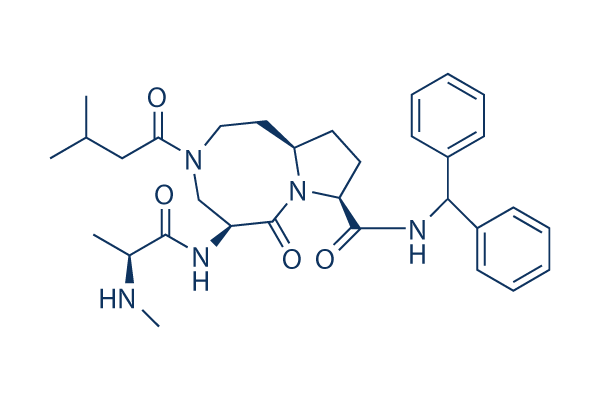
Chemische Struktur
Molekulargewicht: 561.71
Qualitätskontrolle
| Verwandte Ziele | Bcl-2 Caspase PD-1/PD-L1 Ferroptosis p53 Apoptosis related Synthetic Lethality STAT TNF-alpha Ras |
|---|---|
| Weitere IAP Inhibitoren | BV6 SM-164 Birinapant (TL32711) LCL161 GDC-0152 AZD5582 Tolinapant (ASTX660) |
Zellkultur, Behandlung & Arbeitskonzentration
| Zelllinien | Assay-Typ | Konzentration | Inkubationszeit | Formulierung | Aktivitätsbeschreibung | PMID |
|---|---|---|---|---|---|---|
| EVSA-T | Cytotoxicity assay | 72 hrs | Cytotoxicity against human sensitive EVSA-T cells assessed as inhibition of cell growth after 72 hrs by Alamar Blue assay, EC50 = 0.0021 μM. | 26218264 | ||
| MDA-MB-231 | Cytotoxicity assay | 72 hrs | Cytotoxicity against human sensitive MDA-MB-231 cells assessed as inhibition of cell growth after 72 hrs by Alamar Blue assay, EC50 = 0.019 μM. | 26218264 | ||
| HEK293 | Function assay | 2 hrs | Antagonist activity at full-length FLAG-tagged XIAP (unknown origin) transfected in HEK293 cells assessed as inhibition of interaction with caspase 9 after 2 hrs by immunoprecipitation assay, EC50 = 0.034 μM. | 26218264 | ||
| SKOV3 | Growth inhibition assay | 4 days | Growth inhibition of human SKOV3 cells after 4 days by WST8 assay, IC50 = 0.142 μM. | 21443232 | ||
| MDA-MB-231 | Growth inhibition assay | 4 days | Growth inhibition of human MDA-MB-231 cells after 4 days by WST8 assay, IC50 = 0.144 μM. | 21443232 | ||
| MDA-MB-231 | Function assay | 10 nM | Induction of degradation of cIAP1 in human MDA-MB-231 cells at 10 nM by Western blot analysis | 21443232 | ||
| MDA-MB-231 | Function assay | 100 nM | 15 mins | Induction of degradation of cIAP1 in human MDA-MB-231 cells at 100 nM after 15 mins by Western blot analysis | 21443232 | |
| MDA-MB-231 | Apoptosis assay | 1.5 uM | 12 hrs | Induction of apoptosis in human MDA-MB-231 cells assessed as activation of caspase-3 activity at 1.5 uM after 12 hrs by Western blot analysis | 21443232 | |
| MDA-MB-231 | Apoptosis assay | 1.5 uM | 12 hrs | Induction of apoptosis in human MDA-MB-231 cells assessed as activation of PARP cleavage at 1.5 uM after 12 hrs by Western blot analysis | 21443232 | |
| MDA-MB-231 | Antitumor assay | 30 mg/kg | 2 weeks | Antitumor activity against human MDA-MB-231 cells xenografted in SCID mouse assessed inhibition of tumor growth at 30 mg/kg, po administered daily for 5 days/week for 2 weeks | 21443232 | |
| MDA-MB-231 | Antitumor assay | 100 mg/kg | 2 weeks | Antitumor activity against human MDA-MB-231 cells xenografted in SCID mouse assessed inhibition of tumor growth at 100 mg/kg, po administered daily for 5 days/week for 2 weeks | 21443232 | |
| MDA-MB-231 | Antitumor assay | 100 mg/kg | every 3 days | Antitumor activity against human MDA-MB-231 cells xenografted in Balb/c SCID mouse assessed as tumor growth inhibition at 100 mg/kg, po qd measured every 3 days | 26218264 | |
| DAOY | qHTS assay | qHTS of pediatric cancer cell lines to identify multiple opportunities for drug repurposing: Primary screen for DAOY cells | 29435139 | |||
| SJ-GBM2 | qHTS assay | qHTS of pediatric cancer cell lines to identify multiple opportunities for drug repurposing: Primary screen for SJ-GBM2 cells | 29435139 | |||
| A673 | qHTS assay | qHTS of pediatric cancer cell lines to identify multiple opportunities for drug repurposing: Primary screen for A673 cells | 29435139 | |||
| SK-N-MC | qHTS assay | qHTS of pediatric cancer cell lines to identify multiple opportunities for drug repurposing: Primary screen for SK-N-MC cells | 29435139 | |||
| BT-37 | qHTS assay | qHTS of pediatric cancer cell lines to identify multiple opportunities for drug repurposing: Primary screen for BT-37 cells | 29435139 | |||
| NB-EBc1 | qHTS assay | qHTS of pediatric cancer cell lines to identify multiple opportunities for drug repurposing: Primary screen for NB-EBc1 cells | 29435139 | |||
| Saos-2 | qHTS assay | qHTS of pediatric cancer cell lines to identify multiple opportunities for drug repurposing: Primary screen for Saos-2 cells | 29435139 | |||
| LAN-5 | qHTS assay | qHTS of pediatric cancer cell lines to identify multiple opportunities for drug repurposing: Primary screen for LAN-5 cells | 29435139 | |||
| BT-12 | qHTS assay | qHTS of pediatric cancer cell lines to identify multiple opportunities for drug repurposing: Primary screen for BT-12 cells | 29435139 | |||
| OHS-50 | qHTS assay | qHTS of pediatric cancer cell lines to identify multiple opportunities for drug repurposing: Primary screen for OHS-50 cells | 29435139 | |||
| SK-N-MC | qHTS assay | qHTS of pediatric cancer cell lines to identify multiple opportunities for drug repurposing: Confirmatory screen for SK-N-MC cells | 29435139 | |||
| TC32 | qHTS assay | qHTS of pediatric cancer cell lines to identify multiple opportunities for drug repurposing: Confirmatory screen for TC32 cells | 29435139 | |||
| Klicken Sie hier, um weitere experimentelle Daten zu Zelllinien anzuzeigen | ||||||
Chemische Informationen, Lagerung & Stabilität
| Molekulargewicht | 561.71 | Formel | C32H43N5O4 |
Lagerung (Ab dem Eingangsdatum) | |
|---|---|---|---|---|---|
| CAS-Nr. | 1071992-99-8 | SDF herunterladen | Lagerung von Stammlösungen |
|
|
| Synonyme | ARRY-334543, Debio1143, SM-406 | Smiles | CC(C)CC(=O)N1CCC2CCC(N2C(=O)C(C1)NC(=O)C(C)NC)C(=O)NC(C3=CC=CC=C3)C4=CC=CC=C4 | ||
Löslichkeit
|
In vitro |
DMSO
: 112 mg/mL
(199.39 mM)
Ethanol : 112 mg/mL Water : Insoluble |
Molaritätsrechner
|
In vivo |
|||||
In-vivo-Formulierungsrechner (Klare Lösung)
Schritt 1: Geben Sie die untenstehenden Informationen ein (Empfohlen: Ein zusätzliches Tier zur Berücksichtigung von Verlusten während des Experiments)
Schritt 2: Geben Sie die In-vivo-Formulierung ein (Dies ist nur der Rechner, keine Formulierung. Bitte kontaktieren Sie uns zuerst, wenn es im Abschnitt "Löslichkeit" keine In-vivo-Formulierung gibt.)
Berechnungsergebnisse:
Arbeitskonzentration: mg/ml;
Methode zur Herstellung der DMSO-Stammlösung: mg Wirkstoff vorgelöst in μL DMSO ( Konzentration der Stammlösung mg/mL, Bitte kontaktieren Sie uns zuerst, wenn die Konzentration die DMSO-Löslichkeit der Wirkstoffcharge überschreitet. )
Methode zur Herstellung der In-vivo-Formulierung: Nehmen Sie μL DMSO Stammlösung, dann hinzufügenμL PEG300, mischen und klären, dann hinzufügenμL Tween 80, mischen und klären, dann hinzufügen μL ddH2O, mischen und klären.
Methode zur Herstellung der In-vivo-Formulierung: Nehmen Sie μL DMSO Stammlösung, dann hinzufügen μL Maisöl, mischen und klären.
Hinweis: 1. Bitte stellen Sie sicher, dass die Flüssigkeit klar ist, bevor Sie das nächste Lösungsmittel hinzufügen.
2. Achten Sie darauf, das/die Lösungsmittel der Reihe nach hinzuzufügen. Sie müssen sicherstellen, dass die bei der vorherigen Zugabe erhaltene Lösung eine klare Lösung ist, bevor Sie mit der Zugabe des nächsten Lösungsmittels fortfahren. Physikalische Methoden wie Vortex, Ultraschall oder ein heißes Wasserbad können zur Unterstützung des Lösens verwendet werden.
Wirkmechanismus
| Targets/IC50/Ki |
cIAP1-BIR3
(cell-free assay) 1.9 nM(Ki)
cIAP2-BIR3
(cell-free assay) 5.1 nM(Ki)
XIAP-BIR3
(cell-free assay) 66.4 nM(Ki)
|
|---|---|
| In vitro |
AT-406 ist ein Smac-Mimetikum und scheint das AVPI-Peptid sowohl in Wasserstoffbrückenbindungen als auch in hydrophoben Wechselwirkungen mit XIAP genau nachzuahmen, mit zusätzlichen hydrophoben Kontakten mit W323 von XIAP. AT-406 ist empfindlicher gegenüber diesen IAPs als das Smac AVPI-Peptid, mit 50-100-fach höheren Bindungsaffinitäten. AT-406 (bei 1 μM) stellt die Aktivität von Caspase-9 vollständig wieder her, die durch 500 nM XIAP BIR3 in einem zellfreien System unterdrückt wird. In MDA-MB-231-Zellen induziert AT-406 einen schnellen zellulären cIAP1-Abbau und zieht auch das zelluläre XIAP-Protein herunter. AT-406 hemmt effektiv viele menschliche Krebszelllinien und zeigt IC50-Werte von 144 und 142 nM in MDA-MB-231-Zellen und SK-OV-3-Ovarialzellen, mit geringer Toxizität gegenüber normalen menschlichen Brustepithelzellen (MCF-12F) und primären menschlichen normalen Prostataepithelzellen. AT-406 induziert Apoptosis in MDA-MB-231-Zellen durch Induktion der Aktivierung von Caspase-3 und Spaltung von PARP.
|
| Kinase-Assay |
Fluoreszenzpolarisationsbasierte Assays für XIAP, cIAP1 und cIAP2 BIR3 Proteine
|
|
FL-AT-406 (das fluoreszenzmarkierte AT-406) wird verwendet, um eine Reihe neuer FP-Assays zur Bestimmung der Bindungsaffinitäten von Smac-Mimetika an XIAP, cIAP-1 und cIAP-2 BIR3-Proteine zu entwickeln. Der Kd-Wert von FL-AT-406 zu jedem IAP-Protein wird durch Titrationsexperimente unter Verwendung einer festen Konzentration von FL-AT-406 und unterschiedlicher Proteinkonzentrationen bis zur vollständigen Sättigung bestimmt. Fluoreszenzpolarisationswerte werden mit einem Infinite M-1000 Plattenlesegerät in Microfluor 2 96-Well, schwarzen, runden Mikrotiterplatten gemessen. Zu jeder Vertiefung werden FL-AT-406 (2, 1 und 1 nM für Experimente mit XIAP BIR3, cIAP-1 BIR3 bzw. cIAP-2 BIR3) und unterschiedliche Proteinkonzentrationen zu einem Endvolumen von 125 μL im Assaypuffer (100 mM Kaliumphosphat, pH 7,5, 100 μg/mL bovines γ-Globulin, 0,02% Natriumazid, mit 4% DMSO) hinzugefügt. Die Platten werden gemischt und bei Raumtemperatur 2-3 Stunden mit leichtem Schütteln inkubiert. Die Polarisationswerte in Millipolarisationseinheiten (mP) werden bei einer Anregungswellenlänge von 485 nm und einer Emissionswellenlänge von 530 nm gemessen. Gleichgewichtsdissoziationskonstanten (Kd) werden dann durch Anpassung der sigmoidalen dosisabhängigen FP-Zunahmen als Funktion der Proteinkonzentrationen mit der Software Graphpad Prism 5.0 berechnet. In kompetitiven Bindungsexperimenten für XIAP3 BIR3 wird AT-406 mit 20 nM XIAP BIR3-Protein und 2 nM FL-AT-406 im Assaypuffer (100 mM Kaliumphosphat, pH 7,5; 100 μg/mL bovines γ-Globulin; 0,02% Natriumazid) inkubiert. In kompetitiven Bindungsexperimenten für cIAP1 BIR3-Protein werden 3 nM Protein und 1 nM FL-AT-406 verwendet. In kompetitiven Bindungsexperimenten für cIAP2 BIR3 werden 5 nM Protein und 1 nM FL-AT-406 verwendet. Für jedes kompetitive Bindungsexperiment werden die Polarisationswerte nach 2-3 Stunden Inkubation mit einem Infinite M-1000 Plattenlesegerät gemessen. Der IC50-Wert, die Inhibitorkonzentration, bei der 50% des gebundenen Tracers verdrängt werden, wird aus der Kurve mittels nichtlinearer Kleinste-Quadrate-Analyse bestimmt. Die Kurvenanpassung erfolgt mit der PRISM-Software. Ein Ki-Wert für AT-406 wird berechnet.
|
|
| In vivo |
AT-406 weist gute pharmakokinetische (PK) Eigenschaften und eine orale Bioverfügbarkeit bei Mäusen, Ratten, nicht-humanen Primaten und Hunden auf. Im MDA-MB-231-Xenograft induziert AT-406 effektiv den cIAP1-Abbau und die Prozessierung von Procaspase-8 sowie die Spaltung von PARP in Tumorgeweben bei 100 mg/kg mit guter Verträglichkeit sogar bei 200 mg/kg. AT-406 induziert eine signifikante Tumorwachstumshemmung mit p von 0,0012 bei 100 mg/kg.
|
Literatur |
Anwendungen
| Methoden | Biomarker | Bilder | PMID |
|---|---|---|---|
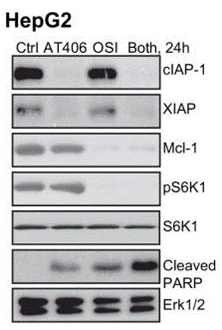
| Western blot | cIAP-1 / XIAP / Mcl-1 / pS6K1 / Cleaved PARP |
|
28036295 |
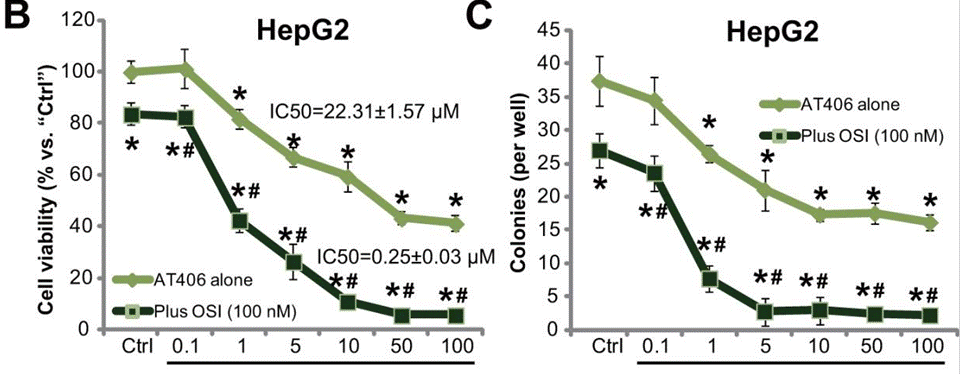
| Growth inhibition assay | Cell viability |
|
28036295 |
Klinische Studieninformationen
(Daten von https://clinicaltrials.gov, aktualisiert am 2024-05-22)
| NCT-Nummer | Rekrutierung | Erkrankungen | Sponsor/Kooperationspartner | Startdatum | Phasen |
|---|---|---|---|---|---|
| NCT01265199 | Terminated | Acute Myelogenous Leukemia (AML) |
Ascenta Therapeutics|The Leukemia and Lymphoma Society |
February 2011 | Phase 1 |
| NCT01078649 | Completed | Cancer|Solid Tumors|Lymphoma|Malignancy |
Debiopharm International SA |
March 29 2010 | Phase 1 |
Technischer Support
Tel: +1-832-582-8158 Ext:3
Wenn Sie weitere Fragen haben, hinterlassen Sie bitte eine Nachricht.

Produkte sind nur für Forschungszwecke bestimmt. Nicht für den menschlichen Gebrauch. Wir verkaufen nicht an Patienten.
©Copyright 2013 Selleck Chemicals. Alle Rechte vorbehalten.