
nur für Forschungszwecke
BIBF 1120 (Nintedanib) PDGFR/VEGFR-Inhibitor
Kat.-Nr.S1010
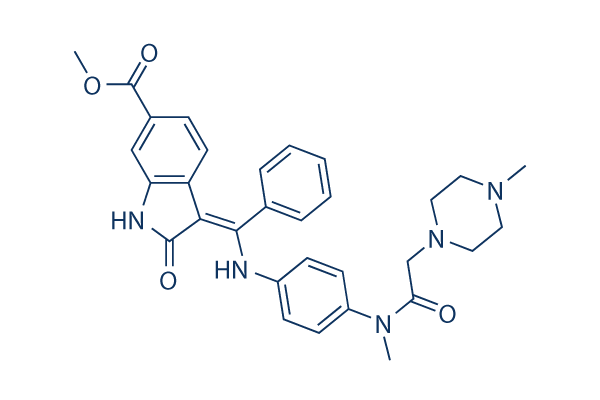
Chemische Struktur
Molekulargewicht: 539.62
Qualitätskontrolle
| Verwandte Ziele | EGFR PDGFR FGFR c-Met Src MEK CSF-1R FLT3 HER2 c-Kit |
|---|---|
| Weitere VEGFR Inhibitoren | SAR131675 SU 5402 Cediranib (AZD2171) Vatalanib (PTK787) 2HCl Anlotinib (AL3818) Dihydrochloride Linifanib (ABT-869) Apatinib (YN968D1) Apatinib (YN968D1) mesylate Ki8751 ZM 323881 HCl |
Zellkultur, Behandlung & Arbeitskonzentration
| Zelllinien | Assay-Typ | Konzentration | Inkubationszeit | Formulierung | Aktivitätsbeschreibung | PMID |
|---|---|---|---|---|---|---|
| SKOV3 | Function Assay | 5 µM | 24 h | DMSO | induces a significant increase in the promoter activities of E-cad, CDH1, and CDH3 | 26061747 |
| A549 | Function Assay | 2/5 μM | 24 h | DMSO | has a general EMT reversal effect | 26061747 |
| T24 | Function Assay | 2/5 μM | 24 h | DMSO | has a general EMT reversal effect | 26061747 |
| Mia-Paca2 | Function Assay | 2/5 μM | 24 h | DMSO | has a general EMT reversal effect | 26061747 |
| A549 | Function Assay | 0.01–5 μM | 24 h | DMSO | induces SFTPD mRNA expression dose dependently | 25843005 |
| A549 | Function Assay | 0.01–5 μM | 72 h | DMSO | enhances SP-D protein expression in a dose-dependent manner at concentrations of up to 5 μM | 25843005 |
| A549 | Function Assay | 5 μM | 0-1 h | DMSO | increases AP-1 activation after 30 min | 25843005 |
| Hep3B | Cell Viability Assay | 0-20 μM | 48 h | decreases cell viability dose dependently | 24657398 | |
| HepG2 | Cell Viability Assay | 0-20 μM | 48 h | decreases cell viability dose dependently | 24657398 | |
| PLC5 | Cell Viability Assay | 0-20 μM | 48 h | decreases cell viability dose dependently | 24657398 | |
| HuH7 | Cell Viability Assay | 0-20 μM | 48 h | decreases cell viability dose dependently | 24657398 | |
| SK-Hep1 | Cell Viability Assay | 0-20 μM | 48 h | decreases cell viability dose dependently | 24657398 | |
| Hep3B | Apoptosis Assay | 0-20 μM | 48 h | induces cell apoptosis dose dependently | 24657398 | |
| HepG2 | Apoptosis Assay | 0-20 μM | 48 h | induces cell apoptosis dose dependently | 24657398 | |
| PLC5 | Apoptosis Assay | 0-20 μM | 48 h | induces cell apoptosis dose dependently | 24657398 | |
| HuH7 | Apoptosis Assay | 0-20 μM | 48 h | induces cell apoptosis dose dependently | 24657398 | |
| SK-Hep1 | Apoptosis Assay | 0-20 μM | 48 h | induces cell apoptosis dose dependently | 24657398 | |
| H1703 | Growth Inhibition Assay | IC50=0.05 μM | 23729403 | |||
| Sf9 | Function assay | 20 mins | Inhibition of mouse GST-fused VEGFR2 expressed in Sf9 insect cells after 20 mins by scintillation counting, IC50 = 0.013 μM. | 18559524 | ||
| Sf9 | Function assay | 20 mins | Inhibition of human GST-fused VEGFR2 expressed in Sf9 insect cells after 20 mins by scintillation counting, IC50 = 0.021 μM. | 18559524 | ||
| NIH3T3 | Function assay | 50 nM | 1 hr | Inhibition of VEGFR2 transfected in mouse NIH3T3 cells at 50 nM incubated for 1 hr measured after 32 hrs washout followed by VEGF stimulation for 10 mins by Western blotting | 18559524 | |
| HT-29 | Antiproliferative assay | 72 hrs | Antiproliferative activity against human HT-29 cells after 72 hrs by MTT assay, IC50 = 4.9 μM. | 28190652 | ||
| SKOV3 | Antiproliferative assay | 72 hrs | Antiproliferative activity against human SKOV3 cells after 72 hrs by MTT assay, IC50 = 28.76 μM. | 28190652 | ||
| BL21 (DE3) | Function assay | 30 mins | Inhibition of His6-tagged MELK catalytic domain (1 to 340 residues) (unknown origin) expressed in Escherichia coli BL21 (DE3) cells using Bcl-GL as substrate measured after 30 mins in presence of [gamma32P]ATP by liquid scintillation counting method, Ki = 0.0056 μM. | 28351607 | ||
| BL21 (DE3) | Function assay | 30 mins | Inhibition of His6-tagged MELK catalytic domain (1 to 340 residues) (unknown origin) expressed in Escherichia coli BL21 (DE3) cells using Bcl-GL as substrate measured after 30 mins in presence of [gamma32P]ATP by liquid scintillation counting method, IC50 = 0.043 μM. | 28351607 | ||
| HT-29 | Antiproliferative assay | 72 hrs | Antiproliferative activity against human HT-29 cells after 72 hrs by MTT assay, IC50 = 0.83 μM. | 28826084 | ||
| MCF7 | Antiproliferative assay | 72 hrs | Antiproliferative activity against human MCF7 cells after 72 hrs by MTT assay, IC50 = 8.28 μM. | 28826084 | ||
| A549 | Antiproliferative assay | 72 hrs | Antiproliferative activity against human A549 cells after 72 hrs by MTT assay, IC50 = 22.62 μM. | 28826084 | ||
| NIH/3T3 | Function assay | 42 hrs | Inhibition of PDGFR in mouse NIH/3T3 cells assessed as reduction in recombinant human PDGF-BB-induced cell proliferation after 42 hrs by cell titer 96 aqueous one solution based assay, IC50 = 0.085 μM. | 29152045 | ||
| Sf9 | Function assay | Inhibition of human VEGFR2 expressed in Sf9 cells, IC50 = 0.005 μM. | 19522465 | |||
| NIH3T3 | Function assay | 1 hr | Inhibition of VEGF-stimulated human VEGFR2 phosphorylation expressed in mouse NIH3T3 cells pretreated for 1 hr measured 32 hrs after drug dose by immunoprecipitation based pulse-chase experiment | 19522465 | ||
| BRP | Apoptosis assay | Induction of apoptosis in BRP cells assessed as caspase-3 cleavage | 19522465 | |||
| BRP | Antiangiogenic assay | Antiangiogenic activity BRP cells assessed as inhibition of cell proliferation by [3H]thymidine incorporation assay | 19522465 | |||
| TC32 | qHTS assay | qHTS of pediatric cancer cell lines to identify multiple opportunities for drug repurposing: Primary screen for TC32 cells | 29435139 | |||
| A673 | qHTS assay | qHTS of pediatric cancer cell lines to identify multiple opportunities for drug repurposing: Primary screen for A673 cells | 29435139 | |||
| DAOY | qHTS assay | qHTS of pediatric cancer cell lines to identify multiple opportunities for drug repurposing: Primary screen for DAOY cells | 29435139 | |||
| Saos-2 | qHTS assay | qHTS of pediatric cancer cell lines to identify multiple opportunities for drug repurposing: Primary screen for Saos-2 cells | 29435139 | |||
| BT-37 | qHTS assay | qHTS of pediatric cancer cell lines to identify multiple opportunities for drug repurposing: Primary screen for BT-37 cells | 29435139 | |||
| SK-N-SH | qHTS assay | qHTS of pediatric cancer cell lines to identify multiple opportunities for drug repurposing: Primary screen for SK-N-SH cells | 29435139 | |||
| NB1643 | qHTS assay | qHTS of pediatric cancer cell lines to identify multiple opportunities for drug repurposing: Primary screen for NB1643 cells | 29435139 | |||
| OHS-50 | qHTS assay | qHTS of pediatric cancer cell lines to identify multiple opportunities for drug repurposing: Primary screen for OHS-50 cells | 29435139 | |||
| LAN-5 | qHTS assay | qHTS of pediatric cancer cell lines to identify multiple opportunities for drug repurposing: Confirmatory screen for LAN-5 cells | 29435139 | |||
| DAOY | qHTS assay | qHTS of pediatric cancer cell lines to identify multiple opportunities for drug repurposing: Confirmatory screen for DAOY cells | 29435139 | |||
| Rh41 | qHTS assay | qHTS of pediatric cancer cell lines to identify multiple opportunities for drug repurposing: Primary screen for Rh41 cells | 29435139 | |||
| MG 63 (6-TG R) | qHTS assay | qHTS of pediatric cancer cell lines to identify multiple opportunities for drug repurposing: Confirmatory screen for MG 63 (6-TG R) cells | 29435139 | |||
| Rh30 | qHTS assay | qHTS of pediatric cancer cell lines to identify multiple opportunities for drug repurposing: Confirmatory screen for Rh30 cells | 29435139 | |||
| U-2 OS | qHTS assay | qHTS of pediatric cancer cell lines to identify multiple opportunities for drug repurposing: Confirmatory screen for U-2 OS cells | 29435139 | |||
| OHS-50 | qHTS assay | qHTS of pediatric cancer cell lines to identify multiple opportunities for drug repurposing: Confirmatory screen for OHS-50 cells | 29435139 | |||
| Rh41 | qHTS assay | qHTS of pediatric cancer cell lines to identify multiple opportunities for drug repurposing: Confirmatory screen for Rh41 cells | 29435139 | |||
| SJ-GBM2 | qHTS assay | qHTS of pediatric cancer cell lines to identify multiple opportunities for drug repurposing: Primary screen for SJ-GBM2 cells | 29435139 | |||
| NB-EBc1 | qHTS assay | qHTS of pediatric cancer cell lines to identify multiple opportunities for drug repurposing: Primary screen for NB-EBc1 cells | 29435139 | |||
| LAN-5 | qHTS assay | qHTS of pediatric cancer cell lines to identify multiple opportunities for drug repurposing: Primary screen for LAN-5 cells | 29435139 | |||
| NB1643 | qHTS assay | qHTS of pediatric cancer cell lines to identify multiple opportunities for drug repurposing: Confirmatory screen for NB1643 cells | 29435139 | |||
| SK-N-MC | qHTS assay | qHTS of pediatric cancer cell lines to identify multiple opportunities for drug repurposing: Confirmatory screen for SK-N-MC cells | 29435139 | |||
| TC32 | qHTS assay | qHTS of pediatric cancer cell lines to identify multiple opportunities for drug repurposing: Confirmatory screen for TC32 cells | 29435139 | |||
| Rh18 | qHTS assay | qHTS of pediatric cancer cell lines to identify multiple opportunities for drug repurposing: Confirmatory screen for Rh18 cells | 29435139 | |||
| Klicken Sie hier, um weitere experimentelle Daten zu Zelllinien anzuzeigen | ||||||
Chemische Informationen, Lagerung & Stabilität
| Molekulargewicht | 539.62 | Formel | C31H33N5O4 |
Lagerung (Ab dem Eingangsdatum) | |
|---|---|---|---|---|---|
| CAS-Nr. | 656247-17-5 | SDF herunterladen | Lagerung von Stammlösungen |
|
|
| Synonyme | BIBF 1120, Intedanib | Smiles | CN1CCN(CC1)CC(=O)N(C)C2=CC=C(C=C2)N=C(C3=CC=CC=C3)C4=C(NC5=C4C=CC(=C5)C(=O)OC)O | ||
Löslichkeit
|
In vitro |
DMSO
: 10 mg/mL
(18.53 mM)
Water : Insoluble Ethanol : Insoluble |
Molaritätsrechner
|
In vivo |
|||||
In-vivo-Formulierungsrechner (Klare Lösung)
Schritt 1: Geben Sie die untenstehenden Informationen ein (Empfohlen: Ein zusätzliches Tier zur Berücksichtigung von Verlusten während des Experiments)
Schritt 2: Geben Sie die In-vivo-Formulierung ein (Dies ist nur der Rechner, keine Formulierung. Bitte kontaktieren Sie uns zuerst, wenn es im Abschnitt "Löslichkeit" keine In-vivo-Formulierung gibt.)
Berechnungsergebnisse:
Arbeitskonzentration: mg/ml;
Methode zur Herstellung der DMSO-Stammlösung: mg Wirkstoff vorgelöst in μL DMSO ( Konzentration der Stammlösung mg/mL, Bitte kontaktieren Sie uns zuerst, wenn die Konzentration die DMSO-Löslichkeit der Wirkstoffcharge überschreitet. )
Methode zur Herstellung der In-vivo-Formulierung: Nehmen Sie μL DMSO Stammlösung, dann hinzufügenμL PEG300, mischen und klären, dann hinzufügenμL Tween 80, mischen und klären, dann hinzufügen μL ddH2O, mischen und klären.
Methode zur Herstellung der In-vivo-Formulierung: Nehmen Sie μL DMSO Stammlösung, dann hinzufügen μL Maisöl, mischen und klären.
Hinweis: 1. Bitte stellen Sie sicher, dass die Flüssigkeit klar ist, bevor Sie das nächste Lösungsmittel hinzufügen.
2. Achten Sie darauf, das/die Lösungsmittel der Reihe nach hinzuzufügen. Sie müssen sicherstellen, dass die bei der vorherigen Zugabe erhaltene Lösung eine klare Lösung ist, bevor Sie mit der Zugabe des nächsten Lösungsmittels fortfahren. Physikalische Methoden wie Vortex, Ultraschall oder ein heißes Wasserbad können zur Unterstützung des Lösens verwendet werden.
Wirkmechanismus
| Targets/IC50/Ki |
VEGFR2
(Cell-free assay) 13 nM
VEGFR3
(Cell-free assay) 13 nM
LCK
(Cell-free assay) 16 nM
FLT3
(Cell-free assay) 26 nM
VEGFR1
(Cell-free assay) 34 nM
FGFR2
(Cell-free assay) 37 nM
PDGFRα
(Cell-free assay) 59 nM
PDGFRβ
(Cell-free assay) 65 nM
FGFR1
(Cell-free assay) 69 nM
FGFR3
(Cell-free assay) 108 nM
Src
(Cell-free assay) 156 nM
Lyn
(Cell-free assay) 195 nM
FGFR4
(Cell-free assay) 610 nM
|
|---|---|
| In vitro |
BIBF1120 hemmt die PDGFR-Kinaseaktivität der PDGFR-alpha- und PDGFR-beta-Typen mit IC50-Werten von 59 nM bzw. 65 nM. Darüber hinaus unterdrückt BIBF1120 die FGFR-Subtypen mit IC50-Werten von 60 nM, 37 nM und 108 nM für FGFR1, FGFR2 bzw. FGFR3. BIBF1120 bindet an die ATP-Bindungsstelle in der Spalte zwischen den Amino- und Carboxy-terminalen Lappen der Kinasedomäne. Das Indolinon-Gerüst bildet zwei Wasserstoffbrückenbindungen mit dem Rückgratstickstoff von Cys919 und dem Rückgratcarbonylsauerstoff von Glu917 in der Scharnierregion. BIBF 1120 hemmt die Proliferation von PDGF-BB-stimulierten BRPs mit einer EC50 von 79 nM in Zellassays. BIBF1120 in Konzentrationen von nur 100 nM blockiert die Aktivierung von MAPK nach Stimulation mit 5% Serum plus PDGF-BB. In Kulturen humaner vaskulärer glatter Muskelzellen (HUASMC) verhindert BIBF1120 die PDGF-BB-stimulierte Proliferation mit einer EC50 von 69 nM. |
| Kinase-Assay |
VEGFR2-Kinase-Assay
|
|
Die zytoplasmatische Tyrosinkinase-Domäne von VEGFR2 (Reste 797-1355 gemäß Sequenz in der Datenbank SWISS-PROT P35968) wird in pFastBac fusioniert an GST kloniert und extrahiert. Die Enzymaktivität wird in Gegenwart oder Abwesenheit von seriellen Verdünnungen von BIBF1120 in 25% DMSO untersucht. Jede Mikrotiterplatte enthält interne Kontrollen wie Leerwert, maximale Reaktion und historische Referenzverbindung. Alle Inkubationen werden bei Raumtemperatur auf einem Rotationsschüttler durchgeführt. 10 μL jeder BIBF1120-Verdünnung werden zu 10 μL verdünnter Kinase (0,8 μg/mL VEGFR2, 10 mM Tris pH 7,5, 2 mM EDTA und 2 mg/mL BSA) gegeben und 1 Stunde vorinkubiert. Die Reaktion wird durch Zugabe von 30 μL Substratmischung, die 62,4 mM Tris pH 7,5, 2,7 mM DTT, 5,3 mM MnCl2, 13,3 mM Mg-Acetat, 0,42 mM ATP, 0,83 mg/mL Poly-Glu-Tyr(4:1) und 1,7 μg/mL Poly-Glu-Tyr(4:1)-Biotin enthält, gestartet und 1 Stunde inkubiert. Die Reaktion wird durch Zugabe von 50 μL 250 mM EDTA, 20 mM HEPES, pH 7,4, gestoppt. 90 μL des Reaktionsgemischs werden auf eine Streptavidinplatte übertragen und 1-2 Stunden inkubiert. Nach drei Waschschritten mit PBS wird der EU-markierte Antikörper PY20 (empfohlene Verdünnung 1:2000 von 0,5 mg/mL markiertem Antikörper in DELFIA-Assay-Puffer) hinzugefügt. Überschüssiger Detektionsantikörper wird durch drei Waschschritte mit DELFIA-Waschpuffer entfernt. Zehn Minuten vor der Messung auf dem Multilabel-Reader wird jede Vertiefung mit 100 μL DELFIA-Enhancement-Lösung inkubiert.
|
|
| In vivo |
In allen bisher getesteten Tumormodellen, einschließlich menschlicher Tumor-Xenografts, die in Nacktmäusen wachsen, und einem syngenen Ratten-Tumormodell, ist BIBF1120 bei gut verträglichen Dosen (25-100 mg/kg täglich p.o.) hochaktiv. Dies zeigt sich in der Magnetresonanztomographie der Tumordurchblutung nach 3 Tagen, der Reduzierung der Gefäßdichte und Gefäßintegrität nach 5 Tagen und einer ausgeprägten Wachstumshemmung. |
Literatur |
|
Anwendungen
| Methoden | Biomarker | Bilder | PMID |
|---|---|---|---|
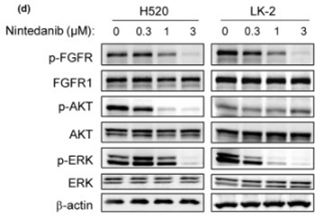
| Western blot | p-EGFR / FGFR1 / p-AKT / AKT / p-ERK / ERK Cyclin A / Cyclin D1 / Cyclin E / CDK2 / CDK4 / CDK6 p-SMAD3 / SMAD3 / p-p38 MAPK / p38 MAPK Fibronectin / Collagen 1a1 |
|
27581340 |
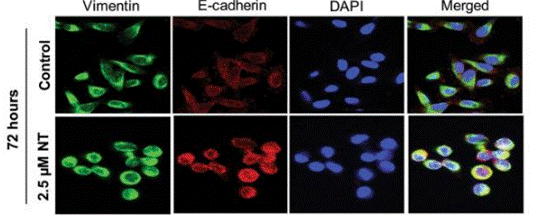
| Immunofluorescence | Vimentin / E-cadherin |
|
29934570 |
Klinische Studieninformationen
(Daten von https://clinicaltrials.gov, aktualisiert am 2024-05-22)
| NCT-Nummer | Rekrutierung | Erkrankungen | Sponsor/Kooperationspartner | Startdatum | Phasen |
|---|---|---|---|---|---|
| NCT06200714 | Recruiting | Idiopathic Pulmonary Fibrosis|Diarrhoea |
Boehringer Ingelheim |
April 30 2024 | -- |
| NCT05676112 | Withdrawn | Pulmonary Fibrosis |
Boehringer Ingelheim|China-Japan Friendship Hospital |
December 29 2023 | -- |
| NCT06070610 | Completed | Healthy |
Boehringer Ingelheim |
November 8 2023 | Phase 1 |
| NCT05755308 | Not yet recruiting | Idiopathic Pulmonary Fibrosis |
Fondazione Policlinico Universitario Agostino Gemelli IRCCS |
October 2023 | Not Applicable |
| NCT06071013 | Not yet recruiting | Non-small Cell Lung Cancer|EGFR Gene Mutation|EGFR-TKI Resistant Mutation |
China Medical University Hospital |
September 28 2023 | Phase 1|Phase 2 |
Technischer Support
Tel: +1-832-582-8158 Ext:3
Wenn Sie weitere Fragen haben, hinterlassen Sie bitte eine Nachricht.

Produkte sind nur für Forschungszwecke bestimmt. Nicht für den menschlichen Gebrauch. Wir verkaufen nicht an Patienten.
©Copyright 2013 Selleck Chemicals. Alle Rechte vorbehalten.