
nur für Forschungszwecke
BIX-01294 trihydrochloride Histone Methyltransferase Inhibitor
Kat.-Nr.S8006
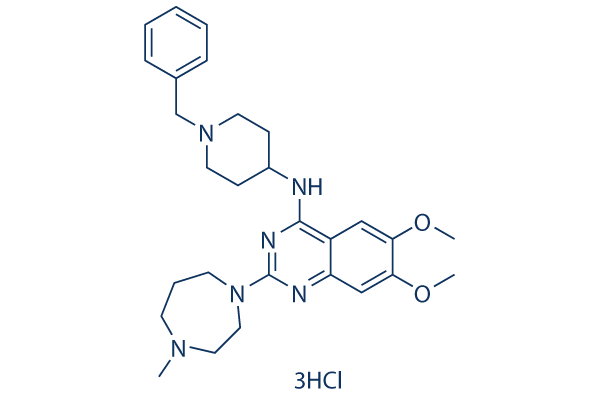
Chemische Struktur
Molekulargewicht: 600.02
Qualitätskontrolle
| Verwandte Ziele | HDAC JAK BET PKC PARP HIF PRMT EZH2 AMPK Histone Acetyltransferase |
|---|---|
| Weitere Histone Methyltransferase Inhibitoren | Pinometostat (EPZ5676) 3-Deazaneplanocin A (DZNep) Hydrochloride UNC1999 EPZ015666 (GSK3235025) EPZ004777 MM-102 (HMTase Inhibitor IX) Chaetocin SGC 0946 EPZ005687 UNC0638 |
Zellkultur, Behandlung & Arbeitskonzentration
| Zelllinien | Assay-Typ | Konzentration | Inkubationszeit | Formulierung | Aktivitätsbeschreibung | PMID |
|---|---|---|---|---|---|---|
| HeLa cells | Function assay | Inhibition of ERK5 phosphorylation in sorbitol-stimulated human HeLa cells, IC50=0.059 μM | 23656407 | |||
| HeLa | Function assay | 4.5 hrs | Inhibition of Ebolavirus glycoprotein/matrix protein VP40 entry in human HeLa cells after 4.5 hrs beta-lactamase reporter assay, IC50 = 0.966 μM. | 29624387 | ||
| BL21 (DE3)-Gold | Function assay | 20 mins | Inhibition of N-terminal hexahistidine-tagged human G9a (913 to 1193 residues) expressed in Escherichia coli BL21 (DE3)-Gold cells using histone H3 (1 to 15 residues) as substrate preincubated for 20 mins followed by substrate addition by mass spectrometr, IC50 = 1.9 μM. | 27720557 | ||
| HL60 | Antiproliferative assay | 48 hrs | Antiproliferative activity against human HL60 cells after 48 hrs by CCK8 assay, IC50 = 2.2 μM. | 27393948 | ||
| A549 | Antiproliferative assay | 48 hrs | Antiproliferative activity against human A549 cells after 48 hrs by CCK8 assay, IC50 = 2.8 μM. | 27393948 | ||
| HepG2 | Antiproliferative assay | 48 hrs | Antiproliferative activity against human HepG2 cells after 48 hrs by CCK8 assay, IC50 = 3.7 μM. | 27393948 | ||
| K562 | Antiproliferative assay | 48 hrs | Antiproliferative activity against human K562 cells after 48 hrs by CCK8 assay, IC50 = 3.9 μM. | 27393948 | ||
| MDA-MB-231 | Function assay | 2 days | Inhibition of G9a in human MDA-MB-231 cells assessed as reduction in H3K9me2 level after 2 days by immunofluorescence in-cell western analysis, IC50 = 4.563 μM. | 29541353 | ||
| K562 | Function assay | 0.5 to 2 uM | 72 hrs | Inhibition of histone methyltransferase G9a in human K562 cells assessed as reduction in histone H3K9me2 levels at 0.5 to 2 uM after 72 hrs by Western blot analysis | 27393948 | |
| TC32 | qHTS assay | qHTS of pediatric cancer cell lines to identify multiple opportunities for drug repurposing: Primary screen for TC32 cells | 29435139 | |||
| DAOY | qHTS assay | qHTS of pediatric cancer cell lines to identify multiple opportunities for drug repurposing: Primary screen for DAOY cells | 29435139 | |||
| SJ-GBM2 | qHTS assay | qHTS of pediatric cancer cell lines to identify multiple opportunities for drug repurposing: Primary screen for SJ-GBM2 cells | 29435139 | |||
| A673 | qHTS assay | qHTS of pediatric cancer cell lines to identify multiple opportunities for drug repurposing: Primary screen for A673 cells | 29435139 | |||
| SK-N-MC | qHTS assay | qHTS of pediatric cancer cell lines to identify multiple opportunities for drug repurposing: Primary screen for SK-N-MC cells | 29435139 | |||
| BT-37 | qHTS assay | qHTS of pediatric cancer cell lines to identify multiple opportunities for drug repurposing: Primary screen for BT-37 cells | 29435139 | |||
| NB-EBc1 | qHTS assay | qHTS of pediatric cancer cell lines to identify multiple opportunities for drug repurposing: Primary screen for NB-EBc1 cells | 29435139 | |||
| Saos-2 | qHTS assay | qHTS of pediatric cancer cell lines to identify multiple opportunities for drug repurposing: Primary screen for Saos-2 cells | 29435139 | |||
| SK-N-SH | qHTS assay | qHTS of pediatric cancer cell lines to identify multiple opportunities for drug repurposing: Primary screen for SK-N-SH cells | 29435139 | |||
| NB1643 | qHTS assay | qHTS of pediatric cancer cell lines to identify multiple opportunities for drug repurposing: Primary screen for NB1643 cells | 29435139 | |||
| LAN-5 | qHTS assay | qHTS of pediatric cancer cell lines to identify multiple opportunities for drug repurposing: Primary screen for LAN-5 cells | 29435139 | |||
| BT-12 | qHTS assay | qHTS of pediatric cancer cell lines to identify multiple opportunities for drug repurposing: Primary screen for BT-12 cells | 29435139 | |||
| Rh18 | qHTS assay | qHTS of pediatric cancer cell lines to identify multiple opportunities for drug repurposing: Primary screen for Rh18 cells | 29435139 | |||
| OHS-50 | qHTS assay | qHTS of pediatric cancer cell lines to identify multiple opportunities for drug repurposing: Primary screen for OHS-50 cells | 29435139 | |||
| RD | qHTS assay | qHTS of pediatric cancer cell lines to identify multiple opportunities for drug repurposing: Primary screen for RD cells | 29435139 | |||
| MG 63 (6-TG R) | qHTS assay | qHTS of pediatric cancer cell lines to identify multiple opportunities for drug repurposing: Primary screen for MG 63 (6-TG R) cells | 29435139 | |||
| wild type fibroblast cells | qHTS assay | qHTS of pediatric cancer cell lines to identify multiple opportunities for drug repurposing: Primary screen for control Hh wild type fibroblast cells | 29435139 | |||
| Rh41 | qHTS assay | qHTS of pediatric cancer cell lines to identify multiple opportunities for drug repurposing: Primary screen for Rh41 cells | 29435139 | |||
| NB1643 | qHTS assay | qHTS of pediatric cancer cell lines to identify multiple opportunities for drug repurposing: Confirmatory screen for NB1643 cells | 29435139 | |||
| A673 | qHTS assay | qHTS of pediatric cancer cell lines to identify multiple opportunities for drug repurposing: Confirmatory screen for A673 cells) | 29435139 | |||
| SK-N-MC | qHTS assay | qHTS of pediatric cancer cell lines to identify multiple opportunities for drug repurposing: Confirmatory screen for SK-N-MC cells | 29435139 | |||
| SJ-GBM2 | qHTS assay | qHTS of pediatric cancer cell lines to identify multiple opportunities for drug repurposing: Confirmatory screen for SJ-GBM2 cells | 29435139 | |||
| BT-37 | qHTS assay | qHTS of pediatric cancer cell lines to identify multiple opportunities for drug repurposing: Confirmatory screen for BT-37 cells | 29435139 | |||
| TC32 | qHTS assay | qHTS of pediatric cancer cell lines to identify multiple opportunities for drug repurposing: Confirmatory screen for TC32 cells | 29435139 | |||
| Rh41 | qHTS assay | qHTS of pediatric cancer cell lines to identify multiple opportunities for drug repurposing: Confirmatory screen for Rh41 cells | 29435139 | |||
| RD | qHTS assay | qHTS of pediatric cancer cell lines to identify multiple opportunities for drug repurposing: Confirmatory screen for RD cells | 29435139 | |||
| Rh30 | qHTS assay | qHTS of pediatric cancer cell lines to identify multiple opportunities for drug repurposing: Confirmatory screen for Rh30 cells | 29435139 | |||
| OHS-50 | qHTS assay | qHTS of pediatric cancer cell lines to identify multiple opportunities for drug repurposing: Confirmatory screen for OHS-50 cells | 29435139 | |||
| SK-N-SH | qHTS assay | qHTS of pediatric cancer cell lines to identify multiple opportunities for drug repurposing: Confirmatory screen for SK-N-SH cells | 29435139 | |||
| Klicken Sie hier, um weitere experimentelle Daten zu Zelllinien anzuzeigen | ||||||
Chemische Informationen, Lagerung & Stabilität
| Molekulargewicht | 600.02 | Formel | C28H38N6O2.3HCl |
Lagerung (Ab dem Eingangsdatum) | |
|---|---|---|---|---|---|
| CAS-Nr. | 1392399-03-9 | SDF herunterladen | Lagerung von Stammlösungen |
|
|
| Synonyme | N/A | Smiles | CN1CCCN(CC1)C2=NC3=CC(=C(C=C3C(=N2)NC4CCN(CC4)CC5=CC=CC=C5)OC)OC.Cl.Cl.Cl | ||
Löslichkeit
|
In vitro |
DMSO
: 98 mg/mL
(163.32 mM)
Water : 98 mg/mL Ethanol : 8 mg/mL |
Molaritätsrechner
|
In vivo |
|||||
In-vivo-Formulierungsrechner (Klare Lösung)
Schritt 1: Geben Sie die untenstehenden Informationen ein (Empfohlen: Ein zusätzliches Tier zur Berücksichtigung von Verlusten während des Experiments)
Schritt 2: Geben Sie die In-vivo-Formulierung ein (Dies ist nur der Rechner, keine Formulierung. Bitte kontaktieren Sie uns zuerst, wenn es im Abschnitt "Löslichkeit" keine In-vivo-Formulierung gibt.)
Berechnungsergebnisse:
Arbeitskonzentration: mg/ml;
Methode zur Herstellung der DMSO-Stammlösung: mg Wirkstoff vorgelöst in μL DMSO ( Konzentration der Stammlösung mg/mL, Bitte kontaktieren Sie uns zuerst, wenn die Konzentration die DMSO-Löslichkeit der Wirkstoffcharge überschreitet. )
Methode zur Herstellung der In-vivo-Formulierung: Nehmen Sie μL DMSO Stammlösung, dann hinzufügenμL PEG300, mischen und klären, dann hinzufügenμL Tween 80, mischen und klären, dann hinzufügen μL ddH2O, mischen und klären.
Methode zur Herstellung der In-vivo-Formulierung: Nehmen Sie μL DMSO Stammlösung, dann hinzufügen μL Maisöl, mischen und klären.
Hinweis: 1. Bitte stellen Sie sicher, dass die Flüssigkeit klar ist, bevor Sie das nächste Lösungsmittel hinzufügen.
2. Achten Sie darauf, das/die Lösungsmittel der Reihe nach hinzuzufügen. Sie müssen sicherstellen, dass die bei der vorherigen Zugabe erhaltene Lösung eine klare Lösung ist, bevor Sie mit der Zugabe des nächsten Lösungsmittels fortfahren. Physikalische Methoden wie Vortex, Ultraschall oder ein heißes Wasserbad können zur Unterstützung des Lösens verwendet werden.
Wirkmechanismus
| Targets/IC50/Ki |
G9a
(Cell-free assay) 2.7 μM
|
|---|---|
| In vitro |
BIX01294 ist ein selektiver Inhibitor der G9a Histon methyltransferase und beeinflusst SUV39H1(H320R) und PRMT1 im getesteten Konzentrationsbereich nicht. BIX-01294 hemmte spezifisch G9a (H3K9me2) und, in geringerem Maße, das eng verwandte GLP-Enzym (primär H3K9me3), mit einem IC50 von 1,7 μM für G9a und 38 μM für GLP. BIX-01294 hemmt G9a auf unkompetitive Weise mit SAM. BIX-01294 (4.1μM) reduziert die H3K9me2-Spiegel in Bulk-Histon-Präparationen aus wt-ES-Zellen, Maus-Embryo-Fibroblasten und HeLa-Zellen, aber nicht in G9a-defizienten Stammzellen. BIX-01294 ist ein wertvoller Inhibitor zur transienten Modulation von chromosomalem H3K9me2. BIX-01294 reduziert H3K9me2 an mehreren G9a-Zielgenen, einschließlich Bim1 und Serac1. BIX01294 könnte die Expression von HIV-1 aus latent infizierten Zellen wie ACH-2 und OM10.1 reaktivieren. |
| Kinase-Assay |
HMTase-Assays
|
|
Dissociation Enhanced Lanthanide Fluoro-ImmunoAssays (DELFIA) werden in weißen, undurchsichtigen 384-Well-Platten durchgeführt, die mit Neutravidin beschichtet sind. Testverbindungen werden auf 12 μg/ml in 50 mM Tris-HCl pH 8,5, das 4 % DMSO enthält, verdünnt und 10 μl in die Vertiefungen gegeben. Blank- und Kontrollvertiefungen erhielten nur Verbindungspuffer. GST-G9a bei 10 μg/ml und SAM bei 40 μM werden in 50 mM Tris HCl pH 8,5/10 mM DTT verdünnt und in einem Volumen von 20 μL hinzugefügt. Blankvertiefungen erhielten nur Tris/DTT-Puffer. Die Reaktionen werden durch Zugabe von 800 nM H3(1-20)-cysbiotin-Substrat in 50 mM Tris pH 8,5 in einem Volumen von 10 μl initiiert und 60 Minuten bei Raumtemperatur inkubiert. Die Platten werden 3-mal mit 100 μl Waschpuffer gewaschen. Als Nächstes werden 50 μl Fluoroimmunoassay (FI) Puffer, der 5ng α-2X-di-meth H3-K9 und 5ng Ziegen-Anti-Kaninchen-Eu-Chelat enthält, zu allen Vertiefungen der Platte gegeben, und die Platte wird eine weitere Stunde bei Raumtemperatur inkubiert. Die Platten werden 3-mal mit 100 μL Waschpuffer gewaschen, und 50 μl Verstärkungslösung wird zu jeder Vertiefung gegeben. Zeitaufgelöste Fluoreszenz wird nach 45 Minuten auf einem Viewlux Microplate Imager gemessen, der 15 Sekunden lang abbildet.
|
Literatur |
|
Anwendungen
| Methoden | Biomarker | Bilder | PMID |
|---|---|---|---|
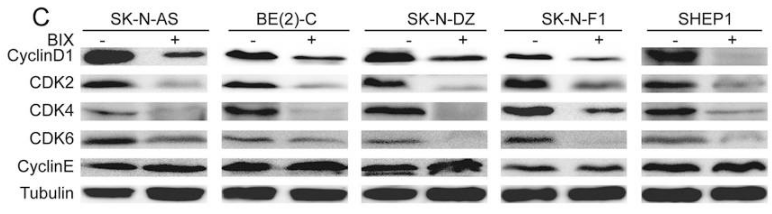
| Western blot | Cyclin D1 / CDK2 / CDK4 / CDK 6 / Cyclin E G9a / H3K9me2 Atg7 / Atg5 / Atg5-Atg12 / Atg3 / Atg12 / LC3B |
|
25198515 |
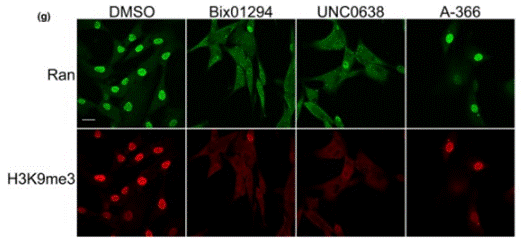
| Immunofluorescence | Ran / H3K9me3 |
|
30565836 |
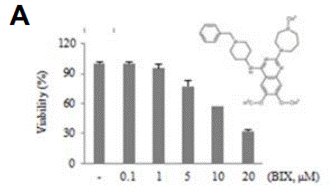
| Growth inhibition assay | Cell viability |
|
26013382 |
Technischer Support
Tel: +1-832-582-8158 Ext:3
Wenn Sie weitere Fragen haben, hinterlassen Sie bitte eine Nachricht.

Produkte sind nur für Forschungszwecke bestimmt. Nicht für den menschlichen Gebrauch. Wir verkaufen nicht an Patienten.
©Copyright 2013 Selleck Chemicals. Alle Rechte vorbehalten.